
Quick summary: Learn how food manufacturers in Belgium can prepare for PPWR compliance, including packaging requirements, technical documentation, conformity assessments, food-contact packaging, and August 2026 readiness.
The Packaging and Packaging Waste Regulation (PPWR) is transforming how packaged food products are designed, manufactured, labelled, and placed on the European market. For food manufacturers in Belgium, compliance extends far beyond selecting sustainable packaging — it requires a structured approach to packaging design, technical documentation, supplier collaboration, conformity assessment, and ongoing compliance management, applied directly at home as an EU Member State.
Whether you manufacture dairy products, beverages, confectionery, meat products, frozen foods, bakery items, snacks, or ready meals, the packaging surrounding your products will increasingly become a regulatory responsibility under PPWR.
As a Regulation rather than a Directive, PPWR entered into force on 11 February 2026 and establishes directly applicable requirements across all EU Member States, including Belgium, without needing transposition into Belgian law. It creates a harmonized framework that affects every business placing packaged food products on the EU market, and it sits alongside Belgium’s existing packaging waste system, including the extended producer responsibility schemes run by Fost Plus (household packaging) and Valipac (industrial and commercial packaging).
Companies that begin preparing now will be better positioned to meet upcoming compliance milestones, satisfy retailer expectations, and build more sustainable packaging strategies.
If your business manufactures or places packaged food products on the Belgian or wider EU market, PPWR introduces new obligations covering:
Rather than treating compliance as a one-time exercise, food manufacturers in Belgium should establish robust governance processes that support packaging compliance throughout the product lifecycle — including alignment with existing Fost Plus and Valipac reporting.
The Packaging and Packaging Waste Regulation (PPWR) establishes a harmonized legal framework governing all packaging placed on the European Union market.
Its objective is to reduce packaging waste while accelerating Europe’s transition toward a circular economy.
Unlike the Packaging and Packaging Waste Directive, which allowed Member States to transpose requirements into national legislation differently, PPWR applies directly across the EU — including Belgium — creating greater consistency for manufacturers operating across multiple countries and replacing the need for separate Belgian implementing legislation on most of its core provisions.
The regulation supports the objectives of the European Green Deal and the Circular Economy Action Plan by introducing common requirements for:
For food manufacturers, this represents a shift from simply purchasing compliant packaging to actively managing packaging compliance throughout sourcing, product development, production, distribution, and post-market activities.
Packaging is no longer viewed as an isolated procurement decision — it has become an integral component of regulatory compliance.
Belgium is one of Europe’s most important food manufacturing and logistics hubs, home to major dairy, brewing, chocolate, bakery, and ready-meal producers alongside a dense network of contract packers and private-label manufacturers supplying the Belgian and wider EU market.
From multinational food companies with Belgian production sites to regional and family-owned producers, businesses place millions of packaged food products onto the Belgian and wider EU market every day.
These organizations rely on diverse packaging formats such as:
Under PPWR, food manufacturers become key economic operators responsible for ensuring that the packaging accompanying their products complies with applicable regulatory requirements — an obligation that applies directly in Belgium rather than as a condition of exporting into the EU.
This means compliance is no longer solely the responsibility of packaging suppliers.
Food manufacturers must work closely with packaging converters, raw material suppliers, laboratories, and logistics partners to collect and maintain evidence demonstrating packaging conformity, while also coordinating with Fost Plus and/or Valipac on their annual Belgian packaging declarations.
Failure to prepare could result in:
As retailers and consumers continue demanding more sustainable packaging, early compliance also strengthens competitive positioning and customer trust.
Understanding your role as an economic operator is the first step toward compliance.
Read our complete guide to PPWR Roles & Responsibilities.
Although several PPWR obligations — including recycled content targets, packaging minimisation requirements, and reuse targets — are phased in over the coming years, 12 August 2026 marks the first major compliance milestone.
From this date, businesses placing packaging on the Belgian and wider EU market must be able to demonstrate compliance with the applicable provisions of the regulation.
Rather than waiting for future deadlines, food manufacturers should focus on building the compliance infrastructure that will support both current and future obligations.
Here are six priorities every food manufacturer should address.
One of the most significant changes introduced by PPWR is the requirement to verify that packaging complies with applicable regulatory requirements before it is placed on the EU market.
For food manufacturers, this means evaluating every packaging format used across their product portfolio.
A conformity assessment should confirm that packaging satisfies relevant PPWR requirements while maintaining the performance characteristics necessary to protect food quality, safety, and shelf life.
Typical assessments include reviewing:
Because food manufacturers often manage hundreds or even thousands of SKUs, establishing standardized conformity assessment processes can significantly improve efficiency and consistency.
Technical documentation provides the evidence supporting your packaging compliance claims.
Every food manufacturer should establish a structured repository containing documentation for every packaging type used across its product portfolio.
Typical documentation includes:
Rather than collecting documentation only when requested, organizations should adopt continuous documentation management processes.
Centralized documentation also simplifies customer audits and regulatory inspections.
PPWR introduces the requirement for a Declaration of Conformity (DoC) for packaging placed on the EU market.
The DoC is a formal declaration confirming that the packaging complies with the applicable provisions of the regulation.
For food manufacturers managing multiple brands, seasonal products, and frequent packaging updates, generating and maintaining Declarations of Conformity manually can quickly become resource-intensive.
Preparation should include:
Implementing these processes early reduces administrative burden as PPWR obligations expand.
Food packaging is subject to strict requirements because it comes into direct or indirect contact with products intended for human consumption.
PPWR reinforces the importance of managing substances used in packaging while complementing existing food-contact material legislation.
Food manufacturers should work closely with packaging suppliers to verify compliance with applicable requirements, including:
Obtaining this information early strengthens supplier relationships and reduces delays when responding to customer or regulatory requests.
Under PPWR, responsibilities differ depending on whether your organization acts as a manufacturer, importer, distributor, or another economic operator.
Many food companies in Belgium perform multiple roles simultaneously — for example, manufacturing products under their own brand while also importing private-label products from outside the EU.
Understanding these responsibilities is essential for ensuring that compliance activities are assigned to the appropriate internal teams.
Cross-functional collaboration between procurement, packaging engineering, quality assurance, regulatory affairs, sustainability, and legal teams will be critical to achieving consistent compliance across the organization.
Packaging compliance depends on accurate and accessible information.
However, many food manufacturers still manage packaging data across disconnected spreadsheets, ERP systems, supplier portals, and shared drives.
As PPWR requirements expand, this fragmented approach becomes increasingly difficult to maintain.
Organizations should begin centralizing packaging information, including:
A centralized packaging data management process not only supports PPWR compliance but also improves collaboration across procurement, product development, sustainability, quality, and regulatory teams, and makes annual Fost Plus and Valipac declarations far easier to compile.
By investing in better data governance today, food manufacturers can reduce compliance risks, improve audit readiness, and build a stronger foundation for future PPWR milestones.
One of the first questions food manufacturers ask is whether PPWR applies to all packaging or only certain materials.
The answer is simple: PPWR applies to virtually all packaging placed on the EU market, regardless of the material used or the food category. Whether you’re packaging dairy products, beverages, bakery goods, frozen meals, confectionery, meat products, or fresh produce, the packaging accompanying your products is likely within the scope of the regulation.
For food manufacturers, this means evaluating every packaging format used throughout the supply chain, including primary, secondary, and tertiary packaging.
Packaging commonly covered under PPWR includes:
Primary packaging comes into direct contact with food products and is critical for product protection, hygiene, and shelf life.
Examples include:
Because these materials often come into contact with food, manufacturers should ensure compliance not only with PPWR but also with applicable food-contact material legislation.
Secondary packaging groups products together for transportation or retail display.
Examples include:
Although consumers may discard secondary packaging immediately after purchase, it remains subject to PPWR requirements.
Food manufacturers also rely heavily on tertiary packaging throughout logistics operations.
Examples include:
These packaging formats play a significant role in reducing product damage while contributing to packaging waste generation.
If your company sources or imports packaged food products from outside the European Union, the packaging accompanying those products is also subject to PPWR.
Importers should verify that suppliers provide the necessary technical documentation and compliance evidence before products enter the Belgian or wider EU market.
Yes.
Food manufacturers should evaluate every packaging format across their portfolio, including:
Different materials may be subject to different technical requirements, but each should be reviewed against applicable PPWR provisions.
Organizations with hundreds or thousands of SKUs should begin building comprehensive packaging inventories now to simplify future compliance activities.
Understanding which packaging falls under PPWR is the first step toward building an effective compliance strategy.
Explore our complete PPWR Scope Guide.
PPWR introduces several interconnected requirements designed to improve packaging sustainability throughout its lifecycle.
For food manufacturers, these requirements influence packaging development, procurement, supplier collaboration, quality assurance, sustainability initiatives, and regulatory compliance.
Rather than treating these obligations independently, businesses should integrate them into product development and packaging governance processes.
Packaging should contain only the amount of material necessary to ensure product protection, hygiene, transportation, storage, and consumer safety.
Although the detailed Article 10 packaging minimisation obligations apply later in the PPWR implementation timeline, companies should begin reviewing packaging designs now.
Food manufacturers should evaluate:
Reducing unnecessary packaging not only supports future PPWR compliance but can also reduce material costs, transportation expenses, and carbon emissions.
Because packaging redesign often requires extensive testing and customer validation, early planning is strongly recommended.
One of PPWR’s central objectives is improving packaging recyclability across the European Union.
Food manufacturers should work with packaging suppliers to ensure packaging can be effectively:
Design considerations include:
Packaging that performs well during recycling processes is more likely to meet future regulatory expectations while supporting corporate sustainability goals, and tends to align more easily with the material streams Fost Plus already sorts in Belgium.
Product development teams should begin incorporating recyclability assessments into packaging approval processes.
PPWR introduces minimum recycled content targets for certain plastic packaging categories over time.
Although implementation will be phased, food manufacturers should begin preparing today by strengthening supplier collaboration.
Recommended activities include:
Companies that establish reliable recycled content verification processes early will be better positioned as future obligations take effect.
PPWR also encourages greater adoption of reusable packaging systems in selected sectors.
While obligations vary depending on packaging applications, food manufacturers should assess whether opportunities exist to introduce reusable packaging within their operations.
Potential applications include:
Designing reusable packaging requires consideration of:
Although reuse may not apply to every food category, businesses should monitor future delegated acts and implementation guidance.
Food packaging must protect both consumers and product quality.
Manufacturers should therefore maintain clear visibility into the substances used throughout their packaging supply chains.
Areas requiring attention include:
Working closely with packaging suppliers improves confidence in material selection while supporting regulatory compliance and customer assurance.
Explore our PFAS in Packaging guide.
PPWR introduces harmonized packaging labelling intended to improve recycling and waste sorting throughout Europe, including a shared set of EU sorting pictograms expected to be finalized around the August 2026 milestone.
Although detailed implementing measures continue to evolve, food manufacturers should begin preparing for standardized packaging information covering:
Because food packaging already contains extensive mandatory product information, manufacturers should assess how future PPWR labelling requirements will integrate with existing packaging artwork, including the phased replacement of the Green Dot logo familiar from Belgian household packaging.
Cross-functional collaboration between packaging designers, regulatory teams, and marketing departments will become increasingly important.
PPWR introduces significant changes across the packaging lifecycle — from packaging design and recyclability to technical documentation and labelling.
Read our complete guide to PPWR Requirements.
Although packaging suppliers manufacture packaging materials, food manufacturers remain responsible for ensuring that the packaging accompanying their products complies with applicable regulatory requirements before products are placed on the EU market.
This requires close collaboration across procurement, packaging engineering, regulatory affairs, quality assurance, sustainability, and supplier management teams.
Typical responsibilities include:
Many organizations underestimate the volume of documentation required across hundreds or thousands of SKUs.
Establishing standardized compliance processes early reduces future administrative burden while improving consistency across product portfolios.
Documentation forms the backbone of PPWR compliance.
Rather than collecting documents reactively, food manufacturers should establish centralized documentation management processes capable of supporting audits, inspections, retailer requests, and regulatory reviews.
Typical documentation includes:
Maintaining well-organized documentation not only supports PPWR compliance but also enables faster responses to customer audits, retailer sustainability questionnaires, and market surveillance authorities.
Technical documentation is more than paperwork — it’s the evidence behind your compliance.
Read our complete guide to PPWR Technical Documentation.
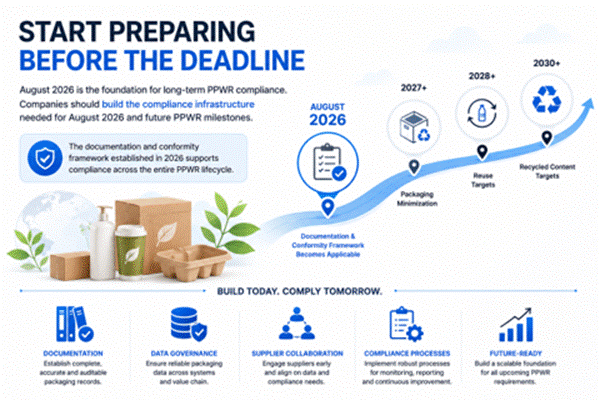
Food manufacturers typically manage diverse product portfolios, multiple packaging suppliers, and complex regulatory requirements. Implementing PPWR across these operations presents several practical challenges.
Large food manufacturers often source packaging materials from numerous suppliers located across different countries.
A single packaged food product may include:
Collecting declarations, certificates, recycled content information, and technical documentation from every supplier can quickly become a significant administrative burden.
Without standardized supplier collaboration processes, documentation gaps become inevitable.
Food companies frequently operate:
Each packaging variation may require different documentation, technical assessments, and compliance records.
Managing this manually through spreadsheets often leads to:
Unlike many industries, food manufacturers must comply with both PPWR and existing food-contact material legislation.
Packaging must protect food quality and safety while meeting sustainability and packaging requirements.
Organizations therefore need clear visibility into:
Coordinating this information across suppliers requires strong governance and documentation processes.
Packaging evolves continuously.
Businesses regularly modify packaging due to:
Each packaging modification may require documentation updates and internal compliance reviews.
Without structured change management, businesses risk maintaining outdated compliance records.
Packaging information often resides across multiple systems.
Typical owners include:
Without centralized packaging data, organizations struggle to provide complete documentation during customer audits or regulatory inspections.
Retailers and brand owners are requesting more detailed packaging information than ever before.
Food manufacturers increasingly receive requests relating to:
Businesses capable of responding quickly gain a competitive advantage while reducing administrative workload.
PPWR requires organizations to manage significantly more packaging information than traditional compliance programs.
Manual systems become increasingly difficult as product portfolios expand.
Digital traceability solutions help food manufacturers establish a connected packaging compliance ecosystem.
These platforms support:
Collect packaging information directly from suppliers through standardized digital workflows.
Maintain structured information relating to:
Store technical files within a centralized repository, improving accessibility during audits and inspections.
Maintain accurate specifications linked to packaging components, products, suppliers, and compliance documentation.
Track packaging revisions while maintaining historical compliance records.
Respond rapidly to customer requests and regulatory inspections using centralized compliance information.
Provide procurement, quality, sustainability, regulatory, and packaging engineering teams with access to consistent packaging information.
By digitizing packaging data, organizations reduce manual administration while improving confidence in compliance decisions.
Managing PPWR compliance requires more than spreadsheets and disconnected systems. As packaging data becomes increasingly complex, food manufacturers need a centralized platform to collect, validate, and manage compliance information across products, suppliers, and packaging formats.
The TraceX PPWR Solution helps food manufacturers digitize packaging compliance by providing end-to-end visibility into packaging data, supplier documentation, and regulatory workflows.
Whether you manufacture dairy products, beverages, bakery goods, frozen foods, meat products, confectionery, or ready meals, TraceX helps simplify compliance throughout the packaging lifecycle.
Instead of managing packaging compliance through disconnected spreadsheets and emails, TraceX provides a structured digital platform that supports both current PPWR requirements and future regulatory developments.
Book a complimentary consultation with a TraceX PPWR expert to assess your packaging compliance readiness and explore how digital traceability can streamline your compliance journey.
The Packaging and Packaging Waste Regulation represents one of the most significant regulatory changes affecting the European food industry in recent years.
For food manufacturers in Belgium, compliance is no longer limited to selecting sustainable packaging materials. It now requires a comprehensive approach encompassing packaging design, supplier collaboration, technical documentation, conformity assessments, food-contact compliance, and robust data management.
While many of the regulation’s obligations will be introduced gradually, the 12 August 2026 application date marks an important milestone. Organizations should use this time to establish the governance, documentation, and digital infrastructure needed to support long-term compliance alongside existing Fost Plus and Valipac obligations.
Businesses that invest early in packaging data management, supplier engagement, and digital compliance processes will be better positioned to respond to evolving regulatory requirements, retailer expectations, and sustainability objectives. More importantly, they’ll reduce compliance risks while building greater resilience and transparency across their packaging value chains.
PPWR is not just a regulatory requirement — it’s an opportunity to modernize packaging operations, strengthen supply chain collaboration, and support the transition to a more circular packaging economy.
Yes. As an EU Member State, Belgium is directly bound by PPWR without any national transposition step. Food manufacturers placing packaged products on the Belgian or wider EU market are responsible for ensuring that the packaging used complies with the applicable provisions of the PPWR. This includes maintaining the documentation and evidence needed to demonstrate compliance.
Yes. Food-contact packaging is within the scope of PPWR. In addition to PPWR obligations, food-contact packaging must continue to comply with applicable EU food-contact material legislation and any other relevant regulatory requirements.
Typical documentation includes packaging specifications, supplier declarations, technical documentation, conformity assessment records, Declaration of Conformity (DoC), material composition information, recycled content evidence, laboratory reports, and supporting compliance documentation. Belgian manufacturers should also retain the material-weight data used for their annual Fost Plus and/or Valipac declarations.
Fost Plus and Valipac are Belgium’s existing extended producer responsibility organizations, covering household and industrial/commercial packaging respectively. PPWR does not replace these schemes but adds EU-wide design, recyclability, labelling, and documentation requirements that food manufacturers must meet alongside their existing Belgian declaration obligations.
Organizations should begin preparing well before the 12 August 2026 application date. Early preparation provides time to review packaging portfolios, engage suppliers, establish documentation processes, and implement packaging data management systems.
Digital traceability platforms centralize packaging specifications, supplier declarations, technical documentation, recycled content data, and compliance records. This improves collaboration, simplifies audits, reduces manual administration, and helps organizations maintain accurate, up-to-date compliance information across the packaging lifecycle.