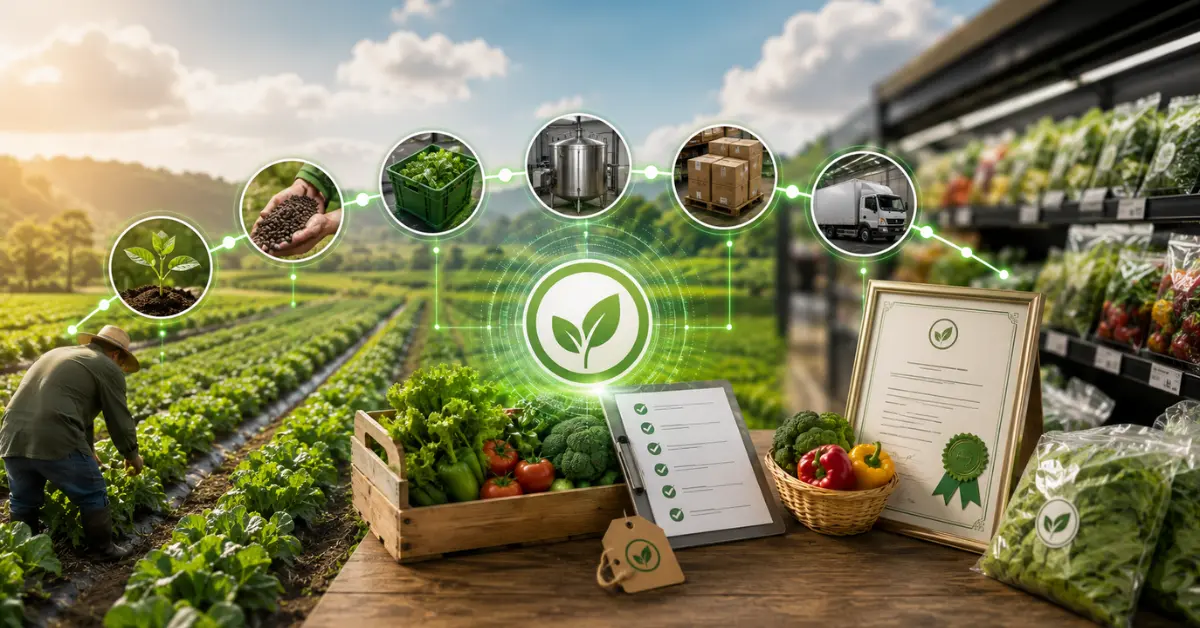
Quick summary: Organic food traceability protects your certification, blocks fraud and unlocks premium markets. See what a strong system captures and how to stay audit-ready.
Organic food traceability is the ability to track an organic product and its inputs across every step from farm to shelf with verifiable, time-stamped records. It is the proof layer that keeps your organic certification defensible under audit, protects you from fraud and decertification, and unlocks premium, trust-driven markets. In 2026, with USDA Strengthening Organic Enforcement mandatory and FSMA 204 on the horizon, digital traceability has shifted from nice-to-have to non-negotiable.
Organic food traceability is what stands between an organic claim and the proof that it’s true. For certified producers, handlers and brands, the organic label is a premium asset and that premium only holds if you can trace every input, batch and handoff back to a verifiable source. The moment you can’t, an auditor’s question becomes a decertification risk and a lost buyer.
In plain terms, organic food traceability is the systematic recording of where an organic product came from, what went into it, and every step it passed through from seed and soil to the shelf. This guide covers what a strong system captures, why it matters more than ever in 2026, and how to make audits and premium-market access routine instead of stressful.
Key takeaways
• Organic food traceability links inputs, batches, certification records and handling into one auditable trail.
• It protects the organic premium: without proof of integrity, a brand risks decertification and lost market access.
• USDA SOE (mandatory since 19 March 2024) tightened import certificates, recordkeeping and farm-to-market traceability.
• Digital systems turn certification renewals and unannounced audits from a scramble into a dashboard.
• The broader TraceX platform is built to run this end-to-end for organic supply chains.
To see how you can strengthen traceability, protect certification integrity and build the transparency needed to access premium markets.
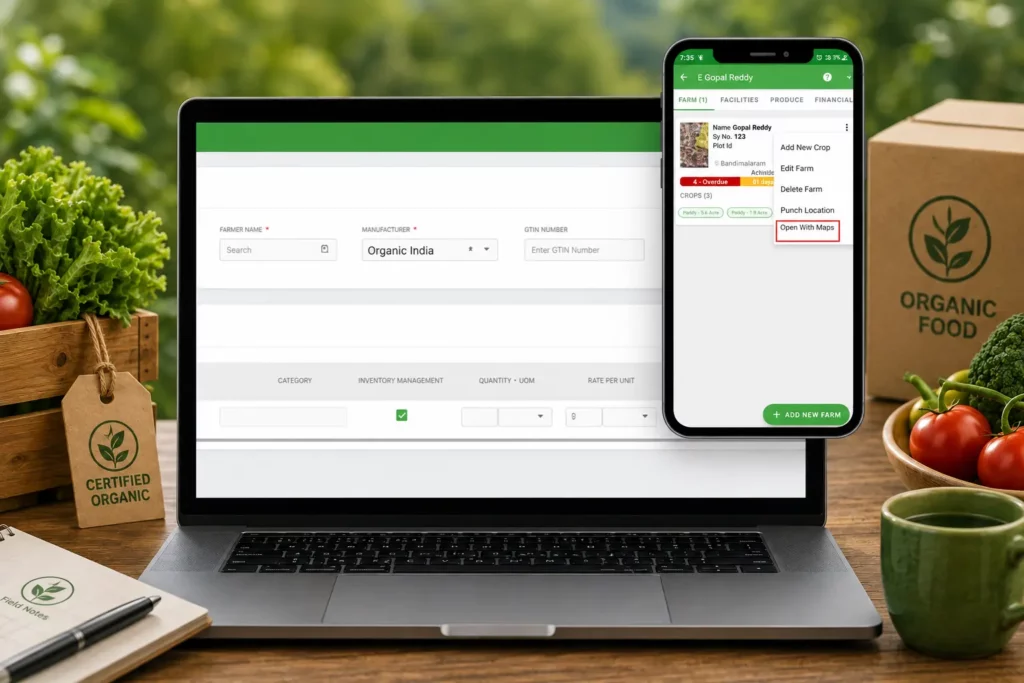
TraceX helps organic food businesses connect farmer and farm data, procurement, processing, batch traceability, quality certifications and product movements in one digital system.
Organic food traceability is the end-to-end documentation of an organic product’s journey, tying physical goods to the certification and compliance evidence that proves organic integrity. It spans both directions: backward to the source, and forward to the next destination.
Inputs: seeds, soil amendments, and approved treatments with proof they meet organic standards.
Events: time-stamped planting, harvesting, storage, processing and transport records.
Batches: each lot uniquely identifiable, linking input application to yield and handling.
Certification: conversion timelines, buffer-zone maps, and inspection records synced to the physical product.
Done well, organic food traceability isn’t a filing cabinet it’s a live system where any batch can be reconstructed on demand.
Why organic food traceability matters now
Three forces have turned organic food traceability from a best practice into a commercial necessity: tightening regulation, rising fraud, and buyers who pay for proof.
Regulatory pressure is rising
The USDA Strengthening Organic Enforcement (SOE) rule has been mandatory since 19 March 2024. It requires NOP Import Certificates for all organic imports, certification of more supply-chain actors (brokers, traders, importers), organic identification on nonretail containers linked to audit-trail documentation, and stronger recordkeeping and farm-to-market traceability the biggest overhaul of the organic rules in decades. In parallel, the US FSMA 204 Food Traceability Rule requires Key Data Elements at defined Critical Tracking Events for high-risk foods (compliance date 20 July 2028 [re-verify]), and the EU Organic Regulation (EU) 2018/848 sets its own control expectations.
Fraud and decertification are real risks
Organic fraud thrives on gaps in the chain. When records are fragmented or paper-based, a single missing document during an unannounced audit can trigger noncompliance and decertification means losing the premium overnight. Robust organic food traceability closes those gaps before an auditor finds them.
Premium markets reward proof
Ethically conscious consumers and B2B buyers increasingly demand verifiable origin. Traceability that can be surface for example via a QR code that shows farm location, inputs and certifications turns compliance data into a front-end marketing advantage and a reason to choose your brand over a cheaper, unverifiable one.
Ethical sourcing is more than making responsible sourcing claimsit’s about having the visibility and evidence to support them across your supply chain.
Read our guide on Ethical Supply Chains to understand how businesses can improve supplier transparency, traceability, responsible sourcing and supply-chain accountability from source to customer.
Most organic brands treat traceability as an audit chore. The winners treat it as their moat. The same dataset that satisfies an SOE inspector is the story a shopper scans on the pack provenance, inputs, certification, all in one tap. When your traceability is strong enough to defend your certification, it’s automatically strong enough to sell your premium. Build it once; use it everywhere.
What a strong organic food traceability system captures
A credible organic food traceability system records the right data at the right moments, and keeps it retrievable in seconds.
Critical tracking events: receiving, transformation, packing and shipping, each with time and location.
Key data elements: lot codes, quantities, handlers, and the links between them.
Certification sync: conversion timelines, buffer-zone maps, inspection and renewal records tied to batches.
Real-time compliance flags: automated reminders for renewals and alerts on gaps before they become findings.
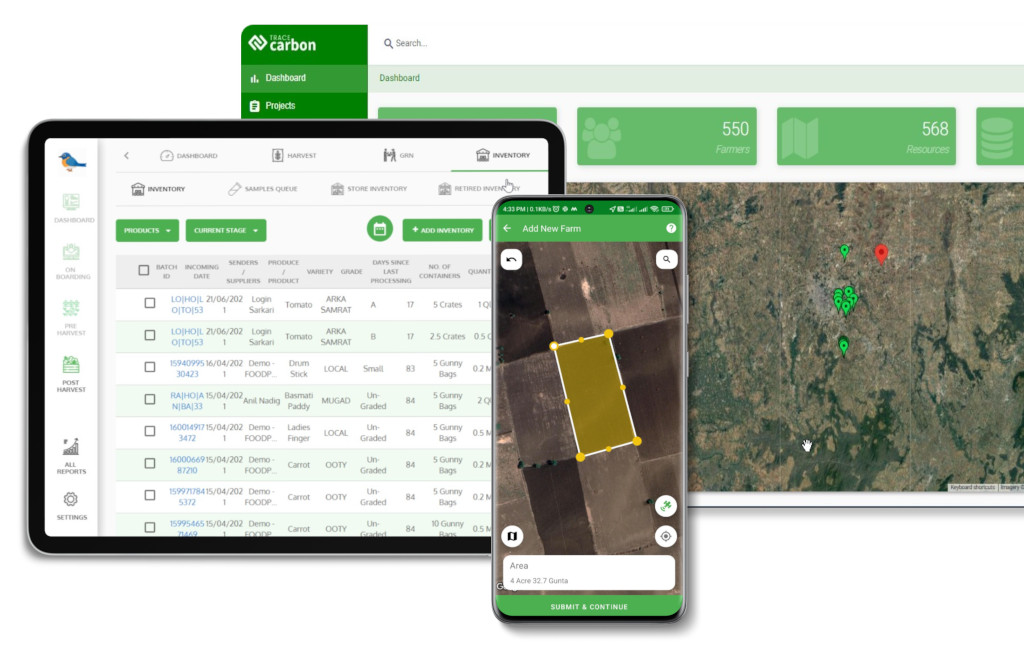
Centralised dashboards: one view of compliance status across the entire supplier network.
Is your supply-chain data still spread across spreadsheets, emails and disconnected systems?
Read our guide on Digital Traceability Systems to understand how businesses can connect suppliers, sourcing, batches, processing, inventory and product movements in one digital traceability workflow.
Organic food traceability: spreadsheets vs. a digital platform
The difference between paper/spreadsheet traceability and a digital platform is the difference between hoping you pass an audit and knowing you will.
Requirement
Spreadsheets / paper
Digital traceability (TraceX platform)
Batch traceability
Manual, easily broken
Unique, retrievable lot-level records
Certification records
Scattered across files
Synced to batches, always current [confirm]
Audit readiness
Days of scrambling
Immediate proof of organic integrity
Renewals & gaps
Missed until it’s late
Automated reminders and real-time flags [confirm]
Consumer transparency
None
QR-linked product journey [confirm]
How TraceX supports organic food traceability
The TraceX food traceability platform is built to run organic food traceability end-to-end, closing the gaps that put certification and premium pricing at risk.
Digital capture of inputs, events and batches from farm to processing.
Certification documentation synced to physical product, with renewal reminders and gap alerts.
Centralised dashboards for compliance status across the supplier network.
QR-code transparency that turns the audit trail into a consumer-facing brand story.
See batch traceability, certification sync and audit-ready dashboards on your own supply chain.
The proof point is resilience: brands like Organic India and Svojas have used TraceX traceability to give consumers a transparent product journey and build reliable, trusted brands.
See How Organic India Built End-to-End Traceability
How do you connect farm management, regenerative practices, procurement, quality certifications and product traceability across an organic supply chain?
Organic India leveraged TraceX to digitize farm management, streamline procurement, track regenerative practices, strengthen product traceability and validate quality certifications.
Read the Organic India case study to see how digital traceability can bring greater visibility and control across the agricultural supply chain.
Buyer’s checklist: choosing an organic food traceability system
If you’re evaluating a platform to protect your organic certification, judge it against this checklist.
Does it capture batch-level records with input, yield and handling links?
Can it sync organic certification documents conversion timelines, buffer-zone maps, inspection records?
Does it automate renewal reminders and flag compliance gaps in real time?
Does it give immediate, audit-ready proof for unannounced inspections?
Does it support consumer-facing QR transparency from the same data?
Does it map to your markets’ rules USDA SOE, FSMA 204, EU 2018/848?
frequently asked questions
What is organic food traceability?
Organic food traceability is the systematic tracking of an organic product and its inputs across every stag from farm to shelf with verifiable, time-stamped records that prove organic integrity backward to the source and forward to the next destination.
Why is organic food traceability important?
It protects the organic premium. Without a defensible trail, a brand risks failing audits, organic fraud, and decertification losing market access and consumer trust. Strong traceability also unlocks premium, transparency-driven sales.
What records does organic food traceability require?
At minimum: input records, time-stamped critical tracking events, unique batch/lot codes, and certification documentation (conversion timelines, buffer-zone maps, inspection and renewal records) synced to the physical product.
How does USDA SOE affect organic food traceability?
The Strengthening Organic Enforcement rule, mandatory since 19 March 2024, requires NOP Import Certificates for all organic imports, certification of more supply-chain actors, organic identification on nonretail containers, and stronger farm-to-market recordkeeping.
Does FSMA 204 apply to organic food?
FSMA 204 applies to foods on the FDA’s Food Traceability List regardless of organic status. If your organic products are on that list, you must record Key Data Elements at Critical Tracking Events. Confirm the current compliance date on FDA.gov.
Can organic food traceability be a marketing advantage?
Yes. The same data that satisfies an auditor can power a QR code showing farm location, inputs and certifications turning back-end compliance into a front-end reason for consumers to trust and choose your brand.
How do I make my organic supply chain audit-ready?
Digitise input, batch and event capture, sync certification records to product, automate renewal and gap alerts, and centralise compliance in one dashboard the workflow the TraceX platform is built to run.
Start using TraceX
Transparency, Trust, & Success for your Climate Journey.
We use cookies on our website to give you the most relevant experience by remembering your preferences and repeat visits. By clicking “Accept All”, you consent to the use of ALL the cookies. However, you may visit "Cookie Settings" to provide a controlled consent.
This website uses cookies to improve your experience while you navigate through the website. Out of these, the cookies that are categorized as necessary are stored on your browser as they are essential for the working of basic functionalities of the website. We also use third-party cookies that help us analyze and understand how you use this website. These cookies will be stored in your browser only with your consent. You also have the option to opt-out of these cookies. But opting out of some of these cookies may affect your browsing experience.
Necessary cookies are absolutely essential for the website to function properly. These cookies ensure basic functionalities and security features of the website, anonymously.
Cookie
Duration
Description
cookielawinfo-checkbox-analytics
11 months
This cookie is set by GDPR Cookie Consent plugin. The cookie is used to store the user consent for the cookies in the category "Analytics".
cookielawinfo-checkbox-functional
11 months
The cookie is set by GDPR cookie consent to record the user consent for the cookies in the category "Functional".
cookielawinfo-checkbox-necessary
11 months
This cookie is set by GDPR Cookie Consent plugin. The cookies is used to store the user consent for the cookies in the category "Necessary".
cookielawinfo-checkbox-others
11 months
This cookie is set by GDPR Cookie Consent plugin. The cookie is used to store the user consent for the cookies in the category "Other.
cookielawinfo-checkbox-performance
11 months
This cookie is set by GDPR Cookie Consent plugin. The cookie is used to store the user consent for the cookies in the category "Performance".
viewed_cookie_policy
11 months
The cookie is set by the GDPR Cookie Consent plugin and is used to store whether or not user has consented to the use of cookies. It does not store any personal data.
Functional cookies help to perform certain functionalities like sharing the content of the website on social media platforms, collect feedbacks, and other third-party features.
Performance cookies are used to understand and analyze the key performance indexes of the website which helps in delivering a better user experience for the visitors.
Analytical cookies are used to understand how visitors interact with the website. These cookies help provide information on metrics the number of visitors, bounce rate, traffic source, etc.
Advertisement cookies are used to provide visitors with relevant ads and marketing campaigns. These cookies track visitors across websites and collect information to provide customized ads.
Download the 2026 Traceability Scorecard and Benchmark Your Supply Chain Across 10 Critical Capabilities.
Download our eBook
Don’t Wait for an Audit to Find Your EUDR Gaps
The 2026 Simplification Package changes how HS codes, DDS pass-through and geolocation rules apply to you. Get the free guide and 20-point readiness checklist before enforcement catches you unprepared.