PPWR Roles Explained: Understand Your Compliance Responsibilities
Published
, 11 minute read
Share this article
Quick summary: Learn how to identify PPWR roles across manufacturers, importers, distributors, and producers, and understand why clear responsibilities are essential for packaging compliance.
PPWR roles and responsibilitiesare among the first and most frequently misunderstood topics as companies prepare for the Packaging and Packaging Waste Regulation. While the question of your specific role seems deceptively simple, the answer isn’t always straightforward. Depending on the packaging type, the branding arrangement, and how products are placed on the EU market, the same company may take on different responsibilities in different scenarios. A business that designs its own packaging in one situation may simply be reselling someone else’s in another—and the obligations change accordingly.
Getting this wrong is more than an administrative slip. It can lead to:
Missing compliance obligations that legally apply to your business.
Duplicating work that another party in the supply chain has already completed.
Assuming responsibilities that actually belong to a supplier, customer, or partner.
Delays in preparing technical documentation and Declarations of Conformity.
Confused about your responsibilities under PPWR? This guide explains how to determine your role under the Packaging and Packaging Waste Regulation and breaks down the obligations for manufacturers, importers, distributors, and producers.
Role clarity is only the first step.
Use our Packaging Compliance Checklist to identify key documentation, supplier information, and compliance activities required to support your packaging obligations.
Turn the 12 August Deadline into a Clear Plan
A short call replaces panic with a prioritized roadmap. Get expert guidance on what to tackle first to be ready in time.
Understanding your role under the Packaging and Packaging Waste Regulation (PPWR) is the foundation of compliance. Responsibilities under PPWR vary depending on whether an organization acts as a manufacturer, importer, distributor, producer, or fulfilment service provider. Because packaging supply chains are complex, many companies may assume different roles across different products and markets. Identifying these responsibilities early helps organizations avoid compliance gaps, streamline documentation, and prepare for evolving PPWR requirements.
Role Under PPWR- Why it needs to be Identified
Under PPWR, almost everything flows from one starting point: your role. Before you can scope budgets, assign owners, or gather evidence, you need to know which obligations sit with you and which sit elsewhere.
Compliance obligations are role-dependent
The regulation assigns different duties to different economic operators. A manufacturer’s obligations are not the same as an importer’s, and a distributor carries a lighter, verification-focused set of responsibilities. Identify the role incorrectly and you risk preparing for the wrong requirements entirely.
Documentation responsibilities vary
Who drafts the technical documentation? Who issues the Declaration of Conformity? Who keeps records and for how long? These answers depend directly on the role you hold for a given packaging item placed on the market.
Supplier and customer requests depend on role clarity
When a customer asks you for compliance evidence or when you need it from a supplier the request only makes sense once roles are clear. Clarity upstream and downstream prevents the back-and-forth that stalls so many compliance programs.
One of the biggest PPWR challenges isn’t understanding the regulation it’s understanding who is responsible for what.
Whether you’re just starting your PPWR journey or refining existing processes, our Guide to PPWR provides a practical roadmap to help packaging, procurement, quality, and sustainability teams navigate compliance with confidence.
Why Companies Are Getting PPWR Roles Wrong
Role confusion is rarely a sign of carelessness. It usually reflects how modern supply chains actually work. The most common reasons include:
Complex supply chains with many hands touching a single product before it reaches the shelf.
Private-label products, where the brand on the package is not the company that physically made it.
Imported packaging or components sourced from outside the EU.
Multiple legal entities involved across design, manufacturing, distribution, and sale.
A lack of cross-functional ownership, leaving no single team accountable for the answer.
The same organization can act as a manufacturer in one scenario and an importer in another.
What are the Key Roles Under PPWR
PPWR draws on the familiar framework of economic operators. Below is a practical breakdown of each role, who typically qualifies, and what it means in day-to-day terms.
Manufacturer
Who qualifies?
A manufacturer is the party that produces packaging or has packaging designed or made and places it on the market under its own name or trademark. If your company defines the packaging’s composition, format, and design intent, you are likely operating as a manufacturer for that item.
Typical responsibilities
Ensuring the packaging meets PPWR’s essential requirements (such as recyclability, minimisation, and substance restrictions).
Preparing and maintaining technical documentation as evidence of conformity.
Issuing the Declaration of Conformity and applying any required conformity marking.
Keeping records available for the relevant retention period.
Example scenario
A beverage company designs a new bottle and specifies the resin, label, and closure. Even if a third party physically produces it, the beverage company markets it under its own brand so it carries the manufacturer’s obligations.
As customers demand greater transparency and packaging data, manufacturers are becoming key enablers of compliance.
Explore our blog, PPWR for Manufacturers, to learn how to stay ahead of evolving requirements and better support your customers.
Importer
Who qualifies?
An importer is established in the EU and places packaging (or packaged products) from a non-EU supplier onto the EU market. The importer is, in effect, the EU’s point of accountability for goods originating outside the bloc.
Key obligations
Verifying that the non-EU manufacturer has carried out the required conformity assessment.
Confirming the technical documentation exists and the packaging is properly marked.
Ensuring their own details are identifiable so the product can be traced.
Taking corrective action and informing authorities if packaging is found to be non-compliant.
Example scenario
A European retailer sources gift boxes from a manufacturer in Asia and sells them under its own listing. Because the goods enter the EU market through the retailer, it assumes importer obligations and cannot simply assume the overseas supplier has handled compliance.
Distributor
Responsibilities and limitations
A distributor makes packaging available on the market without being the manufacturer or importer typically a wholesaler or reseller. Distributor duties are lighter but not absent. A distributor should act with due care: checking that required markings and documentation appear to be present, that the manufacturer and importer are identifiable, and that storage or transport conditions don’t compromise compliance. A distributor does not create the technical documentation, but it cannot knowingly pass on packaging that fails the rules.
Producer
How producer obligations differ from EPR definitions
“Producer” is one of the most confusing terms in this space, because it carries a specific meaning under Extended Producer Responsibility (EPR) frameworks that doesn’t map cleanly onto the manufacturer/importer/distributor chain. In EPR terms, the producer is generally the party that first makes packaging available in a given national market and therefore funds and reports on its end-of-life management registration, fees, and waste data.
Why this causes confusion
A company can be the “producer” for EPR purposes while holding a different role for product-conformity purposes. Treating the two as one and the same is a common trap: the obligations, the registers, and the documentation behind them are not interchangeable. Map each obligation to the framework it comes from, not to a single label.
Fulfilment Service Providers
When do obligations apply?
Fulfilment service providers warehousing, packing, dispatch, and returns handlers, often serving online sellers can fall within scope when there is no manufacturer, importer, or authorised representative established in the EU. In those cases, the fulfilment provider may inherit certain operator-style responsibilities. If you provide or rely on fulfilment services, it’s worth confirming explicitly who carries the compliance duties, rather than assuming they sit with someone else.
Real-World Scenarios
Scenario 1: Brand owner with contract packaging
Who is responsible? A brand owner specifies the packaging and sells under its own name, while a contract packer physically produces it. Because the packaging reaches the market under the brand owner’s trademark, the brand owner typically holds the manufacturer’s obligations including the technical documentation and Declaration of Conformity. The contract packer supplies supporting evidence but is generally not the party that declares conformity to market.
Scenario 2: Private-label packaging
How responsibilities shift. A retailer sells a product made by a supplier but branded as the retailer’s own line. Putting your name or trademark on the packaging usually pulls the manufacturer’s responsibilities toward you. The original maker becomes a supplier of evidence, while the retailer becomes the operator answerable for conformity.
Scenario 3: Imported packaging components
Importer obligations. A company brings in packaging components from outside the EU and assembles or uses them in finished goods sold within the EU. As the entity placing those non-EU goods on the market, the company takes on importer duties verifying the overseas manufacturer’s conformity assessment, confirming documentation, and ensuring traceability.
What information customers may request. A packaging manufacturer sells materials to brands that place finished products on the market. Those customers will increasingly ask for technical evidence: material composition, recyclability data, recycled-content figures, and substance declarations. Being able to provide this quickly is fast becoming a commercial requirement, not just a compliance one.
Why PPWR Is a Cross-Functional Challenge
Even once roles are clear, the data and decisions behind PPWR rarely live in one place. Packaging information is typically scattered across:
Packaging teams, who hold design and material specifications.
Procurement, who manage the suppliers providing materials and evidence.
Quality Assurance, who often own conformity processes.
Regulatory Affairs, who interpret the obligations.
Sustainability / ESG, who track recyclability and reporting metrics.
PPWR ownership rarely belongs to one department and treating it as a single team’s problem is where programs stall.
Questions Every Company Should Ask
A short, honest internal review usually surfaces your role faster than reading the regulation cover to cover. Start here:
Who specifies the packaging?
Whose name or trademark appears on the packaging?
Who places the product on the EU market?
Which entity issues the compliance documentation?
Which suppliers provide the underlying technical evidence?
Common Mistakes to Avoid
Assuming EPR roles and PPWR conformity roles are identical.
Leaving ownership solely to Quality Assurance.
Waiting until customers request documentation before preparing it.
Failing to align internal stakeholders across functions.
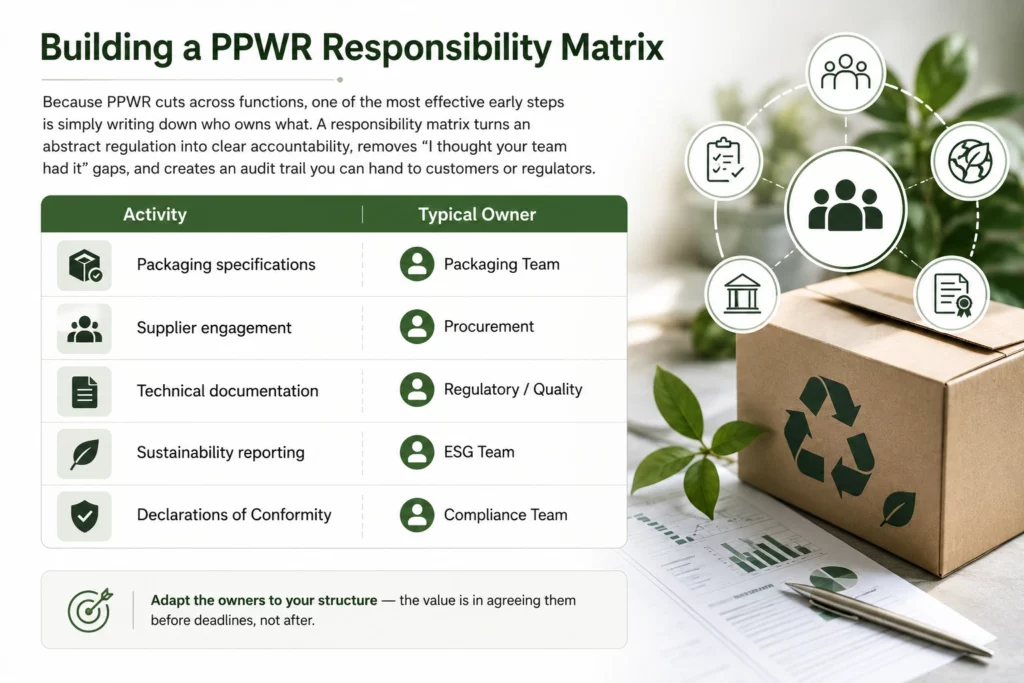
Building a PPWR Responsibility Matrix
Because PPWR cuts across functions, one of the most effective early steps is simply writing down who owns what. A responsibility matrix turns an abstract regulation into clear accountability, removes “I thought your team had it” gaps, and creates an audit trail you can hand to customers or regulators. A simple starting point: list each packaging type, list each obligation, and assign ownership across your business.
How TraceX Helps
TraceX PPWR Solutions helps organizations centralize packaging data, supplier information, and compliance documentation to support PPWR readiness. By creating a single source of truth across functions, companies can improve collaboration, strengthen documentation processes, and respond more effectively to evolving packaging requirements without chasing data across spreadsheets and inboxes every time a customer or regulator asks.
Your Practical Checklist for the 12 August Deadline
Know exactly what “Phase 1 ready” looks like. The handbook walks you through the obligations and evidence you need to have in place.
Understanding your role under PPWR is not just a legal exercise. It’s the foundation for every compliance activity that follows the documentation, the declarations, the supplier requests, and the reporting all depend on it.
Because before companies can answer:
“What do we need to do?”
They first need to answer:
“Who is responsible for doing it?”
Frequently Asked Questions (FAQ’s)
Why is understanding your role under PPWR important?
Your role under PPWR determines your specific compliance obligations, documentation requirements, and responsibilities within the packaging value chain. Incorrect role identification can lead to missed obligations or unnecessary compliance efforts.
What roles are defined under the Packaging and Packaging Waste Regulation (PPWR)?
PPWR defines several economic operators, including:
Manufacturers
Importers
Distributors
Producers
Fulfilment service providers
Each role carries different responsibilities depending on how packaging is placed on the EU market.
Can a company have multiple roles under PPWR?
Yes. A company may act as a manufacturer for one product, an importer for another, and a distributor in different markets. Responsibilities can vary based on the packaging type, ownership, and supply chain arrangement.
Is the PPWR producer definition the same as Extended Producer Responsibility (EPR)?
Not necessarily. While the terms are related, PPWR and national EPR schemes may define “producer” differently. Companies should assess their obligations carefully rather than assuming existing EPR responsibilities automatically apply under PPWR.
Which teams within an organization are typically involved in PPWR compliance?
PPWR is a cross-functional challenge that often involves:
Packaging Engineering
Procurement
Quality Assurance
Regulatory Affairs
Sustainability teams
Successful compliance depends on clear ownership and collaboration across these functions.
Start using TraceX
Transparency, Trust, & Success for your Climate Journey.
We use cookies on our website to give you the most relevant experience by remembering your preferences and repeat visits. By clicking “Accept All”, you consent to the use of ALL the cookies. However, you may visit "Cookie Settings" to provide a controlled consent.
This website uses cookies to improve your experience while you navigate through the website. Out of these, the cookies that are categorized as necessary are stored on your browser as they are essential for the working of basic functionalities of the website. We also use third-party cookies that help us analyze and understand how you use this website. These cookies will be stored in your browser only with your consent. You also have the option to opt-out of these cookies. But opting out of some of these cookies may affect your browsing experience.
Necessary cookies are absolutely essential for the website to function properly. These cookies ensure basic functionalities and security features of the website, anonymously.
Cookie
Duration
Description
cookielawinfo-checkbox-analytics
11 months
This cookie is set by GDPR Cookie Consent plugin. The cookie is used to store the user consent for the cookies in the category "Analytics".
cookielawinfo-checkbox-functional
11 months
The cookie is set by GDPR cookie consent to record the user consent for the cookies in the category "Functional".
cookielawinfo-checkbox-necessary
11 months
This cookie is set by GDPR Cookie Consent plugin. The cookies is used to store the user consent for the cookies in the category "Necessary".
cookielawinfo-checkbox-others
11 months
This cookie is set by GDPR Cookie Consent plugin. The cookie is used to store the user consent for the cookies in the category "Other.
cookielawinfo-checkbox-performance
11 months
This cookie is set by GDPR Cookie Consent plugin. The cookie is used to store the user consent for the cookies in the category "Performance".
viewed_cookie_policy
11 months
The cookie is set by the GDPR Cookie Consent plugin and is used to store whether or not user has consented to the use of cookies. It does not store any personal data.
Functional cookies help to perform certain functionalities like sharing the content of the website on social media platforms, collect feedbacks, and other third-party features.
Performance cookies are used to understand and analyze the key performance indexes of the website which helps in delivering a better user experience for the visitors.
Analytical cookies are used to understand how visitors interact with the website. These cookies help provide information on metrics the number of visitors, bounce rate, traffic source, etc.
Advertisement cookies are used to provide visitors with relevant ads and marketing campaigns. These cookies track visitors across websites and collect information to provide customized ads.
Download the 2026 Traceability Scorecard and Benchmark Your Supply Chain Across 10 Critical Capabilities.
Download our eBook
Don’t Wait for an Audit to Find Your EUDR Gaps
The 2026 Simplification Package changes how HS codes, DDS pass-through and geolocation rules apply to you. Get the free guide and 20-point readiness checklist before enforcement catches you unprepared.