Quick summary: The 5-Layer Supply Chain Traceability Framework explained: learn how identity, geospatial verification, volume reconciliation, compliance workflows, and real-time monitoring work together to build audit-ready, aggregation-resilient traceability across complex global supply chains.
Most companies believe they have traceability until they’re asked to prove it. A shipment is flagged. An auditor requests geolocation data. A regulator questions volume attribution. A buyer demands deforestation-free proof. Suddenly, spreadsheets, supplier declarations, and certification documents aren’t enough. The problem isn’t effort. Its structure. That’s where a Supply Chain Traceability Framework becomes essential.
Core Traceability Pain Points
Multi-Tier & Aggregated Supply Chains Raw materials pass through multiple suppliers, aggregators, and processing stages, causing origin visibility to break beyond Tier 1.
Data Silos & Manual Tracking Disconnected ERP, procurement, and logistics systems, combined with spreadsheet-based processes, prevent continuous data flow.
Transformation & Blending Gaps During cleaning, refining, assembling, or mixing, product identity often loses linkage to its original source.
Regulatory & Buyer Scrutiny Pressure Authorities and global buyers demand structured, auditable, and real-time proof, not fragmented documentation.
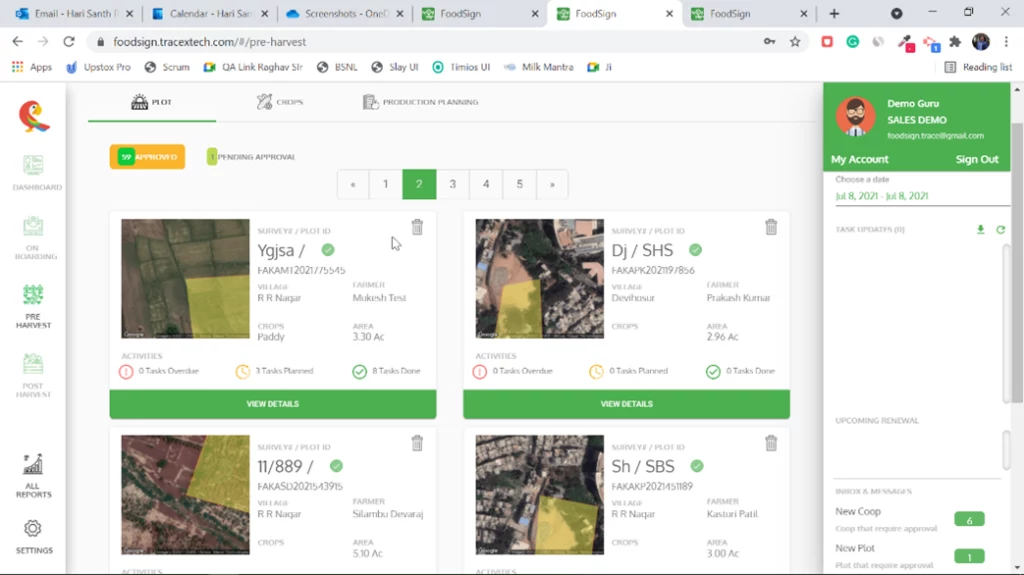
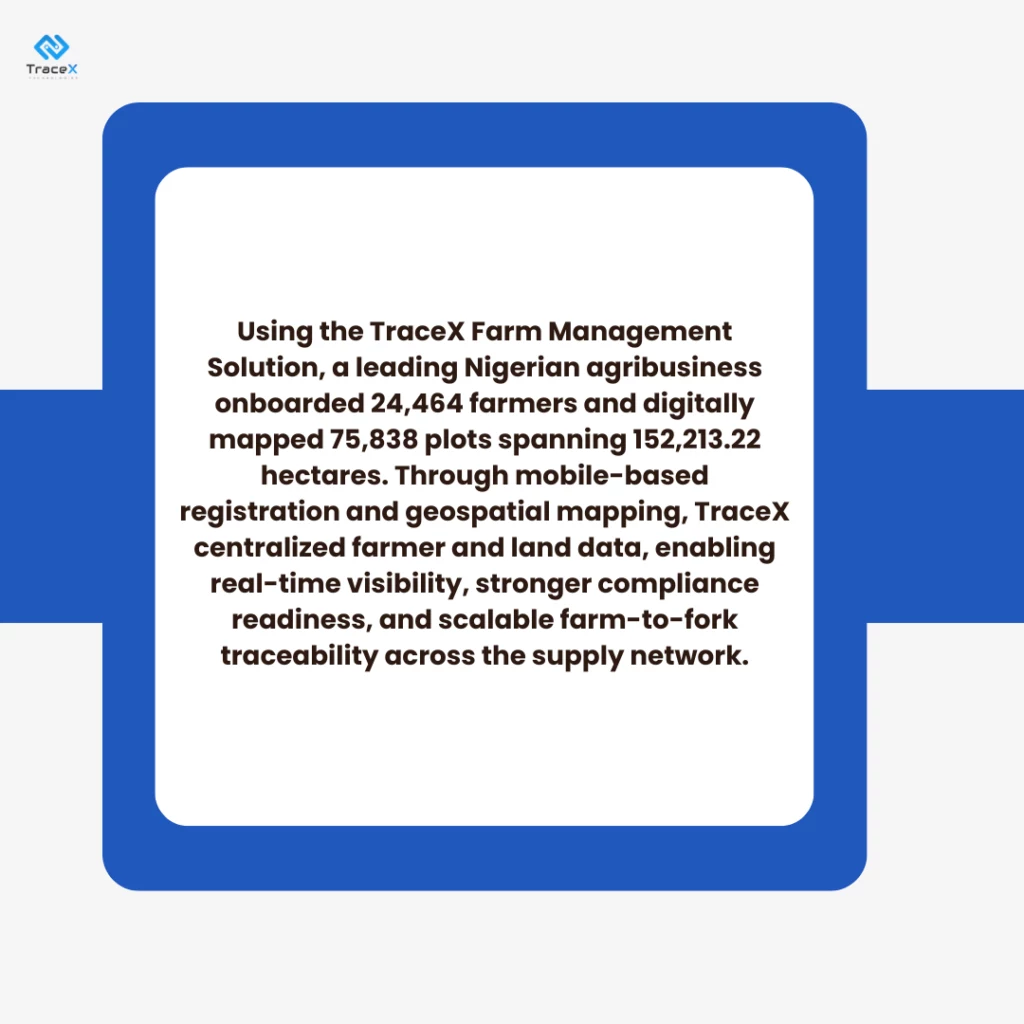
TraceX digital traceability solutions provide a structured, multi-layer architecture that ensures product, supplier, and compliance data remain connected from origin to market, transforming fragmented supply chains into transparent, audit-ready ecosystems.
The 5-Layer Supply Chain Traceability Framework provides that structure. And in today’s enforcement-driven environment, structure is the difference between compliance and commercial disruption.
Key Takeaways
A modern supply chain traceability framework is essential because global value chains are increasingly complex, regulated, and risk-exposed, making fragmented, manual, or siloed tracking systems inadequate for ensuring transparency, compliance, and trust.
Traditional traceability systems often fail due to limited tier visibility, disconnected data sources, spreadsheet-based documentation, and a lack of real-time validation, resulting in slow recalls, compliance gaps, and reputational risk.
A structured 5-layer traceability framework typically includes: (1) data capture at source, (2) standardized product and supplier identification, (3) validation and risk intelligence, (4) integration across operational systems, and (5) governance and reporting.
These layers work together by transforming raw supply chain data into verified, actionable, and auditable intelligence that flows from origin to end customer.
When applied across commodities, whether food, textiles, batteries, or agricultural products, the framework adapts to local sourcing realities while maintaining global compliance standards.
Implementation requires phased execution: visibility mapping, data model design, system integration, supplier onboarding, and governance alignment.
Common misconceptions, such as believing traceability is just QR codes, blockchain, or a compliance checkbox, often undermine success.
In reality, technology acts as an enabler, not the solution itself; true traceability depends on structured processes, cross-functional ownership, and scalable data architecture that converts transparency into competitive advantage.
Why There Is a Need for a Supply Chain Traceability Framework
Traceability on its own is not the problem. Most companies already collect data. They maintain supplier lists. They store shipment records. They track batches internally. The problem is fragmentation.
Without a structured Supply Chain Traceability Framework, traceability efforts become:
Disconnected across departments
Inconsistent across suppliers
Vulnerable at aggregation points
Difficult to defend during audits
Impossible to scale across commodities or geographies
Modern supply chains are layered, global, and heavily aggregated. Data moves separately from goods. Suppliers change. Volumes blend. Regulations tighten.
A framework provides structure.
It ensures that:
Identity is verified before transactions occur
Geolocation is validated before sourcing decisions are made
Volume attribution survives aggregation
Compliance workflows are embedded, not reactive
Monitoring is continuous, not static
Without a framework, traceability becomes reactive documentation.
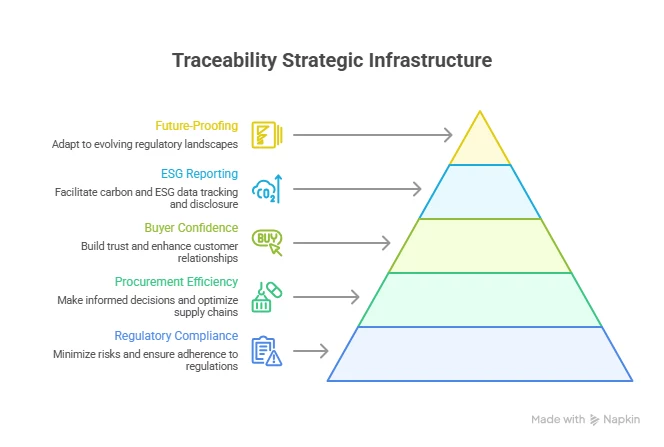
With a framework, traceability becomes infrastructure.
What Is Supply Chain Traceability?
At its core, supply chain traceability is the ability to track and verify:
The origin of a product
The entities involved in its production
The transformation processes applied
The volumes moved and allocated
The compliance status at every stage
It ensures that a product’s journey from source to market can be reconstructed with verifiable evidence.
However, traceability is often confused with related concepts.
Term
Operational Meaning
The “Digital Action”
Transparency
Visibility into the Network: Knowing every actor (Tier 1 to Tier N) and communicating their roles to stakeholders.
Mapping: Disclosing supplier lists, facility IDs, and labor certifications via a public or private portal.
Traceability
Movement of Goods: The ability to follow a specific unit or batch from its “biological origin” to the end consumer.
Tracking: Linking a physical barcode or RFID tag to an immutable record of its journey (e.g., farm coordinates to silo to ship).
Verification
Integrity of Claims: Ensuring that the data provided by suppliers is factually accurate and hasn’t been tampered with.
Validating: Cross-referencing farm polygons with satellite AI or performing “Yield Logic” checks to prevent laundering.
Monitoring
Real-Time Risk Detection: The ongoing oversight of the supply chain to detect and mitigate new risks as they happen.
Surveilling: Automated alerts for land-use changes (deforestation) or sudden spikes in delivery volumes from a single region.
Explore our comprehensive Guide to Supply Chain Traceability and learn how to design systems that survive audits, aggregation, and regulatory scrutiny.
Many organizations assume they have traceability because they collect documents and track shipments internally. On paper, everything appears structured. In reality, these systems are fragile.
Traditional traceability fails not because companies lack effort but because their systems were never designed for regulatory-grade scrutiny, large-scale aggregation, or dynamic risk monitoring.
Let’s break down why.
1️. Aggregation Breaks Attribution
Most high-risk commodities are bulk-handled.
Farms contribute to cooperatives
Cooperatives deliver to silos
Silos load vessels
Vessels supply processors
At each pooling point, volumes from multiple origins mix.
If the system cannot clearly allocate specific volumes back to specific farms or plots, attribution collapses. Once attribution is broken, compliance cannot be proven even if the original farms were compliant.
Aggregation is not a logistics step. It is the biggest traceability control point.
2️. Data Does Not Follow Goods
In traditional systems:
Goods move physically first
Documentation is updated later
Reconciliation happens manually
This creates time gaps and inconsistencies.
When auditors request traceability proof, companies scramble to reconcile spreadsheets, shipment logs, and supplier emails. Manual reconstruction increases error rates and audit exposure.
Traceability fails when data trails behind physical movement.
3️. No Geospatial Validation
Many systems rely on:
Single GPS points
Concession-wide coordinates
Supplier-level location declarations
But regulators increasingly require polygon-level geolocation tied to actual production areas.
Another predictable failure point is volume integrity.
Examples include:
Exported volumes exceeding declared production
No clear allocation logic when blending occurs
No reconciliation between harvest data and shipment data
When regulators compare declared volumes against production capacity, discrepancies raise red flags.
If volume attribution cannot be clearly demonstrated, the entire traceability chain becomes questionable.
5️. Static Documentation in a Dynamic Risk Environment
Traditional traceability treats compliance as a one-time event:
Collect documents
Submit declarations
Archive records
But supply chain risk is dynamic.
Deforestation status can change
Supplier ownership can shift
Regulatory standards evolve
Risk classifications are updated
A static documentation model cannot respond to changing conditions.
Modern traceability must be continuous, monitored, and adaptive.
The 5-Layer Supply Chain Traceability Framework
The 5-Layer Supply Chain Traceability Framework is designed to solve a core problem:
Most traceability systems collect data but they do not structure it in a way that survives complexity, aggregation, and regulatory scrutiny.
Each layer in this framework addresses a specific structural risk. Together, they form a defensible, scalable traceability architecture. If any layer is weak, the entire system becomes vulnerable.
Let’s break down what each layer truly does and why it matters.
Layer 1 – Identity Layer (Who & What)
What This Layer Solves
Traceability begins with clarity of identity.
Before you can track origin, volumes, or compliance, you must know exactly:
Who is involved
What product is being handled
Without a structured identity, data becomes ambiguous and inconsistent.
Why It’s Foundational
If suppliers are identified inconsistently by trade names, abbreviations, or informal references, documentation quickly becomes unreliable. Duplicate records appear. Risk scoring becomes fragmented. Audit trails weaken.
This layer ensures:
Every supplier has a verified legal identity
Every farm, plot, or facility has a unique ID
Every batch has a traceable reference
Products are classified correctly
Think of the Identity Layer as the anchor. If identity is unclear, nothing downstream can be trusted.
Layer 2 – Geospatial & Origin Layer (Where)
What This Layer Solves
Traceability without verified origin is incomplete.
This layer shifts traceability from paperwork to physical reality.
It answers: Where exactly was this product produced?
Why Precision Matters
Many systems rely on:
Supplier-level addresses
Concession-wide coordinates
Single GPS points
But modern compliance demands:
Polygon boundaries
Farm-level mapping
Spatial validation against satellite imagery
Point coordinates cannot confirm land boundaries. They cannot verify deforestation cut-off dates. They cannot withstand regulatory scrutiny.
Polygon mapping defines actual production areas and allows spatial risk analysis.
Without the Geospatial Layer, origin claims remain declarations, not proof.
Land use changes. Suppliers change. Regulations evolve. Deforestation alerts emerge.
Static documentation models fail because they assume risk is fixed.
This layer ensures continuous oversight.
Static vs Dynamic Traceability
Static traceability:
Collect once
File documents
Wait for inspection
Dynamic traceability:
Monitor continuously
Update risk classifications
Flag anomalies
Enable proactive mitigation
The Intelligence Layer integrates:
Satellite alerts
Real-time dashboards
Early warning systems
Carbon & Scope 3 reporting integration
It transforms traceability from record-keeping into a control system.
How the 5 Layers Work Together
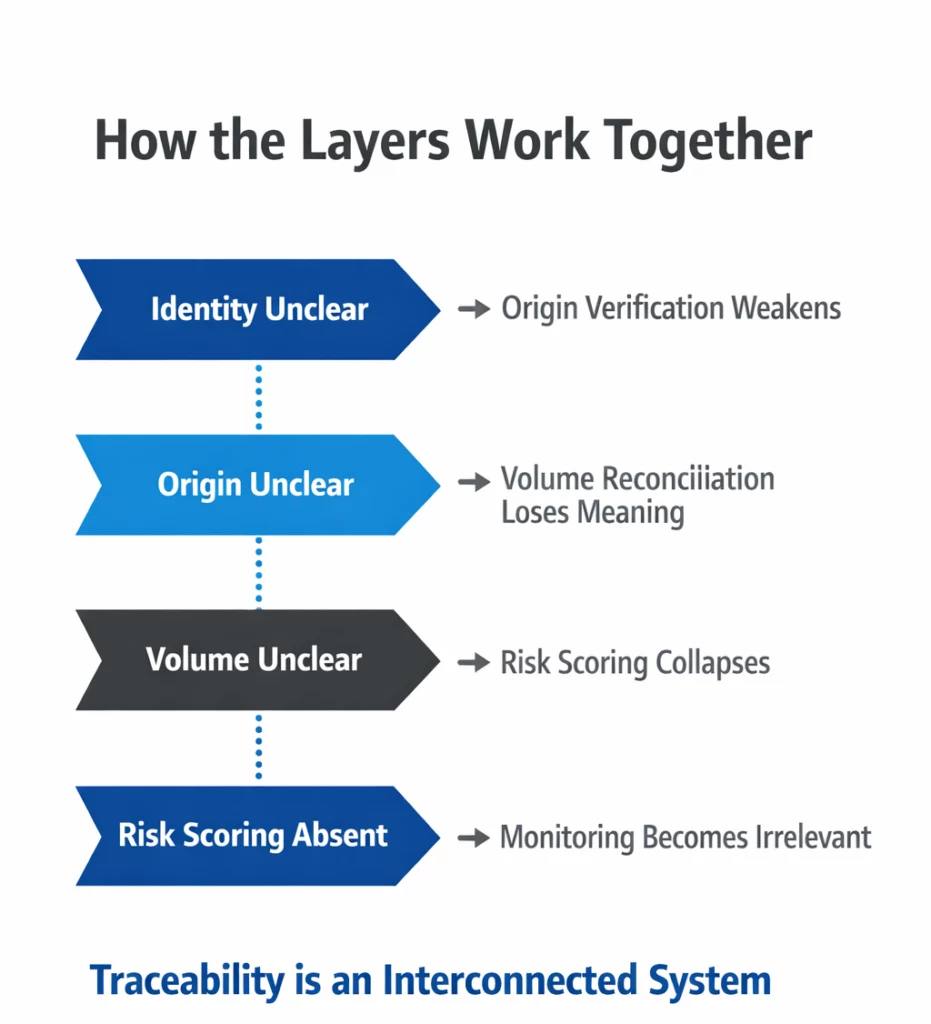
The real strength of the 5-Layer Supply Chain Traceability Framework is not in the individual layers it is in how they reinforce one another.
Traceability fails when companies treat identity, origin, volume tracking, compliance, and monitoring as separate functions. In reality, they are sequential and interdependent.
At each step, both the physical product and its digital record must move together.
Identity Layer: Establishing Who Is Involved
Before anything moves, you must know:
Which farm produced the soy
Which aggregator collected it
Which exporter handled it
If identities are unclear or inconsistently recorded, downstream traceability becomes unreliable. Duplicate records, trade names instead of legal entities, and inconsistent supplier codes weaken the entire system.
The Identity Layer ensures every actor and batch has a unique, verifiable reference.
Without this foundation, everything else becomes guesswork.
Geospatial Layer: Proving Where It Came From
Once identity is clear, the next question is origin.
Did the soy come from:
A verified farm?
A compliant plot?
A location not linked to post-2020 deforestation?
If farm polygons are missing or only point coordinates are used, spatial verification cannot occur.
Without Layer 2: You cannot prove origin even if the farm is compliant.
This creates immediate regulatory exposure.
Transaction & Volume Layer: Maintaining Attribution Through Aggregation
Soy is a bulk commodity. Farms contribute to aggregators. Aggregators pool volumes into silos. Export shipments combine material from multiple sources.
This is where most traceability systems collapse.
If volume allocation logic is not documented:
Compliant soy can mix with non-compliant soy
Production volumes may exceed declared capacity
Attribution to specific farms becomes diluted
Even if farm mapping (Layer 2) is perfect, traceability fails if volume reconciliation is weak.
Layer 3 ensures: Declared volumes reconcile with production capacity and blending logic remains transparent.
Without it, compliance collapses at the first aggregation point.
Risk & Compliance Layer: Turning Data into Defensibility
Collecting identity, geolocation, and volume data is not enough.
Regulators assess whether:
Risk was evaluated
Mitigation steps were applied
Decisions were documented
If risk scoring is absent, due diligence cannot be defended — even if all underlying data exists.
Layer 4 converts traceability into structured compliance workflows.
Without this layer: Traceability becomes documentation without legal strength.
Even after soy reaches the feed manufacturer, risk continues to evolve.
Land use can change
New deforestation alerts can emerge
Supplier risk profiles can shift
If traceability is static collected once and archived it cannot respond to emerging risk.
Layer 5 ensures continuous oversight.
It transforms traceability from a historical record into a live control system.
Applying the Framework Across Commodities — With Real-World Context
The strength of the 5-Layer Supply Chain Traceability Framework is that it is commodity-agnostic. While soy, cocoa, palm oil, and wood have different sourcing models, the structural vulnerabilities are similar: aggregation, origin ambiguity, and compliance exposure.
Let’s examine how the framework applies in real-world scenarios.
Soy
Structural Challenge: Early Aggregation & Bulk Blending
Brazilian soy from hundreds of farms is delivered to regional silos. These silos consolidate volumes before export. A single vessel shipment to Europe may contain soy from multiple municipalities sometimes across different states.
When that shipment reaches a European crusher, the product is already blended.
Where Traceability Breaks
Farm-level data may exist, but volume allocation to export lots is unclear.
GPS points are provided instead of farm polygons.
Production volumes exceed declared farm capacity.
How the Framework Solves It
Identity Layer: Unique IDs for farms, cooperatives, and exporters.
Transaction Layer: Allocation logic reconciles farm output with vessel volume.
Risk Layer: High-risk municipalities flagged before shipment approval.
Monitoring Layer: Ongoing satellite alerts detect new land-use change.
In soy, volume reconciliation and aggregation transparency are critical even perfectly mapped farms cannot protect compliance if blending logic fails.
Cocoa
Structural Challenge: Smallholder Fragmentation
In Côte d’Ivoire or Ghana, cocoa is produced by hundreds of thousands of smallholder farmers. Beans are collected by cooperatives, sold to licensed buying companies, and exported in bulk.
A chocolate manufacturer in Europe may source cocoa that originated from hundreds of individual farms each less than 5 hectares.
Where Traceability Breaks
Village-level location data instead of farm polygons.
Incomplete cooperative membership records.
Paper-based farm registers.
Aggregation at buying centers without volume attribution.
How the Framework Solves It
Identity Layer: Verified farmer IDs linked to cooperatives.
Geospatial Layer: Polygon capture at farm level.
Transaction Layer: Tracking volumes from farmer to cooperative to exporter.
Risk Layer: Scoring farms based on proximity to protected areas.
Fresh Fruit Bunches (FFBs) are delivered from plantations, including smallholders, to palm oil mills. Once processed into crude palm oil (CPO), volumes from multiple plantations are mixed at the mill level.
Downstream refiners often have traceability to the mill but not to the plantation.
Where Traceability Breaks
Plantation-level attribution is missing.
Smallholder suppliers to mills are not mapped.
No clear link between FFB volume and CPO output.
How the Framework Solves It
Identity Layer: Unique IDs for plantations and mills.
Geospatial Layer: Polygon mapping of supplying plantations.
Monitoring Layer: Satellite alerts around mill supply sheds.
In palm oil, mill-level traceability is insufficient. Plantation-level attribution is required for defensibility.
Wood
Structural Challenge: Concession-Level Ambiguity
Timber harvested from large forest concessions in Southeast Asia or Central Africa is processed into logs, veneer, or plywood. Concessions may span thousands of hectares.
European importers often receive documentation tied to concession-level permits not harvest block-level mapping.
Where Traceability Breaks
Concession-wide coordinates instead of harvest polygons.
Mixed species declarations under single HS codes.
Volume mismatches between harvest permits and export documentation.
How the Framework Solves It
Identity Layer: Verified concession owner and logging contractor records.
Geospatial Layer: Harvest block polygon mapping.
Transaction Layer: Reconciliation between logging permits and shipment volume.
Risk Layer: Legality verification and species validation.
Monitoring Layer: Satellite monitoring of concession areas.
In wood supply chains, legality and species verification are as critical as deforestation risk.
Step-by-Step: Implementing the 5-Layer Framework
Step 1 – Map Your Supply Chain Tiers
Identify:
Tier 1 suppliers
Upstream farms or concessions
Aggregation points
Transformation facilities
Step 2 – Identify Traceability Breakpoints
Common breakpoints:
Silos
Mills
Crushing plants
Bulk storage
Blending facilities
Step 3 – Digitize Identity & Geolocation Data
Replace:
Paper records
Unstructured spreadsheets
Email-based documentation
With:
Structured supplier onboarding
Polygon mapping tools
Digital record systems
Step 4 – Integrate Volume Tracking
Implement:
Batch-level tracking
Allocation logic documentation
Production-to-export reconciliation
Step 5 – Layer Risk & Compliance Workflows
Establish:
Supplier risk scoring
Mitigation documentation
Audit-ready reporting
Due diligence validation processes
Step 6 – Enable Continuous Monitoring
Deploy:
Satellite alerts
Risk dashboards
Compliance health metrics
Traceability becomes proactive, not reactive.
Common Misconceptions About Traceability
“Certification Is Enough”
Certification does not replace batch-level attribution and geospatial validation.
“Traceability Starts at Processing”
If origin is not verified upstream, downstream traceability is incomplete.
“We Don’t Need Polygon Mapping”
Precision matters in regulated markets.
“Spreadsheets Are Sufficient”
Spreadsheets fail under scale, aggregation, and audit timelines.
“Aggregation Doesn’t Affect Compliance”
Aggregation is the single largest traceability vulnerability.
Technology as an Enabler
In today’s regulatory and operational environment, traceability cannot depend on spreadsheets, emails, or manual reconciliation especially across multi-tier, cross-border supply chains handling high transaction volumes. This is where TraceX traceability solutions operate as infrastructure, not software add-ons. TraceX provides a structured digital architecture that connects supplier onboarding, farm-level geolocation capture, volume tracking, risk scoring, and compliance workflows into a single interoperable system. Through ERP integrations, automated batch reconciliation, AI-powered geospatial validation, and real-time monitoring dashboards, TraceX ensures that data moves with goods from origin to market without breaking at aggregation or transformation points. Instead of reacting to audits, companies gain a continuous, audit-ready control system. In this context, technology is not a convenience. It is the backbone that makes scalable, defensible, and regulation-aligned traceability possible.
See how TraceX connects origin, processing, compliance, and reporting in one unified traceability architecture.
Supply chains are no longer linear, predictable, or lightly regulated they are multi-tiered, aggregated, cross-border systems operating under increasing scrutiny. In this environment, traceability cannot be reactive documentation or fragmented record-keeping. It must be structured, layered, and continuously monitored. Building traceability that survives complexity means verifying identity before transactions occur, validating origin with precision, reconciling volumes through aggregation, embedding compliance into workflows, and monitoring risk dynamically. When these elements operate as an interconnected system, traceability becomes more than a compliance exercise it becomes operational infrastructure that protects market access, reduces regulatory exposure, and strengthens commercial resilience.
Learn how to design a supply chain compliance framework that withstands audits and regulatory scrutiny.
Do we really need a structured framework if we already have supplier data and certifications?
Supplier declarations and certifications are not enough to survive aggregation, volume reconciliation checks, or regulatory audits. A structured framework ensures data is interconnected, verifiable, and defensible at every stage.
Isn’t this framework too complex for mid-sized companies?
Complexity already exists in your supply chain the framework simply structures it. In fact, layered traceability reduces long-term risk, audit friction, and operational disruption.
Can’t we just focus on Tier 1 suppliers instead of mapping upstream layers?
Regulatory exposure often originates upstream. Without farm-, plantation-, or concession-level verification, Tier 1 traceability cannot prove origin or deforestation compliance.
How does this framework handle aggregation and bulk blending?
The Transaction & Volume Layer specifically addresses allocation logic and reconciliation, ensuring that blended volumes remain attributable and audit-defensible.
Is traceability really necessary if we’re not directly regulated?
Even if you’re not a first operator, downstream buyers and regulators increasingly demand verifiable origin data. Weak traceability creates commercial risk, contract loss, and reputational exposure.
Start using TraceX
Transparency, Trust, & Success for your Climate Journey.
We use cookies on our website to give you the most relevant experience by remembering your preferences and repeat visits. By clicking “Accept All”, you consent to the use of ALL the cookies. However, you may visit "Cookie Settings" to provide a controlled consent.
This website uses cookies to improve your experience while you navigate through the website. Out of these, the cookies that are categorized as necessary are stored on your browser as they are essential for the working of basic functionalities of the website. We also use third-party cookies that help us analyze and understand how you use this website. These cookies will be stored in your browser only with your consent. You also have the option to opt-out of these cookies. But opting out of some of these cookies may affect your browsing experience.
Necessary cookies are absolutely essential for the website to function properly. These cookies ensure basic functionalities and security features of the website, anonymously.
Cookie
Duration
Description
cookielawinfo-checkbox-analytics
11 months
This cookie is set by GDPR Cookie Consent plugin. The cookie is used to store the user consent for the cookies in the category "Analytics".
cookielawinfo-checkbox-functional
11 months
The cookie is set by GDPR cookie consent to record the user consent for the cookies in the category "Functional".
cookielawinfo-checkbox-necessary
11 months
This cookie is set by GDPR Cookie Consent plugin. The cookies is used to store the user consent for the cookies in the category "Necessary".
cookielawinfo-checkbox-others
11 months
This cookie is set by GDPR Cookie Consent plugin. The cookie is used to store the user consent for the cookies in the category "Other.
cookielawinfo-checkbox-performance
11 months
This cookie is set by GDPR Cookie Consent plugin. The cookie is used to store the user consent for the cookies in the category "Performance".
viewed_cookie_policy
11 months
The cookie is set by the GDPR Cookie Consent plugin and is used to store whether or not user has consented to the use of cookies. It does not store any personal data.
Functional cookies help to perform certain functionalities like sharing the content of the website on social media platforms, collect feedbacks, and other third-party features.
Performance cookies are used to understand and analyze the key performance indexes of the website which helps in delivering a better user experience for the visitors.
Analytical cookies are used to understand how visitors interact with the website. These cookies help provide information on metrics the number of visitors, bounce rate, traffic source, etc.
Advertisement cookies are used to provide visitors with relevant ads and marketing campaigns. These cookies track visitors across websites and collect information to provide customized ads.
Download the 2026 Traceability Scorecard and Benchmark Your Supply Chain Across 10 Critical Capabilities.
Download our eBook
Don’t Wait for an Audit to Find Your EUDR Gaps
The 2026 Simplification Package changes how HS codes, DDS pass-through and geolocation rules apply to you. Get the free guide and 20-point readiness checklist before enforcement catches you unprepared.