Spice Farming: A Complete Guide to Sustainable Cultivation and Best Practices
Published
, 8 minute read
Share this article
Quick summary: Discover how sustainable farming practices in spices — from agroforestry and organic inputs to digital traceability — build climate resilience and long-term market competitiveness for spice producers.
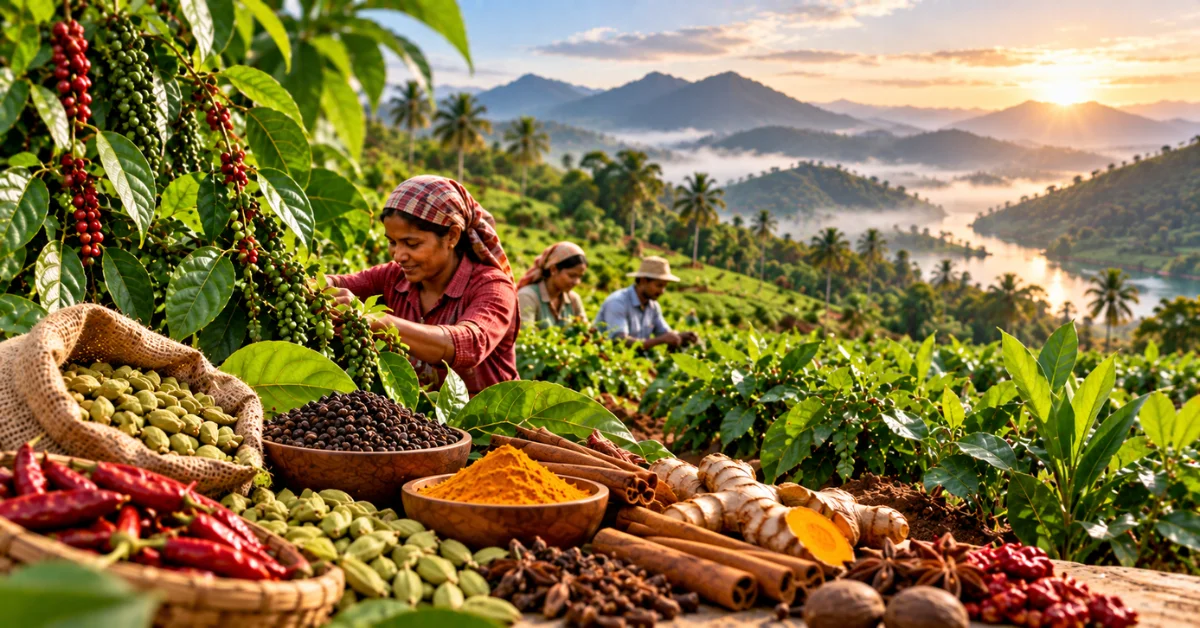
Spice farming is the cultivation of crops such as pepper, cardamom, turmeric, ginger, chilli, cumin and vanilla for their seeds, bark, roots, fruits or pods. Sustainable spice farming combines agroforestry, organic and integrated pest management, intercropping, water-smart irrigation and clean post-harvest handling. Recording those practices at plot level is what turns good agronomy into evidence premium buyers will pay for.
Key takeaways
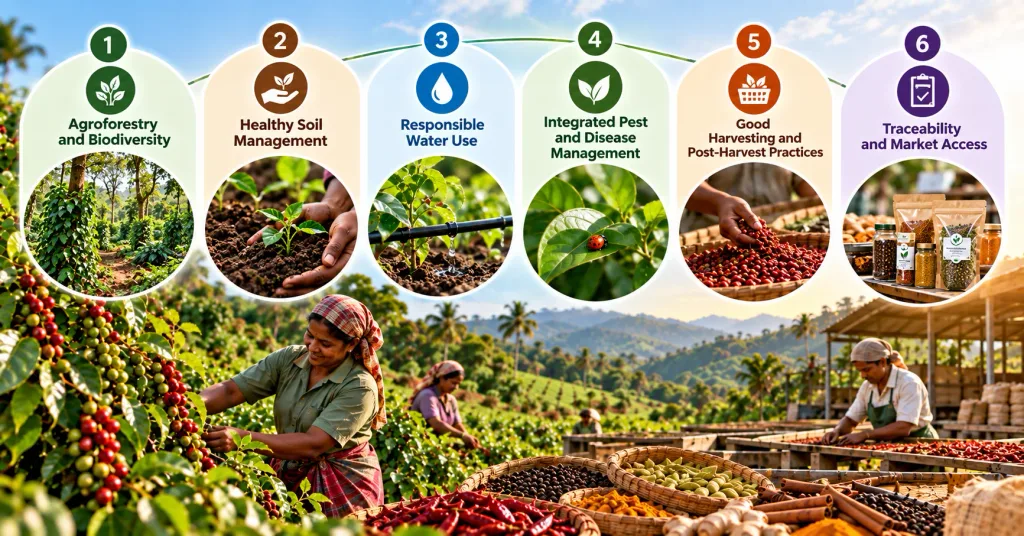
Six practices define sustainable cultivation: agroforestry, organic and IPM inputs, intercropping, water management, soil care and clean post-harvest handling.
Post-harvest drying and moisture control decide whether a lot passes EU residue and contaminant limits.
Sustainable Spices Initiative members target 25% sustainable sourcing of top ingredients by 2025 and 50% by 2030.
Digital farm records let spice farming programmes prove practices to buyers without repeated audits.
Discover how TraceX helps your business improve supply chain transparency, monitor sustainability performance, strengthen supplier accountability, and streamline sustainability data management.
It is the cultivation of aromatic crops, mostly by smallholders in tropical and subtropical regions, for global food, flavour and wellness markets.
Spice farming covers vine crops such as black pepper and vanilla, shade-loving cardamom, rhizomes like turmeric and ginger, annual seed spices such as cumin, coriander and fenugreek, and chilli. Most production happens on small, family-run plots in India, Vietnam, Indonesia, Sri Lanka, Madagascar and parts of Africa, often alongside coffee, coconut or fruit trees.
Sustainable spice farming balances three goals: healthy soils and ecosystems, fair livelihoods for growers, and consistent yields of safe, authentic product. The market rewards it. Rainforest Alliance expects the herbs and spices industry to grow from US$11 billion in 2022 to US$18 billion by 2030.
Discover how sustainable farming techniques help improve soil health, conserve water, protect biodiversity, and support long-term agricultural productivity. Learn how digital solutions can strengthen farm management and promote responsible sourcing.Read the Full Blog →
Spice Farming Best Practices for Sustainable Cultivation
Grow under shade where the crop allows, feed soil biologically, diversify, save water and handle the harvest cleanly.
No single package fits every crop. Perennial vines and shrubs reward long-term canopy and soil investment, while rhizomes and seed spices depend more on rotation, seed quality and timing. The six practices below apply across both, adapted to each crop and agro-climatic zone.
Spice Farming With Agroforestry and Shade
In Kerala, Coorg and Sri Lanka, pepper, cardamom and vanilla grow beneath native trees. Leaf litter feeds the soil, shade buffers heat and erratic rain, and trees add fruit, timber or carbon income.
Spice Farming With Organic Inputs and IPM
Compost, green manure and biofertilisers replace much of the synthetic load, while integrated pest management targets sprays only where needed. This matters commercially because EU maximum residue levels under Regulation (EC) 396/2005 are checked at the border.
Discover how IPM helps farmers manage pests through preventive practices, biological controls, and targeted interventions while reducing reliance on chemical pesticides and supporting long-term agricultural sustainability.Read the Full Blog →
Spice Cultivation Through Intercropping, Rotation and Soil Care
Rotating turmeric or ginger with legumes, intercropping pepper with coffee, and using cover crops or contour planting on slopes break pest cycles, limit erosion and spread income across the year.
Discover how crop rotation helps farmers maintain soil fertility, manage pests and diseases, reduce dependence on chemical inputs, and support long-term agricultural productivity.Read the Full Blog →
Spice Cultivation: Water-Smart Irrigation and Clean Post-Harvest
Drip irrigation, mulching and rainwater harvesting conserve scarce water. After harvest, drying on raised, covered surfaces and controlling moisture reduce mould and mycotoxin risk, which Regulation (EU) 2023/915 limits for spices. In spice farming, a lot can be lost after harvest as easily as in the field.
Why Spice Farming Is Changing: Buyer and Market Pressure
Brands and regulators now ask for proof of practice, not just a certificate or a supplier promise
Sector commitments are rising. Sustainable Spices Initiative members aim for 25% sustainable sourcing of their top three ingredients by 2025, 50% by 2030, and robust due diligence. Regulation adds pressure: the EU Forced Labour Regulation applies to all products from 14 December 2027, and the CSDDD requires the largest companies to run supply chain due diligence from 26 July 2029. Spices are not EUDR commodities, but many buyers apply deforestation-free policies to forest-grown pepper and vanilla. Each of these demands traces back to what happens in spice farming.
Spice Farming Challenges for Smallholders and Exporters
Limited training and inputs: quality biofertilisers, planting material and agronomic advice are hard to reach.
Fragmentation: thousands of small plots make standard practices and data collection difficult.
Certification cost: audit fees and paperwork eat into thin margins.
Paper records: practices happen, but evidence lives in notebooks and spreadsheets.
Climate volatility compounds each gap. Erratic monsoons, heat stress and new pest pressures hit yields hardest on farms with degraded soils and single-crop systems, which are also the farms least able to document improvement.
Exporters face a forced trade-off: fund field audits across every grower, or accept gaps that weaken claims about their spice farming programmes.
Spice Farming Technology: Digital Farm Management and Traceability
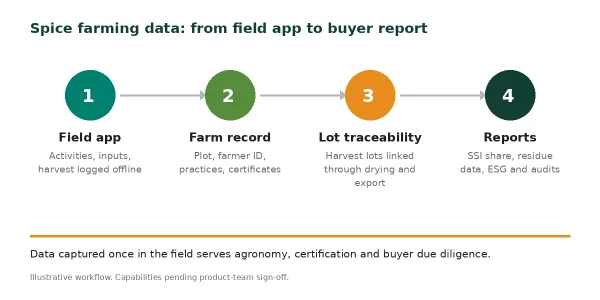
A farm management and traceability platform captures practices once in the field and reuses them for agronomy, certification and buyers.
The goal is to capture each activity once, at source, and reuse it. A field technician logging a compost application or a harvest weight creates a record that serves the agronomist, the certification body and the buyer, instead of three separate data requests later in the season.
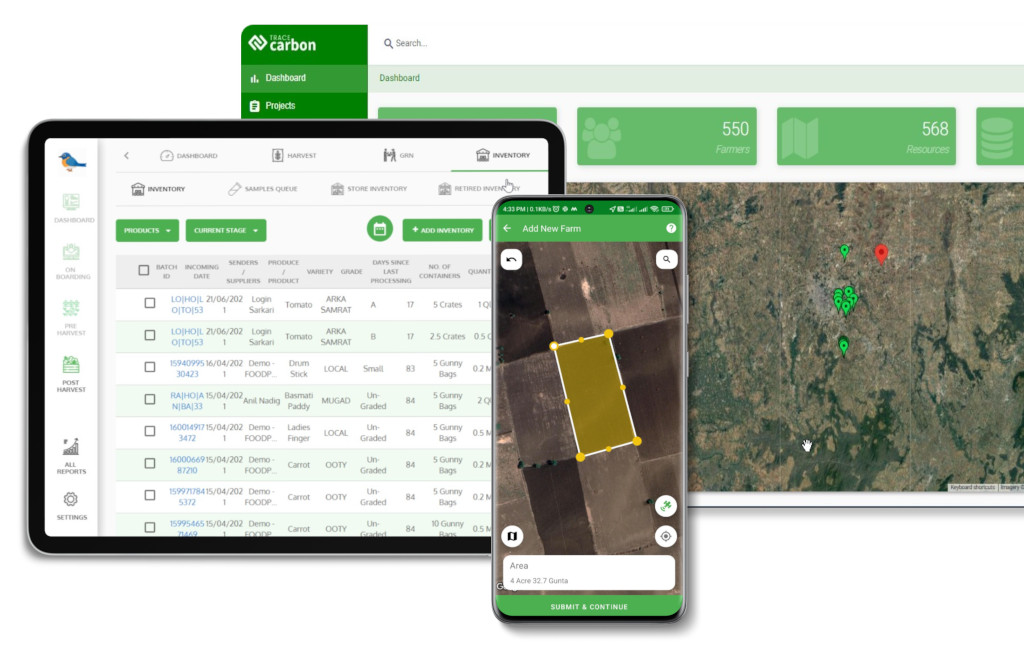
Mobile field app for logging activities, inputs and harvests, including offline capture
Farmer and plot profiles with geotagged locations, practices and certificates
Advisory and alerts when input use deviates from the recommended package of practices
Lot traceability from harvest through drying, processing and export
Carbon and sustainability dashboards for SSI, ESG and buyer reporting
Sustainable spice farming already exists on thousands of farms. What is missing is the data trail. Exporters that digitise practices at the plot level stop paying twice, once for good agronomy and again to prove it.
Spice Farming in Practice: Jayanti Herbs and Spices
A global spice exporter used TraceX to align field teams across its plantations on one platform.
Jayanti Herbs and Spices needed to coordinate many farms, field technicians and supervisors while upholding traceability and sustainability standards. Using TraceX digital hierarchy management, it brought technicians, supervisors and admins onto one platform, gaining clear accountability, faster compliance reporting and end-to-end operational clarity across its Turkish plantations.
Manual records show intent; digital records show each plot and lot.
Need
Manual approach
TraceX platform
Practice records
Field notebooks, extension visits
Timestamped app entries per plot
Input use
Purchase receipts, estimates
Logged applications against recommendations
Certification evidence
Annual audit document packs
Continuous records exportable for auditors
Harvest to export
Collection slips, spreadsheets
Lot IDs linked to contributing farms
Buyer questionnaires
Days of compiling data
Report generated from existing records
Spice Farming Platform Checklist for Exporters and Processors
Choose tools growers will actually use and that buyers will actually accept
Does the field app work offline and in local languages?
Can it model crop-specific practices for pepper, cardamom, turmeric and seed spices?
Does it record inputs against a recommended package of practices?
Can it link plots and farmers to harvest lots through drying and processing?
Does it store certificates and audit evidence per farm?
Can it report sustainable sourcing share for SSI and buyer programmes?
Does it integrate with your ERP and procurement systems?
Frequently Asked Questions (FAQ’s)
What is spice farming?
Spice farming is the cultivation of crops like pepper, cardamom, turmeric, ginger, chilli and cumin for their aromatic seeds, bark, roots or fruits, mostly by smallholders in tropical regions.
What makes spice farming sustainable?
Sustainable spice farming protects soil, water and biodiversity, pays growers fairly and delivers safe product, using agroforestry, organic and IPM inputs, intercropping and careful post-harvest handling.
Which spices grow best under agroforestry?
Black pepper, cardamom and vanilla thrive under shade trees, often intercropped with coffee or areca. Turmeric and ginger also tolerate partial shade.
How does post-harvest handling affect spice quality?
Poor drying and storage cause mould, mycotoxins and contamination that can fail EU contaminant limits. Raised drying surfaces, moisture control and testing protect quality.
Are spices covered by the EUDR?
No. The EUDR covers cattle, cocoa, coffee, oil palm, rubber, soy and wood. Buyers may still apply their own deforestation-free policies to spices.
Which certifications apply to spice farms?
The UEBT and Rainforest Alliance certification, Fairtrade and organic schemes are most common, and SSI recognises a basket of standards.
How does technology help spice farmers?
Digital farm management records practices, guides input use and links plots to harvest lots, so growers and exporters can prove sustainability without repeated audits.
Start using TraceX
Transparency, Trust, & Success for your Climate Journey.
We use cookies on our website to give you the most relevant experience by remembering your preferences and repeat visits. By clicking “Accept All”, you consent to the use of ALL the cookies. However, you may visit "Cookie Settings" to provide a controlled consent.
This website uses cookies to improve your experience while you navigate through the website. Out of these, the cookies that are categorized as necessary are stored on your browser as they are essential for the working of basic functionalities of the website. We also use third-party cookies that help us analyze and understand how you use this website. These cookies will be stored in your browser only with your consent. You also have the option to opt-out of these cookies. But opting out of some of these cookies may affect your browsing experience.
Necessary cookies are absolutely essential for the website to function properly. These cookies ensure basic functionalities and security features of the website, anonymously.
Cookie
Duration
Description
cookielawinfo-checkbox-analytics
11 months
This cookie is set by GDPR Cookie Consent plugin. The cookie is used to store the user consent for the cookies in the category "Analytics".
cookielawinfo-checkbox-functional
11 months
The cookie is set by GDPR cookie consent to record the user consent for the cookies in the category "Functional".
cookielawinfo-checkbox-necessary
11 months
This cookie is set by GDPR Cookie Consent plugin. The cookies is used to store the user consent for the cookies in the category "Necessary".
cookielawinfo-checkbox-others
11 months
This cookie is set by GDPR Cookie Consent plugin. The cookie is used to store the user consent for the cookies in the category "Other.
cookielawinfo-checkbox-performance
11 months
This cookie is set by GDPR Cookie Consent plugin. The cookie is used to store the user consent for the cookies in the category "Performance".
viewed_cookie_policy
11 months
The cookie is set by the GDPR Cookie Consent plugin and is used to store whether or not user has consented to the use of cookies. It does not store any personal data.
Functional cookies help to perform certain functionalities like sharing the content of the website on social media platforms, collect feedbacks, and other third-party features.
Performance cookies are used to understand and analyze the key performance indexes of the website which helps in delivering a better user experience for the visitors.
Analytical cookies are used to understand how visitors interact with the website. These cookies help provide information on metrics the number of visitors, bounce rate, traffic source, etc.
Advertisement cookies are used to provide visitors with relevant ads and marketing campaigns. These cookies track visitors across websites and collect information to provide customized ads.
Download the 2026 Traceability Scorecard and Benchmark Your Supply Chain Across 10 Critical Capabilities.
Download our eBook
Don’t Wait for an Audit to Find Your EUDR Gaps
The 2026 Simplification Package changes how HS codes, DDS pass-through and geolocation rules apply to you. Get the free guide and 20-point readiness checklist before enforcement catches you unprepared.