EUDR Requirements: The Importer’s Compliance Checklist for 2026
Published
, 7 minute read
Share this article
Quick summary: EUDR Requirements Explained: Learn the key compliance rules, geolocation mapping, due diligence statements, risk assessments, and how businesses can meet EU deforestation regulation requirements.
EUDR requirements have become the single biggest blocker between your shipment and the EU border. If you import or export coffee, cocoa, soy, palm oil, cattle, rubber or timber, a missing GPS coordinate, an incomplete risk assessment or a rejected Due Diligence Statement can stop goods at customs – even when the product itself is perfectly compliant.
The EU Deforestation Regulation (EUDR, Regulation 2023/1115) requires companies to prove, with data, that their commodities were not grown on land deforested after 31 December 2020, were produced legally, and can be traced back to the exact plot. The burden of proof sits with you the operator or trader not your supplier.
This guide breaks down each EUDR requirement the way a buyer evaluating a compliance solution actually needs it: the obligation, the real-world pain it creates, and how a digital platform closes the gap so you stay audit-ready and keep shipping.
Key takeaways
EUDR requirements apply to any operator or trader placing coffee, cocoa, soy, palm oil, cattle, rubber or timber on the EU market – you must prove products are deforestation-free, legally produced and traceable to the plot.
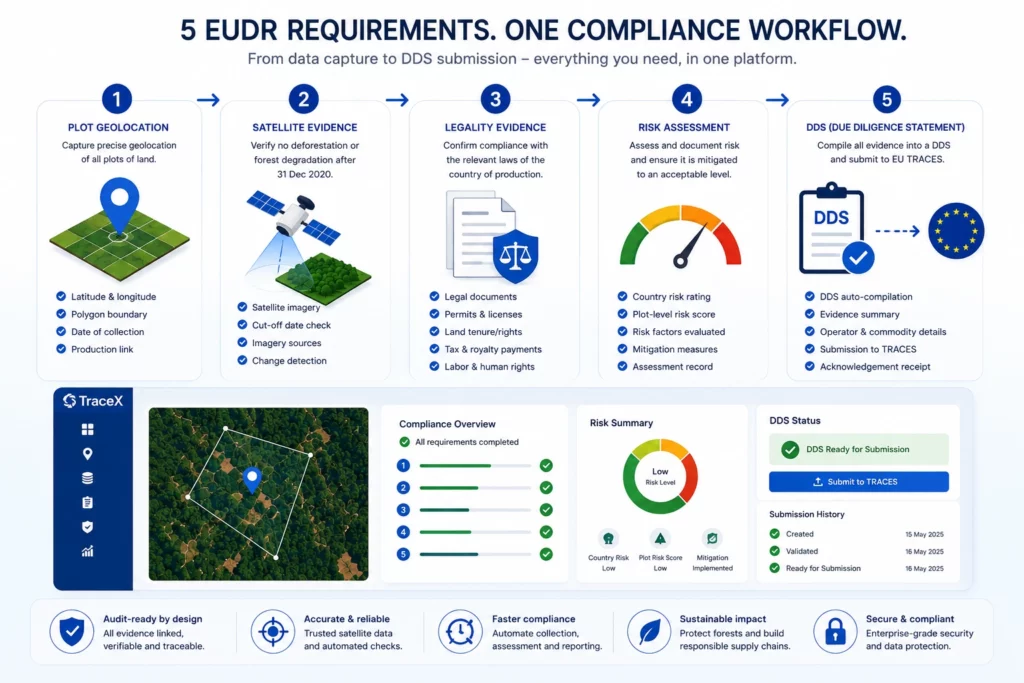
Five obligations sit at the core: plot-level geolocation, a Due Diligence Statement (DDS), a documented risk assessment, deforestation verification against the 31 December 2020 cut-off, and five-year recordkeeping.
Missing one farm coordinate can block a shipment around 60% of DDS rejections trace back to data gaps, and fines reach €50,000+ per infringement.
A digital EUDR platform from TraceX turns these requirements into one audit-ready workflow: farm mapping, satellite checks, automated DDS and TRACES-ready submission.
Dec 30, 2026
EUDR deadline for large & medium operators – SMEs follow on June 30, 2027. The window to get systems in place is closing.
7 commodities in scope
Soy, palm oil, coffee, cocoa, cattle, wood and rubber – plus derived products like chocolate, leather, furniture and paper.
EUDR Requirements at a Glance: The 5 Obligations You Must Meet
Every EUDR requirement maps back to five obligations. Meet all five and your shipment clears; miss one and the DDS fails. Here is the checklist buyers use to scope a solution:
Plot-level geolocation – GPS points or polygons for every production plot.
Due Diligence Statement (DDS) – submitted via EU TRACES before goods are placed on the market.
Risk assessment – documented proof that deforestation risk is “negligible.”
Deforestation verification – against the 31 December 2020 cut-off, using satellite data.
Five-year recordkeeping – all evidence retained and retrievable on demand.
EUDR Geolocation Requirements: Mapping Every Production Plot
The EUDR geolocation requirement is where most operators get stuck – you cannot file a compliant DDS without precise coordinates for every plot. Here is what is required and where the friction is:
The pain: supply chains rarely hold GPS coordinates or polygon maps; data lives in spreadsheets, WhatsApp messages and PDFs across thousands of smallholders.
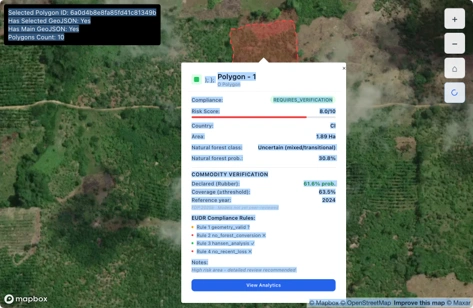
The requirement: GPS point coordinates for small plots, and polygon mapping that traces the full boundary for larger farms (over 4 hectares).
The capability that closes it: mobile field-mapping that captures plot boundaries offline, stores coordinates centrally, and links each shipment to verified plots.
The benefit: clean, validated geolocation data that passes satellite checks and feeds straight into your DDS – no last-minute scramble.
Are your geolocation data and farm maps EUDR-ready?
globally lack digital geolocation mapping – the biggest single barrier to meeting EUDR geolocation requirements at scale.
EUDR Due Diligence Statement Requirements: From Data to DDS
The EUDR due diligence requirement turns all your supply-chain data into one legal declaration the DDS. It is not a form you fill in by hand; at scale it must be generated from validated data:
The pain: collecting supplier docs, geolocation and risk results from scattered sources, then formatting them into a TRACES-ready DDS a top cause of rejections.
The requirement: a DDS confirming deforestation-free, legal production and negligible risk, submitted through EU TRACES before market placement.
The capability that closes it: automated aggregation of supplier, plot and risk data into a standardized, validated DDS, with direct submission to the EU information system.
The benefit: DDS filed in minutes, not days with the audit trail attached.
~60% of DDS rejections
stem from data gaps that trace back to ERP / traceability integration failures – not from the product being non-compliant.
Unsure how to file an EUDR Due Diligence Statement (DDS)?
The EUDR risk assessment requirement forces you to evaluate and document whether your supply chain is linked to deforestation or illegal production before you can submit a DDS:
The pain: manually scoring suppliers, benchmarking country risk and cross-checking satellite data is slow and inconsistent across regions.
The requirement: country-risk benchmarking, supply-chain complexity analysis and satellite verification that together prove negligible risk.
The capability that closes it: automated supplier risk scoring on location, documentation quality, traceability readiness and compliance history.
The benefit: a defensible, repeatable risk record that stands up to a competent-authority audit.
Need a clear evaluation framework?
Walk through an EUDR risk assessment step by step. Get in touch with our experts
EUDR Deforestation Requirements: Verifying the 2020 Cut-Off
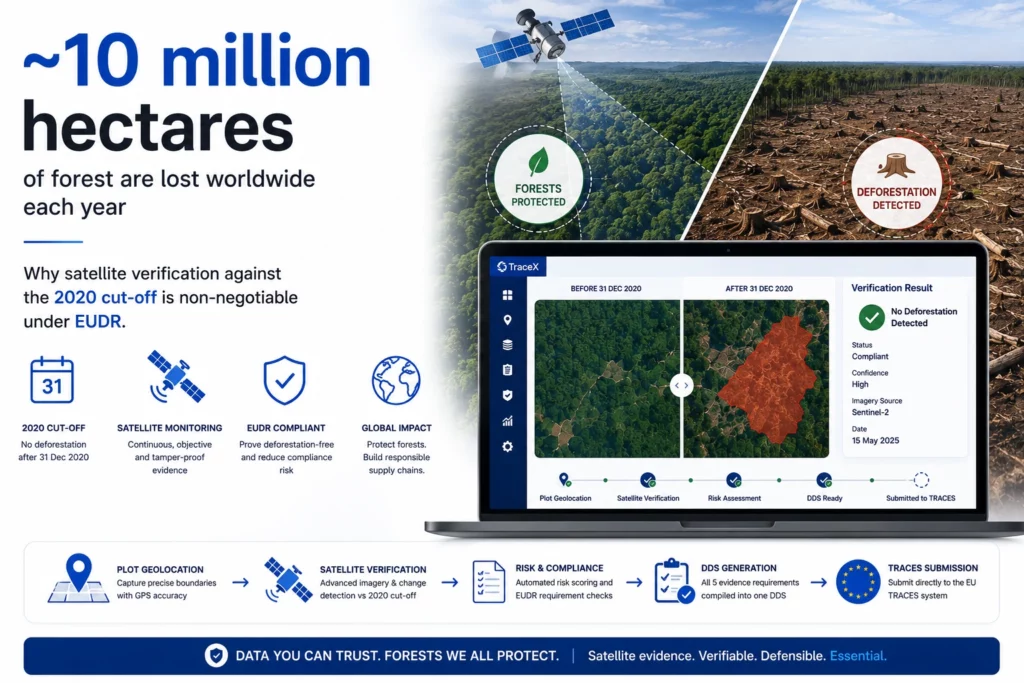
A central EUDR requirement is proving production land was not deforested after 31 December 2020. This is a data problem, solved with satellites:
The pain: companies cannot manually confirm forest cover history across remote sourcing regions.
The requirement: verify each plot against the cut-off using satellite monitoring, historical forest data and tree-cover-loss alerts.
The capability that closes it: overlay analysis that compares farm polygons against forest-loss datasets and flags any overlap automatically.
The benefit: documented, deforestation-free verification attached to every plot and shipment.
EUDR Recordkeeping Requirements: The Five-Year Retention Rule
The final EUDR requirement is retention: every piece of due diligence evidence must be kept for five years and produced on demand:
The pain: records scattered across drives, email and PDF folders cannot produce an audit trail fast enough when an authority asks.
The requirement: five years of geolocation data, supplier declarations, risk results, satellite reports and DDS records, retrievable instantly.
The capability that closes it: a central, secure repository with supplier-level record management and one-click audit reports.
The benefit: inspection-ready in minutes, with full traceability from plot to port.
Meeting EUDR Requirements: Platform vs Spreadsheets vs Certification
Buyers evaluating how to meet EUDR requirements usually weigh four approaches. This comparison shows where each one holds up and where it breaks:
EUDR requirement
Spreadsheets / manual
Generic ERP
Certification only
TraceX EUDR platform
Plot-level geolocation
Manual, error-prone
Stores addresses, not polygons
Not covered
Mobile polygon mapping
Deforestation check (2020)
Not feasible
No satellite layer
Not a substitute
Automated satellite overlay
DDS + TRACES submission
High rejection risk
No DDS output
No DDS
Automated, TRACES-ready
Five-year audit readiness
Slow to retrieve
Fragmented
Certificate ≠ audit trail
One-click audit reports
Scales to smallholders
Breaks at scale
Limited
No
Built for scale
Takeaway: spreadsheets, ERPs and certificates each cover a slice; only an integrated EUDR platform covers all five requirements end to end.
How to Meet EUDR Requirements: Your Next Steps
Turning EUDR requirements into a strategic advantage comes down to one move: replace manual, scattered compliance with a single, audit-ready data flow. TraceX EUDR Solutions helps you to:
Map every production plot with GPS points or polygons.
Verify each plot against the 31 December 2020 cut-off with satellite data.
Score supplier and country risk, and document mitigation.
Generate and submit a TRACES-ready DDS per shipment.
Retain all evidence for five years in one searchable system.
Any operator or trader placing covered commodities – coffee, cocoa, soy, palm oil, cattle, rubber or timber – on the EU market, and the derived products made from them.
Is plot-level geolocation mandatory under EUDR?
Yes. You must provide GPS coordinates for production plots, with polygon mapping required for larger farms so authorities can run satellite deforestation checks.
What is the EUDR cut-off date?
31 December 2020. Commodities grown on land deforested after this date cannot be placed on the EU market, regardless of local legality.
How long must EUDR records be kept?
At least five years, and they must be retrievable on demand for inspection by competent authorities.
Does a certification like Rainforest Alliance meet EUDR requirements?
No. Certifications can support sustainability practices but do not replace EUDR due diligence – geolocation, deforestation verification and a DDS are still required.
What happens if a DDS is rejected?
The shipment is blocked at customs. Most rejections trace back to data gaps, so validated geolocation and supplier data are the best protection.
Start using TraceX
Transparency, Trust, & Success for your Climate Journey.
We use cookies on our website to give you the most relevant experience by remembering your preferences and repeat visits. By clicking “Accept All”, you consent to the use of ALL the cookies. However, you may visit "Cookie Settings" to provide a controlled consent.
This website uses cookies to improve your experience while you navigate through the website. Out of these, the cookies that are categorized as necessary are stored on your browser as they are essential for the working of basic functionalities of the website. We also use third-party cookies that help us analyze and understand how you use this website. These cookies will be stored in your browser only with your consent. You also have the option to opt-out of these cookies. But opting out of some of these cookies may affect your browsing experience.
Necessary cookies are absolutely essential for the website to function properly. These cookies ensure basic functionalities and security features of the website, anonymously.
Cookie
Duration
Description
cookielawinfo-checkbox-analytics
11 months
This cookie is set by GDPR Cookie Consent plugin. The cookie is used to store the user consent for the cookies in the category "Analytics".
cookielawinfo-checkbox-functional
11 months
The cookie is set by GDPR cookie consent to record the user consent for the cookies in the category "Functional".
cookielawinfo-checkbox-necessary
11 months
This cookie is set by GDPR Cookie Consent plugin. The cookies is used to store the user consent for the cookies in the category "Necessary".
cookielawinfo-checkbox-others
11 months
This cookie is set by GDPR Cookie Consent plugin. The cookie is used to store the user consent for the cookies in the category "Other.
cookielawinfo-checkbox-performance
11 months
This cookie is set by GDPR Cookie Consent plugin. The cookie is used to store the user consent for the cookies in the category "Performance".
viewed_cookie_policy
11 months
The cookie is set by the GDPR Cookie Consent plugin and is used to store whether or not user has consented to the use of cookies. It does not store any personal data.
Functional cookies help to perform certain functionalities like sharing the content of the website on social media platforms, collect feedbacks, and other third-party features.
Performance cookies are used to understand and analyze the key performance indexes of the website which helps in delivering a better user experience for the visitors.
Analytical cookies are used to understand how visitors interact with the website. These cookies help provide information on metrics the number of visitors, bounce rate, traffic source, etc.
Advertisement cookies are used to provide visitors with relevant ads and marketing campaigns. These cookies track visitors across websites and collect information to provide customized ads.
Download the 2026 Traceability Scorecard and Benchmark Your Supply Chain Across 10 Critical Capabilities.
Download our eBook
Don’t Wait for an Audit to Find Your EUDR Gaps
The 2026 Simplification Package changes how HS codes, DDS pass-through and geolocation rules apply to you. Get the free guide and 20-point readiness checklist before enforcement catches you unprepared.