EUDR Coffee Compliance: The Complete Guide for Coffee Exporters & Operators (2026)
Published
, 10 minute read
Share this article
Quick summary: Discover how to achieve EUDR coffee compliance with our comprehensive guide. Learn about traceability, sustainable sourcing, and certifications to build a transparent and environmentally-friendly coffee supply chain. Enhance your market position and meet EU regulations effectively.
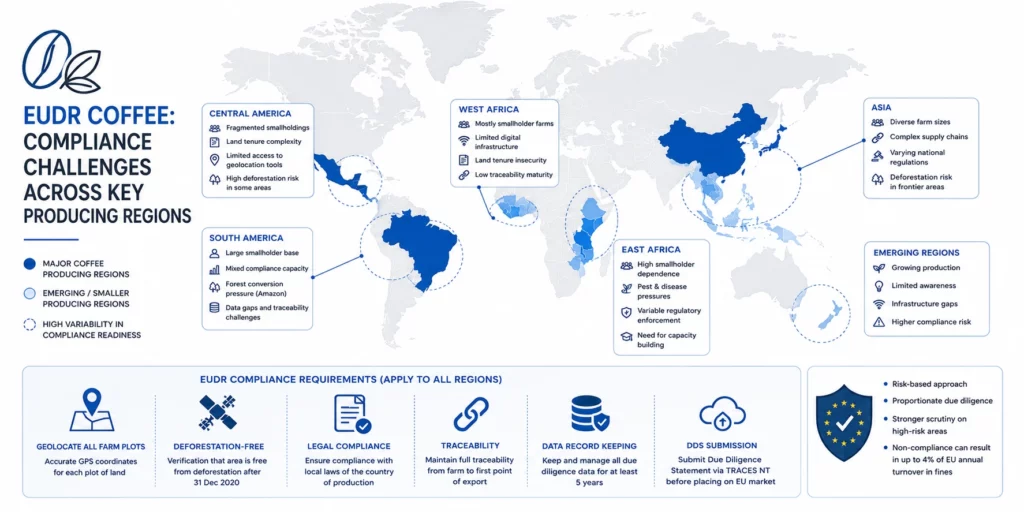
EUDR coffee compliance means ensuring that coffee sold in the EU is sourced from land that was not deforested or degraded after December 31, 2020. Coffee operators must submit a Due Diligence Statement (DDS) supported by GPS coordinates of farms, supply chain traceability data, and proof of legal production. Non-compliance can result in fines of up to 4% of EU turnover and a ban from the EU market.
EUDR coffee compliance is now the single biggest regulatory requirement for every coffee exporter, trader, and operator selling into the European Union. Effective December 30, 2025 (large operators) and June 30, 2026 (SMEs), non-compliant coffee shipments will be blocked at EU borders.
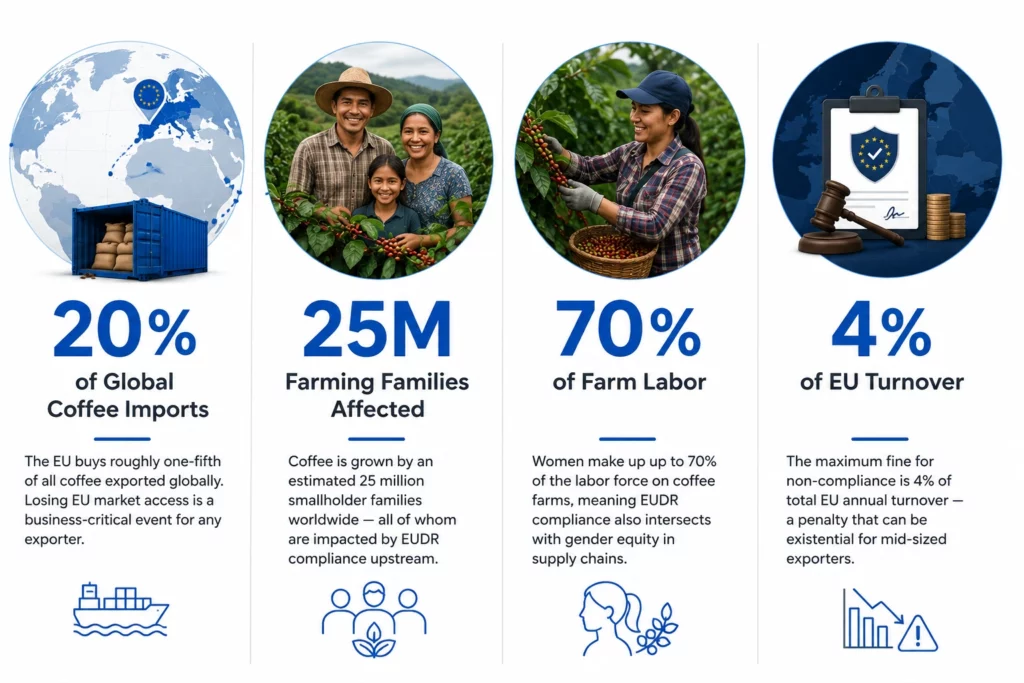
EUDR coffee compliance is now mandatory to access the EU market the world’s largest coffee importer (20% of global imports).
EUDR coffee compliance means that any coffee placed on or exported from the EU market must meet three non-negotiable criteria:
Here is how the decision to invest in EUDR coffee compliance plays out across your business:
EUDR coffee traceability is the backbone of compliance. Without it, you cannot prove deforestation-free sourcing, and your DDS will be rejected.
Manual traceability at scale is impossible. These technology categories are driving EUDR coffee compliance for leading operators:
EUDR coffee sourcing goes beyond regulation it is becoming the new baseline buyers expect. Here are the certification and sourcing standards that align with EUDR requirements:
EUDR coffee compliance is not without friction. Here are the three most common challenges and the proven solutions:
Solve EUDR Coffee Compliance Challenges — Fast
Not all EUDR compliance platforms are built for coffee. Here is what a purpose-built EUDR coffee compliance software solution must include:
EUDR coffee compliance is achievable with the right process. Here are the six steps to get audit-ready:
Start Your EUDR Coffee Compliance Journey Today
EUDR coffee compliance means ensuring that coffee placed on or exported from the EU market is deforestation-free (as of December 31, 2020), legally produced, and supported by a Due Diligence Statement submitted to the EU Information System.
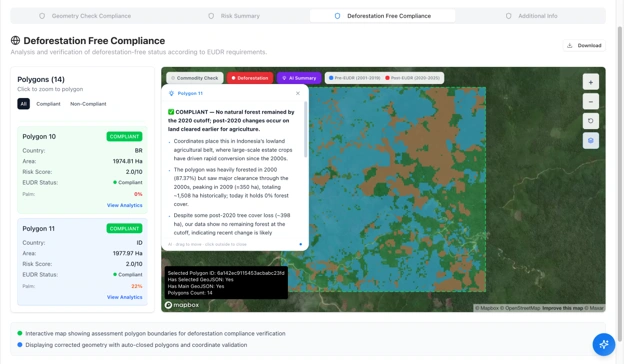
Leading EUDR coffee traceability solutions use blockchain for tamper-proof supply chain records, satellite monitoring to verify deforestation status, IoT sensors for farm-level environmental data, and mobile apps for smallholder data collection.
This guide tells you exactly what you need to do, what’s at stake, and how to get compliant fast with tools, checklists, and a comparison of what compliance looks like in practice.
Key Takeaways
Coffee must be traceable to the farm-plot level with GPS coordinates and documented supply chains.
Penalties include fines up to 4% of EU turnover and market bans.
Technology blockchain, satellite monitoring, IoT is the fastest path to compliant traceability.
Compliance is also a competitive advantage: premium market access, brand trust, and buyer preference.
eudr coffee stats
EUDR Coffee Compliance: What It Actually Requires
Deforestation-free: Grown on land that was not deforested or degraded after December 31, 2020
Legally produced: Sourced in compliance with laws in the country of production
Due Diligence Statement (DDS): Operators must submit a DDS to the EU Information System before placing products on the market
EUDR Coffee Due Diligence Statement: What It Includes
The Due Diligence Statement is the core compliance document. For EUDR coffee, it must contain:
GPS coordinates (geolocation) of the farm plots where coffee was grown
Volume and description of the product (HS code, country of origin)
Name and contact details of the operator and any relevant supplier
Evidence that the commodity is deforestation-free and legally sourced
A risk assessment and, where risk is not negligible, risk mitigation measures taken
Navigating EUDR requirements doesn’t have to be overwhelming.
EUDR Coffee Sourcing: Deforestation-Free Certification and Standards
Rainforest Alliance Certification
Verifies sustainable farming, biodiversity protection, and traceability. Widely recognised as EUDR-aligned proof of sustainable coffee sourcing.
FairtradeCertification
Ensures equitable trade and farm-level transparency. Aligned with EUDR’s emphasis on legal and socially responsible production.
OrganicCertification
Avoids synthetic inputs and emphasises soil health. Organic coffee farms often have lower deforestation risk profiles.
4CStandard
The Coffee Common Code a baseline sustainability standard commonly used to begin traceability documentation in producing countries.
EUDR Coffee Compliance by Region: What Producers Need to Know
EUDR Coffee Compliance in Africa (Ethiopia, Uganda, Ivory Coast)
Africa accounts for roughly 12% of global coffee exports to the EU. Ethiopian and Ugandan Arabica producers face high demand but also face complex smallholder supply chains that make traceability challenging. Key priorities: farmer registration, cooperative-level aggregation, and satellite-based land verification.
EUDR Coffee Compliance in Latin America (Brazil, Colombia)
Brazil is the world’s largest coffee exporter and a major EU supplier. Despite having internal deforestation legislation, EUDR requires additional documentation and due diligence above domestic standards. Colombian producers benefit from strong certification penetration (Rainforest Alliance, UTZ) as a starting point.
EUDR Coffee Compliance in Southeast Asia (Vietnam, Indonesia)
Vietnam is the world’s second-largest coffee producer, primarily Robusta. Indonesian coffee supply chains often involve complex multi-tier intermediaries. Both markets require investment in digital traceability infrastructure to meet EUDR’s farm-plot level requirements.
EUDR Coffee Compliance Challenges and How to Solve Them
Challenge: Millions of smallholder farmers lack access to digital infrastructure, making farm-level data collection extremely difficult.
Solution: Mobile-first data collection apps that work offline, combined with cooperative-level aggregation and NGO/government partnerships to fund farmer onboarding. Platforms from TraceX have built specific smallholder modules for this purpose.
What does digital traceability look like in practice?
Discover how TechnoServe partnered with TraceX to digitize coffee traceability across 3,500 farmers in the Araku Valley, creating a transparent, data-driven supply chain that supports ethical sourcing and sustainable coffee production.
EUDR Coffee Challenge 2: Compliance Cost for Mid-Sized Exporters
Challenge: The upfront cost of building or purchasing a traceability system can be prohibitive for mid-sized exporters without enterprise budgets.
Solution: SaaS-based compliance platforms with per-volume or per-exporter pricing models spread the cost. Shared cooperative infrastructure and sustainability financing (green loans, EU grants) can offset implementation costs.
EUDR Coffee Challenge 3: Data Accuracy and Verification
Challenge: Supply chain data entered manually is prone to error and difficult to verify independently.
Solution: Blockchain-backed records create tamper-proof audit trails. Satellite imagery cross-references farm-level claims against independent land use data. Regular third-party audits and in-system validation rules catch discrepancies before DDS submission.
For coffee roasters sourcing green coffee from EUDR-regulated origins, compliance extends beyond bean quality. Roasters must ensure their supply chains are traceable, collect plot-level geolocation data, conduct due diligence, and verify that coffee is legally produced and deforestation-free before it is placed on the EU market.
TraceX EUDR Compliance Software handles traceability, DDS submission, and risk assessment in one platform.
EUDR coffee compliance means ensuring that coffee placed on or exported from the EU market is deforestation-free (as of December 31, 2020), legally produced, and supported by a Due Diligence Statement submitted to the EU Information System.
When does EUDR apply to coffee?
The EUDR compliance deadline for large coffee operators is December 30, 2025. For SMEs (micro and small enterprises), the deadline is June 30, 2026.
What happens if my coffee is not EUDR compliant?
Non-compliant coffee will be blocked from entering the EU market. Operators face fines of up to 4% of total EU annual turnover, confiscation of products, and temporary or permanent exclusion from the EU market.
Does EUDR apply to all coffee products?
Yes. EUDR applies to coffee beans, roasted coffee, coffee extracts, and products containing coffee covering HS codes 0901 and 2101. It applies to operators placing coffee on the EU market and those exporting from the EU.
What is a Due Diligence Statement (DDS) for EUDR coffee?
A DDS is the formal document operators submit to the EU Information System before placing EUDR-regulated coffee on the market. It includes GPS farm coordinates, supplier information, product description, and evidence of deforestation-free sourcing.
How can smallholder farmers achieve EUDR coffee compliance?
Smallholder farmers can achieve EUDR compliance through cooperative-level aggregation, mobile data collection tools that work offline, and partnerships with NGOs or compliance platforms that provide farmer registration and GPS mapping at scale.
What technology is used for EUDR coffee traceability?
Leading EUDR coffee traceability solutions use blockchain for tamper-proof supply chain records, satellite monitoring to verify deforestation status, IoT sensors for farm-level environmental data, and mobile apps for smallholder data collection.
Is Rainforest Alliance certification enough for EUDR coffee compliance?
Rainforest Alliance certification is a strong starting point and is EUDR-aligned, but it is not sufficient on its own. You still need to submit a Due Diligence Statement and may need additional geolocation and traceability documentation depending on the risk level of your sourcing country.
Start using TraceX
Transparency, Trust, & Success for your Climate Journey.
We use cookies on our website to give you the most relevant experience by remembering your preferences and repeat visits. By clicking “Accept All”, you consent to the use of ALL the cookies. However, you may visit "Cookie Settings" to provide a controlled consent.
This website uses cookies to improve your experience while you navigate through the website. Out of these, the cookies that are categorized as necessary are stored on your browser as they are essential for the working of basic functionalities of the website. We also use third-party cookies that help us analyze and understand how you use this website. These cookies will be stored in your browser only with your consent. You also have the option to opt-out of these cookies. But opting out of some of these cookies may affect your browsing experience.
Necessary cookies are absolutely essential for the website to function properly. These cookies ensure basic functionalities and security features of the website, anonymously.
Cookie
Duration
Description
cookielawinfo-checkbox-analytics
11 months
This cookie is set by GDPR Cookie Consent plugin. The cookie is used to store the user consent for the cookies in the category "Analytics".
cookielawinfo-checkbox-functional
11 months
The cookie is set by GDPR cookie consent to record the user consent for the cookies in the category "Functional".
cookielawinfo-checkbox-necessary
11 months
This cookie is set by GDPR Cookie Consent plugin. The cookies is used to store the user consent for the cookies in the category "Necessary".
cookielawinfo-checkbox-others
11 months
This cookie is set by GDPR Cookie Consent plugin. The cookie is used to store the user consent for the cookies in the category "Other.
cookielawinfo-checkbox-performance
11 months
This cookie is set by GDPR Cookie Consent plugin. The cookie is used to store the user consent for the cookies in the category "Performance".
viewed_cookie_policy
11 months
The cookie is set by the GDPR Cookie Consent plugin and is used to store whether or not user has consented to the use of cookies. It does not store any personal data.
Functional cookies help to perform certain functionalities like sharing the content of the website on social media platforms, collect feedbacks, and other third-party features.
Performance cookies are used to understand and analyze the key performance indexes of the website which helps in delivering a better user experience for the visitors.
Analytical cookies are used to understand how visitors interact with the website. These cookies help provide information on metrics the number of visitors, bounce rate, traffic source, etc.
Advertisement cookies are used to provide visitors with relevant ads and marketing campaigns. These cookies track visitors across websites and collect information to provide customized ads.
Download the 2026 Traceability Scorecard and Benchmark Your Supply Chain Across 10 Critical Capabilities.
Download our eBook
Don’t Wait for an Audit to Find Your EUDR Gaps
The 2026 Simplification Package changes how HS codes, DDS pass-through and geolocation rules apply to you. Get the free guide and 20-point readiness checklist before enforcement catches you unprepared.