Quick summary: Australian Illegal Logging Prohibition Act (ILPA) Risk Assessment Guide for Timber & Wood Products: Learn how to assess legality risk, verify timber origin, strengthen due diligence, and ensure compliance with Australia’s import regulations.
ILPA risk assessment automates the due diligence process required under Australia’s Illegal Logging Prohibition Act using machine learning, satellite forest data, and document parsing to verify that timber and wood products were legally harvested before they reach an Australian port. Platforms from TraceX reduce a compliance workflow that previously took weeks of manual document chasing to a structured, audit-ready risk score in hours.
TL;DR – Key Takeaways
Australia’s ILPA requires importers and domestic processors to conduct due diligence on ALL regulated timber and wood products — penalties reach AUD $222,000 for corporations and AUD $44,400 for individuals per offence [CITE: Australian Department of Agriculture, 2024].
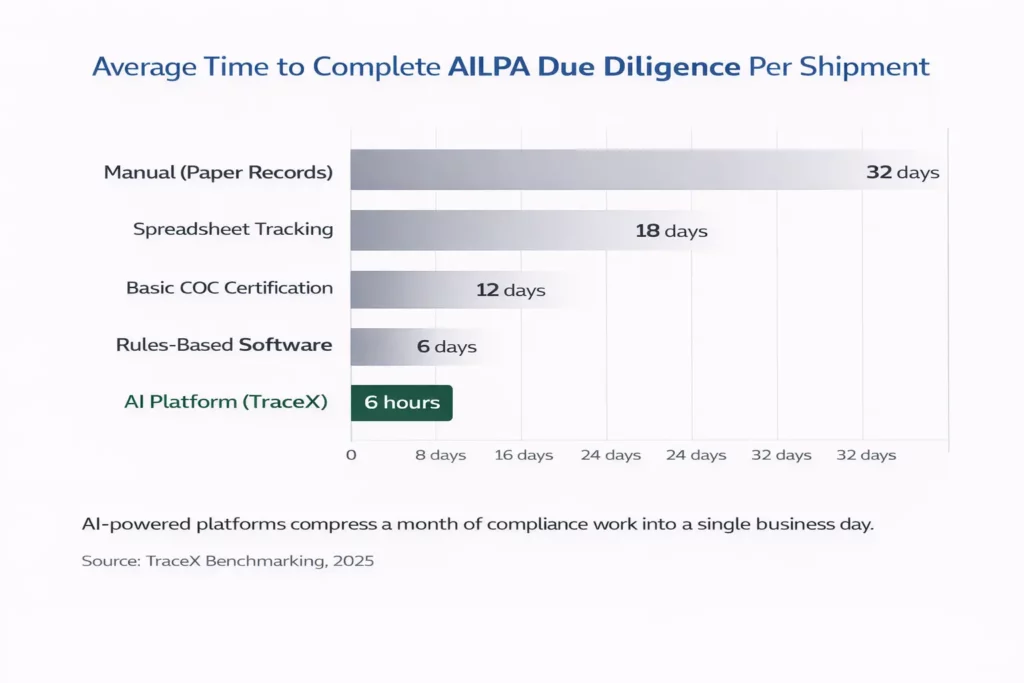
AI-powered risk assessment automates the four core ILPA due diligence pillars — species identification, country-of-harvest legality, permit/certification verification, and supply chain traceability — cutting compliance time by up to 80% vs. manual methods.
TraceX’s compliance platform combines agentic AI document parsing, GPS polygon mapping, and real-time satellite deforestation alerts to deliver ILPA-grade due diligence from supplier to shipment — audit-ready and exportable in one click.
A furniture importer in Melbourne sources teak dining sets from a supplier in Myanmar. A paper merchant in Sydney buys pulp from an Indonesian broker. A hardware wholesaler in Brisbane stocks up on plywood from a Chinese manufacturer who sources from somewhere upstream.
Under Australia’s Illegal Logging Prohibition Act, ‘somewhere upstream’ is not a legal defence. If you can’t prove your timber was harvested legally, you’re exposed. And ‘legally’ is defined not by your own standards but by the laws of the country where the tree was felled.
That’s a staggering compliance burden for any business importing timber, wood products, or paper into Australia. It’s also an almost impossible one to meet manually across complex, multi-tier supply chains. That’s why AI-powered ILPA risk assessment is no longer a nice-to-have, it’s a competitive necessity.
What Is the Australian Illegal Logging Prohibition Act — and Who Must Comply?
Illegal logging accounts for 15–30% of total global timber trade, representing an estimated USD $51–$152 billion in annual trade value. In Southeast Asia Australia’s primary timber sourcing region illegal logging rates in some countries have historically exceeded 80% of total harvest
The Australian Illegal Logging Prohibition Act 2012 (ILPA), enforced under the Illegal Logging Prohibition Regulation 2012, prohibits the import and domestic processing of illegally logged timber. It applies to a broad range of regulated timber and wood products, including solid timber, plywood, engineered wood, paper and paperboard, furniture with timber components, and charcoal.
‘Illegally logged’ timber means timber harvested in contravention of the laws of the country of harvest. This is a country-of-origin legal standard, not an Australian one. That means your due diligence must account for the specific forestry laws, permitting systems, and land tenure regimes of every country in your supply chain.
Who Has a Due Diligence Obligation Under ILPA?
Importers: Any business importing regulated timber or wood products into Australia for commercial purposes. This includes direct importers and agents acting on behalf of foreign suppliers.
Domestic processors: Businesses that process regulated raw logs or timber within Australia including sawmills, chipboard manufacturers, and paper mills using Australian-sourced timber.
Exclusions: Personal imports, products originating entirely from plantation timber in low-risk jurisdictions, and certain certified products may benefit from simplified due diligence but the burden of proof still rests with the importer.
ILPA’s ‘due diligence system’ requirement is frequently misread as a one-time compliance exercise. In practice, it’s an ongoing obligation for importers to maintain and update their due diligence systems, not just complete them at initial import. This ongoing monitoring requirement is where AI automation creates the most significant compliance advantage.
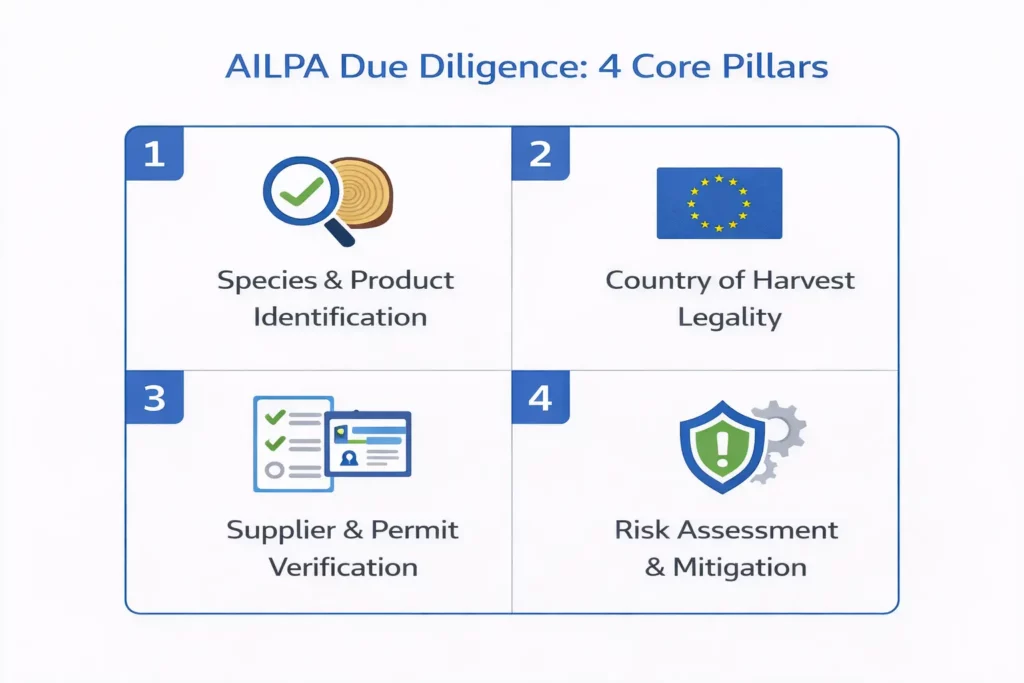
ILPA’s due diligence system requirement (Section 14 of the Act) mandates that importers gather information, assess that information for compliance risk, and, where risk is non-negligible, take steps to mitigate it. In practice, this breaks down into four operational pillars:
Pillar 1: Species and Product Identification
You must document the timber species (scientific and common names), the form of the product (solid timber, plywood, pulp, etc.), and its primary component, including when timber is a minor component of a finished product (e.g., handles, frames, packaging). This sounds straightforward. In practice, species substitution is common: illegally harvested high-value species are relabelled as legal lower-value ones at the point of processing or export.
Pillar 2: Country and Region of Harvest
Every shipment must be traceable to its country of harvest and, where possible, the region or concession. This is where chain-of-custody documentation becomes non-negotiable. Timber that has passed through multiple countries of processing must still be traceable to the original harvest origin.
Pillar 3: Harvesting Legality Verification
You must verify that the timber was harvested in compliance with the laws of the country of origin covering harvesting rights, environmental regulations, and payment of relevant royalties or taxes. Acceptable evidence includes CITES permits, Forest Stewardship Council (FSC) or Programme for the Endorsement of Forest Certification (PEFC) certificates, government-issued harvest permits, and verified chain-of-custody documentation.
Pillar 4: Risk Assessment and Mitigation
After gathering the above information, importers must assess the risk of non-compliance. Where that risk is non-negligible, additional mitigation steps must be taken before import, which can include enhanced supplier audits, independent verification, or source substitution. This risk assessment must be documented and retained.
Most timber importers today manage ILPA compliance through a combination of email threads, PDF attachments, and Excel spreadsheets. A compliance team member emails a supplier requesting a CITES certificate. Three weeks later, a PDF arrives, possibly genuine, possibly not. The species name is checked against a lookup table. The country of origin is cross-referenced against a government advisory list. The harvest permit number is noted in column G of a shared spreadsheet.
It’s a process that worked when import volumes were low and supply chains were simple. Neither of those conditions holds for most modern timber importers.
The Four Failure Points of Manual ILPA Assessment
Document authenticity: CITES permits, harvest licences, and chain-of-custody certificates can be forged. Manual review without access to source-country permit registries cannot reliably detect sophisticated fraud, and importers remain legally liable for relying on fraudulent documentation.
Species verification: Visual species identification from documents alone is insufficient. Timber species can look identical to untrained eyes, and intentional mislabelling is a documented practice in high-risk supply chains.
Multi-tier opacity: Timber often passes through 3–5 intermediaries between forest and port. Each step in the chain can obscure or alter origin information. Manual traceability across multi-tier supply chains produces compliance gaps that auditors and authorities will find.
No real-time monitoring: A supplier that was compliant last year may not be this year, as concession boundaries change, illegal subcontracting occurs, and new deforestation events appear. Manual systems don’t catch this between import cycles.
A 2023 TRAFFIC (wildlife trade monitoring network) analysis found that 37% of timber shipments from high-risk origins entering major markets contained species-level discrepancies between declared and actual species — a figure that manual documentation review consistently fails to detect.
How AI Automates ILPA Risk Assessment: Core Capabilities
AI-powered ILPA compliance platforms don’t replace the legal obligation they fulfil it faster, more consistently, and with a defensible audit trail. Here’s how the core AI capabilities map directly onto ILPA’s four due diligence pillars:
AI Capability 1: Agentic Document Parsing
Natural language processing (NLP) models extract and cross-reference key data from supplier documents, CITES permits, FSC/PEFC certificates, harvest licences, and commercial invoices automatically. Species names are checked against authoritative databases (CITES Appendix listings, IUCN Red List). Permit numbers are flagged for validation against source-country registries where API access is available.
AI Capability 2: Country-Level Legality Risk Scoring
Machine learning models assign legality risk scores to country-species combinations based on: World Bank governance indicators, Global Forest Watch deforestation rates, US Forest Service and WWF forest integrity data, and known illegal logging prevalence by concession type. This risk scoring is dynamically updated quarterly as new deforestation and governance data are published.
AI Capability 3: Satellite Forest Cover Cross-Reference
For suppliers who provide GPS plot coordinates, AI platforms cross-reference harvest origin against satellite forest cover datasets ( Hansen/UMD Global Forest Change) and near-real-time deforestation alerts (GLAD). Any harvest origin overlapping with post-baseline forest loss triggers an elevated risk flag requiring enhanced due diligence.
AI Capability 4: Automated Risk Classification & Audit Documentation
After processing all input data, the platform generates a composite risk score (Low / Medium / High) for each shipment, with a complete evidence log of every data point considered. This documentation is retained in audit-ready format exportable as PDF or CSV satisfying ILPA’s requirement to maintain and produce due diligence records on request.
ILPA Compliance Approaches: How Do They Compare?
Not all compliance approaches deliver the same protection. Here’s how they stack up against ILPA’s documentation and risk assessment requirements:
Compliance Approach
Traceability Depth
Speed
Audit-Readiness
Cost at Scale
Manual paper records
Supplier-level
Months
Very low
Very high
Spreadsheet tracking
Partial
Weeks
Low
High
Basic chain-of-custody cert
Species/origin
Weeks
Medium
Medium
Rules-based software
Batch-level
Days
Medium–High
Medium
AI Traceability Platform (TraceX)
Plot → shipment
Hours
High (audit-ready)
Low at scale
The 5-Step AI ILPA Risk Assessment Pipeline
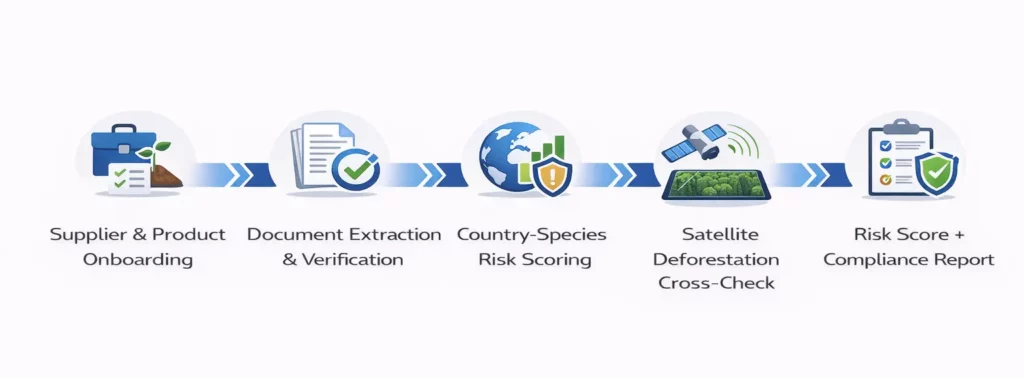
Here’s how a modern AI-powered ILPA risk assessment runs from first supplier contact to a defensible, audit-ready compliance record:
Step 1: Supplier & Product Onboarding
Suppliers are onboarded digitally via a structured data intake providing species declarations, country/region of harvest, harvesting entity details, and certification references. Agentic AI parses uploaded documents (PDFs, scanned permits, spreadsheets) and auto-populates the due diligence workflow. No manual transcription, no email threads.
Step 2: Document Extraction & Authenticity Check
NLP models extract permit numbers, species codes, harvest dates, and issuing authority details from uploaded certificates. Where permit registries are accessible via API (including some CITES national authorities), permit validity is cross-checked automatically. Species names are validated against CITES Appendix listings and IUCN databases in real time.
Step 3: Country-Species Risk Scoring
Each supplier-product combination is scored against a country-species risk matrix. High-deforestation countries (Indonesia, Papua New Guinea, DRC, Myanmar, Cambodia) trigger elevated risk flags by default. High-value, frequently mislabelled species (merbau, ramin, rosewood, teak) receive enhanced scrutiny regardless of declared origin.
Step 4: Satellite Deforestation Cross-Reference
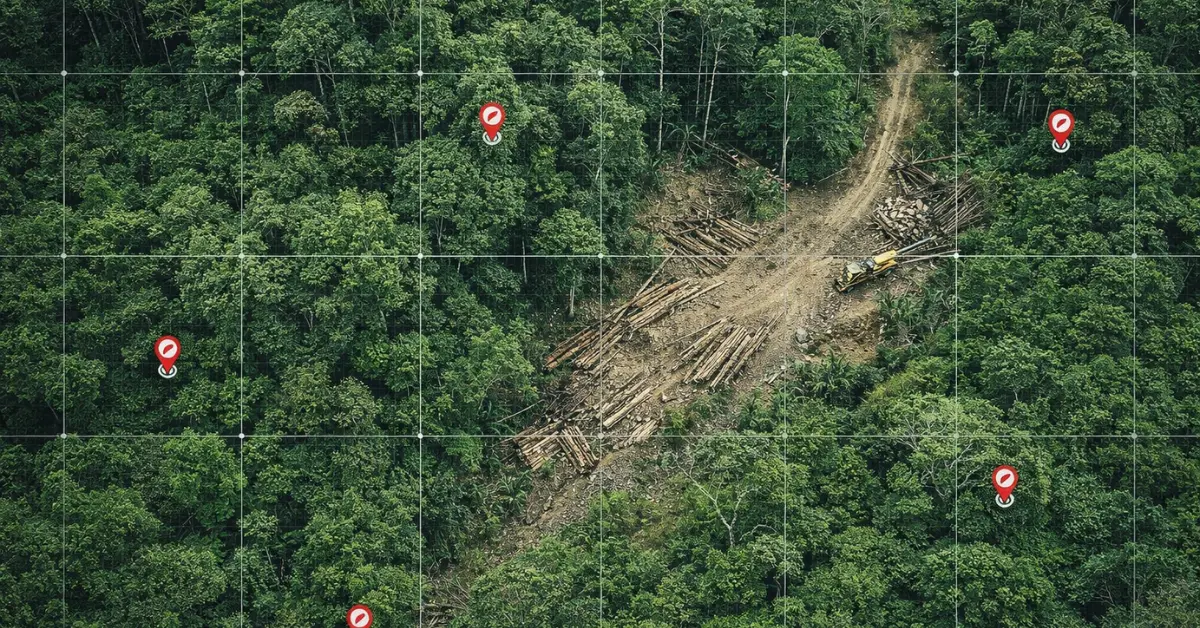
Where GPS harvest coordinates are available, the platform cross-references against Satellite imagery and GLAD near-real-time deforestation alerts. Post-baseline canopy loss within or adjacent to the declared harvest area triggers an automatic elevated risk classification. This step is the most powerful differentiator between AI-powered and manual compliance.
See the AI ILPA Pipeline in Action
Book a 30-minute TraceX walkthrough — we’ll map your timber supply chain against ILPA requirements and show exactly where AI automates your compliance gaps.
The platform generates a consolidated risk score (Low / Medium / High / Non-Negligible) for the shipment, with a full evidence trail: documents reviewed, data sources queried, risk factors identified, and any mitigation actions recommended. The compliance report is audit-ready and exportable in PDF or CSV satisfying ILPA’s documentation retention requirement at Section 35 of the Regulation.
Country & Species Risk Tiering: The Foundation of ILPA Risk Assessment
Of the 14 countries that supply the majority of Australia’s timber imports, 8 are classified as high-risk by the Australian Department of Agriculture based on governance indicators and deforestation rates. Indonesia, Malaysia, and China (as a processing hub for Southeast Asian timber) account for over 60% of Australia’s regulated wood product imports [CITE: Australian Bureau of Statistics, Trade in Goods and Services, 2024].
Country and species risk tiering is the analytical backbone of any credible ILPA risk assessment. Not all origins carry the same risk and not all species require the same level of scrutiny. Here’s how AI platforms operationalise this:
Keruing / Dipterocarp species — Indonesia/Malaysia; often processed in China before onward export, obscuring origin
Third-country processing is ILPA’s biggest enforcement blind spot. Timber harvested illegally in Indonesia is processed in China and exported to Australia as ‘Chinese furniture’ technically manufactured in China, but containing illegally sourced components. AI risk platforms address this by applying country-of-harvest risk weighting to declared component origins, not just the country of final manufacture. This capability is almost entirely absent from manual compliance systems.
ILPA Penalties & Enforcement Reality: What Non-Compliance Actually Costs
As of 2024, the penalties for importing illegally logged timber into Australia are: AUD $222,000 per offence for corporations (1,500 penalty units) and AUD $44,400 per offence for individuals (300 penalty units) for knowingly importing illegal timber. For due diligence failures (insufficient systems), penalties are AUD $66,600 per offence for corporations [CITE: Australian Department of Agriculture, Fisheries and Forestry, Penalty Unit Schedule 2024].
The Australian Border Force and the Department of Agriculture conduct compliance checks on regulated timber imports. The enforcement model combines documentary audits (requested due diligence records), physical inspections (species verification at port), and intelligence-led investigations triggered by risk profiling of import patterns.
What’s less understood is that the penalty is per offence, meaning each individual shipment of non-compliant timber is a separate offence. An importer receiving 12 container shipments per year with inadequate due diligence systems is exposed to 12 separate penalty actions per year, not one.
Beyond Fines: The Operational and Reputational Costs
Shipment detention and destruction: Non-compliant imports can be detained at port and ordered for re-export or destruction at the importer’s cost including detention fees, re-shipping costs, and loss of goods value.
Retailer delisting: Major Australian retailers (including Bunnings, IKEA Australia, and Officeworks) now require ILPA compliance documentation from their timber suppliers as a condition of supply making ILPA compliance a commercial necessity, not just a legal one.
Reputational exposure: Enforcement actions are publicly recorded. A compliance breach in 2025 follows a brand for years in ESG assessments, investor scrutiny, and customer trust evaluations.
TraceX in Action: AI-Powered ILPA Compliance for Real-World Supply Chains
TraceX’s ILPA Compliance Solutions brings enterprise-grade AI risk assessment to the timber and wood products sector addressing the exact compliance bottlenecks that manual systems consistently fail on.
How TraceX Delivers ILPA-Grade Due Diligence
Agentic document parsing: Supplier permits, FSC/PEFC certificates, CITES documentation, and commercial invoices are automatically extracted and cross-referenced. Data entry is eliminated; document gaps are flagged immediately.
Country-species risk matrix: Every declared origin-species combination is scored against TraceX’s dynamic risk intelligence layer, combining World Bank governance data, Global Forest Watch deforestation metrics, and ILPA-specific enforcement guidance.
Satellite deforestation alerts: GPS harvest coordinates are cross-referenced against Satellite imagery( Hansen data Sets) and GLAD near-real-time alerts. Harvest origins in or adjacent to recently deforested areas are flagged for enhanced due diligence before shipment clears.
Audit-ready compliance reports: Every due diligence assessment is documented with a full evidence trail exportable in PDF or CSV, with version control. When the Australian Border Force requests your records, you export rather than scramble.
Ongoing monitoring: ILPA’s ongoing due diligence obligation means compliance can’t be a one-time event. TraceX monitors supplier risk profiles continuously alerting compliance teams when a previously approved supplier’s risk status changes.
Timber importers using TraceX report reducing per-shipment due diligence time by up to 80% while achieving full documentation coverage across multi-tier supply chains that previously had significant traceability gaps.
Ready to Automate Your ILPA Risk Assessment?
TraceX maps every timber shipment against ILPA’s four due diligence pillars — species, legality, permits, and traceability and generates your compliance record automatically.
ILPA Risk Assessment Needs to Be Systematic — Not Sporadic
Australia’s illegal logging laws don’t distinguish between importers who didn’t know their timber was illegal and those who looked the other way. The due diligence obligation is absolute and the documentation burden is ongoing, not one-time.
Manual compliance systems built on email, spreadsheets, and occasional certificate checks were never designed to handle the scale, complexity, or speed of modern timber supply chains. They leave importers exposed to penalties that can reach six figures per shipment, retailer delisting, and reputational damage that ESG auditors and investors will find.
AI-powered ILPA risk assessment changes the compliance equation. It doesn’t reduce your legal obligation it makes fulfilling it practical, scalable, and defensible. That’s not a technology upgrade. It’s a risk management decision.
Struggling with data collection? Learn how to streamline ILPA information collection for accurate compliance.
What is the Australian Illegal Logging Prohibition Act (ILPA)?
ILPA is Australia’s federal legislation prohibiting the import and domestic processing of illegally logged timber and wood products. It requires all regulated importers and domestic processors to implement a ‘due diligence system’ — gathering information, assessing legality risk, and mitigating non-negligible risk before importing. The Act applies to solid timber, plywood, pulp, paper, furniture with timber components, and charcoal.
Who needs to comply with ILPA due diligence requirements?
Any business that imports regulated timber or wood products into Australia for commercial purposes must comply. This includes direct importers, commercial agents acting on behalf of foreign suppliers, and domestic processors using raw Australian timber. Businesses sourcing from certified plantations in low-risk countries may qualify for simplified due diligence but must still document and retain that determination.
What evidence is required for ILPA risk assessment of timber imports?
ILPA requires documentation of: timber species (scientific name), country and region of harvest, name and contact details of the harvesting entity, applicable laws of the country of harvest, and evidence of legal compliance such as CITES permits, FSC/PEFC certificates, government harvest licences, or verified chain-of-custody documentation. Where risk is non-negligible, additional mitigation evidence must also be retained.
How does AI improve ILPA due diligence for wood product importers?
AI automates the most time-consuming and error-prone elements of ILPA due diligence: document extraction and cross-referencing, country-species risk scoring, satellite deforestation cross-checking for GPS-referenced harvest areas, and compliance report generation. The result is a process that takes hours instead of weeks, catches fraud patterns that manual review misses, and generates a defensible audit trail automatically.
What are the penalties for breaching ILPA in Australia?
As of 2024: corporations face AUD $222,000 per offence for knowingly importing illegal timber, and AUD $66,600 per offence for due diligence system failures. Individuals face AUD $44,400 per offence. Penalties apply per shipment not per investigation meaning multiple non-compliant shipments result in multiple compounding penalty exposures. Detained goods may also be ordered for re-export or destruction at the importer’s cost.
Start using TraceX
Transparency, Trust, & Success for your Climate Journey.
We use cookies on our website to give you the most relevant experience by remembering your preferences and repeat visits. By clicking “Accept All”, you consent to the use of ALL the cookies. However, you may visit "Cookie Settings" to provide a controlled consent.
This website uses cookies to improve your experience while you navigate through the website. Out of these, the cookies that are categorized as necessary are stored on your browser as they are essential for the working of basic functionalities of the website. We also use third-party cookies that help us analyze and understand how you use this website. These cookies will be stored in your browser only with your consent. You also have the option to opt-out of these cookies. But opting out of some of these cookies may affect your browsing experience.
Necessary cookies are absolutely essential for the website to function properly. These cookies ensure basic functionalities and security features of the website, anonymously.
Cookie
Duration
Description
cookielawinfo-checkbox-analytics
11 months
This cookie is set by GDPR Cookie Consent plugin. The cookie is used to store the user consent for the cookies in the category "Analytics".
cookielawinfo-checkbox-functional
11 months
The cookie is set by GDPR cookie consent to record the user consent for the cookies in the category "Functional".
cookielawinfo-checkbox-necessary
11 months
This cookie is set by GDPR Cookie Consent plugin. The cookies is used to store the user consent for the cookies in the category "Necessary".
cookielawinfo-checkbox-others
11 months
This cookie is set by GDPR Cookie Consent plugin. The cookie is used to store the user consent for the cookies in the category "Other.
cookielawinfo-checkbox-performance
11 months
This cookie is set by GDPR Cookie Consent plugin. The cookie is used to store the user consent for the cookies in the category "Performance".
viewed_cookie_policy
11 months
The cookie is set by the GDPR Cookie Consent plugin and is used to store whether or not user has consented to the use of cookies. It does not store any personal data.
Functional cookies help to perform certain functionalities like sharing the content of the website on social media platforms, collect feedbacks, and other third-party features.
Performance cookies are used to understand and analyze the key performance indexes of the website which helps in delivering a better user experience for the visitors.
Analytical cookies are used to understand how visitors interact with the website. These cookies help provide information on metrics the number of visitors, bounce rate, traffic source, etc.
Advertisement cookies are used to provide visitors with relevant ads and marketing campaigns. These cookies track visitors across websites and collect information to provide customized ads.
Download the 2026 Traceability Scorecard and Benchmark Your Supply Chain Across 10 Critical Capabilities.
Download our eBook
Don’t Wait for an Audit to Find Your EUDR Gaps
The 2026 Simplification Package changes how HS codes, DDS pass-through and geolocation rules apply to you. Get the free guide and 20-point readiness checklist before enforcement catches you unprepared.