EUDR versus EUTR: What Timber Teams Must Change to Keep EU Market Access
Published
, 12 minute read
Share this article
Quick summary: EUDR versus EUTR explained for timber teams: what changed, new plot-level geolocation and DDS rules, expanded liability, and how to stay EU-market ready.
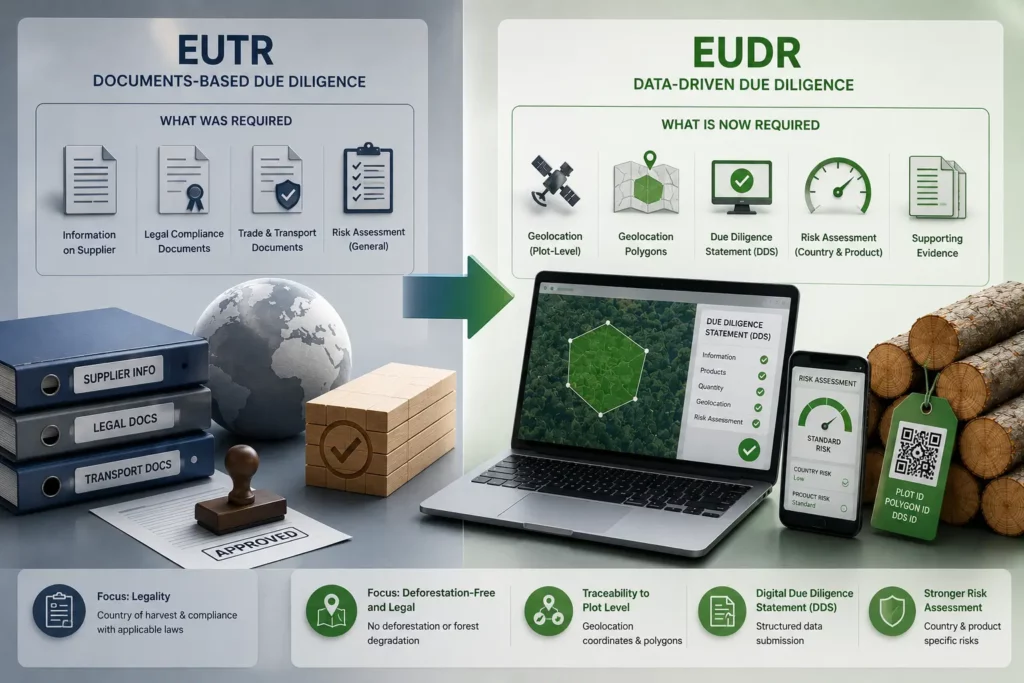
EUDR versus EUTR comes down to one shift: the EU Timber Regulation (EUTR) required you to prove timber was legally harvested, while the EU Deforestation Regulation (EUDR) requires you to prove it is deforestation-free verifiable down to the exact forest plot, using GPS polygon geolocation, a Due Diligence Statement (DDS), and continuous risk assessment. EUTR accepted documents and supplier declarations; EUDR does not. EUDR (Regulation (EU) 2023/1115, as amended by Regulation (EU) 2025/2650) applies from 30 December 2026 for large and medium operators and 30 June 2027 for micro and small operators, at which point EUTR is repealed.
EUDR versus EUTR is the comparison every timber team placing wood on the EU market now has to understand, because the rules they built their compliance around are being replaced. For years, the EU Timber Regulation (EUTR) set the bar: prove your wood was legally harvested, keep the paperwork in order, and you were compliant. That era is ending. The EU Deforestation Regulation (EUDR) asks a harder question can you prove your timber is deforestation-free, right down to the forest plot where it was cut? For supply chains built on documents, supplier declarations, and Tier-1 checks, the honest answer today is often no.
This is the core pain point: systems designed for EUTR are no longer sufficient under EUDR. What once passed an audit can now block EU market access. This guide breaks down EUDR versus EUTR section by section what changed, who is now liable, the new data requirements, and exactly what timber companies must do to transition before the deadline.
Key takeaways
EUTR checked legality; EUDR checks deforestation-free status. The core question moves from “was this timber harvested legally?” to “was it produced without deforestation after 31 December 2020?”
Plot-level geolocation is now mandatory. EUDR requires GPS polygons (GeoJSON) for the exact harvest location; EUTR never did.
Liability extends across the chain. Certificates and single GPS points are no longer enough on their own; the operator placing the product remains responsible if data is missing or unverifiable.
The clock is set. EUDR applies from 30 December 2026 (large/medium) and 30 June 2027 (micro/small); EUTR is repealed at those points.
Digital traceability is the transition path. Moving from EUTR to EUDR means treating traceability as operating infrastructure geolocation capture, satellite screening, and audit-ready DDS records.
EUDR versus EUTR: The Core Shift, Explained Plainly
In one line: EUTR was a legality regime; EUDR is a deforestation-free regime backed by verifiable data. The difference is not cosmetic it changes what evidence counts as proof.
EUTR (Regulation (EU) No 995/2010): in force since 2013, it banned illegally harvested timber and required a due diligence system built on documents and risk assessment.
EUDR (Regulation (EU) 2023/1115): it requires products to be both legal and deforestation-free, proven with geolocation, a DDS, and ongoing risk assessment.
The trap: many teams read EUDR vs EUTR as an “upgrade.” It is a structural replacement, and the evidence bar is much higher.
What EUTR required
Under EUTR, the operator who first placed timber on the EU market had to run a Due Diligence System: collect information on origin, species, quantity, and supplier; assess the risk of illegal harvest; and mitigate that risk where it was more than negligible. Traders further down only kept basic records of who they bought from and sold to. Crucially, timber could still enter the EU even if it came from deforested land — as long as that deforestation was legal under national law.
What EUDR requires
EUDR closes exactly that loophole. It sets a fixed cut-off date of 31 December 2020: relevant commodities must be produced on land that was not deforested after that date. Legality alone is no longer a pass. Operators must submit a DDS via the EU information system (TRACES) with plot-level geolocation and a documented risk assessment before placing products on the market.
EUTR asked: is this timber legal? EUDR asks: is this timber legal AND deforestation-free and can you prove it to the plot?
EUDR versus EUTR at a Glance: The Comparison Table
Dimension
EU Timber Regulation (EUTR)
EU Deforestation Regulation (EUDR)
Core mandate
Legality only bans illegally harvested timber on the EU market.
Legality + deforestation-free bans timber linked to deforestation or degradation after 31 Dec 2020.
Product scope
Timber and primary wood products (limited annex).
Wood plus derived products and six other commodities (cattle, cocoa, coffee, oil palm, rubber, soya). NOTE: certain printed products (CN Ch. 49) removed by Reg. 2025/2650.
Data granularity
General country/region of origin and species documentation.
Plot-level geolocation mandatory GPS coordinates / polygons for the exact harvest location.
Traceability
One-step-back focus on the immediate supplier’s legality.
Forest plot to finished product, preserved through processing and aggregation.
Risk assessment
Operator-defined; each company sets and mitigates its own risk.
Country benchmarking three-tier (low / standard / high) set by the Commission, plus operator due diligence.
Who is liable
Operators run full due diligence; traders keep basic records.
First operator carries primary liability; downstream operators must retain DDS references; non-SME traders face a defined regime.
Enforcement
Member-state level; penalties vary widely.
Standardised fines of at least 4% of EU annual turnover, product seizures, and market bans.
Application date
In force since 2013; repealed at the EUDR application date.
30 Dec 2026 (large/medium); 30 Jun 2027 (micro/small).
EUDR vs EUTR: What Changed in Product Scope
On paper, both regimes cover a lot of the same wood. The difference is depth and reach EUDR pulls in more finished products and pushes obligations further downstream.
Raw timber and logs: covered by both, but EUDR requires proof the plot was not deforested after 31 December 2020.
Sawn wood, panels, plywood, veneer, pulp, and paper: explicitly covered; sawmills, panel makers, and paper producers are now directly on the hook.
Furniture, flooring, and joinery: finished goods must be traced back to forest origin, even across multiple processing countries.
Removed from EUDR scope: certain printed products (CN Chapter 49 books, newspapers, printed pictures) were taken out by Regulation (EU) 2025/2650.
The practical effect of EUDR vs EUTR on scope is simple: more products, and far more companies, are now directly responsible for proving deforestation-free origin.
Is Your Product Covered by the EUDR?Discover which commodities and derived products fall under the EUDR and what they mean for your compliance obligations. Read the Guide →
EUDR versus EUTR: Who Now Bears Legal Responsibility
Liability is where EUDR versus EUTR bites hardest. EUTR concentrated responsibility on the first operator and asked little of traders. EUDR spreads exposure and raises the standard of proof for everyone.
Upstream Operators Are the Foundation of EUDR ComplianceDiscover how upstream operators collect critical supply chain data, support due diligence, and enable downstream businesses to meet EUDR requirements. Read the Guide →
First operators
The first operator the company that first places timber on the EU market carries primary responsibility: submitting the DDS and proving the product is legal and deforestation-free. For most non-EU supply chains, that means the EU importer.
Downstream operators (a new category)
Regulation (EU) 2025/2650 introduced downstream operators as a distinct category. They generally do not submit a fresh DDS where one already exists; instead they must retain the DDS reference identifiers, preserve traceability, and produce records on request. Non-SME downstream operators and traders are no longer required to run full due diligence on every product, but face a defined lighter regime and must act on concrete evidence of non-compliance.
Traders and where exposure appears
Importing timber into the EU under their own name they become a first operator.
Placing products without a valid upstream DDS reference.
Breaking traceability through aggregation, mixing, or poor recordkeeping.
Under EUDR, passing paperwork downstream does not transfer risk. If the data is incomplete or unverifiable, liability stays with the operator placing the product.
EUDR vs EUTR: New Data and Geolocation Requirements
EUDR replaces document-heavy compliance with verifiable, plot-level data. This is the single biggest operational gap when teams compare EUDR vs EUTR readiness.
Plot-level geolocation: GeoJSON polygons for each forest plot — not single GPS points.
Due Diligence Statement (DDS): submitted via TRACES before placing products, now including estimated annual quantity of regulated products.
Deforestation-free verification: evidence the plot was not deforested after 31 December 2020, checked against satellite data.
Continuous risk assessment: country benchmarking (low/standard/high) plus company-level mitigation, retained for five years.
Geolocation Is the Foundation of EUDR ComplianceLearn what geolocation data the EUDR requires, how to collect it accurately, and why it’s essential for demonstrating deforestation-free sourcing. Read the Guide →
EUDR versus EUTR: Common Transition Mistakes
Most avoidable failures come from underestimating how different EUDR and EUTR really are. Watch for these five.
Treating EUDR as “EUTR with extra steps.” It is a shift from document legality to data-driven, deforestation-free proof.
Relying on legality certificates alone. Certificates and permits support legality but do not prove deforestation-free origin.
Using points instead of polygons. Single GPS points fail; authorities expect GeoJSON polygons of plot boundaries.
Losing origin during aggregation. Mixing sources without volume attribution breaks traceability, even with certified suppliers.
Underestimating downstream duties. Missing DDS references or broken data can push liability onto the company placing the product.
A note on certifications: FSC and PEFC certification support risk mitigation and can reduce your due diligence burden, but they do not replace EUDR’s geolocation, DDS, or plot-level evidence obligations. Certified wood still needs the underlying data.
Is Certification Enough for EUDR Compliance?Discover how certifications like FSC, PEFC, and Rainforest Alliance support due diligence and where additional evidence is still required. Read the Guide →
How to Transition from EUTR to EUDR
A successful move treats compliance as operating infrastructure, not paperwork. Five steps close the EUDR versus EUTR gap.
Run an EUTR-vs-EUDR gap analysis. Find where current due diligence falls short on geolocation, traceability depth, and data quality.
Restructure supplier data. Move from loose documents to standardised, EUDR-aligned fields that support DDS submission and audits.
Capture and validate geolocation. Collect plot-level polygons and validate them against satellite imagery and deforestation-risk layers.
Deploy digital traceability. Preserve forest-to-product traceability, manage aggregation, and keep audit-ready records.
Prepare for audits and enforcement. Ensure DDS records, risk assessments, and mitigation evidence can be produced quickly and consistently.
Transitioning from EUTR to EUDR means building systems that prove deforestation-free origin continuously not retroactively.
EUDR vs EUTR: How Digital Traceability Closes the Gap
The shift from EUTR to EUDR turns traceability from a support function into core infrastructure. Manual, document-based systems that passed EUTR audits cannot meet EUDR’s data, verification, and audit demands at scale.
Why manual systems fail under EUDR
Spreadsheets, PDFs, and email-based supplier declarations break down across multiple forests, processing steps, and cross-border flows. They introduce delays, errors, and gaps that can invalidate a DDS at exactly the wrong moment — the border.
What a digital platform adds
GeoJSON polygon capture and validation for each forest plot.
Satellite-based deforestation screening aligned to the 31 December 2020 cut-off.
Blockchain-backed chain-of-custody that preserves origin through aggregation and multiple operators.
AI-driven risk scoring that flags volume mismatches, inconsistent coordinates, and high-risk regions before an audit.
TraceX EUDR compliance in practice
TraceXEUDR Solutions brings these capabilities into one platform built for timber supply chains plot geolocation capture and validation, satellite deforestation analysis, blockchain chain-of-custody, and AI risk scoring that feeds DDS preparation and audit response. The benefit is direct: instead of scrambling to reconstruct origin data per shipment, teams move from reactive, document-heavy compliance to proactive, data-driven EUDR readiness protecting EU market access while lowering operational and regulatory risk.
See your EUDR gaps before regulators do.
To see how geolocation validation, satellite screening, and automated DDS make EUDR compliance audit-ready.
Use this checklist to gauge whether your compliance stack is EUDR-ready or still stuck in EUTR habits. If you cannot tick every box, you have a gap to close before the deadline.
Is your timber compliance EUDR-ready?
Can you produce a GeoJSON polygon for every forest plot in your supply chain?
Can you generate and submit a DDS via TRACES, including estimated annual quantity?
Do you screen every plot against deforestation after 31 December 2020?
Do you retain DDS reference identifiers from upstream operators?
Is origin preserved through aggregation, with volume attribution intact?
Do you have a documented, benchmarked risk assessment kept for five years?
Can you produce complete audit evidence not just a DDS, but the workflow behind it on demand?
Frequently Asked Questions
Is the EU Timber Regulation (EUTR) still in force?
Yes for now. EUTR remains in force until the EUDR application date: 30 December 2026 for large and medium operators and 30 June 2027 for micro and small operators. At those points EUTR is repealed and EUDR governs timber compliance.
What is the single biggest change in EUDR versus EUTR?
The shift from legality-only checks to mandatory proof that timber is deforestation-free, supported by plot-level geolocation (GeoJSON polygons) and verifiable supply-chain data submitted in a DDS.
Do EUTR-compliant companies automatically comply with EUDR?
No. Systems built around documents and supplier declarations do not meet EUDR’s geolocation, traceability, and continuous risk-monitoring requirements. EUTR compliance gives a head start, not a pass.
Who is legally responsible for timber compliance under EUDR?
The first operator placing timber on the EU market carries primary responsibility. Downstream operators must retain DDS references and traceability, and can become liable if data is missing or invalid.
Does FSC or PEFC certification satisfy EUDR?
No. Certification supports risk mitigation and can reduce the due diligence burden, but it does not replace EUDR’s geolocation, DDS, and plot-level evidence obligations.
What happens to timber harvested before the EUDR cut-off?
The deforestation cut-off date is 31 December 2020. Commodities must be produced on land not deforested after that date. Confirm current transitional handling of pre-existing stock against EUR-Lex, as details are being refined.
What should timber companies do now to move from EUTR to EUDR?
Run a gap analysis, restructure supplier data, capture and validate plot-level geolocation, deploy digital traceability, and prepare audit-ready DDS and risk records ahead of the deadline.
Start using TraceX
Transparency, Trust, & Success for your Climate Journey.
We use cookies on our website to give you the most relevant experience by remembering your preferences and repeat visits. By clicking “Accept All”, you consent to the use of ALL the cookies. However, you may visit "Cookie Settings" to provide a controlled consent.
This website uses cookies to improve your experience while you navigate through the website. Out of these, the cookies that are categorized as necessary are stored on your browser as they are essential for the working of basic functionalities of the website. We also use third-party cookies that help us analyze and understand how you use this website. These cookies will be stored in your browser only with your consent. You also have the option to opt-out of these cookies. But opting out of some of these cookies may affect your browsing experience.
Necessary cookies are absolutely essential for the website to function properly. These cookies ensure basic functionalities and security features of the website, anonymously.
Cookie
Duration
Description
cookielawinfo-checkbox-analytics
11 months
This cookie is set by GDPR Cookie Consent plugin. The cookie is used to store the user consent for the cookies in the category "Analytics".
cookielawinfo-checkbox-functional
11 months
The cookie is set by GDPR cookie consent to record the user consent for the cookies in the category "Functional".
cookielawinfo-checkbox-necessary
11 months
This cookie is set by GDPR Cookie Consent plugin. The cookies is used to store the user consent for the cookies in the category "Necessary".
cookielawinfo-checkbox-others
11 months
This cookie is set by GDPR Cookie Consent plugin. The cookie is used to store the user consent for the cookies in the category "Other.
cookielawinfo-checkbox-performance
11 months
This cookie is set by GDPR Cookie Consent plugin. The cookie is used to store the user consent for the cookies in the category "Performance".
viewed_cookie_policy
11 months
The cookie is set by the GDPR Cookie Consent plugin and is used to store whether or not user has consented to the use of cookies. It does not store any personal data.
Functional cookies help to perform certain functionalities like sharing the content of the website on social media platforms, collect feedbacks, and other third-party features.
Performance cookies are used to understand and analyze the key performance indexes of the website which helps in delivering a better user experience for the visitors.
Analytical cookies are used to understand how visitors interact with the website. These cookies help provide information on metrics the number of visitors, bounce rate, traffic source, etc.
Advertisement cookies are used to provide visitors with relevant ads and marketing campaigns. These cookies track visitors across websites and collect information to provide customized ads.
Download the 2026 Traceability Scorecard and Benchmark Your Supply Chain Across 10 Critical Capabilities.
Download our eBook
Don’t Wait for an Audit to Find Your EUDR Gaps
The 2026 Simplification Package changes how HS codes, DDS pass-through and geolocation rules apply to you. Get the free guide and 20-point readiness checklist before enforcement catches you unprepared.