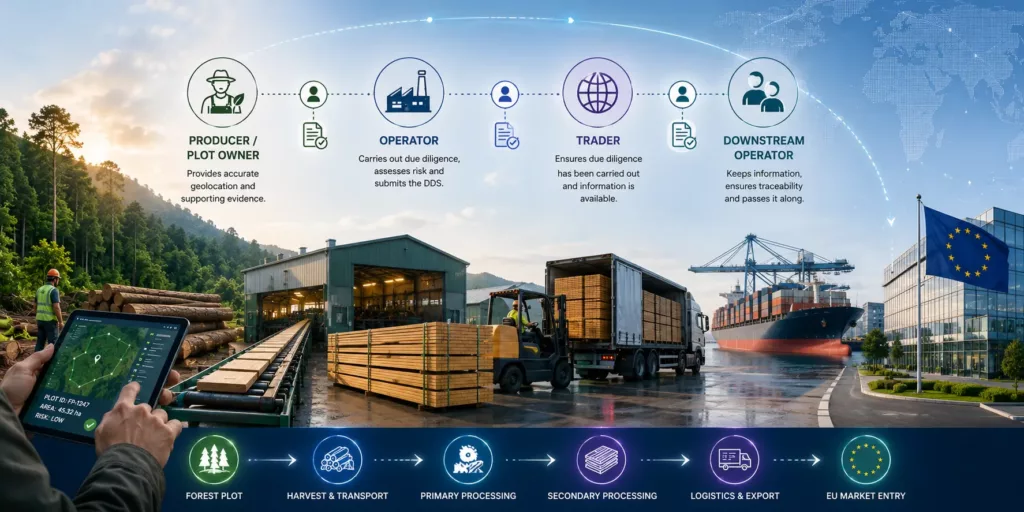
EUDR Roles and Supply Chain Responsibilities: Who Must Do What?
Published
, 12 minute read
Share this article
Quick summary: Understand EUDR roles and responsibilities for operators, traders, importers, exporters, SMEs, smallholders and authorised representatives across supply chains.
Understanding EUDR Roles and Supply chain responsibilities and who is responsible for due diligence, risk assessment, and compliance across the supply chain is essential for businesses placing relevant products on the EU market or exporting them. From operators and traders to importers, exporters, manufacturers, and smallholders, each role has specific obligations under the EU Deforestation Regulation (EUDR).
Under the EU Deforestation Regulation (EUDR), responsibilities depend on the role a business plays in the supply chain, the product concerned, its size and whether it is placing a relevant product on the EU market, making it available, or exporting it. Operators have core due diligence responsibilities; traders have obligations that differ by their status and the applicable provisions. Importers, exporters, manufacturers, downstream businesses and non-EU companies must identify their legal role rather than assume that another party’s checks automatically cover them. Contracts and authorised representatives can support a process, but they do not remove legal duties that the Regulation places on the responsible business.
Key Takeaways
EUDR duties depend on the product, legal role, transaction and applicable provisions—not simply on where a company is based.
Operators and traders can have different responsibilities; SME and non-SME status may affect the applicable requirements.
Why EUDR Roles and Supply Chain Responsibilities Matter
EUDR compliance is a supply-chain responsibility, not just a document collection exercise. A product may pass through a producer, aggregator, processor, manufacturer, importer, distributor and exporter before it reaches the market. Each business needs to understand whether it is an operator, trader or another downstream actor under the applicable rules, what information it must hold, and what actions it must take before the relevant product is placed on or made available on the EU market or exported.
Misclassifying a business can create gaps in due diligence, DDS references, recordkeeping and hand-offs between companies. Cross-border manufacturing makes this especially important: the location of a factory alone does not determine every party’s responsibilities. The relevant product, transaction, role and applicable EUDR provisions must be assessed together.
The Main EUDR Roles at a Glance
Operators
An operator is generally the natural or legal person who, in the course of a commercial activity, places a relevant product on the EU market or exports it, as defined by the Regulation. Operators subject to the full due diligence regime must exercise due diligence, collect the information required by Article 9, assess risk under Article 10 and mitigate more-than-negligible risk under Article 11 before the relevant activity. They must also submit the required Due Diligence Statement (DDS), where applicable, and maintain the supporting records.
A trader is generally a person in the supply chain other than the operator who makes relevant products available on the market in the course of a commercial activity. Trader obligations depend on their status and the applicable EUDR provisions. Businesses should not assume that every trader has identical duties or that a trader’s recordkeeping obligations are interchangeable with an operator’s due diligence responsibilities.
Businesses that process, transform or use relevant commodities in a product may have different obligations depending on whether the resulting product is listed in Annex I and whether the business qualifies as an operator or downstream operator under the rules in force. A product’s classification and the transaction being undertaken matter; the label ‘manufacturer’ alone does not settle the legal role.
Company size can affect which procedures or simplified provisions apply, but it should not be treated as a blanket exemption from EUDR. Micro and small primary operators (MSPOs) may be eligible for specific simplified provisions when the legal conditions are met. Businesses should confirm the current definition, establishment criteria, commodity scope and applicable requirements before relying on these provisions. Smallholders may need practical support to provide plot geolocation and production information, while downstream companies need reliable systems to receive and retain information relevant to their role.
Who Is an Economic Operator Under EUDR?
Under Article 2 of the EUDR, an operator is generally a natural or legal person who, in the course of a commercial activity, places relevant products on the EU market or exports them. The exact role depends on the product and transaction.
Economic operators must identify their obligations under the Regulation. Depending on their role and the applicable provisions, these may include collecting supplier and geolocation information, conducting due diligence, assessing deforestation and legality risks, implementing mitigation measures, and submitting a DDS where required.
Businesses should not assume that a supplier, manufacturer, or authorised representative automatically takes over their legal responsibilities.
Article 4 establishes core responsibilities for operators. In general, operators must exercise due diligence in accordance with Article 8 before placing relevant products on the market or exporting them, and they must not place or export products unless the required due diligence has been exercised and the risk of non-compliance is absent or negligible. Operators are responsible for the due diligence system and for ensuring that the required process is carried out.
In practical terms, this means establishing a repeatable workflow for supplier information, plot geolocation, deforestation and legality checks, risk assessment, mitigation, DDS submission and recordkeeping. The precise steps depend on the product, source and applicable legal provisions. A supplier’s assurance, certificate or declaration may support the file but should not be treated as an automatic replacement for the operator’s own required due diligence.
EUDR Article 5: Trader Obligations
Article 5 addresses obligations for traders and, under the applicable provisions, differentiates between SME and non-SME traders. Relevant duties can include collecting and retaining prescribed information about suppliers and business customers and making information available to competent authorities when required. Non-SME traders may face obligations aligned more closely with those of operators under the current legal framework, so businesses should confirm their classification and the latest rules before relying on a simplified process.
For procurement and compliance teams, the practical priority is to maintain traceable records that connect products, suppliers, customers and relevant DDS or reference information where required. Businesses should map what they receive from upstream partners, what they must verify or retain, and what they must pass to downstream partners.
Cross-border manufacturing can involve a non-EU producer, an intermediary, an EU importer, a contract manufacturer and a distributor. Responsibilities should be mapped against the actual flow of relevant products and the legal role of each party. A factory outside the EU is not automatically the only responsible party, and an importer should not assume that a supplier’s internal process removes the importer’s own duties.
Before shipments move, agree on who provides plot-level geolocation, production and legality evidence; who checks and reconciles product and quantity data; who submits a DDS when required; how DDS references are communicated; and who retains supporting records. Contracts can allocate operational tasks and service levels, but they cannot override legal obligations imposed by the Regulation.
Authorised Representatives: Mandates, Responsibilities and Limits
An operator may appoint an authorised representative in accordance with the Regulation to submit a DDS on its behalf where the legal conditions are met. The mandate should clearly define the authorised activity and be retained as part of the compliance records. The representative’s role is not a general transfer of the operator’s due diligence responsibility: the operator remains responsible for compliance with its obligations. Confirm the current legal wording and conditions before relying on a representative arrangement.
Importers should establish whether the goods are relevant products under Annex I, identify the operator for the transaction and ensure the required information and due diligence steps are completed before the applicable market-placement activity. Exporters must assess their role under the Regulation when exporting relevant products from the EU and complete the applicable due diligence and DDS steps where required.
A non-EU company can be involved in producing or supplying goods intended for the EU market. Its contractual obligations may include providing accurate geolocation, production, traceability and legality information, but the legal operator under EUDR must be identified under the Regulation’s definitions and transaction rules. Do not determine responsibility solely by the supplier’s country of establishment.
SMEs, Non-SME Traders and Smallholders
SMEs and smallholders may face practical challenges with mapping plots, gathering legal documents and maintaining digital records. Support can include clear supplier instructions, local-language onboarding, geolocation assistance, standardised evidence requests and early validation to avoid repeated corrections. Any simplified process must be checked against the current law and the business’s actual role.
Non-SME traders should pay particular attention to the provisions that apply to their category, including the records and checks required under the current framework. Company size alone is not enough to determine obligations; legal role, product scope and transaction context also matter.
Micro and Small Primary Operators (MSPOs)
Micro and small primary operators are a specific category under the EUDR framework and should not be confused with every SME or every smallholder. The applicable simplified provisions depend on the current legal text and the operator meeting the relevant criteria. Businesses sourcing from MSPOs should verify the status and information provided, understand which obligations remain applicable, and ensure the relevant records and traceability information are maintained. Do not assume that MSPO status automatically removes every EUDR requirement or resolves risk concerns.
Smallholder Risk Mitigation
Smallholder risk mitigation works best when buyers identify data gaps early and help suppliers correct them. Practical measures include plot mapping support, validation of coordinates or polygons, clear evidence checklists, document verification and traceability controls that prevent material from unknown sources being mixed into a compliant flow. Where risk remains unresolved, the responsible business must follow the applicable EUDR requirements rather than treating capacity constraints as automatic grounds to accept the risk.
Competent Authorities: What Businesses Should Expect
Competent authorities designated by EU Member States oversee EUDR implementation and can carry out checks, request information and examine whether businesses meet their obligations. Businesses should be able to retrieve due diligence records, explain their role and decisions, and show how relevant products are linked to supporting evidence and DDS information. A clear, consistent audit trail reduces the time needed to respond to information requests.
How to Build a Clear Responsibility Matrix
Identify each relevant product and confirm whether it falls within Annex I.
Map each party in the transaction and determine its legal role under EUDR.
Assign owners for geolocation, supplier data, legality evidence, risk assessment and mitigation.
Confirm who submits the DDS where required and how references are shared.
Define recordkeeping, document access and response procedures for competent-authority requests.
Reassess the process when products, suppliers, roles or applicable rules change.
How TraceX Helps Coordinate EUDR Supply-Chain Responsibilities
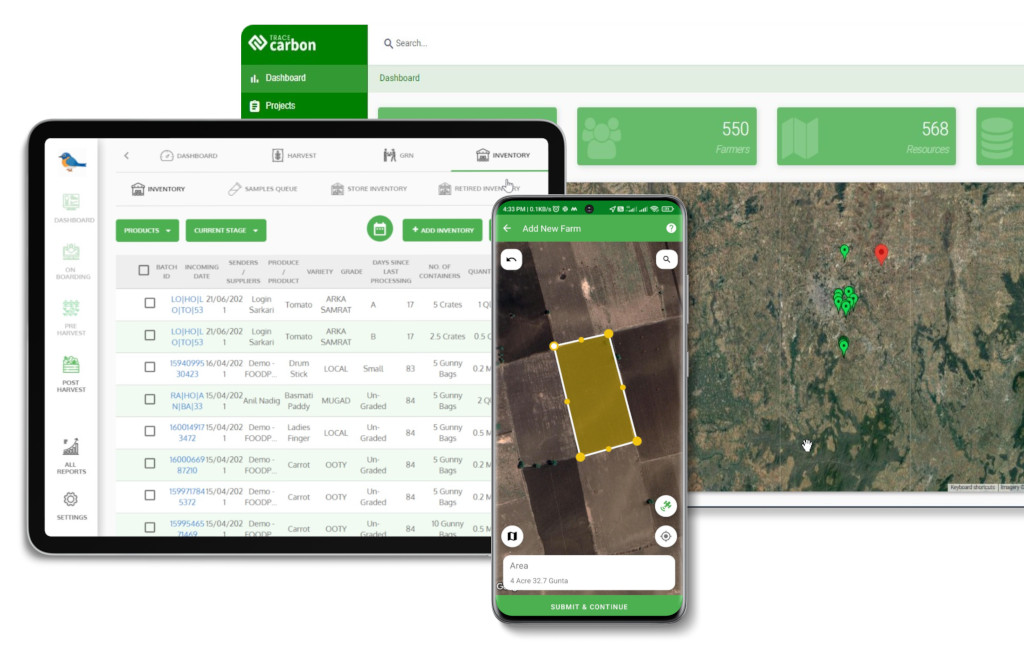
TraceX supports supplier onboarding, plot-level data management, traceability, risk assessment and due diligence workflows. A connected process can help teams collect evidence consistently, identify missing data, link information to suppliers and products, and keep records accessible for review. This is particularly useful when responsibilities span suppliers, processors, importers and customers across borders.
Technology does not replace legal interpretation or the obligations of the responsible business. It helps operational teams coordinate the information and actions needed to make those responsibilities visible and manageable.
Bring supplier onboarding, plot-level geolocation, risk assessment, traceability and compliance records into a connected workflow.
Book a TraceX demo to explore how your team can close data gaps, coordinate cross-border responsibilities and prepare for EUDR due diligence reviews.
Frequently Asked Questions
Who is responsible for EUDR compliance?
Responsibility depends on the legal role of each party and the relevant product and transaction. Operators have core due diligence duties; traders have obligations under the applicable provisions. Businesses should identify their role rather than assume another party’s checks cover them.
Does an authorised representative take over EUDR responsibility?
No, authorized representative does not take over the responsibility. A representative may perform the authorised task under a valid mandate, but the operator remains responsible for its obligations under the Regulation.
Do non-EU companies have EUDR responsibilities?
Non-EU suppliers may need to provide accurate data and supporting evidence under commercial arrangements. The legal operator and duties must be determined under the Regulation’s definitions and transaction rules.
Are SMEs and smallholders exempt from EUDR?
SMEs and smallholders are not exempt from EUDR. Do not assume a blanket exemption. Applicable requirements depend on the current legal framework, the party’s role and the relevant product. Check current official guidance for any simplified provisions.
What are MSPOs under EUDR?
MSPO refers here to micro and small primary operators. Their applicable requirements depend on the current legal text and whether they meet the relevant criteria. Do not treat the term as interchangeable with all SMEs or smallholders.
What should companies do first?
The companies should map products and supply-chain parties, confirm legal roles, establish data and evidence responsibilities, validate plot information, and define how due diligence records and DDS references are shared.
Start using TraceX
Transparency, Trust, & Success for your Climate Journey.
We use cookies on our website to give you the most relevant experience by remembering your preferences and repeat visits. By clicking “Accept All”, you consent to the use of ALL the cookies. However, you may visit "Cookie Settings" to provide a controlled consent.
This website uses cookies to improve your experience while you navigate through the website. Out of these, the cookies that are categorized as necessary are stored on your browser as they are essential for the working of basic functionalities of the website. We also use third-party cookies that help us analyze and understand how you use this website. These cookies will be stored in your browser only with your consent. You also have the option to opt-out of these cookies. But opting out of some of these cookies may affect your browsing experience.
Necessary cookies are absolutely essential for the website to function properly. These cookies ensure basic functionalities and security features of the website, anonymously.
Cookie
Duration
Description
cookielawinfo-checkbox-analytics
11 months
This cookie is set by GDPR Cookie Consent plugin. The cookie is used to store the user consent for the cookies in the category "Analytics".
cookielawinfo-checkbox-functional
11 months
The cookie is set by GDPR cookie consent to record the user consent for the cookies in the category "Functional".
cookielawinfo-checkbox-necessary
11 months
This cookie is set by GDPR Cookie Consent plugin. The cookies is used to store the user consent for the cookies in the category "Necessary".
cookielawinfo-checkbox-others
11 months
This cookie is set by GDPR Cookie Consent plugin. The cookie is used to store the user consent for the cookies in the category "Other.
cookielawinfo-checkbox-performance
11 months
This cookie is set by GDPR Cookie Consent plugin. The cookie is used to store the user consent for the cookies in the category "Performance".
viewed_cookie_policy
11 months
The cookie is set by the GDPR Cookie Consent plugin and is used to store whether or not user has consented to the use of cookies. It does not store any personal data.
Functional cookies help to perform certain functionalities like sharing the content of the website on social media platforms, collect feedbacks, and other third-party features.
Performance cookies are used to understand and analyze the key performance indexes of the website which helps in delivering a better user experience for the visitors.
Analytical cookies are used to understand how visitors interact with the website. These cookies help provide information on metrics the number of visitors, bounce rate, traffic source, etc.
Advertisement cookies are used to provide visitors with relevant ads and marketing campaigns. These cookies track visitors across websites and collect information to provide customized ads.
Download the 2026 Traceability Scorecard and Benchmark Your Supply Chain Across 10 Critical Capabilities.
Download our eBook
Don’t Wait for an Audit to Find Your EUDR Gaps
The 2026 Simplification Package changes how HS codes, DDS pass-through and geolocation rules apply to you. Get the free guide and 20-point readiness checklist before enforcement catches you unprepared.