Cross-Border DPP Compliance: The Operational Risk Most Exporters Underestimate
Published
, 15 minute read
Share this article
Quick summary: Cross-Border DPP Compliance is the operational risk most exporters underestimate. Learn how regulatory misalignment, supplier data gaps, and weak traceability can disrupt market access and how to build a scalable compliance strategy.
Global exporters are racing to prepare for Digital Product Passport mandates but few fully grasp the operational shockwave these regulations will trigger across international supply chains. Cross-Border DPP Compliance is not just about uploading product data into a new EU system; it requires aligning multiple jurisdictions, harmonizing fragmented supplier data, and orchestrating verification across diverse regulatory environments.
Today, regulatory misalignment, inconsistent data standards, and multi-tier supplier networks are creating hidden exposure where a single data gap in one country can disrupt market access across an entire region. Many organizations assume DPP readiness is a documentation exercise. In reality, it is a cross-border compliance transformation that demands structured data governance, interoperable systems, and coordinated multi-actor validation.
For global exporters, the real risk is not failing to adopt the Digital Product Passport it is underestimating the complexity of making Cross-Border Digital Product Passport Compliance work at scale. TraceX DPP solutions enable this transformation by centralizing product data, digitizing multi-tier supplier inputs, and automating audit-ready, cross-border compliance workflows ensuring seamless Digital Product Passport readiness at scale.
Key Takeaways
Cross-border Digital Product Passport compliance requires exporters to align product lifecycle data, supplier traceability, and ESG disclosures with evolving EU Digital Product Passport mandates.
Many exporters underestimate the operational risk fragmented supplier data, regulatory misalignment, and manual workflows can lead to shipment delays, market access restrictions, penalties, and reputational damage.
To stay compliant, companies must build five core capabilities: end-to-end traceability, centralized data architecture, regulatory monitoring, supplier verification, and audit-ready reporting.
A structured strategy starting with a DPP gap assessment and supported by digital traceability infrastructure transforms compliance from a reactive burden into a scalable competitive advantage.
What is Cross-border Digital Product Passport compliance?
Cross-border Digital Product Passport compliance refers to ensuring that products exported into regulated markets meet Digital Product Passport data, traceability, and transparency requirements across multiple jurisdictions.
Cross-Border DPP Compliance refers to the ability of companies to create, validate, and maintain Digital Product Passport (DPP) data that satisfies regulatory requirements across multiple jurisdictions particularly when exporting into regulated markets such as the European Union. It goes beyond basic product documentation and requires structured, interoperable, and verifiable lifecycle data that can withstand regulatory scrutiny across borders.
For global manufacturers and exporters, this means aligning internal systems, suppliers, and compliance workflows to meet the Digital Product Passport standards imposed by importing markets without disrupting operations.
Understanding Digital Product Passport (DPP) Requirements Across Jurisdictions
Overview of the Digital Product Passport Concept
A Digital Product Passport (DPP)is a structured, machine-readable digital record that contains detailed information about a product’s composition, environmental footprint, origin, and lifecycle attributes.
It is designed to:
Increase transparency across value chains
Enable circular economy practices
Support regulatory enforcement
Improve consumer access to sustainability data
Facilitate repair, reuse, and recycling
Unlike traditional compliance documentation, DPP data must be persistent, interoperable, and accessible to multiple stakeholders including regulators, supply chain actors, and in some cases, consumers.
How Digital Product Passport Impacts Non-EU Exporters Selling into Regulated Markets
Cross-Border Digital Product Passport Compliance is particularly critical for non-EU exporters.
If a company manufactures products outside the EU but sells into EU-regulated markets:
It must comply with EU DPP data requirements.
Importers may refuse non-compliant products.
Missing or inconsistent DPP data can delay customs clearance.
Distributors may require verifiable Digital Product Passport documentation before onboarding products.
In practice, this means global exporters must align their internal data systems with EU regulatory standards even if those standards do not apply domestically.
DPP becomes a market access condition, not a regional regulatory preference.
Key Data Fields Required Under Digital Product Passport Frameworks
Although specific data requirements vary by product category, DPP frameworks commonly require structured data in areas such as:
1. Material Composition
Raw materials used
Recycled content percentages
Hazardous substances (if applicable)
2. Carbon Footprint & Environmental Impact
Product-level carbon footprint
Energy use during production
Environmental impact indicators
3. Lifecycle Information
Manufacturing origin
Supply chain traceability
Use-phase data (where relevant)
End-of-life guidance
4. Repairability & Circularity
Disassembly instructions
Spare parts availability
Repair manuals
Durability metrics
Recycling instructions
These data fields must be standardized, machine-readable, and verifiable, making Digital Product Passport compliance not just a reporting exercise, but a digital data governance transformation.
Why Cross-Border Alignment Matters
Different jurisdictions may:
Interpret sustainability requirements differently
Enforce documentation at varying levels of strictness
Require interoperability between systems
Without a harmonized internal data architecture, companies risk:
Data duplication
Inconsistent declarations across markets
Audit exposure
Reputational risk
Cross-Border Digital Product Passport Compliance is therefore about building a unified compliance orchestration system that can adapt to multiple regulatory environments while maintaining operational efficiency and market access.
Why Exporters Are Underestimating the Risk
Many global exporters assume Digital Product Passport readiness is simply an extension of existing compliance documentation. In reality, Cross-Border DPP Compliance exposes deep structural weaknesses in global supply chains. What appears manageable at the product level often unravels when data must be standardized, validated, and shared across jurisdictions, suppliers, and regulatory systems.
The real risk is not regulatory awareness it is operational misalignment.
The Hidden Operational Gaps in Global Supply Chains
Disconnected Supplier Data
Most exporters rely on multi-tier supplier networks across multiple countries. However:
Supplier data often exists in siloed systems
Formats vary across regions and partners
Critical fields, such as material composition or carbon data, are incomplete
Upstream traceability is limited to transactional records
When Digital Product Passport requires structured, machine-readable lifecycle data, these silos become compliance bottlenecks.
Inconsistent ESG Reporting Standards
Suppliers may follow different ESG frameworks depending on geography:
Some report under voluntary sustainability standards
Others provide minimal environmental disclosures
Metrics may not align with EU DPP environmental calculation methodologies
This inconsistency makes harmonized product-level sustainability declarations difficult. Without standardized ESG inputs, DPP submissions risk inaccuracy or regulatory rejection.
Manual Compliance Workflows
Many exporters still rely on:
Email-based document exchange
Spreadsheet consolidation
Manual validation processes
Static PDF declarations
DPP frameworks require dynamic, structured, interoperable data—not static documentation. Manual workflows increase the risk of errors, delays, and non-compliant submissions.
Poor Lifecycle Traceability
Traditional supply chains focus on:
Purchase orders
Shipment tracking
Commercial documentation
DPP requires:
Full material breakdown
Production process data
Repairability attributes
End-of-life guidance
If lifecycle traceability is not embedded from design through distribution, exporters cannot reliably generate complete Digital Product Passports.
Regulatory Mismatch Between Exporting and Importing Countries
One of the most underestimated risks in Cross-Border DPP Compliance is regulatory asymmetry.
EU DPP vs. Local Compliance Frameworks
Exporting countries may have:
Minimal sustainability reporting requirements
Different environmental disclosure standards
No digital passport infrastructure
Meanwhile, the EU may require:
Standardized lifecycle datasets
Machine-readable digital identifiers
Interoperable compliance architecture
Exporters must bridge this regulatory gap internally even if domestic laws do not demand it.
Data Residency Laws
Some countries restrict:
Cross-border data transfers
Storage of sensitive business information
Cloud hosting outside national boundaries
This creates tension when DPP data must be shared across EU systems, certification bodies, or market surveillance authorities.
Exporters must design compliance architectures that respect local data protection rules while meeting EU transparency requirements.
Language & Documentation Requirements
DPP-related documentation may need to:
Be accessible in specific EU languages
Follow standardized terminology
Align with technical documentation templates
Translation inconsistencies or non-standardized descriptions can introduce compliance ambiguity.
What Happens If You Fail Cross-Border DPP Requirements?
Failure to meet Cross-Border DPP Compliance obligations is not a minor administrative issue it can trigger direct commercial, operational, and reputational consequences across multiple markets.
Shipment Delays at Customs
If Digital Product Passport data is incomplete, inconsistent, or unverifiable, customs authorities may delay product clearance. Missing lifecycle data, carbon footprint documentation, or material declarations can halt shipments until corrections are made disrupting supply chain timelines and increasing logistics costs.
Market Access Restrictions
Products that do not meet DPP requirements may be prohibited from being placed on regulated markets such as the EU. Importers and distributors may refuse non-compliant goods, effectively blocking entry into high-value regions. For exporters, DPP compliance becomes a condition of sale not an optional enhancement.
Product Recalls
If incorrect or misleading DPP data is identified after market placement, authorities may require corrective action, including product withdrawal or recall. This is particularly critical where environmental claims, hazardous material disclosures, or repairability statements are inaccurate.
Financial Penalties
Regulatory authorities may impose administrative fines for non-compliance, false declarations, or failure to provide required digital documentation. Beyond direct penalties, companies may incur additional costs from shipment storage, legal advisory, re-labelling, or system remediation.
Brand and ESG Reputation Damage
In an environment where sustainability transparency is increasingly scrutinized, failure to comply with DPP requirements can undermine brand credibility. Buyers, investors, and consumers expect verifiable ESG claims. Non-compliance signals weak governance, exposing companies to reputational damage and long-term trust erosion.
The 5 Operational Pillars of Cross-Border DPP Readiness
Achieving Cross-Border DPP Compliance requires more than regulatory awareness it demands structured operational transformation. Companies that succeed build their readiness around five core pillars that connect data, supply chains, and compliance governance into a unified system.
1. End-to-End Supply Chain Traceability
Digital Product Passports rely on verified lifecycle data. Without end-to-end traceability from raw material sourcing to manufacturing, distribution, and end-of-life, DPP records cannot be trusted or validated.
This pillar requires:
Mapping multi-tier suppliers across geographies
Preserving material identity through aggregation and transformation
Linking product components to origin and processing stages
Traceability becomes the structural backbone that feeds accurate DPP data.
2. Centralized Digital Product Passport Data Architecture
DPP data must be structured, machine-readable, and interoperable. Fragmented spreadsheets and siloed systems cannot support cross-jurisdiction compliance.
A centralized architecture enables:
Standardized product-level data models
Controlled data governance and version management
Automated data validation workflows
ERP, PLM, and supplier system integrations
Secure role-based access controls
Without centralized data orchestration, exporters face inconsistencies, duplication, and audit risk.
3. Multi-Jurisdiction Regulatory Monitoring
Cross-border compliance means navigating evolving regulatory expectations across importing markets.
Companies must:
Track EU Ecodesign and DPP delegated acts
Monitor country-specific enforcement practices
Align sustainability metrics with regional methodologies
Prepare for category-specific rollout timelines
Regulatory misalignment is a major risk continuous monitoring ensures systems evolve alongside new requirements.
4. Supplier Data Verification Framework
Suppliers are the primary source of DPP data and the greatest point of failure.
A robust verification framework includes:
Standardized supplier onboarding protocols
Structured digital questionnaires aligned with DPP fields
Validation of material composition and ESG claims
Cross-checking carbon footprint methodologies
Risk scoring based on geography and product category
Verification ensures that upstream declarations can withstand downstream regulatory scrutiny.
5. Audit-Ready Documentation & Reporting
Regulators and market surveillance authorities require proof not assumptions.
Audit readiness requires:
Immutable data logs and change histories
Traceable documentation linked to product identifiers
Exportable compliance reports
Consistent lifecycle documentation across jurisdictions
Rapid retrieval capabilities during inspections
Companies that build documentation workflows into daily operations avoid last-minute compliance crises.
Which industries are most impacted by DPP compliance?
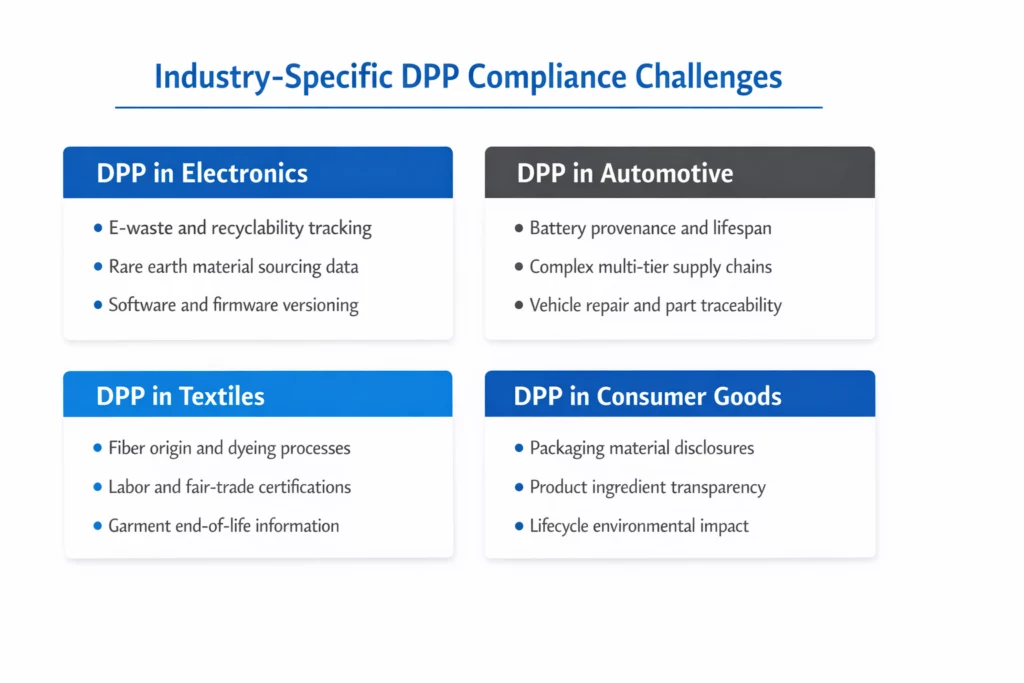
Industries with complex global supply chains, such as electronics, automotive, textiles, and consumer goods, face the highest compliance risk due to material traceability and lifecycle reporting requirements.
How to Build a Cross-Border Digital Product Passport Compliance Strategy
Building a scalable Cross-Border Digital Product Passport Compliance strategy requires structured planning, digital infrastructure, and regulatory alignment. Organizations that treat DPP as a transformation initiative not a documentation exercise, will be better positioned to maintain seamless market access.
Step 1: Conduct a Digital Product Passport Gap Assessment
Start by identifying the gap between your current product data environment and DPP requirements in target markets.
This includes:
Reviewing existing material composition data
Assessing lifecycle and carbon footprint documentation
Evaluating supplier traceability depth
Identifying missing repairability or circularity metrics
Mapping regulatory obligations by product category and geography
A structured gap assessment clarifies where data is incomplete, inconsistent, or non-machine-readable and prevents last-minute compliance disruption.
Step 2: Map Tier-2 and Tier-3 Suppliers
DPP requirements extend beyond direct suppliers. Material origin, sustainability claims, and environmental impact data often originate upstream.
Companies must:
Identify Tier-2 and Tier-3 suppliers contributing materials
Map component-level traceability
Validate ESG disclosures across tiers
Establish standardized supplier data submission protocols
Segment suppliers by regulatory and geographic risk
Without upstream visibility, DPP declarations remain vulnerable to audit exposure.
Step 3: Implement Digital Traceability Infrastructure
Cross-border DPP compliance requires interoperable, machine-readable data systems.
This involves:
Centralized product data architecture
Unique digital product identifiers (e.g., QR, serial-based IDs)
ERP and PLM integration
Automated data validation workflows
Secure, role-based access controls
Version management and update tracking
Digital traceability ensures lifecycle data flows seamlessly from supplier to regulator across jurisdictions.
Step 4: Align with ESG & Sustainability Reporting
DPP data overlaps significantly with ESG disclosures. Aligning reporting frameworks reduces duplication and inconsistency.
Companies should:
Harmonize carbon footprint methodologies
Align lifecycle assessments with regulatory formats
Standardize sustainability metrics across markets
Integrate DPP datasets with ESG reporting tools
Ensure consistency between public sustainability claims and passport data
This prevents regulatory contradictions and protects brand credibility.
Step 5: Prepare for Audit & Certification
Audit readiness must be embedded into operational workflows not treated as a periodic activity.
Organizations should:
Maintain immutable audit trails
Archive historical product versions
Enable rapid data retrieval
Prepare export-ready compliance reports
Conduct internal mock audits across jurisdictions
Being audit-ready ensures smoother inspections, faster customs clearance, and reduced regulatory risk.
How TraceX Supports Cross-Border DPP Compliance
TraceX Digital Product Passport solutions provide end-to-end digital infrastructure to centralize product data, verify supplier inputs, and automate lifecycle traceability across global supply chains.
With structured data governance, multi-tier supplier onboarding, and audit-ready reporting workflows, TraceX enables organizations to operationalize Cross-Border DPP Compliance with confidence and scale.
Schedule a Cross-Border DPP Compliance Consultation
Cross-Border DPP Compliance: The Operational Risk Most Exporters Underestimate
Cross-Border DPP Compliance is no longer a future regulatory concern it is an operational reality that will define market access in regulated economies. Exporters who underestimate the complexity of aligning supplier data, lifecycle traceability, ESG disclosures, and jurisdiction-specific requirements risk shipment delays, compliance failures, and reputational damage. Digital Product Passports demand structured, interoperable, and verifiable data that travels seamlessly across borders. The organizations that treat DPP as supply-chain infrastructure not a reporting obligation will protect global market access, strengthen buyer confidence, and turn regulatory complexity into strategic advantage.
Discover how to ensure seamless data exchange between suppliers, ERPs, regulators, and digital passport platforms.
Digital Product Passport (DPP) compliance becomes mandatory based on product category rollout timelines under the EU Ecodesign for Sustainable Products Regulation (ESPR). Implementation begins sector by sector, with priority categories like batteries, textiles, and electronics expected to phase in from 2026 onward.
Does DPP apply to non-EU manufacturers?
Yes. DPP applies to non-EU manufacturers if they place products on the EU market. Exporters must meet EU Digital Product Passport requirements through their importers or authorized representatives to ensure lawful market access and avoid shipment delays or restrictions.
What data must be included in a Digital Product Passport?
A Digital Product Passport typically includes material composition, carbon footprint data, lifecycle information, repairability metrics, recycled content, manufacturing origin, and end-of-life guidance. Data must be structured, machine-readable, and aligned with product-specific regulatory requirements under applicable EU delegated acts.
How can exporters automate DPP compliance?
Exporters can automate DPP compliance by implementing centralized data platforms, integrating ERP and supplier systems, digitizing lifecycle traceability, standardizing ESG reporting inputs, and using automated validation workflows to ensure consistent, machine-readable, audit-ready Digital Product Passport data across markets.
What systems are required to support DPP reporting?
DPP reporting requires centralized product data management systems, supplier onboarding tools, traceability infrastructure, ERP and PLM integration, carbon calculation engines, document management systems, and secure access controls to ensure accurate, version-controlled, and interoperable compliance data.
Start using TraceX
Transparency, Trust, & Success for your Climate Journey.
We use cookies on our website to give you the most relevant experience by remembering your preferences and repeat visits. By clicking “Accept All”, you consent to the use of ALL the cookies. However, you may visit "Cookie Settings" to provide a controlled consent.
This website uses cookies to improve your experience while you navigate through the website. Out of these, the cookies that are categorized as necessary are stored on your browser as they are essential for the working of basic functionalities of the website. We also use third-party cookies that help us analyze and understand how you use this website. These cookies will be stored in your browser only with your consent. You also have the option to opt-out of these cookies. But opting out of some of these cookies may affect your browsing experience.
Necessary cookies are absolutely essential for the website to function properly. These cookies ensure basic functionalities and security features of the website, anonymously.
Cookie
Duration
Description
cookielawinfo-checkbox-analytics
11 months
This cookie is set by GDPR Cookie Consent plugin. The cookie is used to store the user consent for the cookies in the category "Analytics".
cookielawinfo-checkbox-functional
11 months
The cookie is set by GDPR cookie consent to record the user consent for the cookies in the category "Functional".
cookielawinfo-checkbox-necessary
11 months
This cookie is set by GDPR Cookie Consent plugin. The cookies is used to store the user consent for the cookies in the category "Necessary".
cookielawinfo-checkbox-others
11 months
This cookie is set by GDPR Cookie Consent plugin. The cookie is used to store the user consent for the cookies in the category "Other.
cookielawinfo-checkbox-performance
11 months
This cookie is set by GDPR Cookie Consent plugin. The cookie is used to store the user consent for the cookies in the category "Performance".
viewed_cookie_policy
11 months
The cookie is set by the GDPR Cookie Consent plugin and is used to store whether or not user has consented to the use of cookies. It does not store any personal data.
Functional cookies help to perform certain functionalities like sharing the content of the website on social media platforms, collect feedbacks, and other third-party features.
Performance cookies are used to understand and analyze the key performance indexes of the website which helps in delivering a better user experience for the visitors.
Analytical cookies are used to understand how visitors interact with the website. These cookies help provide information on metrics the number of visitors, bounce rate, traffic source, etc.
Advertisement cookies are used to provide visitors with relevant ads and marketing campaigns. These cookies track visitors across websites and collect information to provide customized ads.
Download the 2026 Traceability Scorecard and Benchmark Your Supply Chain Across 10 Critical Capabilities.
Download our eBook
Don’t Wait for an Audit to Find Your EUDR Gaps
The 2026 Simplification Package changes how HS codes, DDS pass-through and geolocation rules apply to you. Get the free guide and 20-point readiness checklist before enforcement catches you unprepared.