EUDR for Importers: Requirements, Responsibilities and Compliance Checklist
Published
, 8 minute read
Share this article
Quick summary: Learn EUDR requirements for importers, operator responsibilities, geolocation and DDS workflows, customs references, common gaps, and compliance software.
EUDR for importers means ensuring that relevant commodities and products entering the EU meet the EU Deforestation Regulation’s requirements. An EU business that first places an in-scope product on the EU market is generally an upstream operator and must complete the applicable due diligence and submit a Due Diligence Statement (DDS), unless a specific simplified route applies. Importers need to confirm product scope, collect supplier and plot-level information, assess deforestation and legality risks, mitigate any more-than-negligible risk, and keep the declaration and shipment records connected. Customs clearance alone does not establish EUDR compliance.
Key Takeaways: EUDR for Importers
Verify product scope: Check whether your products fall under EUDR Annex I and confirm the applicable CN codes.
Understand your legal role: Determine whether your business is an upstream operator, downstream operator, or customs declarant, as responsibilities differ.
Collect reliable supplier data: Obtain the required supplier details, country of production, and plot-level geolocation information.
Conduct risk-based due diligence: Assess deforestation and legality risks, and implement mitigation measures if the identified risk is more than negligible.
Manage DDS references accurately: Ensure declaration references are correctly linked to the relevant products, invoices, quantities, and shipments.
Maintain accessible records: Keep due diligence evidence and supporting documentation in line with applicable EUDR retention requirements.
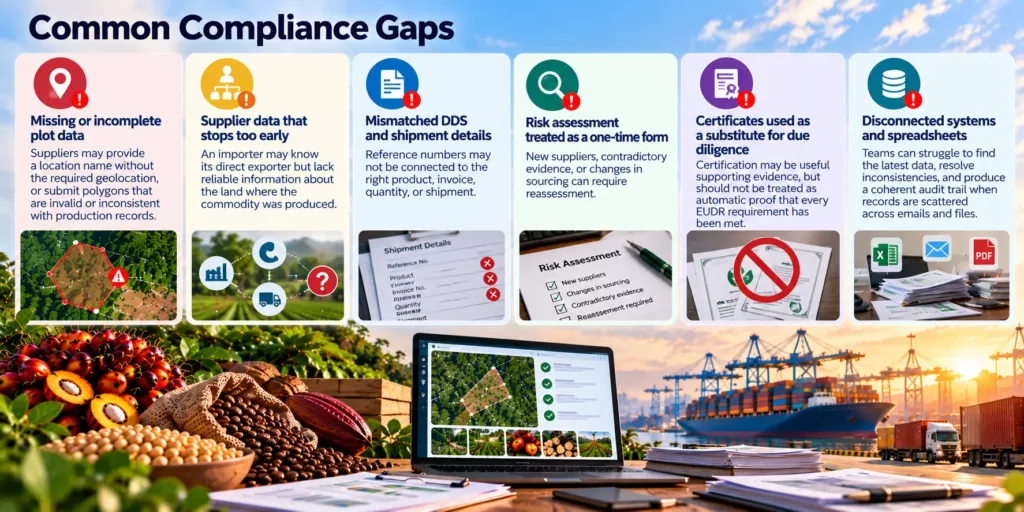
Address data gaps early: Missing geolocation, inconsistent supplier information, and mismatched references can create compliance risks and delays.
Use digital traceability to improve readiness: Centralised supplier data, risk assessments, and shipment-level records can reduce manual work and improve audit readiness.
Download our eBook to assess your EUDR readiness, uncover data gaps, and take proactive steps towards stronger compliance.
The EU Deforestation Regulation (Regulation (EU) 2023/1115) covers cattle, cocoa, coffee, oil palm, rubber, soya and wood, along with products listed in Annex I. Importers should check the exact product description and Combined Nomenclature (CN) code: not every product made from a listed commodity is automatically in scope.
Relevant products must be deforestation-free, produced in accordance with relevant legislation in the country of production, and covered by the required due diligence process. For the deforestation-free criterion, the cut-off date is 31 December 2020. The legality criterion is separate and concerns relevant laws in the country of production.
Importers should not rely only on a supplier declaration, sustainability certificate, or customs paperwork. These may support an evidence file but do not automatically replace the information, risk assessment, and declaration steps required by the regulation. Verify the current legal text and Commission guidance before relying on an exemption or simplified route.
Who Is Legally Responsible? Importer, Operator and Customs Declarant
In many import scenarios, the EU-based business that first places an in-scope product on the EU market is the EUDR upstream operator. It is generally responsible for carrying out due diligence and submitting the DDS before placing the product on the market, subject to the applicable rules and any specific simplified declaration route.
The customs declarant is the person or business lodging the customs declaration. This role is not automatically the same as the EUDR operator. A customs broker may submit customs paperwork on behalf of a client, but that does not by itself transfer the operator’s EUDR responsibilities.
A non-EU supplier can provide the data and evidence needed by the importer, but the EU operator remains responsible for fulfilling its legal obligations. Some businesses may have more than one role across different transactions. Classify each product flow according to the activity, product, and point at which it is placed on the EU market. SMEs and micro or small primary operators may be subject to specific provisions, so confirm eligibility rather than assuming all importers follow the same process.
Read our blog on EUDR Due Diligenceto understand the key requirements, avoid common compliance gaps, and build a more transparent, audit-ready supply chain with TraceX.
Importer Compliance Workflow
A practical workflow makes it easier to catch missing data before a shipment is ready.
Step 1: Confirm product scope. Match the product to Annex I and verify its CN code and relevant commodity.
Step 2: Identify suppliers and production origin. Collect supplier details and identify the country of production. Trace the relevant commodity to the production area rather than stopping at the immediate exporter or trader.
Step 3: Collect geolocation and production information. Obtain the required plot geolocation points or polygons as applicable\ and relevant production information. Validate coordinates, polygon geometry, and links between plots and supplied quantities. Incomplete or invalid plot data can undermine the entire assessment.
Step 4: Assess deforestation and legality risks. Evaluate the information gathered, including production location, country context, supply-chain complexity, and credible evidence of deforestation or legal non-compliance. Country benchmarking can inform the process but does not remove the need to meet the applicable requirements.
Step 5: Mitigate risk. If the assessment identifies more than negligible risk, take appropriate mitigation measures and reassess. Do not treat unresolved material gaps as automatically acceptable.
Step 6: Submit the DDS. Where required, submit the due diligence statement through the EU Information System and retain the resulting reference information. Do not submit until the required information and assessment are complete.
Step 7: Link declaration and shipment records. Connect the DDS reference to purchase orders, invoices, product codes, quantities, customs data, and shipment records so the evidence can be retrieved later.
DDS and Customs Clearance: Keep References Aligned
A DDS and a customs declaration serve different purposes. The DDS records the EUDR due diligence process for a relevant product; customs declarations support the import procedure. Teams should coordinate these workflows so the EUDR reference or identifier required for the transaction is available and correctly associated with the relevant goods.
Build a matching process across the product description, CN code, quantity, supplier, invoice, shipment, and DDS reference. Where a shipment contains several products or declaration references, define how each line item is mapped. If a reference is missing, invalid, or linked to the wrong goods, escalate it before assuming the shipment is compliant.
The customs broker, procurement team, logistics team, and EUDR compliance owner should have clearly assigned responsibilities. A successful customs submission should not be treated as proof that all substantive EUDR obligations have been met.
EUDR Importer Checklist
Before placing a relevant product on the EU market, check that you can answer yes to the following:
Have we verified that the product and its CN code fall within Annex I?
Have we confirmed which legal entity is the EUDR operator for this transaction?
Do we have the required supplier, country-of-production, and plot-level information?
Have geolocation files and plot details been validated?
Have we assessed deforestation and legality risks using reliable evidence?
Have we addressed any more-than-negligible risk before proceeding?
Has the required DDS been submitted and its reference recorded?
Does the reference match the relevant product, invoice, quantity, and shipment?
Can we retrieve the underlying evidence and decision records when requested?
Are responsibilities clear across suppliers, procurement, compliance, logistics, and customs brokers?
Revisit the checklist when suppliers, sourcing regions, products, or regulatory requirements change.
Read our blog on EUDR Compliance Challengesto understand the common roadblocks, discover practical solutions, and learn how TraceX helps businesses streamline compliance and build audit-ready, transparent supply chains.
EUDR Software for Importers: From Manual Tracking to Connected Compliance
Spreadsheets can help organise a limited number of suppliers, but they become harder to maintain when importers manage many products, origins, plot files, DDS references, and shipments. Manual processes also make it difficult to spot missing evidence early or show how a risk decision was reached.
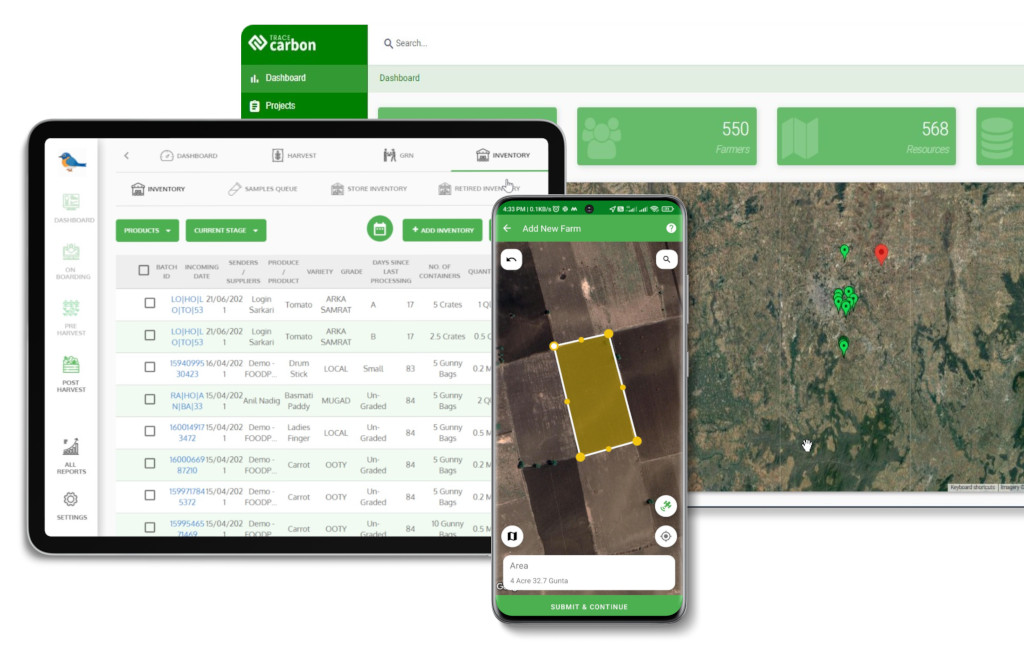
A connected EUDR platform can centralise supplier onboarding, plot geolocation, validation, risk assessment evidence, declaration references, and shipment-level records. Useful capabilities include role-based access, alerts for missing data, traceable review steps, exportable evidence, and integrations with procurement or ERP workflows.
TraceX supports supply-chain teams with supplier data management, geolocation workflows, traceability, risk assessment, and compliance evidence management. The aim is to reduce fragmented manual work and improve visibility not to replace the operator’s responsibility to ensure the required information is accurate and the due diligence process is complete.
EUDR readiness depends on more than obtaining a declaration reference. Importers need reliable supplier data, valid plot geolocation, documented risk decisions, and a consistent way to connect due diligence evidence to products and shipments.
TraceX helps businesses bring supplier onboarding, traceability, risk assessment, and compliance evidence into a connected workflow.
See how your team can improve data visibility, reduce manual follow-ups, and prepare a more audit-ready EUDR process.
No,not every business described commercially as an importer has the same legal role. If the business is the upstream operator placing an in-scope product on the EU market, a DDS is generally required unless a specific provision or simplified route applies. Confirm the role and product scope first.
Can a non-EU supplier submit the DDS for the importer?
A supplier can provide data and may assist with processes, but the EU operator remains responsible for its applicable obligations. An authorised representative may be able to submit on the operator’s behalf where permitted; this does not automatically transfer the operator’s legal responsibility.
Does customs clearance mean the product is EUDR-compliant?
No, customs clearance does not mean the product is EUDR compliant. Customs and EUDR processes are distinct, even when their data and references must be coordinated.
Are sustainability certificates sufficient?
Not on their own. They may support the evidence file but do not automatically replace required geolocation, risk assessment, mitigation, and declaration steps.
What records should importers keep?
The importers should keep the information, assessment evidence, DDS references, supplier and product records, and other documentation required for the operator’s role under the current legal framework. Verify applicable retention rules in the current consolidated regulation.
Start using TraceX
Transparency, Trust, & Success for your Climate Journey.
We use cookies on our website to give you the most relevant experience by remembering your preferences and repeat visits. By clicking “Accept All”, you consent to the use of ALL the cookies. However, you may visit "Cookie Settings" to provide a controlled consent.
This website uses cookies to improve your experience while you navigate through the website. Out of these, the cookies that are categorized as necessary are stored on your browser as they are essential for the working of basic functionalities of the website. We also use third-party cookies that help us analyze and understand how you use this website. These cookies will be stored in your browser only with your consent. You also have the option to opt-out of these cookies. But opting out of some of these cookies may affect your browsing experience.
Necessary cookies are absolutely essential for the website to function properly. These cookies ensure basic functionalities and security features of the website, anonymously.
Cookie
Duration
Description
cookielawinfo-checkbox-analytics
11 months
This cookie is set by GDPR Cookie Consent plugin. The cookie is used to store the user consent for the cookies in the category "Analytics".
cookielawinfo-checkbox-functional
11 months
The cookie is set by GDPR cookie consent to record the user consent for the cookies in the category "Functional".
cookielawinfo-checkbox-necessary
11 months
This cookie is set by GDPR Cookie Consent plugin. The cookies is used to store the user consent for the cookies in the category "Necessary".
cookielawinfo-checkbox-others
11 months
This cookie is set by GDPR Cookie Consent plugin. The cookie is used to store the user consent for the cookies in the category "Other.
cookielawinfo-checkbox-performance
11 months
This cookie is set by GDPR Cookie Consent plugin. The cookie is used to store the user consent for the cookies in the category "Performance".
viewed_cookie_policy
11 months
The cookie is set by the GDPR Cookie Consent plugin and is used to store whether or not user has consented to the use of cookies. It does not store any personal data.
Functional cookies help to perform certain functionalities like sharing the content of the website on social media platforms, collect feedbacks, and other third-party features.
Performance cookies are used to understand and analyze the key performance indexes of the website which helps in delivering a better user experience for the visitors.
Analytical cookies are used to understand how visitors interact with the website. These cookies help provide information on metrics the number of visitors, bounce rate, traffic source, etc.
Advertisement cookies are used to provide visitors with relevant ads and marketing campaigns. These cookies track visitors across websites and collect information to provide customized ads.
Download the 2026 Traceability Scorecard and Benchmark Your Supply Chain Across 10 Critical Capabilities.
Download our eBook
Don’t Wait for an Audit to Find Your EUDR Gaps
The 2026 Simplification Package changes how HS codes, DDS pass-through and geolocation rules apply to you. Get the free guide and 20-point readiness checklist before enforcement catches you unprepared.