What Buyers Expect from Traceable Botanical Supply Chains in 2026 and Beyond
Published
, 18 minute read
Share this article
Quick summary: What buyers expect from traceable botanical supply chains in 2026 and beyond—farm-level transparency, batch traceability, sustainability proof, and compliance-ready data to meet evolving global regulations and buyer standards.
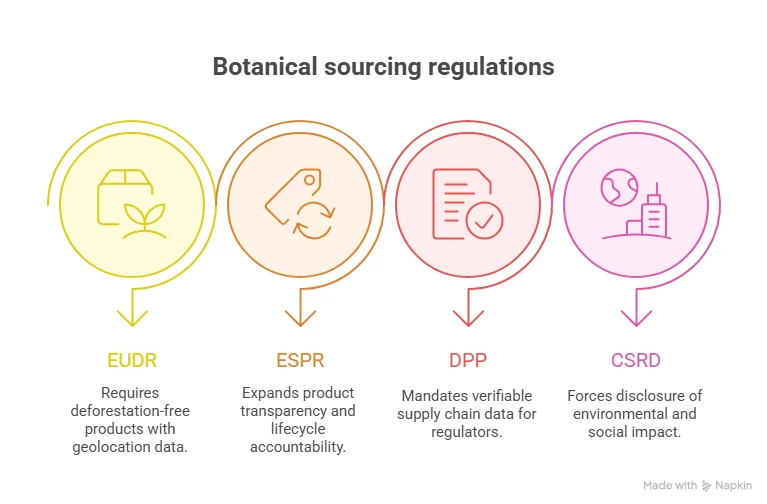
Global buyers are no longer asking if your botanical supply chain is traceable they’re asking how deep it goes. Buyers expect Botanical Supply Chains to deliver end-to-end, verifiable traceability from farm to finished product. This includes digitized farmer and plot data, batch-level chain of custody, proof of ethical and sustainable sourcing, and audit-ready compliance with regulations like EUDR, CSRD, and buyer ESG requirements. Certifications alone are no longer sufficient, buyers demand primary, real-time data on origin, practices, quality, and emissions. Botanical supply chains that lack digital traceability face higher rejection risk, slower approvals, and loss of premium market access.
Fragmented botanical sourcing spread across smallholder farms, informal aggregators, and multiple intermediaries creates blind spots in origin, practices, and handling. When sustainability claims rely on paper records or third-party declarations without data linkage, buyers struggle to verify legality, ethics, and quality. This increasingly results in shipment rejections, audit failures, delayed approvals, and reputational risk for brands.
As regulatory scrutiny and ESG expectations rise, buyers are resetting the bar. They now expect end-to-end, verifiable traceability across botanical sourcing, linking farm-level practices, batch movements, processing, and documentation into a single chain of custody. This shift moves trust from claims to data, and from certificates to continuous, auditable proof.
Key Takeaways
A botanical supply chain encompasses the full journey of plant-based ingredients from farm or wild collection through harvest, aggregation, processing, and delivery to end markets such as wellness, cosmetics, food, and pharmaceuticals.
Buyers require traceability across this chain because rising regulations, zero-tolerance sustainability standards, and brand risk demand verifiable proof of origin, ethics, and quality.
At the farm level, buyers expect digitized farmer onboarding, GPS-mapped plots, visibility into crop practices, and monitoring of labour and community impact because if it didn’t happen at the farm, it doesn’t count.
Sustainability proof now goes beyond certificates to include continuous monitoring, biodiversity protection, regenerative practices, and living-income indicators.
As botanicals move through harvest, aggregation, and processing, buyers require batch- and lot-level traceability, strong chain-of-custody controls, and recall readiness to prevent mixing and adulteration.
TraceX helps suppliers meet these expectations by digitizing farm and farmer data, enabling end-to-end botanical traceability, monitoring sustainability and certifications, and delivering compliance-ready reporting turning traceability from a burden into a buyer qualification.
Learn how leading companies are using traceability, transparency, and data-driven practices to meet buyer expectations, reduce risk, and future-proof their supply chains.
A Botanical Supply Chain is a specialized logistics network dedicated to the sourcing, processing, and distribution of plant-derived materials such as herbs, spices, essential oils, and medicinal plant extracts.
While a standard agricultural supply chain (like wheat or corn) focuses on volume and calories, a botanical supply chain is obsessed with phytochemistry (the chemical profile of the plant) and provenance (where and how it was grown).
The “Seed to Shelf” Journey
The journey of a botanical is far more delicate than that of industrial commodities. Because active compounds (like caffeine in coffee or curcumin in turmeric) can degrade quickly, the chain is highly time sensitive.
Sourcing (Cultivation vs. Wild Harvesting): Unlike soy or palm oil, many botanicals are “wild-crafted” collected from their natural habitats rather than farms.
Post-Harvest Handling: Immediate drying or cooling is required to “lock in” the active metabolites.
Processing & Extraction: The raw plant biomass is converted into powders, oils, or tinctures using solvents like water or ethanol.1
Standardization: This is the most critical step. Scientists test the extract to ensure it contains exactly X% of a specific active ingredient every single time.
Quality & Compliance: Testing for “adulterants” (cheaper plants mixed in) and contaminants like heavy metals or pesticides.2
Why Botanical Supply Chains are Unique
The “Nature Factor” makes these chains significantly more complex than typical industrial ones:
Chemical Variability: A lavender plant grown in high-altitude Provence has a different chemical signature than one grown in a greenhouse. The supply chain must account for these “terroir” effects.
The Adulteration Risk: Because high-quality botanicals (like Saffron or Rhodiola) are expensive, there is a high risk of fraud. Supply chains now use DNA Barcoding to verify species.
Smallholder Dominance: As we discussed with Coffee and Cocoa, most botanicals are grown by millions of small farmers rather than a few massive plantations. This creates the massive Traceability Gap we looked at earlier.
Botanical vs. Industrial Supply Chains
Feature
Industrial (e.g., Steel, Plastic)
Botanical (e.g., Ginseng, Vanilla)
Raw Material
Consistent, man-made or mined
Highly variable, biological
Key Metric
Durability, Weight
Purity, Active Compound %
Risk Factors
Machine failure, Shipping
Weather, Pests, Overharvesting
Traceability
Batch numbers
Plot-level Geolocation (EUDR)
Life Span
Years
Months (degrades quickly)
The global botanical supply chains, encompassing ingredients like herbs, spices, extracts, and supplements for food, beverages, cosmetics, and wellness, are valued at USD 121-130 billion in 2025, projected to reach USD 167-294 billion by 2030-2035 at CAGRs of 6.6-7.7%, driven by clean-label demand and Asia-Pacific growth (7.6% CAGR).
Herbs & spices dominate with 44% market share, while dried plants hold 70% of forms; trade in medicinal/aromatic plants surged 133% in value from $117M (2010) to $274M (2023), with the US (6% CAGR), EU markets (France 5.6%, UK 5.1%), and botanical supplements alone hitting $60B in 2025 (10.2% CAGR to $119B by 2032).
Why do buyers require Traceability in botanical supply chains?
Traceability has moved from a “nice-to-have” to a commercial, legal, and reputational necessity for buyers of botanical ingredients. Across wellness, cosmetics, pharmaceuticals, and food, buyers are now expected to prove not just promise where botanicals come from, how they were produced, and whether they meet environmental and ethical standards. Several converging forces are driving this shift.
1. Escalating Regulatory Pressure Is Forcing Proof, Not Promises
Governments particularly in the EU are replacing voluntary sustainability commitments with legally enforceable traceability requirements.
For botanical buyers, this means:
Supplier declarations are no longer sufficient
Incomplete or unverifiable sourcing data can result in blocked market access, fines, or product withdrawal
Traceability is now a regulatory prerequisite, not a sustainability initiative
2. Zero-Tolerance for Deforestation, Exploitation, and Adulteration
Botanical supply chains often originate in high-risk regions, involving:
Smallholder farmers
Wild-harvested materials
Multi-layered trader networks
Without traceability, buyers face serious risks:
Environmental risks:
Illegal deforestation or harvesting from protected ecosystems
Biodiversity loss linked to over-collection
Social and ethical risks:
Child labor or forced labor in upstream sourcing
Exploitative pricing of indigenous or rural communities
Quality and safety risks:
Adulteration or substitution of plant species
Contamination, misidentification, or dilution of active compounds
Modern buyers operate under zero-tolerance expectations. Traceability enables:
Verification of species authenticity
Confirmation of ethical botanical sourcing practices
Detection of non-compliance before products reach market
3. Brand and Reputational Risk Has Become Too High to Ignore
In sectors like wellness, cosmetics, pharma, and food, trust is a core brand asset.
A single traceability failure can lead to:
Consumer backlash and loss of credibility
Regulatory investigations or recalls
Investor and partner scrutiny
Long-term erosion of brand equity
Consumers increasingly ask:
Where was this botanical grown or harvested?
Was it sourced ethically and sustainably?
Can the brand prove its claims?
Traceability protects brands by allowing them to:
Substantiate sustainability and ethical claims
Respond quickly to audits or media inquiries
Demonstrate leadership in responsible sourcing
4. Buyers Are Shifting From Declarations to Data-Backed Proof
Historically, botanical sourcing relied on:
Supplier self-attestations
Paper certificates
Trust-based relationships
This model no longer holds up under modern scrutiny.
Today’s buyers require:
Farm-level or harvest-site traceability
Digital records and verifiable documentation
Chain-of-custody transparency across all intermediaries
Real-time or near-real-time access to sourcing data
Traceability systems now serve as:
Risk management tools
Compliance infrastructure
Competitive differentiators
Companies that cannot provide data-backed proof are increasingly removed from preferred supplier lists.
5. Traceability Is Now a Commercial Requirement, Not Just Compliance
Beyond risk mitigation, traceability enables:
Faster onboarding with global buyers
Access to premium markets and certifications
Improved supply chain resilience and forecasting
Stronger relationships with ethically aligned brands
In practice, botanical buyers are using traceability to:
Simplify audits and regulatory reporting
Reduce supply disruptions
Align sourcing with ESG and sustainability goals
For botanical buyers, traceability is no longer optional because it underpins:
Regulatory compliance
Ethical botanical sourcing
Brand protection
Market access
Consumer trust
In an era of tightening regulations and heightened transparency expectations, botanical supply chain compliance depends on verifiable traceability from origin to finished product. Buyers who fail to adapt risk being excluded from global markets while those who invest in robust traceability gain long-term resilience and competitive advantage.
Explore how verifiable sourcing and responsible practices can strengthen your brand, protect communities, and meet global ethical standards.
What are the Buyer Expectations at the Farm Level
If it didn’t happen at the farm, it doesn’t count
Farm-level traceability has become the foundation of credibility in botanical supply chains. Buyers no longer accept aggregated, downstream assurances they expect verifiable, digitized proof starting at the point of origin. This shift reflects regulatory mandates, brand risk exposure, and a growing insistence on measurable sustainability.
Digitized Farmer Onboarding and KYC
Modern buyers expect every participating farmer or collector to be digitally onboarded, not informally listed.
Input records (fertilizers, pesticides, soil amendments)
Harvest timing, methods, and yields
Post-harvest handling at the farm level
Why buyers care:
Ensures quality, potency, and consistency
Reduces contamination and adulteration risk
Supports clean-label, organic, and sustainability claims
Farm-level data allows buyers to move from assumptions to evidence-based sourcing decisions.
Read the full case study to see how TraceX’s digital crop management improved planning and yields for smallholder farmers
Monitoring Labor Standards and Community Impact
Ethical sourcing expectations now extend directly to the farm and community level.
Buyers expect visibility into:
Labor practices and wage compliance
Child and forced labor risk mitigation
Health, safety, and working conditions
Community benefits and fair-trade practices
This is especially critical for:
Botanicals sourced from developing regions
Wild-harvested or seasonal labor systems
Brands operating under ESG and human rights frameworks
Farm-level social data helps buyers demonstrate responsible sourcing, not just environmental compliance.
From Aggregation to Origin-Level Proof
Historically, sustainability data was:
Aggregated at cooperative or exporter level
Self-reported and rarely verified
Disconnected from individual farms
Today’s buyers demand:
Origin-level traceability tied to each lot or batch
Digital records that travel with the product
Evidence that can withstand audits and scrutiny
Farm-level traceability is no longer a premium feature it is the baseline expectation for sustainable botanical sourcing.
What sustainability proof do buyers expect for botanicals?
Buyers of botanical ingredients now expect verifiable, continuous, and outcome-based proof that sourcing is ethical and sustainable. High-level commitments, certificates alone, or once-a-year audits are no longer sufficient. Instead, buyers require living evidence that environmental protection, social responsibility, and economic fairness are embedded throughout the supply chain starting at the source.
Alignment With Recognized Sustainability Certifications
Certifications remain important, but buyers increasingly treat them as entry points, not end points.
Reduced chemical dependency and improved ecosystem resilience
Accepted forms of proof include:
GPS-based land-use and habitat data
Species inventories or monitoring records
Practice-level data tied to individual farms or harvest zones
For botanicals often sourced from biodiversity hotspots buyers expect sourcing to protect and restore nature, not degrade it.
Living Income and Livelihood Indicators
Ethical sourcing now includes economic viability for producers, not just environmental safeguards.
Buyers expect visibility into:
Farm-gate pricing and payment transparency
Progress toward living income benchmarks
Income diversification and resilience indicators
Community investment and benefit-sharing outcomes
Why this matters:
Chronic underpayment drives unethical practices
Fair livelihoods reduce deforestation and labor exploitation
Regulators and investors increasingly scrutinize social impact
Buyers are moving from fair-trade claims to measurable livelihood outcomes, backed by data.
From Claims to Verifiable, Linked Evidence
Sustainability claims without traceable proof are now considered high-risk.
Buyers increasingly require:
Digital records linked to specific farmers, plots, and batches
Time-stamped, auditable sustainability data
Alignment between certifications, farm practices, and reported outcomes
Documentation that can withstand regulatory and third-party scrutiny
The expectation is clear: ethical sourcing must be proven, not asserted.
For botanical buyers, sustainability verification has evolved into a continuous, data-backed system rather than a checklist exercise.
Traceability Through Harvest, Aggregation & Processing
As botanical ingredients move beyond the farm, traceability must remain intact through harvest, aggregation, and processing. This midstream phase is where risk increases most sharply materials are combined, handled by multiple actors, and transformed. Buyers therefore expect batch-level traceability and robust chain-of-custody controls to preserve integrity, quality, and compliance.
Batch-Level Traceability From Harvest to Aggregation
Buyers require each harvest to be captured as a distinct, traceable batch at the point of collection.
What this involves:
Assignment of unique batch IDs at harvest
Recording harvest date, location, farmer/collector, and quantity
Digital handover records as material moves to aggregation points
Time-stamped batch receipts and transfers
Why it matters:
Prevents loss of origin data during consolidation
Enables verification of volume consistency
Forms the backbone of regulatory and buyer audits
Without batch-level traceability, downstream claims about origin, sustainability, or quality become unverifiable.
Prevention of Mixing, Dilution, and Adulteration
Aggregation is the most common point of integrity failure in botanical supply chains.
Buyer concerns include:
Mixing compliant and non-compliant material
Dilution of high-quality botanicals with lower-grade inputs
Intentional or accidental adulteration with substitute species
To mitigate this, buyers expect:
Controlled aggregation protocols
Physical or digital segregation of batches
Clear documentation of any allowed mixing
Species verification and quality checks at intake
Batch-level controls help ensure that what was harvested is exactly what is processed, protecting both safety and efficacy.
Chain of Custody Models: Identity Preserved vs Mass Balance
Buyers increasingly specify chain-of-custody models based on risk profile and end-use.
Common models in botanical sourcing:
Identity Preserved (IP):
Material from a specific farm or group remains segregated
Full traceability from origin to final product
Preferred for premium, regulated, or high-risk botanicals
Mass Balance:
Certified and non-certified material may be mixed
Volumes are tracked to ensure certified input equals certified output
Often used where physical segregation is impractical
Traceability Through Processing and Transformation
Processing often involves drying, extraction, milling, or blending each step introduces transformation risk.
Buyers expect:
Traceable input-to-output conversion records
Documentation of yield loss or gain
Segregation of batches during processing
Recording of processing methods and locations
This ensures:
Transparency in material flow
Defensible quality and potency claims
Compliance with food, cosmetic, and pharmaceutical standards
Processing data must link back to original batches to maintain end-to-end traceability.
Lot-to-Batch Linkage for Quality and Recall Readiness
Final products are typically managed as lots, while raw materials originate as batches.
Buyers require:
Clear linkage between incoming batches and outgoing lots
Digital traceability that enables one-step-back, one-step-forward tracking
Rapid identification of affected products in case of quality issues or recalls
Recalls without precise traceability are costly and reputationally damaging
Buyers prioritize suppliers who can demonstrate recall readiness
Lot-to-batch linkage transforms traceability from a documentation exercise into a risk management system.
In today’s market, chain of custody botanicals and batch-level traceability are non-negotiable requirements, not operational extras.
How TraceX Helps Meet Buyer Expectations
As buyer requirements for botanical traceability become stricter, suppliers need digital systems that convert complex, on-ground realities into audit-ready proof. TraceX Sustainable Sourcing Platform is designed specifically to meet these expectations connecting farm-level data to finished batches while supporting sustainability, compliance, and buyer transparency.
Digitized Farm & Farmer Management
TraceX enables suppliers to move away from fragmented spreadsheets and paper records toward structured, verifiable farm-level data.
Batch and Lot-Level Botanical Traceability
TraceX maintains traceability as botanicals move through harvest, aggregation, processing, and distribution.
Sustainability and Certification Monitoring
TraceX goes beyond static certification records by enabling continuous sustainability oversight. Buyers can validate ethical and sustainable sourcing claims with real, traceable evidence not just certificates.
Explore how TraceX transformed Jayanti Group’s spice supply chain with end-to-end traceability and verified sustainability practices
TraceX converts traceability and sustainability data into buyer- and regulator-ready reports. Buyers gain faster onboarding, lower compliance risk, and confidence that suppliers can meet evolving global regulations.
See how TraceX helps botanical suppliers meet buyer traceability expectations
By transforming traceability into a strategic capability, TraceX enables suppliers to remain competitive, compliant, and trusted in global botanical markets.
Traceability Is Now a Buyer Qualification, Not a Differentiator
Traceability has crossed a critical threshold in the botanical sector: it is no longer a competitive advantage, but a basic qualification to do business. Buyers now use traceability as a gatekeeping criterion suppliers either provide verifiable, farm-to-batch proof of ethical, sustainable, and compliant sourcing, or they are excluded from consideration altogether. In a market shaped by strict regulations, zero-tolerance risk policies, and heightened brand accountability, traceability defines credibility. Suppliers who treat it as optional risk losing access to global buyers, while those who embed robust traceability into their operations secure long-term relevance, resilience, and trust.
Learn how modern practices ensure ethical sourcing, traceability, and operational resilience.
We use cookies on our website to give you the most relevant experience by remembering your preferences and repeat visits. By clicking “Accept All”, you consent to the use of ALL the cookies. However, you may visit "Cookie Settings" to provide a controlled consent.
This website uses cookies to improve your experience while you navigate through the website. Out of these, the cookies that are categorized as necessary are stored on your browser as they are essential for the working of basic functionalities of the website. We also use third-party cookies that help us analyze and understand how you use this website. These cookies will be stored in your browser only with your consent. You also have the option to opt-out of these cookies. But opting out of some of these cookies may affect your browsing experience.
Necessary cookies are absolutely essential for the website to function properly. These cookies ensure basic functionalities and security features of the website, anonymously.
Cookie
Duration
Description
cookielawinfo-checkbox-analytics
11 months
This cookie is set by GDPR Cookie Consent plugin. The cookie is used to store the user consent for the cookies in the category "Analytics".
cookielawinfo-checkbox-functional
11 months
The cookie is set by GDPR cookie consent to record the user consent for the cookies in the category "Functional".
cookielawinfo-checkbox-necessary
11 months
This cookie is set by GDPR Cookie Consent plugin. The cookies is used to store the user consent for the cookies in the category "Necessary".
cookielawinfo-checkbox-others
11 months
This cookie is set by GDPR Cookie Consent plugin. The cookie is used to store the user consent for the cookies in the category "Other.
cookielawinfo-checkbox-performance
11 months
This cookie is set by GDPR Cookie Consent plugin. The cookie is used to store the user consent for the cookies in the category "Performance".
viewed_cookie_policy
11 months
The cookie is set by the GDPR Cookie Consent plugin and is used to store whether or not user has consented to the use of cookies. It does not store any personal data.
Functional cookies help to perform certain functionalities like sharing the content of the website on social media platforms, collect feedbacks, and other third-party features.
Performance cookies are used to understand and analyze the key performance indexes of the website which helps in delivering a better user experience for the visitors.
Analytical cookies are used to understand how visitors interact with the website. These cookies help provide information on metrics the number of visitors, bounce rate, traffic source, etc.
Advertisement cookies are used to provide visitors with relevant ads and marketing campaigns. These cookies track visitors across websites and collect information to provide customized ads.
Download the 2026 Traceability Scorecard and Benchmark Your Supply Chain Across 10 Critical Capabilities.
Download our eBook
Don’t Wait for an Audit to Find Your EUDR Gaps
The 2026 Simplification Package changes how HS codes, DDS pass-through and geolocation rules apply to you. Get the free guide and 20-point readiness checklist before enforcement catches you unprepared.