EUDR Geolocation Requirements: What It Takes to Submit a DDS Without Rejections
Published
, 8 minute read
Share this article
Quick summary: Learn what geolocation data is required under EUDR, how point vs. polygon mapping affects compliance, and how tech platforms help you automate it. Avoid costly shipment rejections with this complete geolocation guide.
EUDR geolocation requirements are the single detail standing between your shipment and the EU market — and the one most compliance teams underestimate. If you import, export, or manufacture coffee, cocoa, soy, palm oil, rubber, cattle, or timber, you are now required to prove that every batch is traceable to the exact plot of land where it was grown. Not the region. Not the cooperative. The plot.
In plain language: EUDR geolocation requirements are the rule that you must submit precise GPS coordinates (a point or a polygon) for every plot of land used to produce a regulated commodity, attached to your Due Diligence Statement (DDS) in the EU’s TRACES system. Miss it, mis-format it, or reuse a coordinate from a past batch, and your goods can be held at customs.
Key takeaways
EUDR geolocation requirements mean tracing every commodity back to the exact plot of land where it was produced by coordinate, not by region or farm name.
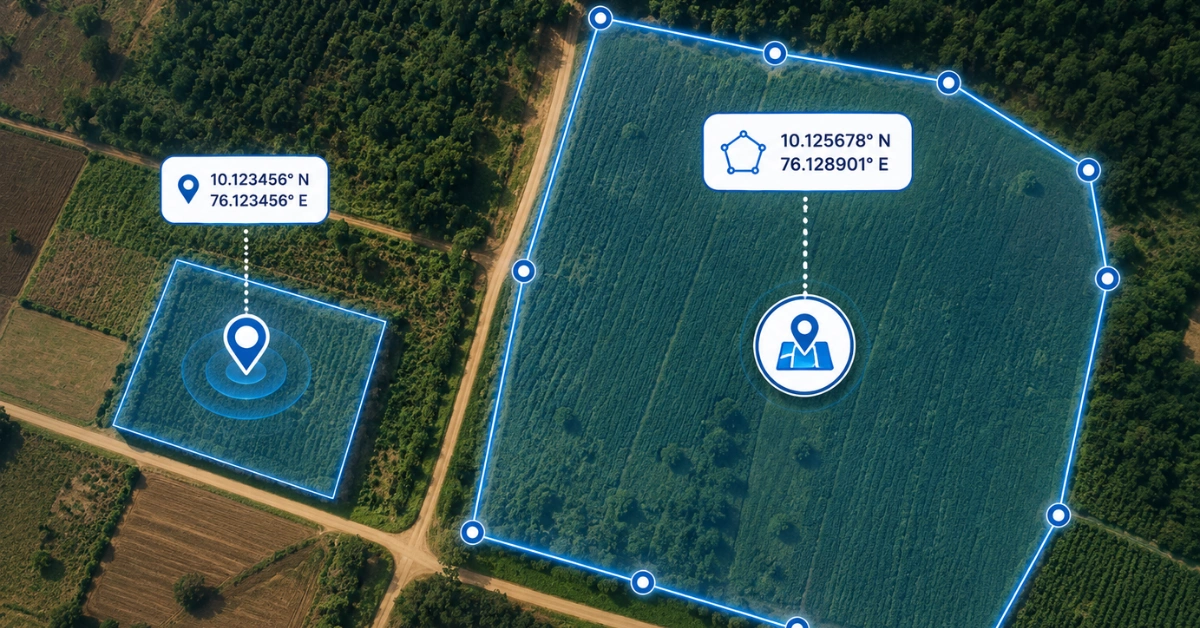
Plots of 4 hectares or less (and cattle establishments) need a single point; plots over 4 hectares need a polygon. Coordinates must carry at least six decimal places.
Bad or missing geolocation data is the #1 reason a Due Diligence Statement (DDS) is rejected and a rejected DDS legally blocks your shipment.
TraceX validates geometry with a 13-point GeoJSON check, cross-references two EU-accepted satellite datasets, and submits to TRACES NT in one click cutting prep from weeks to minutes.
Geolocation isn’t “just another field” on the form. It’s the foundation your entire compliance claim stands on.
Get My Free EUDR Compliance Assessment
No obligation. Assessment delivered by our EUDR specialists
EUDR geolocation requirements, explained in plain language
EUDR geolocation requirements define exactly what location data you must collect and how precise it has to be before a DDS can be filed. The standard is unusually strict because regulators cross-check your coordinates against satellite deforestation data.
Here is what “compliant” means at the data level:
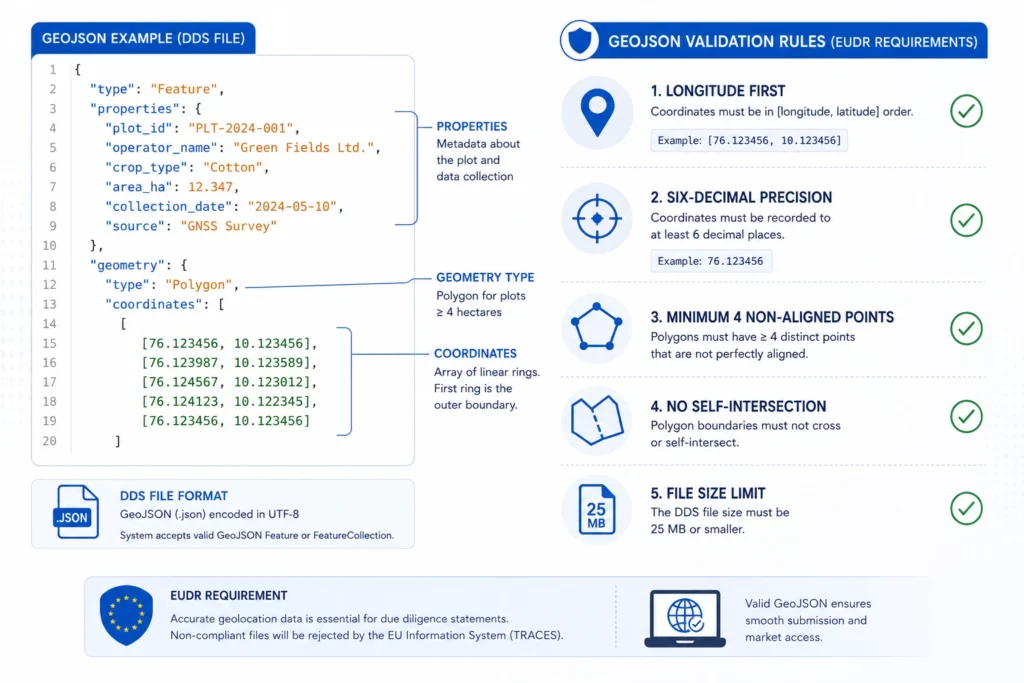
Precision: coordinates in decimal degrees, accurate to at least six decimal places (roughly 0.1 m resolution).
Order: in GeoJSON, longitude comes first, then latitude. Latitude sits between -90 and +90; longitude between -180 and +180.
Polygons: at least four non-aligned points, no self-intersections, one polygon per plot — contiguous or not.
Cut-off date: the plot must be deforestation-free after 31 December 2020, regardless of local legality.
A single faulty polygon or a reused coordinate can derail an entire shipment, trigger an audit, or block EU market access.
How do I collect plot level geolocation data for EUDR Compliance?
The format you owe depends entirely on plot size. Get this wrong and the geometry validation fails before a deforestation check even runs.
Plot type
Required format
What to capture
≤ 4 hectares, or cattle establishment
Single point (one lat / one long)
One central coordinate, 6+ decimals
> 4 hectares (non-cattle commodities)
Polygon (≥ 4 non-aligned points)
Full plot perimeter, no self-intersections
Note: a central point with a circumference is not an accepted substitute for a polygon on plots over four hectares.
Who is responsible for EUDR geolocation data and why it’s you
This is where buyers get caught out. Under EUDR geolocation requirements, the operator usually the EU-based importer or first placer on the market is fully responsible for the accuracy of the geolocation, even when a producer or smallholder supplied it.
You can use a producer’s coordinates but the liability for accuracy is yours, not theirs.
If the producer doesn’t sell directly into the EU, they aren’t bound by the regulation. You are.
You must verify the geolocation matches the actual plot, which may mean capacity-building and validation support for smallholders.
See how TraceX validates supplier-supplied coordinates for you
GeoJSON and DDS rules behind EUDR geolocation requirements
Once coordinates are captured, EUDR geolocation requirements dictate how they’re packaged for the TRACES system. The European Commission specifies GeoJSON for encoding the geographic data a “geometry” describing the shape, plus “properties” holding non-spatial attributes.
The hard limits you cannot break
File size: each DDS is capped at 25 MB roughly 30,000–40,000 points or polygons per file.
Format overhead: GeoJSON is not memory-efficient and can be about double the size of a Shapefile or Geopackage for the same data.
Geometry integrity: polygons need ≥ 4 non-aligned points with no intersecting sides; points need 6+ decimal precision.
Coordinates can originate in different reference systems (UTM, WGS84, Lambert) and file formats (CSV, KML, Shapefile, GeoJSON), managed in tools like QGIS, ArcGIS, or Google Earth but they must arrive in TRACES as clean, valid GeoJSON.
Struggling with GeoJSON errors in your EUDR workflow?
Why EUDR geolocation data fails and what each failure costs
Most rejections trace back to geolocation, not paperwork. If your supply chain runs through smallholders or aggregation points, the gaps are structural not careless.
Aggregation destroys origin data. When a collector buys from 200 farmers in one market day, plot coordinates are often never captured. Around 85% of cocoa and 65% of coffee reaching the EU comes from smallholder farms under two hectares (European Commission EUDR guidance, 2023).
Commingling makes verification binary. A lot that is 98% deforestation-free but 2% unverified is non-compliant the whole shipment is suspect.
Connectivity blocks capture. With smallholders producing 80%+ of global cocoa and only ~29% internet access in Sub-Saharan Africa, online-only tools simply never collect the data.
Records must survive five years. Every DDS and supporting dataset must be audit-ready until the EU’s first consolidated review by 30 June 2030.
A rejected DDS doesn’t just mean a fine. It means lost EU market access, broken brand trust, and a stalled supply chain.
Are GeoJSON errors slowing down your EUDR compliance process?
How TraceX meets EUDR geolocation requirements end to end
TraceX EUDR Solutions was built to close exactly these gaps turning fragmented field data into a TRACES-ready DDS without the manual scramble. Here’s how each capability maps to the requirement it solves.
Offline-first plot capture for smallholders
Field agents capture accurate point and polygon coordinates, photograph land records, and register farmer profiles in zero-connectivity areas data syncs automatically when a signal returns. This is the only scalable way to meet EUDR geolocation requirements across India, Africa, and Southeast Asia.
13-point GeoJSON geometry validation
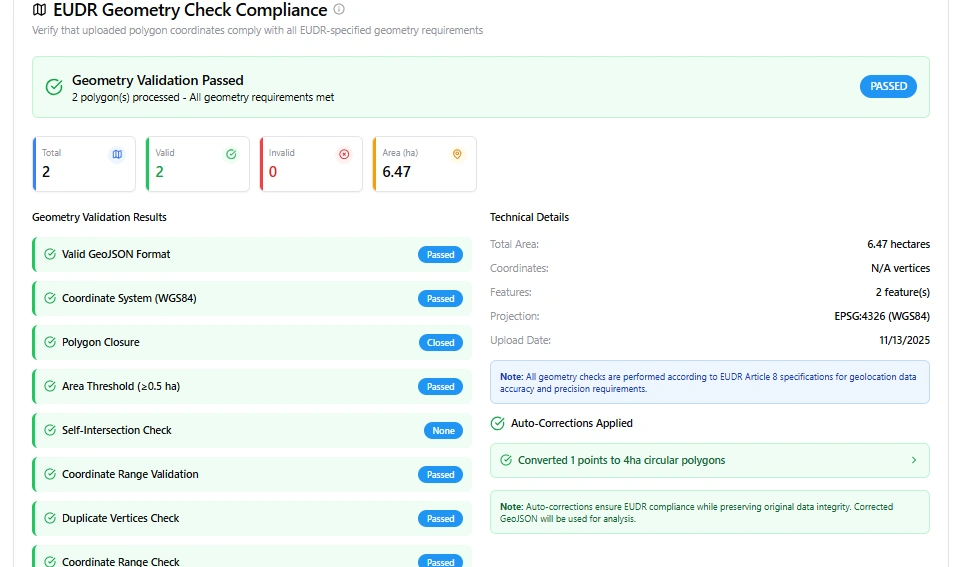
Before any deforestation check runs, TraceX validates the integrity and structure of your GeoJSON through a 13-point geometry assessment confirming polygon boundaries are clean, closed, and EUDR-ready, so you catch the errors that cause DDS rejections upstream.
Satellite deforestation cross-check
Once geometry is confirmed valid, TraceX runs a deforestation risk analysis against two trusted, EU-accepted satellite datasets, verifying plots against the 31 December 2020 cut-off.
Batch linkage through aggregation
TraceX captures farm-gate transaction data at the first point of purchase which farmer, what quantity, from which geolocation, on what date creating a digital aggregation ledger that preserves plot-level traceability even as physical commodities commingle.
One-click DDS submission to TRACES NT
With an API-ready integration to TRACES NT, verified supply-chain data goes from validated to submitted in minutes instead of the days-to-weeks manual DDS preparation takes, an up-to-80% reduction in compliance prep time.
“I’m a compliance lead at an EU cocoa importer sourcing from 3,000 smallholders in West Africa with no formal land titles. I need plot-level polygons, deforestation-free proof against the 2020 cut-off, and a valid DDS reference before cargo reaches Rotterdam.” — TraceX captures the plots offline through cooperatives, validates the GeoJSON, cross-checks satellite data, and files the DDS to TRACES NT.
EUDR geolocation requirements: comparing your options
Teams typically meet EUDR geolocation requirements one of three ways. Here’s how the approaches stack up on the capabilities that actually prevent DDS rejections.
Capability for EUDR geolocation requirements
Spreadsheets / manual GIS
Single-point GPS tool
TraceX EUDR Platform
Offline plot capture (no signal)
No
Sometimes
Yes
Polygon + point in one workflow
Manual
Point only
Yes
GeoJSON geometry validation before submission
No
No
13-point check
Satellite deforestation cross-check (post-2020)
No
No
Yes
Batch-to-plot linkage after aggregation
No
No
Yes
One-click DDS to TRACES NT
No
No
Yes
5-year audit-ready record retention
Fragile
Partial
Yes
Ready to submit your EUDR Due Diligence Statement (DDS)?
Do low-risk countries still require plot coordinates?
Yes. Regardless of a country’s risk level, all operators must provide geolocation point or polygon for the origin of every commodity.
Can I submit the DDS first and add geolocation later?
No. Plot-level geolocation must be collected and validated before the Due Diligence Statement is submitted.
What if smallholders have no land title or formal ID?
Geolocation of the plot is still required, but the regulation doesn’t demand personal land-registry data only the coordinates of the plot supplying the commodity, provided the farmer can legally sell under local law.
Point or polygon — how do I decide?
Plots of 4 hectares or less (and cattle establishments) use a single point. Plots over 4 hectares require a polygon outlining the perimeter.
How precise must the coordinates be?
At least six decimal places, in decimal degrees, with longitude listed before latitude in GeoJSON.
How do I collect coordinates in areas with no signal?
Use offline-capable mobile capture tools that store GPS points and land records locally and sync once connectivity returns.
Start using TraceX
Transparency, Trust, & Success for your Climate Journey.
We use cookies on our website to give you the most relevant experience by remembering your preferences and repeat visits. By clicking “Accept All”, you consent to the use of ALL the cookies. However, you may visit "Cookie Settings" to provide a controlled consent.
This website uses cookies to improve your experience while you navigate through the website. Out of these, the cookies that are categorized as necessary are stored on your browser as they are essential for the working of basic functionalities of the website. We also use third-party cookies that help us analyze and understand how you use this website. These cookies will be stored in your browser only with your consent. You also have the option to opt-out of these cookies. But opting out of some of these cookies may affect your browsing experience.
Necessary cookies are absolutely essential for the website to function properly. These cookies ensure basic functionalities and security features of the website, anonymously.
Cookie
Duration
Description
cookielawinfo-checkbox-analytics
11 months
This cookie is set by GDPR Cookie Consent plugin. The cookie is used to store the user consent for the cookies in the category "Analytics".
cookielawinfo-checkbox-functional
11 months
The cookie is set by GDPR cookie consent to record the user consent for the cookies in the category "Functional".
cookielawinfo-checkbox-necessary
11 months
This cookie is set by GDPR Cookie Consent plugin. The cookies is used to store the user consent for the cookies in the category "Necessary".
cookielawinfo-checkbox-others
11 months
This cookie is set by GDPR Cookie Consent plugin. The cookie is used to store the user consent for the cookies in the category "Other.
cookielawinfo-checkbox-performance
11 months
This cookie is set by GDPR Cookie Consent plugin. The cookie is used to store the user consent for the cookies in the category "Performance".
viewed_cookie_policy
11 months
The cookie is set by the GDPR Cookie Consent plugin and is used to store whether or not user has consented to the use of cookies. It does not store any personal data.
Functional cookies help to perform certain functionalities like sharing the content of the website on social media platforms, collect feedbacks, and other third-party features.
Performance cookies are used to understand and analyze the key performance indexes of the website which helps in delivering a better user experience for the visitors.
Analytical cookies are used to understand how visitors interact with the website. These cookies help provide information on metrics the number of visitors, bounce rate, traffic source, etc.
Advertisement cookies are used to provide visitors with relevant ads and marketing campaigns. These cookies track visitors across websites and collect information to provide customized ads.
Download the 2026 Traceability Scorecard and Benchmark Your Supply Chain Across 10 Critical Capabilities.
Download our eBook
Don’t Wait for an Audit to Find Your EUDR Gaps
The 2026 Simplification Package changes how HS codes, DDS pass-through and geolocation rules apply to you. Get the free guide and 20-point readiness checklist before enforcement catches you unprepared.