PFAS in Food Packaging: What the 2026 EU Ban Means for Your Business
Published
, 10 minute read
Share this article
Quick summary: Learn what the 2026 EU PFAS restrictions mean for food packaging manufacturers, FMCG brands, retailers, and packaging suppliers. Explore compliance risks, safer material alternatives, sustainable packaging strategies, and how businesses can prepare for evolving chemical and packaging regulations.
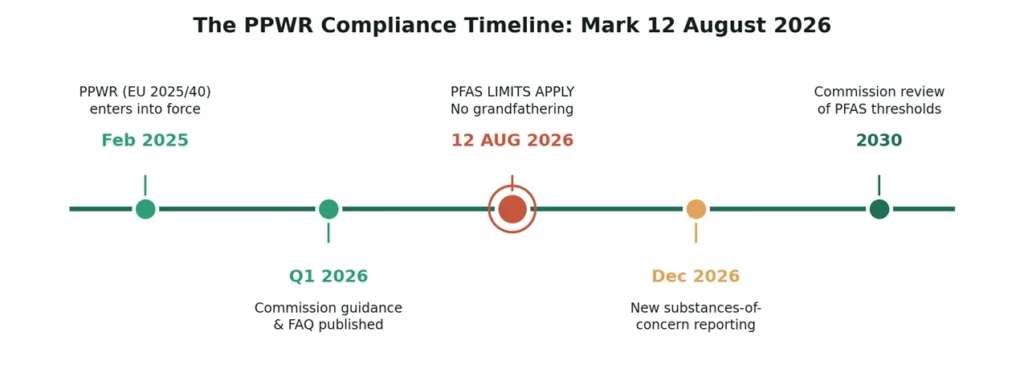
What is the 2026 EU ban on PFAS in food packaging? It is a binding restriction under the EU’s Packaging and Packaging Waste Regulation (PPWR, Regulation (EU) 2025/40) that prohibits per- and polyfluoroalkyl substances (PFAS) in food-contact packaging above strict concentration limits. It takes effect on 12 August 2026 and applies uniformly across all 27 EU member states, including to imported packaging. Unlike most chemical restrictions, it contains no sell-through period: any non-compliant packaging placed on the EU market after that date is illegal, regardless of when it was manufactured. For any business that sells food packaging or packaged food into Europe, 12 August 2026 is a hard line between market access and market exclusion.
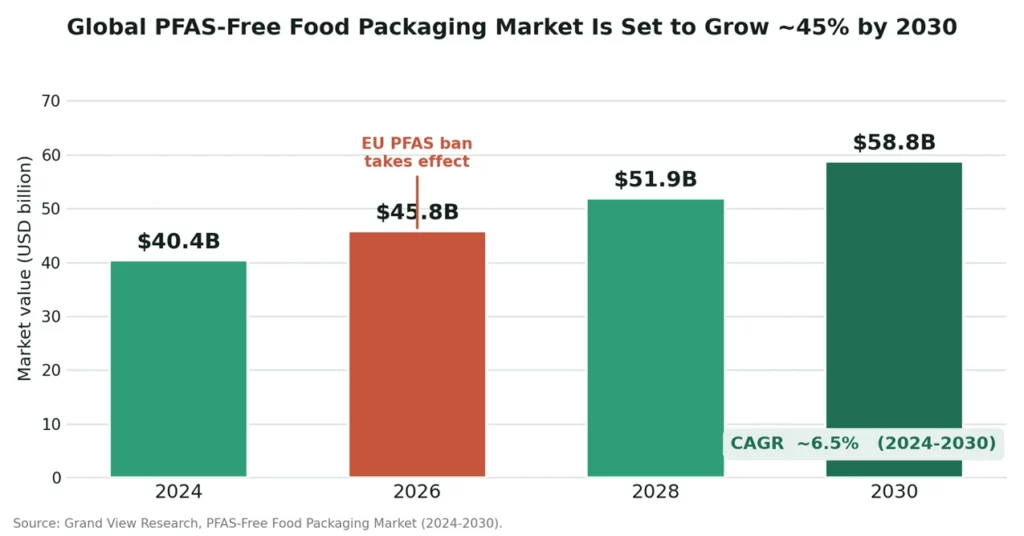
According to Grand View Research, the global PFAS-free food packaging market size was estimated at USD 40,402.0 million in 2024 and is projected to reach USD 58,785.9 million by 2030, growing at a CAGR of 6.5% from 2025 to 2030. The industry is driven by increasing regulatory restrictions on PFAS usage and rising consumer demand for safer, sustainable packaging alternatives.
Keep Selling into the EU — Compliantly
Non-compliant packaging can be pulled from EU shelves. See how TraceX gives you the evidence trail to prove conformity and protect your market access.
From 12 August 2026, food-contact packaging that exceeds PFAS limits cannot be placed on the EU market under Regulation (EU) 2025/40, the Packaging and Packaging Waste Regulation (PPWR). There is no grandfathering. Packaging produced before the deadline is still banned if it is sold after it. Stockpiling will not save you. Three limits apply: 25 ppb for any individual PFAS, 250 ppb for the sum of targeted PFAS, and 50 ppm total fluorine the last figure includes polymeric PFAS. It applies to imports, coatings, additives, and multilayer packaging with a virgin inner layer. There is no ‘inner-liner’ loophole. The real deadline is earlier than August 2026: reformulation, testing, and supplier re-qualification take six to twelve months and major retailers are imposing their own pre-compliance cut-offs.
What Are PFAS and Why Is the EU Banning Them?
PFAS are a family of thousands of synthetic chemicals prized for repelling grease, oil, and water. In food packaging they have done an unglamorous but valuable job: keeping butter from soaking through a wrapper, stopping a fast-food box from going limp, letting a microwave popcorn bag survive the heat. Because they barely break down in the environment, they have earned the nickname ‘forever chemicals.’
Regulators are acting because the same persistence that makes PFAS useful makes them a health concern. EU authorities link long-term PFAS exposure to carcinogenicity, reproductive toxicity, and effects on the immune system and food packaging is a recognised exposure route, because the chemicals can migrate from the wrapper into the food itself. That evidence base is what underpins Article 21 of the PPWR.
One nuance matters before you brief your team. In regulatory language, ‘PFAS-free’ does not mean ‘zero PFAS.’ It means below the PPWR limit values. PFAS are so widespread that trace background levels are almost unavoidable; compliance is about staying under defined thresholds, not proving a perfect absence.
What Exactly Does the 2026 EU Ban Require?
The PPWR entered into force on 11 February 2025 and replaces the decades-old Packaging Directive 94/62/EC. The shift from a directive to a regulation is not a technicality: a directive had to be transposed into 27 national laws, each with its own wording. A regulation is directly applicable and identical everywhere. There is now one rulebook, one deadline, and far less room for national interpretation.
From 12 August 2026, food-contact packaging is prohibited from the EU market if PFAS meet or exceed any of three concentration limits:
PFAS limit
Threshold
What it covers and how it is measured
Any individual PFAS
25 ppb
A single PFAS compound, measured by targeted analysis. Polymeric PFAS are excluded from this figure.
Sum of PFAS
250 ppb
The total of targeted PFAS compounds, measured by targeted analysis. Polymeric PFAS are excluded.
Total fluorine
50 ppm
Total fluorine including polymeric PFAS. Cross this line and the burden of proof flips: you must prove the fluorine is not from restricted PFAS.
That last point is the one most teams underestimate. The PPWR builds in a burden-of-proof reversal. Because validated analytical methods are still being finalised, draft Commission guidance sets out a stepwise test: screen for total fluorine first; if it is below 50 ppm, the sample is compliant. If it is higher, you must demonstrate with further analysis that the fluorine is not organic PFAS. A high reading is treated as a problem until you prove otherwise, not the reverse.
Most chemical restrictions give industry an exit ramp a sell-through window to clear existing inventory. The PPWR does not. Packaging manufactured in July 2026 is just as banned as packaging manufactured in 2024 if it is sold into the EU after the deadline. An inventory buffer is not an asset here; it is a write-off waiting to happen.
Treat 12 August 2026 as a reporting date, not a working date. Reformulating a barrier coating, validating shelf life, re-qualifying a converter, and assembling a defensible technical file is realistically a six-to-twelve-month programme. Work backwards and your true internal deadline lands in late 2025 or early 2026 which, for most readers, means the clock has already run down. Add the fact that large EU retailers are setting their own pre-compliance cut-offs ahead of the legal date, and the practical runway is shorter still.
Learn what PPWR means for manufacturers, brand owners, importers, retailers, and packaging suppliers—and discover the practical steps organizations can take today to prepare for upcoming requirements and maintain seamless access to EU markets.
The Five Hardest Compliance Challenges and How to Approach Them
Awareness of the deadline is near-universal. Execution is where companies stall. These are the five obstacles that turn a simple-sounding ban into a genuine programme of work.
1. Seeing the PFAS You Never Added
The ban covers intentionally added PFAS but ‘intentionally added’ includes substances introduced by a coating, ink, adhesive, or processing aid you never specified yourself. PFAS frequently enter packaging two or three tiers up the supply chain, invisible on your own bill of materials.
Approach: map PFAS at substance level across every tier, not just your direct suppliers.
2. Replacing Performance, Not Just Chemistry
Swapping a fluorinated coating is easy on paper. Matching its grease and moisture resistance is the hard part especially for demanding formats like hot, oily foods and frozen-then-microwaved meals.
Approach: treat reformulation as a performance-qualification project with shelf-life and barrier testing, not a like-for-like substitution.
3. Getting Declarations Suppliers Can Stand Behind
A one-line e-mail saying ‘no PFAS’ is worthless in an inspection. You need declarations that specify the limits, reference Regulation (EC) No 1935/2004, and are backed by test data.
Approach: issue a standard PFAS declaration request now, and treat suppliers who cannot or will not complete it as a sourcing risk to be replaced.
4. Testing in a Field Without a Finalised Method
Validated analytical methods for the PPWR are still being settled, and results sit close to the thresholds, so measurement uncertainty can decide compliance.
Approach: use accredited laboratories, follow the total-fluorine-first screening logic, and prioritise testing on your highest-risk materials grease-resistant paper, molded fibre, and coated board.
5. Documentation That Survives an Audit
The PPWR requires a Declaration of Conformity and a supporting technical file demonstrating ongoing conformity. Spreadsheets and scattered e-mails do not scale to hundreds of SKUs and multi-tier supplier networks.
Approach: build a single, centralised, audit-ready record of substances, declarations, and test reports before not during an enforcement check.
What PFAS-Free Alternatives Actually Work?
No single material replaces fluorochemistry across every format. The realistic answer is a toolkit, matched to the food and the pack:
Water-based dispersion coatings — the leading drop-in route for paper and board; they deliver grease resistance without fluorine and can keep packaging recyclable.
Bio-based barrier coatings and films — plant-derived polymers that provide oil and moisture resistance, often with a compostability story.
Mineral coatings (clay, silica) — inorganic barriers that resist grease and can be tuned for specific applications.
Natural waxes — a long-established, food-safe barrier for the right formats.
Molded fibre and bagasse — structural alternatives for bowls, trays, and clamshells, increasingly engineered without fluorinated additives.
Kraft paper with enhanced internal sizing — reduces the need for a surface coating altogether.
One caution: ‘bio-based,’ ‘compostable,’ and ‘PFAS-free’ are not synonyms. Some compostable and biobased packaging still carries a PFAS coating. Always require a material declaration that explicitly excludes PFAS do not infer it from a green claim.
Your 90-Day PPWR Readiness Roadmap
If you have not started, start now. This is a deliberately compressed plan to move from exposure to evidence:
Phase
Window
Priority actions
Audit
Days 1–30
Inventory every food-contact SKU sold into the EU. Map intentionally added PFAS and all fluorinated coatings, inks, and processing aids. Flag the highest-risk items first greaseproof paper, molded fibre, and coated board.
Verify
Days 31–60
Issue standardised PFAS-free declaration requests to every supplier tier under Regulation (EC) No 1935/2004. Commission accredited testing on high-risk materials, using the total-fluorine-first screening approach.
Convert & document
Days 61–90
Qualify PFAS-free alternatives with shelf-life and barrier validation. Lock in compliant suppliers. Assemble the Declaration of Conformity and a centralised technical file ready for inspection.
Learn PPWR at Your Own Pace — No Strings Attached
Prefer to do your homework first? Download the handbook for a complete grounding in PPWR before you decide on any next step.
Does the ban apply to packaging manufactured before August 2026?
Yes. The PPWR has no grandfathering provision. What matters is the date the packaging is placed on the EU market, not the date it was made. Non-compliant stock made before the deadline cannot be legally sold after it.
Does it apply to imported packaging?
Yes. The limits apply to all food-contact packaging placed on the EU market, including imports. The importer carries responsibility for compliance, so a supplier’s informal assurance is not an adequate defence.
Is biobased or compostable packaging automatically PFAS-free?
No. Some compostable and biobased packaging still uses a PFAS coating for grease resistance. Always obtain a material declaration that explicitly excludes PFAS rather than assuming a green credential covers it.
What does ‘PFAS-free’ legally mean under the PPWR?
It does not mean zero PFAS. It means the packaging is below the PPWR limit values — 25 ppb for any individual PFAS, 250 ppb for the sum of targeted PFAS, and 50 ppm total fluorine. Compliance is defined by thresholds, not perfect absence.
Are polymeric PFAS and fluoropolymers covered?
Yes. While polymeric PFAS are excluded from the 25 ppb and 250 ppb targeted-analysis limits, they are captured by the 50 ppm total-fluorine limit. Fluoropolymers used as processing aids therefore fall within scope.
What happens if a company fails to comply?
Non-compliant packaging faces complete exclusion from the EU market. Enforcement can also include import rejection and penalties under national law. For businesses with significant EU revenue, the commercial consequence lost market access outweighs the fine itself.
Start using TraceX
Transparency, Trust, & Success for your Climate Journey.
We use cookies on our website to give you the most relevant experience by remembering your preferences and repeat visits. By clicking “Accept All”, you consent to the use of ALL the cookies. However, you may visit "Cookie Settings" to provide a controlled consent.
This website uses cookies to improve your experience while you navigate through the website. Out of these, the cookies that are categorized as necessary are stored on your browser as they are essential for the working of basic functionalities of the website. We also use third-party cookies that help us analyze and understand how you use this website. These cookies will be stored in your browser only with your consent. You also have the option to opt-out of these cookies. But opting out of some of these cookies may affect your browsing experience.
Necessary cookies are absolutely essential for the website to function properly. These cookies ensure basic functionalities and security features of the website, anonymously.
Cookie
Duration
Description
cookielawinfo-checkbox-analytics
11 months
This cookie is set by GDPR Cookie Consent plugin. The cookie is used to store the user consent for the cookies in the category "Analytics".
cookielawinfo-checkbox-functional
11 months
The cookie is set by GDPR cookie consent to record the user consent for the cookies in the category "Functional".
cookielawinfo-checkbox-necessary
11 months
This cookie is set by GDPR Cookie Consent plugin. The cookies is used to store the user consent for the cookies in the category "Necessary".
cookielawinfo-checkbox-others
11 months
This cookie is set by GDPR Cookie Consent plugin. The cookie is used to store the user consent for the cookies in the category "Other.
cookielawinfo-checkbox-performance
11 months
This cookie is set by GDPR Cookie Consent plugin. The cookie is used to store the user consent for the cookies in the category "Performance".
viewed_cookie_policy
11 months
The cookie is set by the GDPR Cookie Consent plugin and is used to store whether or not user has consented to the use of cookies. It does not store any personal data.
Functional cookies help to perform certain functionalities like sharing the content of the website on social media platforms, collect feedbacks, and other third-party features.
Performance cookies are used to understand and analyze the key performance indexes of the website which helps in delivering a better user experience for the visitors.
Analytical cookies are used to understand how visitors interact with the website. These cookies help provide information on metrics the number of visitors, bounce rate, traffic source, etc.
Advertisement cookies are used to provide visitors with relevant ads and marketing campaigns. These cookies track visitors across websites and collect information to provide customized ads.
Download the 2026 Traceability Scorecard and Benchmark Your Supply Chain Across 10 Critical Capabilities.
Download our eBook
Don’t Wait for an Audit to Find Your EUDR Gaps
The 2026 Simplification Package changes how HS codes, DDS pass-through and geolocation rules apply to you. Get the free guide and 20-point readiness checklist before enforcement catches you unprepared.