Quick summary: Ensure EUDR compliance with end-to-end wood chip traceability. Learn how batch tracking, AI monitoring, and blockchain can safeguard your supply chain from deforestation risks. Future-proof your business—discover compliance solutions today!
Can you guarantee that every wood chip in your supply chain is deforestation-free? As the EUDR deadline looms, businesses in the paper and packaging, must ensure wood chip traceability from forest to final product—or risk supply chain disruptions, rejected shipments, and hefty penalties.
Blended materials make compliance a nightmare. Sourcing wood from multiple regions and processing it into pulp, packaging, or rubber makes tracing individual wood chips back to their original forest plots nearly impossible. Without real-time tracking, batch-level documentation, and supplier transparency, businesses face compliance risks, audit failures, and reputational damage. How can you ensure full wood chip traceability while staying compliant with EUDR? Let’s explore the solutions.
Key Takeaways
Key Challenges in Tracing Wood Chips to Their Source
How to Establish Wood Chip Traceability for EUDR Compliance
Best Practices for EUDR Compliance in the Wood Industry
TraceX EUDR Compliance Platform
Key Challenges in Tracing Wood Chips to Their Source
Tracking wood chips back to their original plantations is difficult due to:
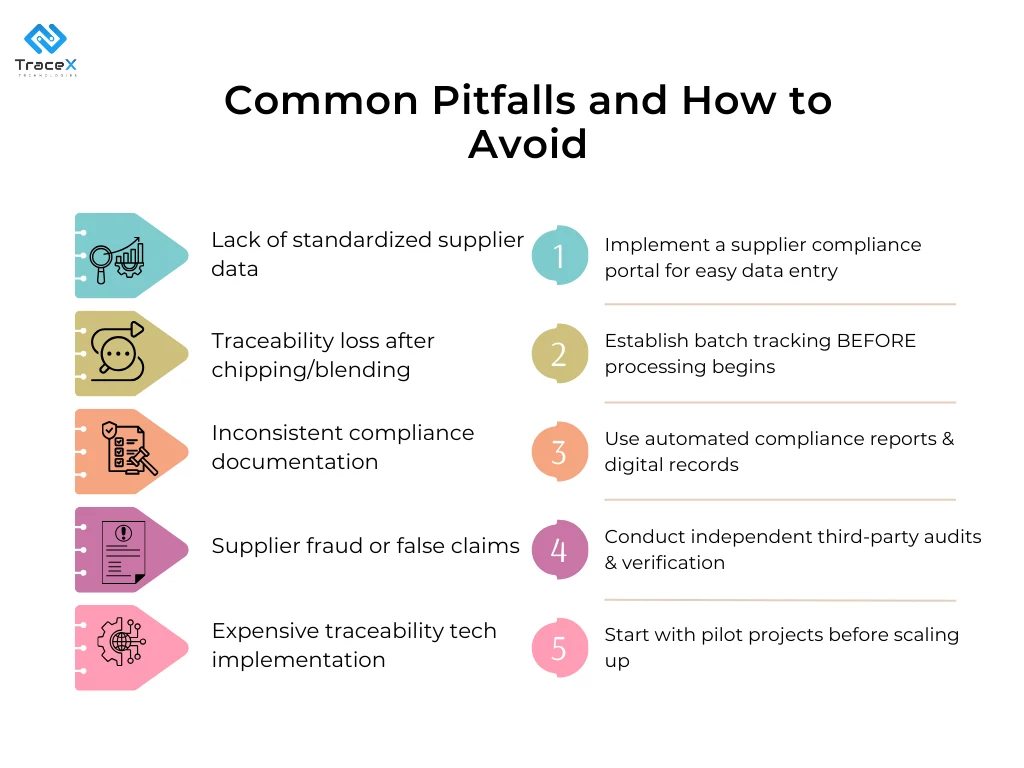
Blending of Materials
Wood from different suppliers and regions is mixed together before processing.
Once blended, it’s difficult to distinguish the source of each individual fiber.
Lack of Farm-to-Factory Tracking
Many companies don’t have geolocation data for the exact plots where the trees were harvested.
This creates gaps in the supply chain when verifying deforestation-free sources.
Inconsistent Supplier Documentation
Some suppliers lack proper compliance records, making it hard to verify origin.
Risk of fraudulent documentation from high-risk suppliers.
Loss of Unique Identifiers During Processing
Logs can be tracked, but once chipped, pulped, or shredded, they lose their original identity.
Tracking wood past the sawmill or processing plant is a major challenge.
Imports from high-risk regions (e.g., Indonesia, Brazil) require extra scrutiny.
How to Establish Wood Chip Traceability for EUDR Compliance
Since tracking individual wood chips is impractical, businesses should use a batch-based traceability system that maintains links between raw materials and their original sources.
Implement a Digital Chain of Custody System
Assign unique digital IDs (QR codes, barcodes) to logs and timber batches before processing.
Use blockchain-based traceability platforms for tamper-proof supply chain records. Maintain supplier declarations linking harvested trees to GPS-verified forest plots.
Example:
A pulp and paper company sources wood from three suppliers. Each supplier logs geolocation data of harvested trees into a cloud-based traceability system, linking shipments to digital IDs. These IDs remain attached to batches of wood chips, ensuring each blend can be traced back to specific forest sources.
Use Batch Segmentation Before Processing
Instead of tracking each chip, track wood batches (lots) and document proportions from different suppliers.
Assign tracking tags before blending begins to maintain source integrity.
Example:
A paper mill processes 1,000 tons of wood chips daily, sourced from five different plantations. Before blending, each batch is scanned and logged into an ERP system that links proportions of each supplier’s contribution. If compliance checks are needed, authorities can verify which plantations contributed to each production run.
Use AI and Satellite Monitoring for Risk Assessment
Cross-check supplier GPS coordinates with real-time deforestation maps.
Flag shipments from areas where recent deforestation has been detected.
Example:
A packaging company sources wood from Southeast Asia. They use satellite monitoring tools to verify that their suppliers’ plots have not been cleared after 2020 (EUDR compliance threshold). If deforestation is detected, the supplier’s shipment is flagged as high-risk before entering production.
DNA and Isotope Testing for Verification
DNA fingerprinting can match processed wood with its original tree species and region.
Stable isotope testing verifies whether wood fibers match declared sources.
Example:
A European company imports pulp from South America. They perform randomized isotope testing on shipments to detect if the raw material matches the declared origin. If discrepancies appear, the supplier must provide additional proof of sourcing compliance
Blockchain-Based Traceability for Compliance Reporting
Upload supplier data to a blockchain ledger for tamper-proof tracking.
Provide real-time access to compliance records for regulators & buyers.
Track wood from forest to final product—logs, wood chips, pulp, and packaging.
Example:
A global paper producer integrates blockchain with supplier traceability reports. Customers can scan a QR code on a product to verify its deforestation-free status.
Best Practices for EUDR Compliance in the Wood Industry
If your business is in paper, packaging, furniture, , or any wood-based industry, you already know the EU Deforestation Regulation (EUDR) is a game-changer. No more gray areas—either you can prove your wood supply is deforestation-free, or you risk blocked shipments, rejected orders, and major fines.
But how can you trace each wood chip back to its source when wood is chipped, pulped, blended, and processed along the way? The answer lies in smart traceability strategies that connect batches to their origin, digitize compliance, and leverage technology for real-time monitoring.
Let’s break down five best practices to help you stay ahead of EUDR compliance, protect your supply chain, and maintain customer trust.
1️. Batch Tracking is the Most Practical Approach
Why individual tracking is unrealistic:
Once wood is chipped or turned into pulp, it’s impossible to track each fiber back to its original log.
Instead of tracking every single piece, companies should track batches that maintain a documented link to their source forest.
Best Practice:
Implement batch tagging at the harvesting stage, where logs from a specific plantation or concession are grouped under one identifier.
Maintain batch-level geolocation data and ensure that each batch moving forward carries its origin details.
Require suppliers to register each batch digitally before shipment, so all incoming materials can be traced back.
Example:
A European paper mill sources pulp from multiple countries. By using batch tracking, they segregate pulp from certified forests vs. high-risk zones. This allows them to prove compliance without needing to trace every fiber individually.
2️. Use Digital Traceability Systems for Tamper-Proof Records
Why paperwork fails:
Manual tracking systems (spreadsheets, PDFs, paper logs) are easily lost, falsified, or outdated.
EUDR requires verifiable, tamper-proof records, making digital traceability essential.
Best Practice:
Adopt cloud-based traceability systems to store all compliance records securely.
Use blockchain technology to ensure that once supplier data is entered, it cannot be altered or manipulated.
Integrate ERP systems with traceability platforms, so sourcing data is seamlessly recorded and shared with regulators.
Example:
A furniture manufacturer in Germany digitized its entire supply chain, tracking logs from certified plantations to final furniture assembly. Using blockchain, they ensure that their sourcing records are 100% verifiable and tamper-proof, giving them a compliance advantage over competitors.
3️. Leverage AI & Satellite Monitoring to Detect Deforestation Risks
Why traditional auditing isn’t enough:
Satellite data reveals deforestation in real time, but many businesses still rely on outdated land certificates.
EUDR requires proof that no deforestation has taken place after December 31, 2020—a paper certificate won’t cut it.
Best Practice:
Use AI-driven satellite monitoring tools to cross-check supplier locations against deforestation alerts.
Require suppliers to share GPS data of harvest sites and validate this against real-time forest maps.
Implement automated risk scoring, where suppliers flagged as high-risk require further verification.
Example
According to Global Forest Watch, over 11 million hectares of tropical forest were lost in 2022 alone—many in regions linked to wood supply chains. AI-based risk detection systems can flag deforestation before high-risk materials enter your supply chain.
4️. Conduct Independent Testing & Audits for Supplier Verification
Why supplier self-reporting isn’t enough:
Some suppliers may falsify sustainability claims to maintain contracts.
Without third-party verification, businesses risk importing non-compliant materials unknowingly.
Best Practice:
Require independent audits to verify supplier compliance with EUDR, FSC, and PEFC standards.
Use DNA or isotope testing to confirm whether wood fibers match the claimed country or forest of origin.
Conduct spot-check compliance audits before approving high-risk suppliers.
Example:
A paper packaging company sources pulp from multiple regions. By testing fiber samples, they detect inconsistencies between supplier claims and actual material origin—helping them avoid fraudulent sourcing.
5️. Ensure Regulatory Alignment & Maintain Full Compliance Documentation
Why incomplete documentation leads to rejection:
Without full documentation, shipments risk being held at EU customs or outright rejected.
Companies must prove their supply chains are fully traceable, linking each wood product to a deforestation-free source.
Best Practice:
Maintain digital records of supplier geolocation data, certifications, and risk assessments.
Ensure compliance with EUDR, FSC (Forest Stewardship Council), and PEFC (Programme for the Endorsement of Forest Certification).
Establish an internal compliance team to stay updated on regulation changes and conduct pre-export document checks.
TraceX EUDR Compliance Platform: End-to-End Traceability for a Deforestation-Free Supply Chain
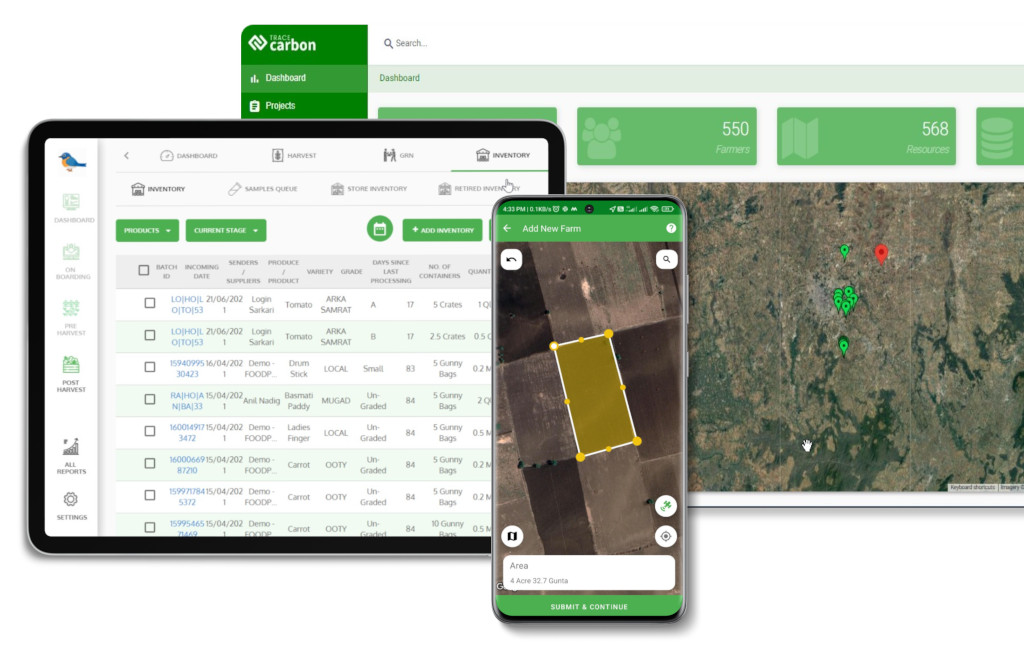
TraceX offers a comprehensive EUDR Compliance platform designed to help businesses in agriculture, timber, rubber, and food industries achieve full compliance with the EU Deforestation Regulation (EUDR). The platform provides real-time tracking, supplier verification, and automated compliance reporting, ensuring that every product in the supply chain is deforestation-free and meets regulatory standards.
Key Features & Capabilities:
Geo-Tagged Farm & Supplier Mapping – Track wood, rubber, cocoa, coffee, palm oil, and soy back to their exact source locations with GPS-based monitoring.
Batch-Level Traceability – Maintain batch-wise tracking of materials, ensuring they can be linked to verified deforestation-free sources.
Blockchain-Powered Compliance – Store tamper-proof sourcing data that meets EUDR requirements, ensuring transparency and audit readiness.
Automated Due Diligence Reports (DDS) – Generate and submit EUDR-compliant DDS reports seamlessly.
AI & Satellite Monitoring – Detect deforestation risks in supplier regions using real-time remote sensing data.
ERP & Supply Chain Integration – Sync compliance data with existing procurement, ERP, and logistics systems for seamless operations.
Third-Party Certification & Verification – Integrate with FSC, PEFC, and organic certification bodies for additional compliance validation.
Looking for an easy-to-use, tech-driven EUDR compliance solution?
Future-Proof Your Business with Wood Chip Traceability
EUDR compliance is no longer an option—it’s a necessity. As regulations tighten, businesses in the paper, packaging, furniture, and wood industries must adopt robust wood chip traceability systems to prove their supply chains are deforestation-free. By implementing batch tracking, digital traceability tools, AI-based monitoring, and supplier audits, companies can eliminate compliance risks, prevent shipment rejections, and build consumer trust.
The time to act is now. Whether you’re sourcing raw timber, processing wood chips, or manufacturing wood-based products, a proactive traceability strategy is your strongest asset.
Frequently Asked Questions ( FAQ’s)
How can businesses track wood chips back to their original forest plot?
Companies use batch tracking, digital supplier records, and GPS-based monitoring to link wood chips to verified deforestation-free sources before processing.
What technology is best for ensuring wood chip traceability under EUDR?
A combination of blockchain, AI-powered satellite monitoring, geolocation tagging, and ERP-integrated compliance dashboards helps businesses maintain real-time traceability.
What are the consequences of non-compliance with EUDR for wood-based industries?
Non-compliance can lead to shipment rejections, regulatory fines, market access loss, and reputational damage, making traceability a critical investment for businesses.
Start using TraceX
Transparency, Trust, & Success for your Climate Journey.
We use cookies on our website to give you the most relevant experience by remembering your preferences and repeat visits. By clicking “Accept All”, you consent to the use of ALL the cookies. However, you may visit "Cookie Settings" to provide a controlled consent.
This website uses cookies to improve your experience while you navigate through the website. Out of these, the cookies that are categorized as necessary are stored on your browser as they are essential for the working of basic functionalities of the website. We also use third-party cookies that help us analyze and understand how you use this website. These cookies will be stored in your browser only with your consent. You also have the option to opt-out of these cookies. But opting out of some of these cookies may affect your browsing experience.
Necessary cookies are absolutely essential for the website to function properly. These cookies ensure basic functionalities and security features of the website, anonymously.
Cookie
Duration
Description
cookielawinfo-checkbox-analytics
11 months
This cookie is set by GDPR Cookie Consent plugin. The cookie is used to store the user consent for the cookies in the category "Analytics".
cookielawinfo-checkbox-functional
11 months
The cookie is set by GDPR cookie consent to record the user consent for the cookies in the category "Functional".
cookielawinfo-checkbox-necessary
11 months
This cookie is set by GDPR Cookie Consent plugin. The cookies is used to store the user consent for the cookies in the category "Necessary".
cookielawinfo-checkbox-others
11 months
This cookie is set by GDPR Cookie Consent plugin. The cookie is used to store the user consent for the cookies in the category "Other.
cookielawinfo-checkbox-performance
11 months
This cookie is set by GDPR Cookie Consent plugin. The cookie is used to store the user consent for the cookies in the category "Performance".
viewed_cookie_policy
11 months
The cookie is set by the GDPR Cookie Consent plugin and is used to store whether or not user has consented to the use of cookies. It does not store any personal data.
Functional cookies help to perform certain functionalities like sharing the content of the website on social media platforms, collect feedbacks, and other third-party features.
Performance cookies are used to understand and analyze the key performance indexes of the website which helps in delivering a better user experience for the visitors.
Analytical cookies are used to understand how visitors interact with the website. These cookies help provide information on metrics the number of visitors, bounce rate, traffic source, etc.
Advertisement cookies are used to provide visitors with relevant ads and marketing campaigns. These cookies track visitors across websites and collect information to provide customized ads.
Download the 2026 Traceability Scorecard and Benchmark Your Supply Chain Across 10 Critical Capabilities.
Download our eBook
Don’t Wait for an Audit to Find Your EUDR Gaps
The 2026 Simplification Package changes how HS codes, DDS pass-through and geolocation rules apply to you. Get the free guide and 20-point readiness checklist before enforcement catches you unprepared.