Global Regulations on Illegal Logging: The 2026 Supply Chain Compliance Guide
Published
, 15 minute read
Share this article
Quick summary: Global regulations on illegal logging EUDR, Lacey Act, FLEGT, UK UKTR are reshaping supply chains. Learn what's required and how to comply before your next shipment is blocked.
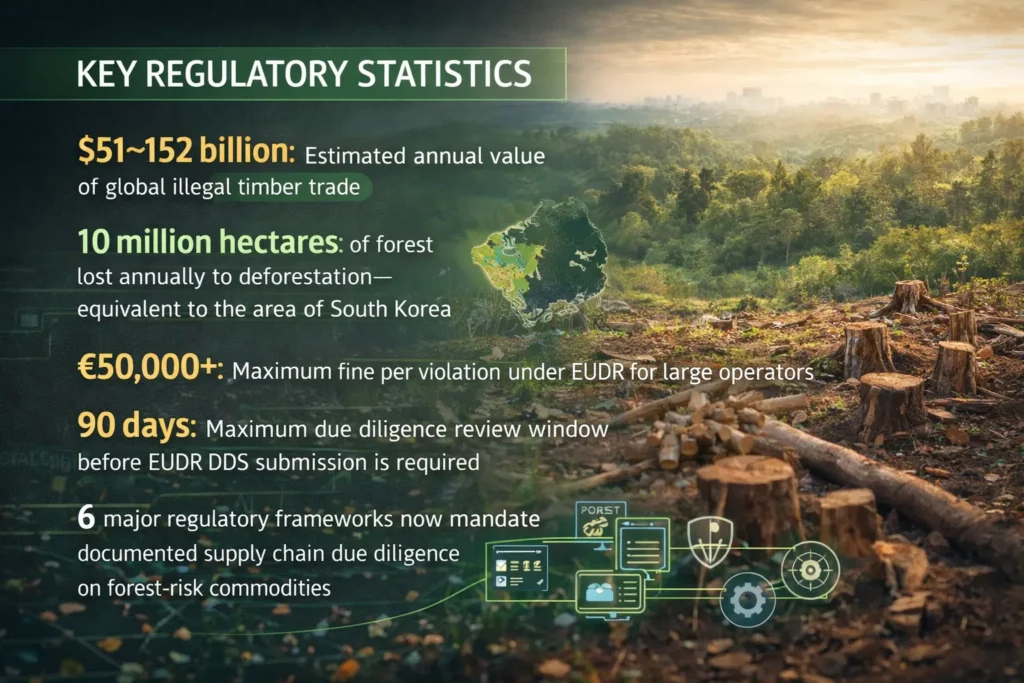
Somewhere between a sawmill in Sumatra and a kitchen table in Stuttgart, someone has to prove the wood is legal. That gap between raw commodity and verified provenance is precisely where global regulators are now applying maximum pressure. Global regulations on illegal logging led by the EU Deforestation Regulation (EUDR), the US Lacey Act, EU FLEGT, and the UK Forest Risk Commodities framework collectively ban the import, sale, and trade of timber and forest-risk commodities that cannot be proven legal at the point of harvest. As of 2026, non-compliance can result in EU shipment bans, fines exceeding 50,000 per violation, and criminal prosecution. For supply chain operators sourcing timber, rubber, palm oil, soy, cocoa, or coffee, documented due diligence is no longer optional it’s a market entry requirement.
Illegal logging accounts for 15-30% of global timber trade by volume worth an estimated $51-152 billion annually. Every year, forests the size of Portugal disappear, and a significant portion of the cleared land feeds directly into supply chains that have no mechanism to detect it.
That’s changing fast. Six major regulatory frameworks spanning the EU, US, UK, Australia, Japan, and South Korea now require importers and operators to perform documented due diligence on the legal origin of forest-risk commodities. The penalties aren’t theoretical: US prosecutors have pursued criminal charges under the Lacey Act for shipments as small as $300 in wood products. The EU’s EUDR threatens to block entire commodity categories from the world’s largest trading bloc.
This guide maps every major global regulation, quantifies what non-compliance actually costs, identifies the four ICP challenges every compliance team struggles with, and explains how supply chain technology is replacing the clipboard-and-spreadsheet era for good.
Key Takeaways
At least 6 major global regulations now criminalize or restrict trade in illegally logged timber and deforestation-linked commodities with fines exceeding 50,000 per shipment under EUDR.
The core ICP challenges: GPS-level plot mapping at scale, fragmented supplier documentation, offline-field data collection from smallholder farmers, and multi-regulation reporting burdens.
Solutions from TraceX automate Due Diligence Statements, geo-map farm plots against satellite deforestation data, and produce audit-ready reports removing manual compliance risk end-to-end.
Want a complete breakdown of global illegal logging laws?
Download our free eBook on Illegal Logging Regulations to understand how major frameworks like EUDR, EUTR, and AILPA impact timber and forest-risk supply chains.
What Does Illegal Logging Mean Under Global Trade Law?
Illegal logging isn’t a single act it’s a category of violations defined differently by each jurisdiction, which is precisely what makes multi-market compliance so difficult.
Under most frameworks, ‘illegal logging’ covers: harvesting timber without valid government authorization, logging in protected areas or reserved forests, exceeding permitted harvest volumes, exporting without complying with the source country’s export regulations, and tax and royalty evasion on timber revenues.
The challenge for importers? You’re not expected to know the forestry law of every origin country by heart. You are expected to conduct risk-based due diligence gathering information, assessing risk, and mitigating risk before the commodity enters your supply chain or crosses a regulated border. Most frameworks define ‘negligible risk’ as the target threshold; anything above requires additional mitigation steps.
How Regulators Define ‘Legal’ Timber
Legality is origin-country dependent. Under the EU FLEGT framework, Voluntary Partnership Agreements (VPAs) with origin countries create a licensed verification system timber from FLEGT partner countries can cross EU borders with a FLEGT licence. But only a handful of countries have active VPAs: Ghana, Indonesia, Cameroon, Republic of Congo, Liberia, and a few others.
For all other origin countries including the major timber exporters like Brazil, Malaysia, Russia, and China importers must conduct their own due diligence to verify legality claims. This is where paper-based systems fail and technology becomes critical.
Illegal logging continues to disrupt global timber supply chains. Understand the risks, regulations, and how to mitigate them – read our in-depth blog.
From forest to finished product – explore the complete timber value chain and where traceability matters most.
Which Global Regulations Govern Illegal Logging?
1. EU Deforestation Regulation (EUDR) – The Strictest Standard in Force
Effective for large operators as of December 30, 2025, the EUDR is the most comprehensive anti-deforestation trade law ever enacted. It applies to seven commodity categories cattle, cocoa, coffee, palm oil, soya, wood, rubber and all derived products (including furniture, paper, chocolate, and leather goods).
The core obligation: operators placing these commodities on the EU market must submit a Due Diligence Statement (DDS) via the EU TRACES system, backed by geolocation data (GPS coordinates or polygon maps) showing that the commodity was produced on land that was not deforested or forest-degraded after December 31, 2020. Risk assessment must be documented. High-risk origin countries face enhanced scrutiny.
Penalties: Fines of at least 4% of the operator’s EU annual turnover; product confiscation; exclusion from public procurement; and criminal liability for individuals where applicable.
2. US Lacey Act – The Oldest, Still the Sharpest
Amended in 2008 to cover plants and plant products (including timber), the Lacey Act makes it a federal crime to import, export, transport, sell, or acquire any plant product that was taken in violation of any US or foreign law. It’s the world’s first law to extend jurisdiction to the laws of the origin country meaning a US importer can be prosecuted for violating Indonesian forestry law.
High-profile prosecutions include a 2008 case against Gibson Guitar for importing illegally sourced wood from Madagascar. Penalties: Up to $50,000 per civil violation; criminal penalties up to $500,000 for organisations and $250,000 for individuals. Import declarations listing the scientific name, country of harvest, and value of plant products are required for all commercial shipments.
3. EU FLEGT – Forest Law Enforcement, Governance and Trade
FLEGT (Forest Law Enforcement, Governance and Trade) is the EU’s older bilateral framework, establishing Voluntary Partnership Agreements (VPAs) with timber-exporting countries to license legally produced timber. Under the EU Timber Regulation (EUTR), which FLEGT underpins, operators placing timber on the EU market must exercise due diligence risk assessment, information collection, risk mitigation.
While EUDR supersedes EUTR for many product categories, FLEGT remains active and FLEGT-licensed timber still satisfies EUDR legality requirements for covered wood products. Operators dealing with VPA-country timber should understand both systems.
4. UK Timber Regulations and Forest Risk Commodities Framework
Post-Brexit, the UK retained the core EUTR due diligence obligations under UK Timber Regulations (UKTR). More recently, the Environment Act 2021 introduced Section 27 provisions creating the Forest Risk Commodities (FRC) regime, expected to be fully operational in 2025-2026. The FRC regime will require any UK business with a global annual turnover of £50 million or more to conduct due diligence on forest-risk commodities in their supply chains and publish an annual compliance statement.
5. Australia, Japan, South Korea – Converging Frameworks
Australia’s Illegal Logging Prohibition Act (ILPA, 2012) prohibits importing illegally logged timber or timber products. It requires due diligence for regulated timber products. Japan’s Clean Wood Act (Act on Promotion of Use of Legally Harvested Wood, 2017) encourages operators to source only legal timber. South Korea has aligned procurement policies with FLEGT principles. None carry the enforcement teeth of EUDR or Lacey yet but the direction of travel globally is unmistakable: mandatory, documented, digitally verifiable due diligence.
Global Illegal Logging Regulation Comparison
The following table maps the key regulatory frameworks, their scope, and compliance requirements.
What Are the Challenges of Illegal Logging Compliance?
Knowing the regulations is step one. Operationalising them across supply chains that span multiple countries, thousands of smallholder farmers, and legacy ERP systems is an entirely different problem. These are the four challenges that dominate every compliance conversation.
Challenge 1 – Plot-Level Geolocation at Scale
EUDR’s GPS polygon requirement is operationally the hardest part of compliance for most operators. The EU Technical Guidance calls for latitude/longitude coordinates accurate enough to identify individual farm plots yet most smallholder farmers in high-risk origins (Sumatra, West Africa, the Amazon basin) have no formal land documentation whatsoever. Operators can’t simply request a GPS coordinate from a farmer who has never owned a smartphone. They need field agents, offline capture tools, and satellite cross-validation to build a map from scratch at scale, across potentially thousands of supply chain participants.
TraceX addresses this through its offline-first mobile app, which enables field agents to capture GPS polygon boundaries even without internet connectivity. Plots are automatically cross-validated against JRC and Hansen satellite deforestation datasets before being included in a DDS.
Achieving EUDR compliance starts with precise geolocation. See how a leading tire manufacturer implemented large-scale polygon mapping to enable plot-level traceability and meet regulatory requirements – explore the full case study.
Challenge 2 – Fragmented Supplier Documentation
Due diligence requires collecting KYC documentation, land tenure records, certification status, and harvest authorisations from every supplier in the chain often in multiple languages, across different national legal frameworks. Most operators are doing this manually via email threads, PDFs, and shared spreadsheets. The result: missing data, outdated documents, audit failures, and an inability to prove due diligence to a regulator on demand.
TraceX’s Agentic AI engine can automatically parse supplier documentation from email attachments extracting KYC fields, certification expiry dates, and land tenure data and flag gaps before a DDS submission is attempted. This eliminates the 3-6 person-weeks of manual data consolidation that most compliance teams spend before each regulatory cycle.
Challenge 3 – Smallholder Last-Mile Data Collection
Smallholder farmers who account for 70-80% of commodity production in high-risk tropical regions present unique barriers to digital compliance. Low literacy, poor connectivity, multiple languages, and communal land tenure systems all make standard enterprise data collection tools impractical.
The compliance gap isn’t that farmers are non-compliant. It’s that the data infrastructure to prove their compliance doesn’t exist. Operators who can’t bridge this gap will simply be unable to sell into the EU market regardless of their actual sourcing practices. Multilingual supplier portals, offline-first tools, and mobile-first interfaces are operational necessities, not nice-to-haves.
Challenge 4 – Multi-Regulation Reporting Burden
Large operators sourcing timber, rubber, and agricultural commodities simultaneously face EUDR, EUTR/FLEGT, Lacey Act declarations, UKTR obligations, and potentially CSRD Scope 3 reporting requirements each with different data formats, submission systems, and update cycles. Without a unified data architecture, every regulation becomes a separate data collection and reporting workstream. The administrative overhead alone can overwhelm compliance teams at mid-size operators.
What Are the Penalties for Non-Compliance with Illegal Logging Regulations?
The question isn’t whether penalties are real it’s whether your risk management strategy reflects the actual magnitude. Here’s what non-compliance costs across major frameworks:
Regulation
Jurisdiction
Max Financial Penalty
Additional Consequences
EUDR
EU
4% of annual EU turnover
Product confiscation, public procurement exclusion, criminal liability for individuals
The real cost of non-compliance under EUDR isn’t the fine it’s market access. A single DDS rejection doesn’t just delay one shipment. It triggers a mandatory regulatory review, damages buyer relationships, and may flag your company for enhanced monitoring across future shipments. For exporters whose entire revenue base is EU-market dependent, this is an existential risk not a line item on a risk register.
How Does Technology Solve Illegal Logging Compliance?
Digital traceability platforms have reduced EUDR DDS preparation time by up to 80% compared to manual methods for early adopter operators in Southeast Asia and West Africa. The compliance gap is no longer about data availability it’s about data architecture.
A complete technology response to illegal logging compliance needs to solve five problems simultaneously:
Farm-level geolocation – GPS polygon capture for every plot, validated against satellite imagery
Document automation – AI-powered extraction of KYC, certifications, land tenure records from supplier documents
Risk scoring – real-time deforestation alerts using Sentinel-2, GLAD, and JRC satellite datasets
DDS generation – automated Due Diligence Statement creation and submission to EU TRACES
Audit trail – blockchain-backed, tamper-proof record of every data point from farm to border
The TraceX Regulatory Compliance Platform
TraceX is built specifically for the operational realities of emerging market supply chains where connectivity is intermittent, literacy levels are variable, and land documentation is informal. Its Regulatory Compliance Platform provides:
Agentic AI that auto-parses supplier documentation from email attachments, extracting compliance-relevant fields without manual data entry
GPS polygon-based geolocation mapping for farm plots, validated in real time against JRC and Hansen deforestation datasets
Automated DDS generation with direct API integration to EU TRACES for submission-ready compliance
Satellite deforestation alerts via JRC and Hansen, operators are notified when any plot in their supply chain shows deforestation risk
Blockchain-immutable audit trails that cannot be manipulated every transaction, document, and GPS point is locked in an immutable record
One-click export in PDF, XML, and CSV formats for regulatory audits
Are your supply chain operations EUDR-ready?
Most operators discover their geolocation gaps when it’s already too late to fix them before a shipment deadline. TraceX can map your current compliance posture in a single onboarding session.
TraceX in Action: Deforestation-Free Sourcing at Scale
Consider the operational challenge facing a mid-size palm oil processor in Southeast Asia supplying three EU-based FMCG brands. Their supply base: 1,800 smallholder farmers across two provinces, paper-based land records, no existing GPS infrastructure.
The compliance requirement: plot-level GPS polygons for every farm, validated deforestation-free status post December 31, 2020, documented risk assessment, and a DDS submitted to EU TRACES before each shipment.
With TraceX, the implementation sequence is:
Deploy offline-first mobile app to field agent network, agents capture GPS polygon boundaries using device GPS, even without connectivity
Sync captured data to TraceX cloud when connectivity is available, platform auto-validates each plot against JRC and Hansen deforestation layers
Agentic AI processes supplier KYC documents, extracting certification data and flagging missing fields
Risk scoring applied, each plot receives a compliance risk tier based on deforestation proximity, land tenure certainty, and certification status
DDS auto-generated and submitted to EU TRACES, operator retains blockchain-immutable audit record
The result: a compliance-ready DDS in days, not months without hiring a dedicated compliance team for manual data aggregation. This is the gap TraceX was built to close.
Global regulations on illegal logging aren’t converging on a distant horizon they’re enforcement-active today. EUDR is live. The Lacey Act is prosecuting. The UK’s Forest Risk Commodities framework is in implementation. The supply chain operators who will maintain EU market access through 2026 and beyond are those who’ve already built the geolocation infrastructure, document automation, and audit trail systems to meet due diligence requirements on demand.
The operators still relying on manual spreadsheets, email-based documentation, and paper GPS records are one regulatory audit away from a market access crisis. The question isn’t whether to invest in compliance infrastructure it’s whether you invest before or after the first shipment block.
Ready to Build a Deforestation-Free Supply Chain?
TraceX works with agri-food exporters, F&B brands, and development organisations across Southeast Asia, West Africa, and India to operationalise EUDR compliance from farm plot to EU border.
What is the EUDR and how does it affect timber importers?
The EU Deforestation Regulation (EUDR), effective December 2025 for large operators, requires all businesses placing cattle, cocoa, coffee, palm oil, soy, wood, and rubber products on the EU market to submit a GPS-backed Due Diligence Statement (DDS) via the TRACES system. Timber importers must provide plot-level geolocation data proving no deforestation occurred on their sourcing plots after December 31, 2020. Failure to comply can result in penalties equivalent to 4% of EU annual turnover and product confiscation
What products are covered under global illegal logging regulations?
Coverage varies by regulation. EUDR covers timber, wood products, furniture, paper, and all seven forest-risk commodity categories. The US Lacey Act covers all plant products in commercial trade, including musical instruments, flooring, and paper. UK UKTR currently covers timber and wood products, with expansion expected under the Forest Risk Commodities regime. Australia’s ILPA focuses on regulated timber products. The common thread: any product containing wood or forest-derived materials is increasingly within regulatory scope.
What are the penalties for illegal timber imports into the EU?
Under EUDR, financial penalties must be at least 4% of the offending operator’s EU annual turnover for serious violations which for a mid-size commodity trader could mean penalties in the millions of euros. Additional consequences include product confiscation and destruction, exclusion from EU public procurement contracts, and criminal liability for responsible individuals. Member states are required to set penalties that are ‘effective, proportionate, and dissuasive.’ Early enforcement actions will set the market benchmark.
How do I prove deforestation-free sourcing to EU buyers?
Proof of deforestation-free sourcing under EUDR requires three things: GPS coordinates or polygon maps for every plot in your supply chain, a documented risk assessment demonstrating negligible deforestation risk, and a Due Diligence Statement submitted through the EU TRACES NT system referencing satellite-validated geolocation data. Blockchain-backed records strengthen the defensibility of your DDS in the event of regulatory audit. Solutions from TraceX automate GPS capture, satellite validation, and DDS generation in a single integrated workflow.
What technology tools help with illegal logging compliance?
The most effective technology stacks for illegal logging compliance combine four capabilities: GPS polygon capture tools (especially offline-capable mobile apps for remote sourcing regions), satellite deforestation monitoring (using Sentinel-2, GLAD, and JRC datasets), AI-powered document automation (for processing supplier KYC and certification documents at scale), and DDS/regulatory reporting automation with direct integration to EU TRACES. TraceX’s Regulatory Compliance Platform integrates all four into a single platform, purpose-built for emerging market supply chains.
Start using TraceX
Transparency, Trust, & Success for your Climate Journey.
We use cookies on our website to give you the most relevant experience by remembering your preferences and repeat visits. By clicking “Accept All”, you consent to the use of ALL the cookies. However, you may visit "Cookie Settings" to provide a controlled consent.
This website uses cookies to improve your experience while you navigate through the website. Out of these, the cookies that are categorized as necessary are stored on your browser as they are essential for the working of basic functionalities of the website. We also use third-party cookies that help us analyze and understand how you use this website. These cookies will be stored in your browser only with your consent. You also have the option to opt-out of these cookies. But opting out of some of these cookies may affect your browsing experience.
Necessary cookies are absolutely essential for the website to function properly. These cookies ensure basic functionalities and security features of the website, anonymously.
Cookie
Duration
Description
cookielawinfo-checkbox-analytics
11 months
This cookie is set by GDPR Cookie Consent plugin. The cookie is used to store the user consent for the cookies in the category "Analytics".
cookielawinfo-checkbox-functional
11 months
The cookie is set by GDPR cookie consent to record the user consent for the cookies in the category "Functional".
cookielawinfo-checkbox-necessary
11 months
This cookie is set by GDPR Cookie Consent plugin. The cookies is used to store the user consent for the cookies in the category "Necessary".
cookielawinfo-checkbox-others
11 months
This cookie is set by GDPR Cookie Consent plugin. The cookie is used to store the user consent for the cookies in the category "Other.
cookielawinfo-checkbox-performance
11 months
This cookie is set by GDPR Cookie Consent plugin. The cookie is used to store the user consent for the cookies in the category "Performance".
viewed_cookie_policy
11 months
The cookie is set by the GDPR Cookie Consent plugin and is used to store whether or not user has consented to the use of cookies. It does not store any personal data.
Functional cookies help to perform certain functionalities like sharing the content of the website on social media platforms, collect feedbacks, and other third-party features.
Performance cookies are used to understand and analyze the key performance indexes of the website which helps in delivering a better user experience for the visitors.
Analytical cookies are used to understand how visitors interact with the website. These cookies help provide information on metrics the number of visitors, bounce rate, traffic source, etc.
Advertisement cookies are used to provide visitors with relevant ads and marketing campaigns. These cookies track visitors across websites and collect information to provide customized ads.
Download the 2026 Traceability Scorecard and Benchmark Your Supply Chain Across 10 Critical Capabilities.
Download our eBook
Don’t Wait for an Audit to Find Your EUDR Gaps
The 2026 Simplification Package changes how HS codes, DDS pass-through and geolocation rules apply to you. Get the free guide and 20-point readiness checklist before enforcement catches you unprepared.