PPWR Scope Explained: What Falls Under the EU’s New Packaging Law
Published
, 12 minute read
Share this article
Quick summary: PPWR scope covers all packaging on the EU market from 12 Aug 2026. See what's in, what's exempt, and how to map your SKUs before the deadline.
The PPWR (Packaging and Packaging Waste Regulation, Regulation (EU) 2025/40) applies to all packaging placed on the EU market whether made in the EU or imported, whether B2B or B2C, whether empty or filled, and whether sold online or in-store. The first hard deadline is 12 August 2026, when every packaging SKU must carry a Declaration of Conformity. The scope is intentionally broad. Almost no operator selling physical goods into the EU escapes it. Understanding the full PPWR scope is critical because the regulation applies across virtually every packaging format and supply chain model including primary, secondary, transport, industrial, e-commerce, B2B, and consumer packaging making packaging compliance a business-wide responsibility rather than a packaging-team initiative.
If you’re reading this, you’re probably trying to figure out two things: which of your SKUs are in scope, and whether your current supplier-data setup can actually prove it. This guide walks through both the legal scope and the operational reality of meeting it.
Key Takeaways PPWR scope covers every item used for the containment, protection, handling, delivery, or presentation of products placed on the EU market including imports, B2B packaging, and e-commerce shipments. From 12 August 2026, each unique packaging type needs a Declaration of Conformity backed by verifiable supplier data (Regulation (EU) 2025/40). Companies without digital traceability will struggle to prove conformity.
See Your Single Source of Truth in Action
Packaging specs, supplier documentation, technical dossiers, and compliance evidence — all centralized in one platform. See how TraceX helps you prepare for PPWR with confidence.
The PPWR replaces the 30-year-old Packaging and Packaging Waste Directive (94/62/EC) with one directly applicable regulation across all 27 EU member states. It entered into force on 11 February 2025, with the first hard compliance deadline on 12 August 2026, after which every packaging type placed on the EU market must be covered by a valid Declaration of Conformity (Regulation (EU) 2025/40, 2025).
The scope is deliberately wide. PPWR applies to all packaging placed on the EU market, regardless of material, function, or whether it is empty or filled with products including B2B and B2C packaging; household, commercial, industrial, e-commerce, and transport packaging; and packaging produced within the EU as well as imported from third countries.
PPWR isn’t really a packaging design problem most companies already meet the physical requirements. It’s a data problem. The gap is proving it: collecting verified substance test results, recycler certificates, and full material breakdowns from every supplier in the chain. A pet food brand can use a recyclable PET tray. Proving the PET is 30% recycled, free of PFAS, and traceable to a specific recycler that’s the part that breaks compliance programs.
Brands running EUDR Due Diligence Statements with structured supplier data already have the foundation for PPWR conformity. The same agentic AI that parses geolocation, certifications, and KYC for EUDR can extract substance declarations, recycled content certificates, and material composition data for PPWR Declarations of Conformity.
Before drilling into formats, the PPWR uses three structural tiers — primary, secondary, and tertiary that determine which obligations apply. The table below shows the most common in-scope and out-of-scope determinations procurement teams need to make.
Items that are products in their own right (empty toolbox sold standalone)
Secondary packaging (shrink-wrap around can multipacks)
Refillable pepper mill sold empty (it is the product)
Tertiary / transport packaging (pallet wrap, shipping cartons)
Food packaging sold empty by the final distributor
E-commerce shipping packaging
Items integral to the product (permanent product housings)
Coffee capsules and pads
Clothing hangers sold separately
Clothing hang tags (when sold with the product)
—
Toy boxes (in addition to Toy Safety Regulation)
—
Single-portion formats previously exempt under national rules
—
Imported packaging from outside the EU
—
The expansion is significant. PPWR brings into scope items like coffee capsules and pads, certain single-portion formats, and transport packaging that were sometimes exempt under national rules. If your supply chain ran around the old Directive’s national variations, those workarounds are gone.
Primary, Secondary, and Tertiary Packaging
The three packaging tiers each carry slightly different obligations under the PPWR. Primary packaging the layer touching the product faces the strictest substance and recyclability rules. Secondary packaging (grouped formats like multipack shrink-wrap) is subject to minimisation rules limiting empty space. Tertiary packaging (pallet wrap, shipping cartons, crates) carries the heaviest reuse targets, with 40% reuse mandated by 2030 for B2B transport packaging between different companies.
Edge Cases — Coffee Capsules, Hang Tags, and E-commerce
A few classification calls worth flagging for procurement teams. Coffee capsules and pads are now explicitly packaging under PPWR they were grey-area items in several member states before. Clothing hang tags are packaging only when sold with the garment sold alone, they are products. Toy boxes are simultaneously packaging (PPWR) and product (Toy Safety Regulation), so both regimes apply.
PPWR assigns obligations by role, not location. Whether you manufacture, import, or distribute packaging, the PPWR assigns specific duties and many companies hold multiple roles at once and don’t realise it. Identifying every role your business plays is the first scoping step.
Economic Operator Roles Under PPWR
Role
Who fits this category
Primary scope-mapping duty
Manufacturer
Defines packaging specifications (not the factory that physically prints/forms it)
Issue Declaration of Conformity per SKU; conformity assessment under Annex VII
Cooperation duties; record-keeping for goods stored or shipped
Online marketplace operator
Platforms enabling third-party EU sales
Information duties; compliance verification for sellers
Multi-role exposure is the silent risk in PPWR scoping. A coffee exporter in Vietnam selling roasted beans through its own online store to EU customers is simultaneously a manufacturer (of the bag), an importer (when shipping to the EU), a distributor (in B2C transactions), and potentially a producer for Extended Producer Responsibility purposes. Each role carries different documentation duties. Most ICPs underestimate how many PPWR roles they occupy.
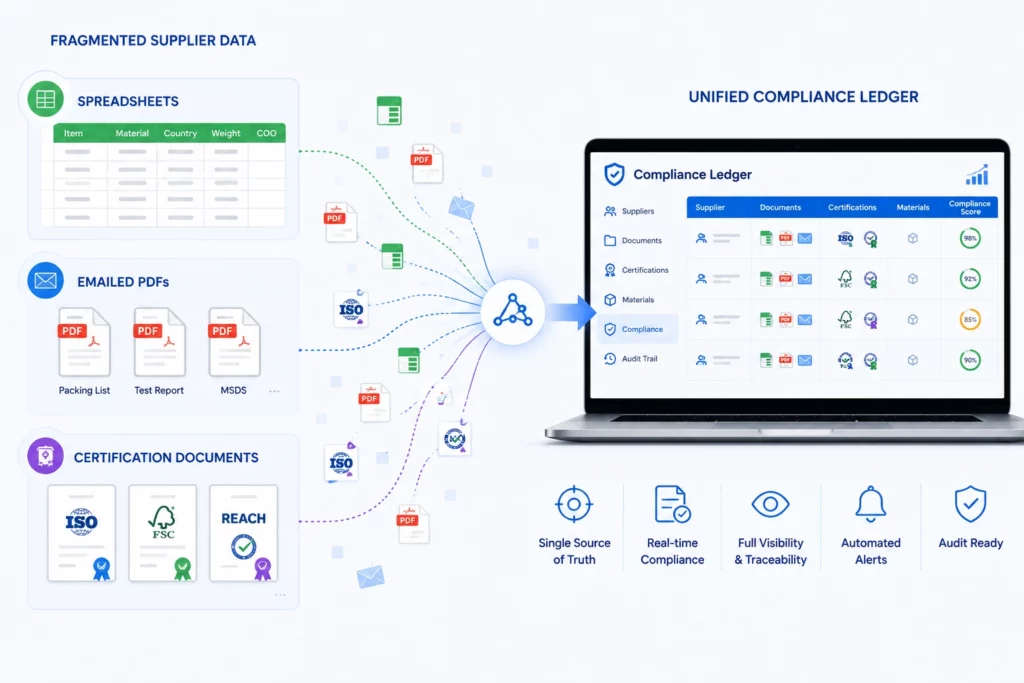
Brands with vertically integrated operations or fragmented co-packer relationships need a single source of truth for every SKU which supplier produced what, with which substances, against which conformity assessment. TraceX’s blockchain-backed supplier records solve this by binding each role’s data to an immutable, audit-ready chain.
What Are the Key PPWR Scope Obligations From 12 August 2026?
The August 2026 deadline triggers three immediate obligations that determine market access: the Declaration of Conformity, the PFAS food-contact ban, and revised substance-of-concern minimisation rules. Each is non-negotiable from day one.
By the Numbers — PPWR 2026 Readiness
186.5 kg
Average EU packaging waste per citizen in 2022 (Eurostat, 2024)
+20.6%
Total packaging waste increase across the EU, 2011–2022 (Eurostat, 2024)
12 Aug 2026
First hard PPWR deadline no grace period, no transition
9–18 months
Typical packaging development cycle August 2026 is already past for many SKUs in motion
Declaration of Conformity
From 12 August 2026, every unique packaging SKU placed on the EU market must be covered by a Declaration of Conformity backed by technical documentation. The DoC must reference Annex I scope criteria, recyclability assessments, and substance compliance. Products without a valid DoC cannot legally enter the market.
From 12 August 2026, the PPWR prohibits placing food-contact packaging on the market if it contains per- and poly-fluoroalkyl substances (PFAS) at or above specified concentration limits. This is one of the most operationally disruptive rules PFAS appear in coated paper boards, fryer-safe liners, and microwave wrappers that food brands often source through several intermediaries who never disclosed the chemistry.
August 2026 is the starting line, not the finish line. The obligations phase in through 2040 in waves, each adding new categories of requirements to packaging that’s already in scope.
PPWR Phased Timeline 2026–2040
Year
Key milestone
12 Aug 2026
Declaration of Conformity mandatory; PFAS food-contact ban; substance-of-concern minimisation
Feb 2027
HORECA / takeaway reusable packaging access for consumers
2028
Standardised labelling requirements; harmonised material identification
2030
100% packaging design-for-recycling; 10% PCR food-contact-sensitive plastics; 35% PCR other plastics; 30% PCR PET bottles; 40% B2B transport packaging reuse; Annex V single-use plastic bans
2035
30% recycling rate for wood; 55% for all other packaging categories at scale
2040
65% PCR in plastic packaging; 70% transport packaging reuse rate
Scope expansion via Annex V. The 2030 Annex V bans aren’t symbolic they remove entire SKU categories from the market. HORECA condiment sachets, single-use plastic packaging in the accommodation sector for individual bookings, and certain very-lightweight produce wraps are scoped out of legal commerce. Brands selling to hotel chains, airlines, and QSR networks face concentrated 2030 risk.
What Are the Biggest PPWR Scope Challenges for Global Suppliers?
Three operational problems will dominate PPWR readiness conversations for the next 18 months, and none of them are about packaging design.
1. Substance verification across deep supply chains. PFAS, heavy metals, and substances of concern aren’t disclosed unless someone asks. Food brands sourcing coated boards through converters who source from mills who source from chemistry suppliers face a four-tier verification problem. Manual email chases break down at scale.
2. Recycled content traceability.PCR claims require chain-of-custody from the recycler upward. Most companies already meet the physical requirements the gap is proving it: collecting verified substance test results, recycler certificates, and full material breakdowns from every supplier in the chain. Recycler audits don’t show up in ERP. They show up in PDFs in someone’s inbox.
3. Conformity assessment for every SKU. A mid-sized FMCG brand can manage 500–2,000 unique packaging configurations. Each one needs technical documentation, conformity assessment evidence, and a signed DoC. Spreadsheet-based compliance hits a wall around 200 SKUs.
EUDR-PPWR data overlap Brands already running EUDR (EU Deforestation Regulation) compliance for forest-risk commodities have built supplier data infrastructure KYC, certifications, traceability records that directly translates to PPWR documentation. If TraceX customers running EUDR DDS workflows redeploy their supplier-data pipelines for PPWR, the marginal compliance cost is a fraction of starting from zero. The companies that don’t have an EUDR-style infrastructure are looking at building it from scratch in less than 18 months.
Our agentic AI was built to extract structured compliance data from unstructured supplier documents emails, PDFs, scanned certificates, language-mixed invoices. The same parsing engine that auto-generates EUDR Due Diligence Statements can populate PPWR Declarations of Conformity. Substance declarations, recycled content certificates, and conformity test reports become structured records inside one audit-ready chain.
Wondering how much of your packaging portfolio is actually documentation-ready?
Book a 30-minute portfolio mapping session with a TraceX compliance specialist — we’ll walk through your SKUs, your supplier base, and where the gaps are likely to surface before August 2026
How to Map Your Packaging Portfolio Against PPWR Scope
A practical five-step scoping playbook for compliance teams starting now.
Inventory every unique packaging SKU placed on the EU market, including imported goods. Build a single registry covering primary, secondary, and tertiary formats per product line.
Identify your role(s) per SKU, manufacturer, importer, distributor, fulfilment service provider, online marketplace operator. Multi-role exposure is the default, not the exception.
Map suppliers and request substance declarations, focus PFAS verification on food-contact items first; this is the August 2026 hard stop.
Audit recycled content claims and pull recycler certificates, every PCR percentage on a label must be defensible by 2030. Building chain-of-custody now beats panic-collecting later.
Stand up a digital documentation system, Declarations of Conformity, technical files, conformity assessments, and substance records all need to live somewhere queryable, exportable, and audit-defensible. Spreadsheets won’t survive the first audit.
How TraceX Helps Organizations Achieve PPWR Compliance
TraceX helps manufacturers, brand owners, importers, retailers, and packaging suppliers simplify PPWR compliance through a centralized platform for packaging data management, supplier collaboration, conformity assessments, and audit-ready documentation.
Ready to map your PPWR exposure?
TraceX’s Regulatory Compliance Platform automates supplier data collection, substance verification, and Declaration of Conformity generation across your full packaging portfolio.
PPWR scope is broad by design. If your products reach EU consumers in any form, the safest assumption is that you’re in scope until proven otherwise. The August 2026 deadline isn’t moving, and the data infrastructure needed to prove conformity substance verification, recycled content traceability, supplier documentation takes longer to build than to design new packaging.
The companies that get through this cleanly will be the ones treating PPWR readiness as a supplier-data problem, not a packaging-design problem.
Frequently Asked Questions (FAQ’s)
Does PPWR Apply to Non-EU Companies?
Yes. PPWR applies to any packaging placed on the EU market regardless of where the operator is established. Any empty or filled packaging made available within the EU including via online sales and cross-border delivery falls within scope. Non-EU exporters typically designate an EU-based authorised representative to discharge documentation obligations.
What Packaging Is Exempt From PPWR?
Items that are products in their own right, not packaging, are out of scope for example, an empty toolbox sold standalone or a refillable pepper mill. Food packaging sold empty by the final distributor (e.g., empty pizza boxes sold at retail) is also excluded. The test is function: if the item exists to contain, protect, handle, deliver, or present another product, it’s packaging.
Is the PPWR the Same as ESPR?
No, but they overlap. ESPR (Ecodesign for Sustainable Products Regulation) covers product design and Digital Product Passports across many categories. PPWR is packaging-specific. The PPWR Substances of Concern definition is aligned to ESPR, and Digital Product Passport infrastructure built for ESPR can carry PPWR conformity data.
When Does PPWR Come Into Force?
The PPWR entered into force on 11 February 2025 and applies generally across the EU from 12 August 2026. From that date, Declarations of Conformity are mandatory, the PFAS food-contact ban applies, and most core obligations become enforceable. Additional milestones phase in through 2040.
What Are the Penalties for PPWR Non-Compliance?
Member states set penalties under their national enforcement regimes, but consequences include market access denial (non-compliant packaging cannot be placed on the EU market), product recalls, retail delisting, and administrative fines. For FMCG operators, the practical risk is losing shelf space retail buyers are already asking for PPWR readiness evidence.
Start using TraceX
Transparency, Trust, & Success for your Climate Journey.
We use cookies on our website to give you the most relevant experience by remembering your preferences and repeat visits. By clicking “Accept All”, you consent to the use of ALL the cookies. However, you may visit "Cookie Settings" to provide a controlled consent.
This website uses cookies to improve your experience while you navigate through the website. Out of these, the cookies that are categorized as necessary are stored on your browser as they are essential for the working of basic functionalities of the website. We also use third-party cookies that help us analyze and understand how you use this website. These cookies will be stored in your browser only with your consent. You also have the option to opt-out of these cookies. But opting out of some of these cookies may affect your browsing experience.
Necessary cookies are absolutely essential for the website to function properly. These cookies ensure basic functionalities and security features of the website, anonymously.
Cookie
Duration
Description
cookielawinfo-checkbox-analytics
11 months
This cookie is set by GDPR Cookie Consent plugin. The cookie is used to store the user consent for the cookies in the category "Analytics".
cookielawinfo-checkbox-functional
11 months
The cookie is set by GDPR cookie consent to record the user consent for the cookies in the category "Functional".
cookielawinfo-checkbox-necessary
11 months
This cookie is set by GDPR Cookie Consent plugin. The cookies is used to store the user consent for the cookies in the category "Necessary".
cookielawinfo-checkbox-others
11 months
This cookie is set by GDPR Cookie Consent plugin. The cookie is used to store the user consent for the cookies in the category "Other.
cookielawinfo-checkbox-performance
11 months
This cookie is set by GDPR Cookie Consent plugin. The cookie is used to store the user consent for the cookies in the category "Performance".
viewed_cookie_policy
11 months
The cookie is set by the GDPR Cookie Consent plugin and is used to store whether or not user has consented to the use of cookies. It does not store any personal data.
Functional cookies help to perform certain functionalities like sharing the content of the website on social media platforms, collect feedbacks, and other third-party features.
Performance cookies are used to understand and analyze the key performance indexes of the website which helps in delivering a better user experience for the visitors.
Analytical cookies are used to understand how visitors interact with the website. These cookies help provide information on metrics the number of visitors, bounce rate, traffic source, etc.
Advertisement cookies are used to provide visitors with relevant ads and marketing campaigns. These cookies track visitors across websites and collect information to provide customized ads.
Download the 2026 Traceability Scorecard and Benchmark Your Supply Chain Across 10 Critical Capabilities.
Download our eBook
Don’t Wait for an Audit to Find Your EUDR Gaps
The 2026 Simplification Package changes how HS codes, DDS pass-through and geolocation rules apply to you. Get the free guide and 20-point readiness checklist before enforcement catches you unprepared.