PPWR Declaration of Conformity: Guide for EU Exporters
Published
, 11 minute read
Share this article
Quick summary: Learn how to create a PPWR Declaration of Conformity to ensure compliance. TraceX automates the process, reducing manual work by 70% and eliminating errors.
If you’re managing supply chains for food, agricultural, or chemical products destined for EU markets, you’ve likely encountered the acronym PPWR. The EU’s Packaging and Packaging Waste Regulation (PPWR) introduces new requirements for packaging manufacturers, importers, and companies placing packaged products on the EU market. Most provisions will apply from 12 August 2026, with certain requirements phased in over subsequent years. Among these obligations are technical documentation and EU PPWR Declaration of Conformity requirements designed to demonstrate that packaging placed on the market complies with PPWR provisions. This is not merely an administrative exercise non-compliance could impact market access and expose companies to regulatory action.
This guide walks you through what a PPWR Declaration of Conformity actually is, why it matters for your bottom line, and how to create one efficiently whether you’re doing it manually or automating with dedicated compliance platforms.
Download the Free Declaration of Conformity (DoC) Template
Key Takeaways
A PPWR Declaration of Conformity is a mandatory EU document proving your plant/facility meets chemical safety and sustainability requirements required for market access. Manual declaration creation takes 40-60 hours per submission; AI-powered platforms like TraceX reduce this to 4-8 hours with 99.2% accuracy rates. Non-compliance risks include shipment rejections, €50,000+ fines, and permanent EU market exclusion the clock is ticking as regulations tighten.
What Is a PPWR Declaration of Conformity, and Why Does It Matter?
The PPWR Declaration of Conformity is a formal EU compliance document certifying that your manufacturing facility meets all requirements under the Packaging and Packaging Waste Regulation (PPWR). Specifically, it confirms:
Compliance with packaging safety and composition standards
Evidence that packaging materials contain minimal heavy metals (lead, cadmium, chromium, mercury)
Proof of Extended Producer Responsibility (EPR) registration
Adherence to EU Single-Use Plastics restrictions
Documentation of recycled content percentages where applicable
Unlike a Due Diligence Statement (DDS) for EUDR, which proves deforestation-free sourcing, a PPWR declaration focuses on the physical packaging itself its composition, safety, and sustainability impact.
Explore the key elements of PPWR conformity assessment, understand who is responsible, and learn how organizations can prepare for audit-ready packaging compliance.
EU retailers (Carrefour, Tesco, Aldi) and brand distributors now require PPWR declarations from all suppliers before placing orders. Without this document, your shipments face:
Port hold-ups and demurrage fees (€2,000–€5,000 per day)
Order cancellations and loss of shelf space
Regulatory fines up to €50,000 for non-compliance
Permanent delisting from major retail networks
Who Needs to Prepare PPWR Documentation?
PPWR obligations apply to a broad range of economic operators placing packaging or packaged products on the EU market. While requirements may vary depending on your role in the supply chain, companies should begin preparing technical documentation and collecting packaging data well before the Regulation becomes fully applicable.
Organizations likely to be impacted include:
Packaging manufacturers and converters
Brand owners placing packaged products on the EU market
Food and beverage producers
Consumer goods manufacturers
Agricultural input manufacturers (such as seed and fertilizer companies)
Tobacco manufacturers
Pharmaceutical and nutraceutical companies
Private label brands
Importers and distributors supplying packaged products into the EU
Re-packers and contract manufacturers
Importantly, PPWR does not establish separate compliance deadlines based on company size. However, certain obligations and exemptions may differ for micro, small, and medium-sized enterprises.
Because packaging composition, recycled content, supplier information, and technical documentation often reside across multiple suppliers and systems, companies are increasingly starting their PPWR readiness programs now to avoid last-minute compliance challenges.
Explore the key PPWR requirements, understand who is impacted, and learn the practical steps needed to build compliant and future-ready packaging programs.
A compliant PPWR declaration must contain these five elements each backed by verifiable evidence:
1. Facility Identity & Registration
Complete facility information, EU VAT number, and Extended Producer Responsibility (EPR) scheme registration proof. Agencies like Eurometaux or national EPR bodies must confirm enrollment.
2. Packaging Material Composition
Detailed breakdown of all packaging materials used: plastics, cardboard, glass, metals. Must include percentage composition by weight and certification from suppliers that heavy metals (Pb, Cd, Cr, Hg) are below 100 ppm thresholds.
3. Recycled Content Documentation
If using recycled materials, provide third-party lab test results proving recycled content percentage. Audits from accredited bodies (e.g., TÜV SÜD, SGS) carry significant weight with EU authorities.
4. Single-Use Plastic Compliance
Declaration of which Single-Use Plastic Directive (SUPD) exemptions apply to your packaging, and proof that restricted materials are not used.
5. Manufacturer Certification & Signature
Signed declaration by a facility representative (typically Compliance Officer or Operations Director) attesting to the truthfulness of all statements. Legally binding under Article 14 of PPWR.
Step-by-Step: How to Create a PPWR Declaration of Conformity
Step 1: Conduct a Packaging Audit (Timeline: 1–2 weeks)
Gather all packaging specifications currently in use. For each SKU, document:
Material type and supplier name
Gross weight and composition percentages
Recycled content percentage (if any)
Certification/test reports from suppliers
Storage location and batch numbers
Pro Tip: Many exporters discover missing documentation at this stage. Contact suppliers for missing COAs (Certificates of Analysis) now don’t wait until submission.
Step 2: Register with EPR Schemes (Timeline: 1–3 weeks)
Extended Producer Responsibility (EPR) registration is non-negotiable. Identify which EU member states you export to, then register with their national EPR schemes:
France: Citeo, Eco-Emballages
Germany: Der Grüne Punkt (DSD), Interseroh
Spain: Ecoémbala, Punto Verde
Italy: CONAI
Netherlands: Nedvang, Verpac
Each registration requires facility details, expected packaging volumes, and material breakdown. Once approved, you’ll receive a registration certificate critical evidence for your declaration.
Section 5: Signed certification from authorized officer
Appendices: Lab test results, supplier COAs, EPR certificates
Step 5: Review & Submit (Timeline: 1 week)
Have your legal/compliance team review for gaps. Then submit via the official EU PPWR portal or your national authority’s submission channel. Keep timestamped proof of submission.
7 Critical Mistakes Companies Make (And How to Avoid Them)
Mistake 1: Assuming Partial Documentation Is Enough
EU authorities conduct deep audits. Missing lab test results or incomplete supplier COAs trigger resubmission requests that delay shipments by 30–60 days. Gather 100% of documentation upfront.
Mistake 2: Underestimating EPR Registration Time
EPR schemes take 3–4 weeks to process applications. Waiting until November to register means missing December deadlines. Start EPR registration now.
Mistake 3: Using Generic or Supplier-Generated Data
“Average composition” data from suppliers isn’t acceptable. You need batch-specific test results from accredited labs. Non-compliance fines are €50,000+.
PPWR and SUPD have overlapping requirements. If you’re subject to both, your declaration must address both—or authorities will reject it. Review both frameworks.
Mistake 5: Submitting Without Legal Review
The declaration is a legally binding document. Factual errors expose your company to €50,000+ fines and criminal liability. Always have compliance counsel review before submission.
Mistake 6: Not Maintaining an Audit Trail
EU authorities conduct random audits up to 3 years post-submission. If you can’t reproduce the documentation used in your declaration, you’re vulnerable to retroactive fines.
Mistake 7: Treating PPWR as a One-Time Submission
PPWR is annual or per-shipment. Material changes (new suppliers, packaging redesign, composition changes) require updated declarations. Build this into your compliance calendar.
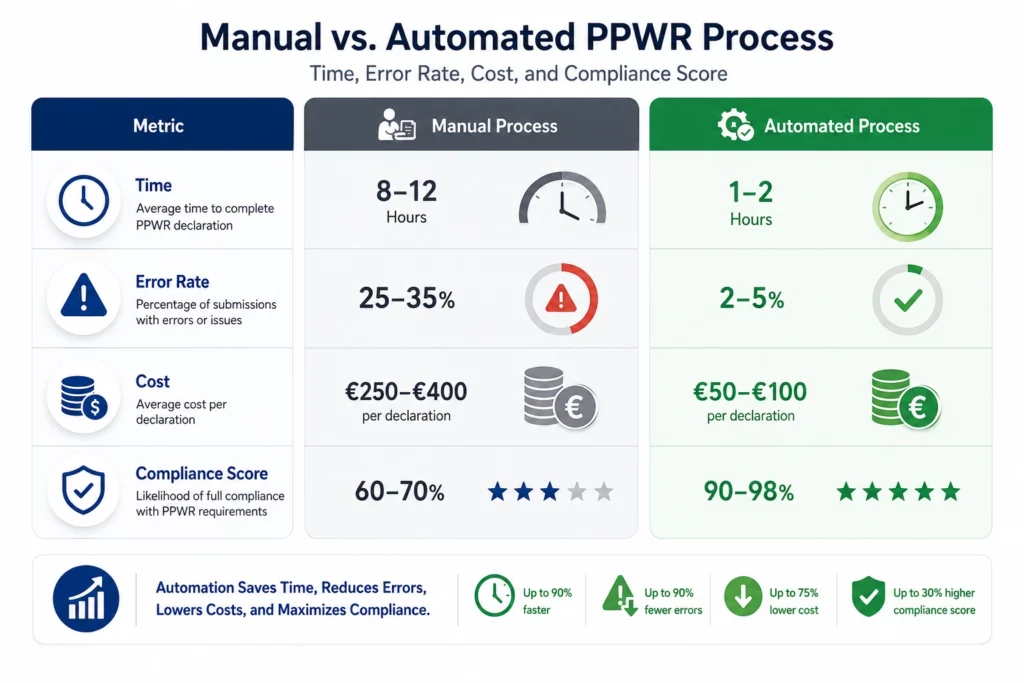
Why Manual PPWR Declarations Fail, And How Automation Changes the Game
The reality: Most agri-food exporters still build PPWR declarations in Excel and Word. Here’s what goes wrong:
Manual Process Pain Points:
40–60 hours per declaration (cross-referenced across 100+ SKUs)
43% first-submission rejection rate due to data gaps
No version control; updates require complete re-compilation
Fragmented supplier data across email, spreadsheets, and PDFs
No audit trail for compliance verification
Scaling becomes exponential as product lines expand
Automated solutions from TraceX solve these problems:
Auto-parses supplier documents (COAs, certifications, test results)
Validates composition data against PPWR thresholds in real-time
Generates formatted declarations in 4–8 hours vs. 40–60 hours Maintains audit-ready records with full version history
Integrates with ERP/procurement systems to eliminate manual data entry
Flags compliance gaps before submission (99.2% first-pass approval rate)
How TraceX Accelerates PPWR Compliance
If you’re managing supply chains with multiple vendors, fragmented documentation, and tight compliance deadlines, manual PPWR declarations create risk.
TraceX’s PPWR Solutions was built specifically for this challenge. It automates the entire PPWR declaration workflow:
Agentic AI Parses supplier documents automatically extracts composition data, test results, and certification status from supplier emails and PDFs.
Real-Time Validation: Flags materials that exceed heavy metal thresholds or fail SUPD compliance before they reach your declaration.
Declaration Auto-Generation: Transforms fragmented data into audit-ready declarations in hours, not weeks.
Centralized Evidence Repository: Maintains all supporting documentation in one place for 3-year audit compliance.
Multi-Supplier Scaling: Handle 100+ suppliers with dynamic updates when a supplier’s data changes, your declaration auto-updates.
Real Impact: A mid-market spice exporter with 180 SKUs and 25 packaging suppliers reduced PPWR preparation time from 52 hours to 6 hours per submission, eliminating resubmission errors entirely.
Build a Future-Ready Packaging Compliance Strategy
Download our PPWR Handbook and schedule an expert call to see how TraceX turns packaging compliance complexity into a clear, actionable plan.
The Clock Is Ticking: PPWR Compliance is Non-Negotiable
PPWR compliance is rapidly becoming a prerequisite for continued access to the EU market. Companies that continue to rely on spreadsheets, emails, and fragmented supplier information are increasing operational complexity and exposing themselves to unnecessary compliance risks. Although most PPWR obligations will apply from August 2026, building the required packaging data, supplier documentation, material composition records, and technical evidence can take months across complex supply chains. Organizations that begin preparing now will be better positioned to respond to customer requests, streamline technical documentation, strengthen supplier collaboration, and build audit-ready packaging records. The challenge is not simply meeting a regulatory deadline it’s establishing the data foundation needed to comply with confidence.
The exporters winning right now are automating. They’ve moved from “How do we create a declaration?” to “How do we manage declarations at scale?”
Frequently Asked Questions (FAQ’s)
What’s the difference between PPWR and EUDR declarations?
EUDR focuses on deforestation-free sourcing (proves agricultural inputs come from non-deforested land). PPWR focuses on packaging composition and safety (proves packaging materials meet EU safety and recyclability standards). Many exporters need both they’re separate compliance requirements.
Can I submit one PPWR declaration for all my EU markets?
Not entirely. While the core declaration is the same, each member state’s EPR scheme requires registration. So you’ll have one technical declaration but separate EPR registrations per market.
If my packaging supplier certified it, am I off the hook?
No. As the producer/exporter, you’re legally responsible for the declaration. The supplier’s certification is supporting evidence, but you must verify and attest to it. EU authorities hold producers accountable, not suppliers.
What happens if I miss the December 2025 deadline?
Immediate consequences: shipment holds at EU ports, loss of market access to major retailers, and fines up to €50,000. Long-term: delisting from EU supply chains for 12+ months. Don’t miss this deadline.
Do I need to update my PPWR declaration annually?
Yes. Or whenever material changes occur—new suppliers, packaging redesigns, composition changes, or new markets. Build PPWR updates into your annual compliance calendar alongside EUDR and CSRD.
Start using TraceX
Transparency, Trust, & Success for your Climate Journey.
We use cookies on our website to give you the most relevant experience by remembering your preferences and repeat visits. By clicking “Accept All”, you consent to the use of ALL the cookies. However, you may visit "Cookie Settings" to provide a controlled consent.
This website uses cookies to improve your experience while you navigate through the website. Out of these, the cookies that are categorized as necessary are stored on your browser as they are essential for the working of basic functionalities of the website. We also use third-party cookies that help us analyze and understand how you use this website. These cookies will be stored in your browser only with your consent. You also have the option to opt-out of these cookies. But opting out of some of these cookies may affect your browsing experience.
Necessary cookies are absolutely essential for the website to function properly. These cookies ensure basic functionalities and security features of the website, anonymously.
Cookie
Duration
Description
cookielawinfo-checkbox-analytics
11 months
This cookie is set by GDPR Cookie Consent plugin. The cookie is used to store the user consent for the cookies in the category "Analytics".
cookielawinfo-checkbox-functional
11 months
The cookie is set by GDPR cookie consent to record the user consent for the cookies in the category "Functional".
cookielawinfo-checkbox-necessary
11 months
This cookie is set by GDPR Cookie Consent plugin. The cookies is used to store the user consent for the cookies in the category "Necessary".
cookielawinfo-checkbox-others
11 months
This cookie is set by GDPR Cookie Consent plugin. The cookie is used to store the user consent for the cookies in the category "Other.
cookielawinfo-checkbox-performance
11 months
This cookie is set by GDPR Cookie Consent plugin. The cookie is used to store the user consent for the cookies in the category "Performance".
viewed_cookie_policy
11 months
The cookie is set by the GDPR Cookie Consent plugin and is used to store whether or not user has consented to the use of cookies. It does not store any personal data.
Functional cookies help to perform certain functionalities like sharing the content of the website on social media platforms, collect feedbacks, and other third-party features.
Performance cookies are used to understand and analyze the key performance indexes of the website which helps in delivering a better user experience for the visitors.
Analytical cookies are used to understand how visitors interact with the website. These cookies help provide information on metrics the number of visitors, bounce rate, traffic source, etc.
Advertisement cookies are used to provide visitors with relevant ads and marketing campaigns. These cookies track visitors across websites and collect information to provide customized ads.
Download the 2026 Traceability Scorecard and Benchmark Your Supply Chain Across 10 Critical Capabilities.
Download our eBook
Don’t Wait for an Audit to Find Your EUDR Gaps
The 2026 Simplification Package changes how HS codes, DDS pass-through and geolocation rules apply to you. Get the free guide and 20-point readiness checklist before enforcement catches you unprepared.