Quick summary: ESPR DPP Regulation explained: understand Digital Product Passport requirements, product scope, timelines, and what manufacturers and importers must do to comply with EU sustainability rules.
The ESPR DPP is reshaping how businesses access the EU market and many are not ready. What was once managed through static documents and periodic audits is now shifting to always-on, digital compliance, exposing gaps in data, supplier visibility, and system readiness. The ESPRDPP Regulation mandates the use ofDigital Product Passports (DPPs) to improve product sustainability, traceability, and circularity across the EU market.
Under the DPP Regulation, manufacturers and importers must provide standardized data on product composition, origin, environmental impact, and compliance. The regulation applies to priority product categories such as textiles, batteries, electronics, and construction materials, with phased enforcement starting from 2026. The DPP Regulation ensures transparent, verifiable product information to support regulatory enforcement, market access, and sustainable product design.
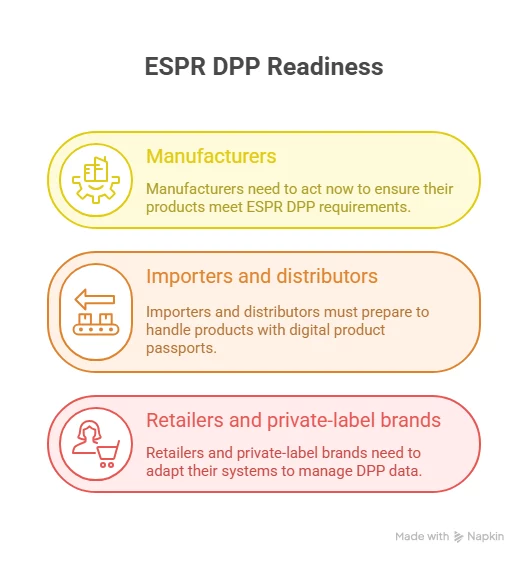
As the backbone of the EU Circular Economy Action Plan, ESPR makes Digital Product Passports mandatory, moving compliance from paperwork to infrastructure. Manufacturers, importers, brand owners, and retailers will all be accountable making early DPP adoption essential to avoid disruption, delays, and lost market access.
Key Takeaways
The Digital Product Passport (DPP) Regulation under ESPR requires manufacturers, importers, and brand owners to provide standardized, digital product data covering identity, composition, origin, sustainability metrics, and compliance evidence.
Priority products such as batteries, textiles, electronics, and furniture must implement DPPs in phased timelines starting from 2026.
Minimum DPP data enables EU market access, while extended, sector-specific data supports circularity and ESG goals.
Effective compliance depends on structuring product- and batch-level data, integrating supplier information, and adopting the Digital Product Passport solution to ensure scalable, audit-ready, and future-proof implementation.
What is required under the Digital Product Passport (DPP) Regulation?
Under the ESPR, manufacturers must create Digital Product Passports containing standardized product, sustainability, and compliance data. Requirements vary by product category and are defined through delegated acts, with phased implementation starting from 2026.
Overview of the ESPR Regulation
The Ecodesign for Sustainable Products Regulation (ESPR) is a cornerstone of the EU’s sustainability framework, established to make products placed on the EU market more durable, resource-efficient, and transparent. Its legal foundation lies in the EU Green Deal and the Circular Economy Action Plan, which aim to reduce environmental impact across product lifecycles. Unlike earlier Ecodesign directives that focused mainly on energy-related products and efficiency, ESPR has a broader scope, covering almost all physical goods and introducing requirements on durability, reparability, recyclability, carbon footprint, and supply chain transparency.
Role of Digital Product Passports Under ESPR
Under ESPR, Digital Product Passports (DPPs) are mandatory because they provide the digital infrastructure needed to enforce sustainability requirements at scale. DPPs centralize product-level data on composition, origin, environmental performance, and compliance, making it accessible to regulators, businesses, and consumers. By enabling end-to-end traceability and standardized data sharing, DPPs support circularity initiatives such as repair, reuse, and recycling, while allowing authorities to verify compliance in real time. In effect, DPPs transform ESPR from a policy goal into an enforceable, data-driven regulation.
Download the complete ESPR DPP eBook to understand requirements, timelines, and implementation strategies and get your roadmap from compliance to competitive advantage.
Which Products Require Digital Product Passports Under ESPR?
The ESPR DPP framework applies to a wide range of physical products placed on the EU market, with implementation prioritized based on environmental impact, circularity potential, and supply chain risk. Rather than applying uniformly across all goods, ESPR introduces product-specific DPP requirements through phased rollouts and delegated acts.
ESPR identifies priority product categories that must implement Digital Product Passports due to their material intensity, waste footprint, or sustainability risk:
Batteries: Including EV, industrial, and portable batteries, with detailed requirements on material composition, carbon footprint, and end-of-life recovery.
Textiles & apparel: Covering garments, footwear, and home textiles, with focus on fiber composition, recycled content, durability, and supply chain traceability.
Electronics & ICT products: Such as smartphones, laptops, and servers, requiring transparency on components, repairability, and material recovery.
Furniture: Addressing durability, materials used, and circular design attributes.
Construction products (future phases): Including steel, cement, and building materials, where environmental impact and lifecycle data are critical.
These categories are addressed first because they represent high environmental impact and high regulatory priority within the EU Circular Economy Action Plan.
ESPR DPP Timeline by Product Category
ESPR DPP implementation follows a phased, category-specific timeline:
2024–2025: Development of delegated acts defining detailed DPP requirements for priority products
2026: Initial DPP enforcement begins for early product categories (notably batteries and textiles)
2027–2030: Gradual expansion of DPP obligations across additional regulated product groups
This staged approach gives businesses time to build digital infrastructure—but also requires early preparation, as data readiness must precede enforcement.
How Delegated Acts Define DPP Requirements
Delegated acts are legally binding EU instruments used to specify how ESPR requirements apply to each product category. They are critical because they translate the regulation into operational obligations.
Delegated acts define:
Required data fields: Such as material composition, origin, carbon footprint, durability, and recycled content
Data access rights: Determining which stakeholders (regulators, consumers, repairers, recyclers) can access which data
Verification requirements: Including validation methods, third-party checks, and audit expectations
Without delegated acts, DPP obligations remain high-level; with them, compliance becomes product-specific and enforceable.
Why DPP Requirements Differ by Product
DPP requirements vary by product category because risk profiles, lifecycles, and circularity pathways differ. A battery requires deep visibility into critical raw materials and recycling potential, while textiles focus more on fiber composition, durability, and social compliance. Electronics emphasize repairability and component recovery, while construction products prioritize lifecycle emissions and material performance.
By tailoring DPP requirements, ESPR ensures that data collection is relevant, proportional, and effective, while still achieving its core goals of traceability, circularity, and regulatory enforcement.
What Data Must Be Included in an ESPR Digital Product Passport?
The ESPR Digital Product Passport (DPP) Regulation establishes a standardized set of mandatory data that must be made available for products placed on the EU market. These requirements ensure products are transparent, traceable, and verifiably compliant across their lifecycle. While the exact data fields are finalized through delegated acts for each product category, ESPR defines a common baseline of information that all regulated products must provide.
Product Identification
Each DPP must clearly identify the product through model numbers, SKUs, serial numbers, or batch identifiers. This ensures traceability at product or batch level and allows regulators, buyers, and downstream actors to link the passport to the physical product accurately.
Manufacturer and Economic Operator Details
The DPP must include information on the manufacturer, brand owner, importer, or authorized representative responsible for placing the product on the EU market. This establishes accountability and enables enforcement authorities to identify the responsible economic operator in cases of non-compliance.
Material Composition and Substances of Concern
Detailed data on materials, components, and substances of concern is required to support product safety, circularity, and end-of-life processing. This includes disclosure of restricted or hazardous substances in line with EU chemical regulations, enabling safer recycling, repair, and reuse.
Environmental and Carbon Footprint Indicators
Products must report environmental performance metrics, such as carbon footprint, resource use, and energy efficiency, based on standardized methodologies. These indicators allow regulators and buyers to compare products, verify sustainability claims, and enforce ESPR performance requirements.
Compliance Declarations and Certifications
The DPP must contain declarations of conformity, test results, and references to applicable certifications or standards. This digitalizes compliance evidence, reducing reliance on static documents while enabling faster verification during audits or market surveillance.
Repairability, Durability, and Recyclability Data
To support the circular economy, ESPR requires data on product lifespan, repair options, spare parts availability, and recyclability. This information empowers repairers, recyclers, and consumers while ensuring products meet design-for-circularity requirements.
Minimum vs Extended DPP Data Requirements Under ESPR
The ESPR Digital Product Passport (DPP) framework distinguishes between minimum (baseline) data required for EU market access and extended, sector-specific data tailored to the sustainability risks and circularity needs of different product categories. This layered approach ensures proportional compliance while enabling deeper transparency where it matters most.
Minimum DPP Data (Baseline Compliance)
Minimum DPP data represents the non-negotiable information that all regulated products must provide to be placed on the EU market. These fields establish product identity, accountability, and basic sustainability disclosure.
Baseline requirements include:
Mandatory data fields such as product identifiers, manufacturer or economic operator details, and compliance declarations
Standardized data formats defined by the EU to ensure interoperability across systems, regulators, and member states
Core sustainability indicators aligned with ESPR requirements, enabling market surveillance and enforcement
This minimum dataset ensures that every regulated product has a digital, verifiable compliance record, replacing fragmented documentation with structured data.
Extended DPP Data (Sector-Specific)
Extended DPP data applies to specific product categories where deeper sustainability, safety, or circularity insights are required. These requirements are defined through delegated acts and vary by sector.
Examples include:
Batteries: Detailed carbon footprint calculations, recycled content percentages, and performance data to support battery passports and circular energy systems
Textiles: Fiber composition, origin of raw materials, processing steps, and recycled content to verify sustainability claims and supply chain traceability
Circularity and end-of-life instructions: Repairability scores, disassembly guidance, reuse potential, and recycling pathways to enable circular economy outcomes
Extended data transforms DPPs from a compliance tool into a lifecycle intelligence asset, supporting product design, sustainability differentiation, and downstream recovery.
How to Structure Product Data for ESPR Compliance
Meeting ESPR DPP requirements depends not only on what data is collected, but on how product data is structured, connected, and maintained across systems. A robust data architecture ensures interoperability, accuracy, and audit readiness as DPP obligations scale.
Data Architecture for ESPR DPP
A clear distinction between product-level and batch-level data is essential. Product-level data applies to standardized items with consistent specifications, while batch-level data is used for products with variable inputs, such as materials or sourcing locations. ESPR-compliant data architecture must also link supplier, component, and material data, creating a digital chain of custody that connects upstream inputs to the final product. This structure enables traceability, accountability, and rapid issue resolution.
Interoperability and Standards
ESPR requires DPP data to be accessible and interoperable across the EU ecosystem. Standards such as GS1 Digital Link enable consistent product identification, while QR codes and APIs provide scalable access to DPP data for regulators, buyers, and consumers. Seamless integration with ERP, PLM, and sustainability systems ensures that DPP data aligns with operational records, product specifications, and ESG reporting, avoiding duplication and manual reconciliation.
Ensuring Data Accuracy and Audit Readiness
Accurate, up-to-date data is critical for compliance and enforcement. Version control ensures changes to product specifications or sustainability data are tracked over time, while data validation processes verify completeness and correctness at each supply chain stage. End-to-end traceability strengthens audit readiness, allowing authorities to verify claims quickly. In some cases, blockchain or secure registries are used to enhance data integrity and prevent unauthorized modification, further strengthening trust and compliance.
TraceX to assess your ESPR DPP readiness and build a future-proof compliance strategy.
When approached strategically, the ESPR Digital Product Passport shifts from a regulatory obligation to a source of operational intelligence. By structuring product and supply chain data digitally, companies gain real-time visibility into materials, suppliers, and sustainability performance insights that drive better sourcing, design, and risk management decisions. Early adopters benefit from higher buyer trust, faster EU market access, and reduced compliance friction as enforcement tightens. Most importantly, ESPR DPP lays the digital foundation for future EU sustainability regulations, enabling businesses to scale compliance efficiently while strengthening transparency, resilience, and long-term competitiveness.
Understand how the EU Green Deal is reshaping product sustainability
Learn how the Circular Economy model is driving Digital Product Passports.
Find out which products require Digital Product Passports under ESPR
Frequently Asked Questions (FAQ’s)
What products are covered under ESPR DPP?
ESPR DPP initially applies to batteries, textiles, electronics, and other high-impact product categories, with additional sectors added through delegated acts.
When will ESPR DPP become mandatory?
Implementation begins in 2026, with timelines varying by product category.
Is ESPR DPP required for non-EU manufacturers?
Yes. Any product placed on the EU market must comply, regardless of country of origin.
Start using TraceX
Transparency, Trust, & Success for your Climate Journey.
We use cookies on our website to give you the most relevant experience by remembering your preferences and repeat visits. By clicking “Accept All”, you consent to the use of ALL the cookies. However, you may visit "Cookie Settings" to provide a controlled consent.
This website uses cookies to improve your experience while you navigate through the website. Out of these, the cookies that are categorized as necessary are stored on your browser as they are essential for the working of basic functionalities of the website. We also use third-party cookies that help us analyze and understand how you use this website. These cookies will be stored in your browser only with your consent. You also have the option to opt-out of these cookies. But opting out of some of these cookies may affect your browsing experience.
Necessary cookies are absolutely essential for the website to function properly. These cookies ensure basic functionalities and security features of the website, anonymously.
Cookie
Duration
Description
cookielawinfo-checkbox-analytics
11 months
This cookie is set by GDPR Cookie Consent plugin. The cookie is used to store the user consent for the cookies in the category "Analytics".
cookielawinfo-checkbox-functional
11 months
The cookie is set by GDPR cookie consent to record the user consent for the cookies in the category "Functional".
cookielawinfo-checkbox-necessary
11 months
This cookie is set by GDPR Cookie Consent plugin. The cookies is used to store the user consent for the cookies in the category "Necessary".
cookielawinfo-checkbox-others
11 months
This cookie is set by GDPR Cookie Consent plugin. The cookie is used to store the user consent for the cookies in the category "Other.
cookielawinfo-checkbox-performance
11 months
This cookie is set by GDPR Cookie Consent plugin. The cookie is used to store the user consent for the cookies in the category "Performance".
viewed_cookie_policy
11 months
The cookie is set by the GDPR Cookie Consent plugin and is used to store whether or not user has consented to the use of cookies. It does not store any personal data.
Functional cookies help to perform certain functionalities like sharing the content of the website on social media platforms, collect feedbacks, and other third-party features.
Performance cookies are used to understand and analyze the key performance indexes of the website which helps in delivering a better user experience for the visitors.
Analytical cookies are used to understand how visitors interact with the website. These cookies help provide information on metrics the number of visitors, bounce rate, traffic source, etc.
Advertisement cookies are used to provide visitors with relevant ads and marketing campaigns. These cookies track visitors across websites and collect information to provide customized ads.
Download the 2026 Traceability Scorecard and Benchmark Your Supply Chain Across 10 Critical Capabilities.
Download our eBook
Don’t Wait for an Audit to Find Your EUDR Gaps
The 2026 Simplification Package changes how HS codes, DDS pass-through and geolocation rules apply to you. Get the free guide and 20-point readiness checklist before enforcement catches you unprepared.