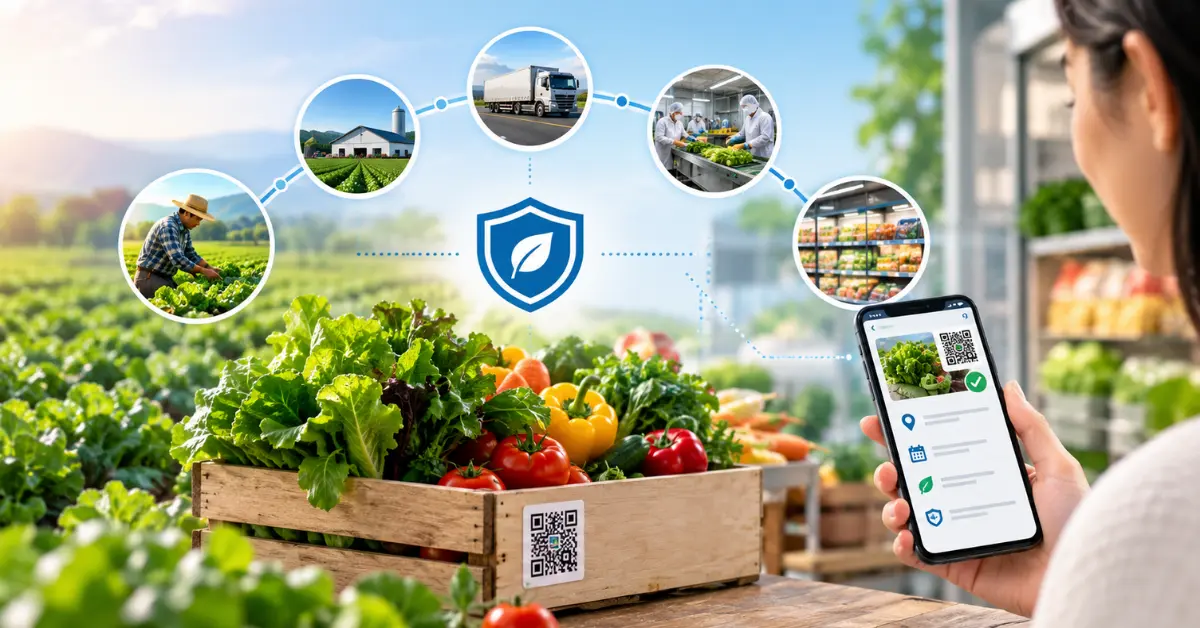
Quick summary: Food safety improves when supply-chain data, batch traceability and blockchain connect every stage—strengthening transparency, recalls and accountability.
How connected supply-chain data and blockchain can strengthen food safety, transparency and accountability
Food safety depends on controls at every stage of the food supply chain. Inspections, laboratory testing, certifications and quality checks are essential but when food moves through multiple organisations, another question becomes equally important: can a business prove what happened to that product at every stage?
A food product may move from a farm to an aggregator, processor, warehouse, transporter, distributor and retailer before reaching the consumer. Each participant generates information such as batch numbers, quality checks, certificates, processing records, storage conditions and shipment details. Yet this information can remain fragmented across different organisations and systems.
The result is a fundamental food safety challenge: the data may exist, but the complete product story may be difficult to reconstruct.
Digital traceability and blockchain can help address this challenge by connecting supply-chain events and creating a more trusted record of product history. Blockchain is not a replacement for food-safety controls; it can act as a trust layer within a broader traceability architecture.
Need Greater Visibility Across Your Food Supply Chain?
Food safety requires end-to-end visibility — businesses need to know where products come from, how they were handled and where they went.
Traceability connects the entire product journey — from farm and raw material to processing, finished products, shipments and customers.
Blockchain can strengthen trust in supply-chain records by creating a tamper-evident record of selected events, quality checks, certifications and custody transfers.
Food safety evidence needs to be connected to the right batch — including laboratory reports, inspections, certificates and supplier declarations.
Better traceability enables faster, more targeted recalls by helping businesses identify affected batches and trace their downstream distribution.
Technology does not replace food-safety controls — blockchain works best as part of a broader system combining data capture, traceability, verification, analytics and corrective-action workflows.
Why Food Safety Needs Urgent Attention
Recent enforcement actions across India show that food safety is not just a compliance requirement, it is an immediate business and public-health priority. In Maharashtra, intensified food-safety inspections have resulted in licences being suspended at restaurants, food outlets and warehouses after authorities found issues including pest infestations, expired or improperly stored food, inadequate segregation, poor hygiene and missing traceability records. Similar inspections in Delhi and Bengaluru have uncovered expired food, poor storage and hygiene lapses even at high-end hospitality establishments. These incidents highlight a critical gap: food businesses need more than periodic inspections they need continuous visibility into what is sourced, handled, stored and distributed. When food safety information is fragmented across suppliers, batches, facilities and quality records, identifying the source of a problem and acting quickly becomes harder. Digital traceability can help businesses maintain a connected evidence trail, strengthen accountability and respond faster when food-safety risks emerge.
FSSAI reported that more than 2.23 lakh food samples were analysed during 2025–26, with over 40,000 found to be non-conforming.
Why Traceability Matters for Food Safety
Food safety incidents rarely begin where they are discovered. A contamination issue may originate at the farm, during processing, through improper storage or during transportation. By the time it is detected, the affected product may have moved through several stages.
Can You Trace Every Step of Your Food Supply Chain?Discover how digital food traceability can connect suppliers, batches, processing, quality records and distribution to strengthen food safety and supply-chain visibility.
Blockchain is a distributed digital ledger that can provide a tamper-evident record of selected transactions or supply-chain events. In a food-safety context, authorised participants can use it to record events such as product origin, batch creation, processing, quality checks, certifications, custody transfers and shipment movements.
The value is not simply storing information on a blockchain. It is creating greater confidence that a shared record has not been retrospectively altered without detection.
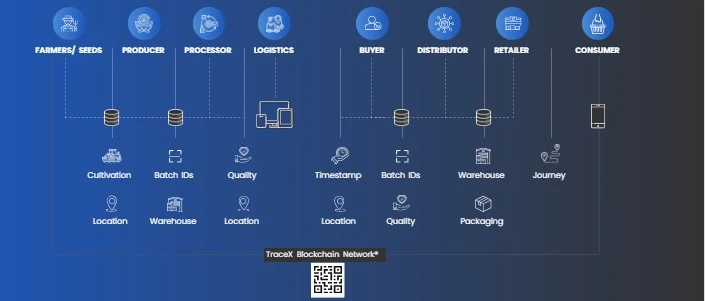
A practical blockchain-enabled model can connect: Farm → Raw Material → Batch → Processing → Finished Product → Shipment → Customer.
Can Blockchain Make Your Food Supply Chain More Trustworthy?Explore how blockchain-enabled traceability can connect product origins, batches, quality records and supply-chain events to strengthen food safety and transparency.
Food safety begins with knowing where ingredients and products originate. For agricultural commodities, this may require connecting a finished product to a farm, producer, harvest event and raw-material batch.
A digital traceability system can capture farm identification, production location, harvest date, commodity, quantity and supplier. A blockchain layer can provide a persistent, tamper-evident record of selected events, creating a stronger provenance trail.
2. Strengthening Batch-Level Traceability
Food safety often comes down to batch-level control. If a raw material is found to be contaminated, a manufacturer needs to know which production lots used it and which finished products may be affected.
A connected traceability system can establish relationships between raw-material batches, processing batches, finished products, shipments and customers. This supports more targeted investigations and recall decisions when sufficiently granular traceability data is available.
Can You Trace Every Batch From Source to Sale?Learn how batch-level traceability can connect raw materials, processing, quality checks and shipments to improve food safety, recalls and supply-chain visibility.
Food supply chains generate substantial quality and safety evidence, including laboratory reports, inspection results, certificates, temperature records, moisture measurements, microbiological testing and supplier declarations.
The challenge is ensuring that each piece of evidence can be connected to the correct product or batch. Blockchain can provide a tamper-evident record of when a quality event was recorded, which batch it related to and which authorised participant recorded it.
Importantly, blockchain does not make a laboratory result accurate by itself. Sampling, testing methods, laboratory competence and operational controls remain essential. Blockchain can help protect the integrity and traceability of the record after information is captured.
4. Improving Supplier Accountability
Modern food supply chains can involve multiple tiers of suppliers. A manufacturer may buy from a processor, who sources from an aggregator, who sources from multiple producers.
Digital traceability can create a clearer record of the relationships between participants and the products they handle.
Who supplied the product?
When was it supplied?
Which batch was supplied?
What certifications or declarations accompanied it?
What quality checks were completed?
When did custody change?
A shared, tamper-evident record can strengthen accountability where multiple organisations contribute to the same product journey.
5. Faster and More Targeted Recalls
One of the clearest business benefits of food traceability is recall management. When a food-safety incident occurs, time is critical.
A business needs to identify the affected raw material, determine which production batches used it, locate the resulting finished products and establish where those products were distributed.
With connected traceability, the organisation can follow the chain backwards and forwards: Source → Batch → Processing → Finished Product → Shipment → Customer.
This can help reduce the time required to identify affected products and support more targeted recall decisions.
6. Building Consumer Trust
Food safety is also a trust issue. Consumers increasingly want to understand where products come from and whether claims about quality, origin or sustainability can be supported.
QR codes and digital product information can provide a consumer-facing window into selected supply-chain information. For example: Scan QR → Product → Batch → Origin → Certifications → Processing → Relevant product information.
The important point is that consumer transparency should be connected to the underlying traceability record. A QR code alone does not create trust; the quality and traceability of the information behind it does.
See How Green Earth Strengthened Food Safety With TraceXDiscover how digital traceability and blockchain technology helped Green Earth improve transparency, streamline supply-chain processes and strengthen food safety and quality in vegetable contract farming.
Blockchain Is Not a Substitute for Food-Safety Controls
Blockchain should not be presented as a standalone solution to food safety. It can help preserve and share records, but it cannot determine whether the original data was truthful, correctly measured or properly collected.
A robust food-safety architecture therefore needs multiple layers:
Data capture from farms, suppliers, factories, laboratories, warehouses and logistics providers
Traceability connecting events to products, batches and lots
Verification through inspections, testing, certifications and controls
A trust layer such as blockchain where shared records add value
Analytics to identify risks and anomalies
Action workflows for recalls, corrective actions and supplier interventions
The right question is not whether a company should put all its food data on a blockchain. The better question is where a tamper-evident, shared record can strengthen trust in the existing traceability process.
What a Connected Food-Safety Traceability Model Looks Like
A practical digital model can connect the complete product journey:
Farm / Supplier → Raw Material Capture → Quality & Laboratory Checks → Processing → Packaging → Warehouse → Logistics → Distribution → Consumer
At each stage, relevant events can be digitally captured and associated with the relevant product, batch or lot. A blockchain layer can then be used selectively to create a shared, tamper-evident record of important events between participating organisations.
Where TraceX Fits
For businesses seeking stronger food safety and supply-chain transparency, the first requirement is reliable, structured traceability data.
TraceX can help organisations capture and connect information across agricultural and food supply chains, from producers and farm-level information through aggregation, processing and downstream movement.
Farmers and suppliers
Farm and production information
Raw materials
Batches and lots
Processing activities
Quality and compliance information
Certifications
Supply-chain transactions
Finished products
Downstream movement
This provides a traceability foundation on which additional verification and trust mechanisms can operate.
The principle is simple: capture the data, connect the events, verify the evidence and make the supply chain traceable.
Ready to Build a More Transparent, Traceable Supply Chain?Connect with our experts to explore how TraceX can help you strengthen traceability, improve compliance and turn supply-chain data into actionable insights.
→ Connect With TraceX
From Reactive Food Safety to Proactive Visibility
Traditional food-safety controls remain essential. But digital traceability can complement inspections and testing by providing continuous visibility into the movement and history of products.
Instead of relying only on finding problems after they occur, businesses can build systems that make it easier to investigate anomalies, identify affected batches and respond quickly.
The future model is not inspection versus technology. It is inspection plus traceability plus data plus verification plus accountability.
Food safety depends on trust between consumers, brands, suppliers, regulators and supply-chain partners. That trust becomes stronger when it can be supported by reliable evidence.
Blockchain can provide a trust layer where multiple organisations need confidence in shared records. Digital traceability provides the context around those records. Data provides the evidence.
Together, these capabilities can help businesses build food-safety processes that are more transparent, connected and accountable.
The goal is not simply to know what happened after a food-safety incident. The goal is to have enough connected information to trace what happened, establish what was affected and act quickly.
Conclusion
The food supply chain is too interconnected for food safety information to remain fragmented. From farm-level production and raw-material sourcing to processing, logistics and distribution, every stage can contribute information that matters to the safety and integrity of the final product.
Blockchain can strengthen trust in selected shared records, while traceability platforms can connect the broader supply-chain story. Together, they create an evidence-driven approach to food safety.
For food businesses, the opportunity is clear: move from disconnected records toward a connected digital trail that can support verification, accountability, transparency and faster response.
In food safety, trust is not created by a claim. It is built by evidence—and evidence becomes more valuable when it can be traced.
Frequently Asked Questions
What is the role of blockchain in food safety?
Blockchain can provide a tamper-evident, shared record of selected food-supply-chain events such as origin, batch creation, quality checks, certifications and custody transfers. It complements rather than replaces food-safety controls and traceability systems.
How does traceability improve food safety?
Traceability connects products and batches to their origin, processing history, quality evidence and distribution. This can help businesses investigate incidents faster, identify affected products and support more targeted recalls.
Can blockchain prevent food contamination?
Blockchain cannot prevent contamination by itself. It can help create a trusted record of supply-chain events and evidence, while prevention still depends on proper sourcing, hygiene, testing, storage, processing and food-safety controls.
How can blockchain help with food recalls?
By connecting raw-material batches to production lots, finished products and shipments, a traceability system can help businesses identify which products may be affected and where they were distributed. A blockchain layer can strengthen trust in selected shared records.
Why is food traceability important for consumer trust?
Traceability can provide evidence about a product’s origin, handling and supply-chain journey. When appropriate information is made available to consumers through digital channels, it can support greater transparency and confidence.
How does TraceX support food traceability?
TraceX provides a digital traceability foundation for connecting producers, suppliers, raw materials, batches, processing activities, quality information and downstream movements across agricultural and food supply chains.
Start using TraceX
Transparency, Trust, & Success for your Climate Journey.
We use cookies on our website to give you the most relevant experience by remembering your preferences and repeat visits. By clicking “Accept All”, you consent to the use of ALL the cookies. However, you may visit "Cookie Settings" to provide a controlled consent.
This website uses cookies to improve your experience while you navigate through the website. Out of these, the cookies that are categorized as necessary are stored on your browser as they are essential for the working of basic functionalities of the website. We also use third-party cookies that help us analyze and understand how you use this website. These cookies will be stored in your browser only with your consent. You also have the option to opt-out of these cookies. But opting out of some of these cookies may affect your browsing experience.
Necessary cookies are absolutely essential for the website to function properly. These cookies ensure basic functionalities and security features of the website, anonymously.
Cookie
Duration
Description
cookielawinfo-checkbox-analytics
11 months
This cookie is set by GDPR Cookie Consent plugin. The cookie is used to store the user consent for the cookies in the category "Analytics".
cookielawinfo-checkbox-functional
11 months
The cookie is set by GDPR cookie consent to record the user consent for the cookies in the category "Functional".
cookielawinfo-checkbox-necessary
11 months
This cookie is set by GDPR Cookie Consent plugin. The cookies is used to store the user consent for the cookies in the category "Necessary".
cookielawinfo-checkbox-others
11 months
This cookie is set by GDPR Cookie Consent plugin. The cookie is used to store the user consent for the cookies in the category "Other.
cookielawinfo-checkbox-performance
11 months
This cookie is set by GDPR Cookie Consent plugin. The cookie is used to store the user consent for the cookies in the category "Performance".
viewed_cookie_policy
11 months
The cookie is set by the GDPR Cookie Consent plugin and is used to store whether or not user has consented to the use of cookies. It does not store any personal data.
Functional cookies help to perform certain functionalities like sharing the content of the website on social media platforms, collect feedbacks, and other third-party features.
Performance cookies are used to understand and analyze the key performance indexes of the website which helps in delivering a better user experience for the visitors.
Analytical cookies are used to understand how visitors interact with the website. These cookies help provide information on metrics the number of visitors, bounce rate, traffic source, etc.
Advertisement cookies are used to provide visitors with relevant ads and marketing campaigns. These cookies track visitors across websites and collect information to provide customized ads.
Download the 2026 Traceability Scorecard and Benchmark Your Supply Chain Across 10 Critical Capabilities.
Download our eBook
Don’t Wait for an Audit to Find Your EUDR Gaps
The 2026 Simplification Package changes how HS codes, DDS pass-through and geolocation rules apply to you. Get the free guide and 20-point readiness checklist before enforcement catches you unprepared.