FSC Certified Wood for EUDR: How to Prove Compliance Before Your Shipment Ships
Published
, 11 minute read
Share this article
Quick summary: Learn how FSC-certified wood supports EUDR compliance, what additional evidence is required beyond FSC certification, and how to prove deforestation-free sourcing before your shipment reaches the EU.
FSC certified wood for EUDR is the first question on every EU buyer’s checklist right now. If you export timber, furniture, flooring or packaging from Asia, Africa or Latin America, you’ve probably already heard it: “Your shipment is FSC certified, but is it EUDR-compliant?”
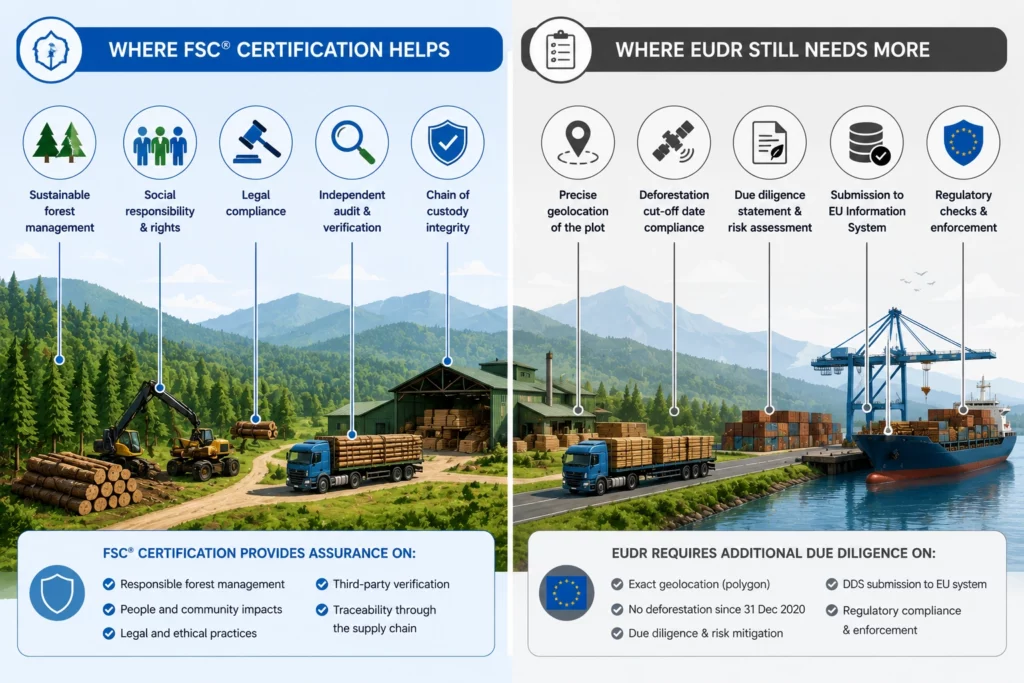
Here’s the plain-language version. FSC certified wood means the timber was independently audited as responsibly and legally managed. EUDR the EU Deforestation Regulation, is a law that bans deforestation-linked products from the EU market and makes you prove it, shipment by shipment. The two overlap, but they are not the same thing. Certified is not the same as compliant, and that gap is where shipments get stuck at customs.
This guide walks through exactly where FSC fits into your EUDR strategy, what gaps remain, and how to close them so you keep your EU market access instead of losing it to a missing coordinate.
Key takeaways
FSC certified wood for EUDR reduces your risk and supplies legality evidence but it does not satisfy EUDR on its own.
EUDR still demands plot-level geolocation, proof the land was forest on 31 Dec 2020, a risk assessment, and a Due Diligence Statement (DDS).
Non-compliance can mean fines of at least 4% of EU-wide turnover, seized goods, and blocked market access.
The fastest path from “certified” to “compliant”: pair your FSC Chain of Custody with a digital traceability platform that maps plots, runs deforestation checks, and auto-generates your DDS.
FSC Certified Wood for EUDR: What You’re Actually Required to Prove
Before you can rely on FSC certified wood for EUDR, you need to know what the regulation actually asks for. EUDR doesn’t reward intent it requires verifiable proof for every consignment:
Geolocation of the exact plot where the wood was harvested (GPS points or polygons).
A Due Diligence Statement (DDS) that links each shipment to its origin and confirms negligible risk.
Legal documentation showing land rights and compliance with the laws of the country of origin.
Deforestation-free proof — the land was not deforested after 31 December 2020.
The responsibility sits upstream, with the operator placing goods on the EU market and records must be kept for five years and produced on demand during audits.
The stakes, in numbers
Fines of at least 4% of EU-wide annual turnover under Article 25 plus seized goods, seized revenues, and up to a 12-month ban from public procurement.
Enforcement applies from 30 December 2026 for large and medium operators, and 30 June 2027 for micro and small operators (Regulation (EU) 2025/2650).
31 December 2020 is the deforestation-free cut-off even legal clearing after that date disqualifies the product.
By one mid-2025 analysis, only ~30% of upstream actors and ~12% of downstream actors had deforestation-tracing systems in place most supply chains are not ready.
From geolocation data and traceability to risk assessments and Due Diligence Statements, the EU Deforestation Regulation introduces several obligations that companies across the value chain need to understand.
No. FSC certification supports EUDR compliance but does not replace it. You still have to submit a DDS with precise geolocation and proof of legality. FSC gets you most of the way it just doesn’t cross the finish line for you.
If you’re already sourcing FSC certified wood, you’re ahead of most exporters but not off the hook. Here’s exactly where FSC certified wood pulls its weight for EUDR, framed around the questions your EU buyer is really asking.
1. “How do I know this wood wasn’t harvested illegally?”
What FSC gives you: annual third-party audits that verify legal harvest rights, adherence to national forestry law, and stakeholder engagement. FSC shows the forest origin is legally managed the legality leg EUDR cares about.
2. “Can you trace this shipment back to the source plot?”
What FSC gives you: access to forest management plans, tenure documents and traceability logs. That’s part of the documentation but EUDR still wants plot-level GPS, which FSC doesn’t hand you by default.
3. “How risky is it to buy wood from your source?”
What FSC gives you: a credibility signal that often earns a lower inherent risk rating in DDS assessments reducing, but not removing, your due-diligence burden.
4. “Can you prove this wood didn’t get mixed with non-compliant batches?”
What FSC gives you: Chain of Custody (CoC) certification that tracks the product through every transformation and transfer, batch by batch the backbone of traceability integrity.
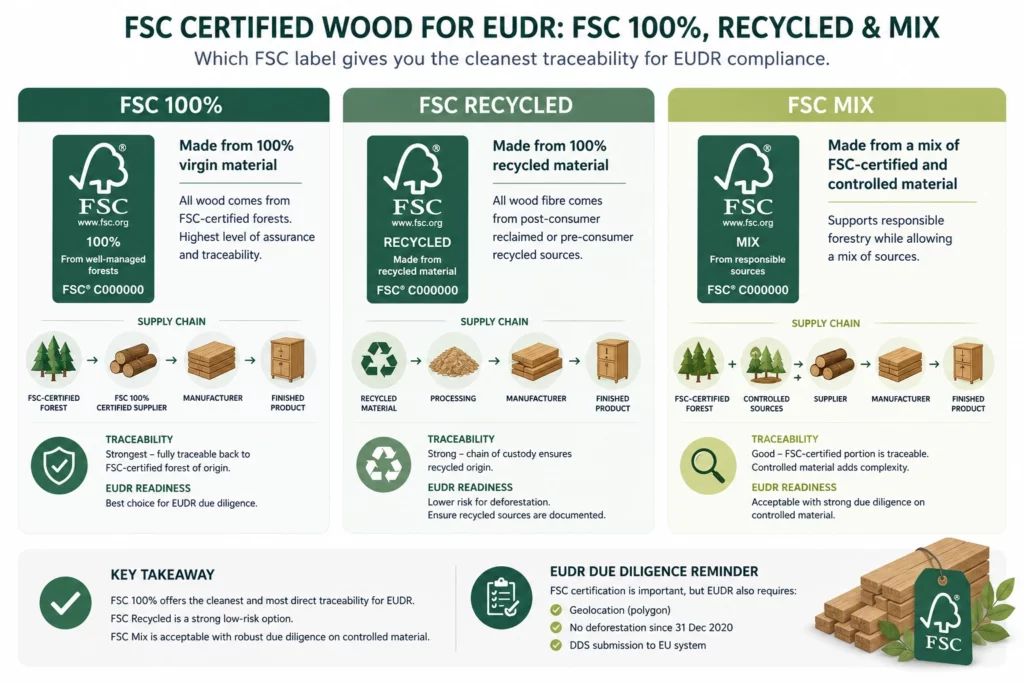
Lowers deforestation risk; weak on origin visibility
FSC Mix
Blend of certified, recycled and controlled sources
Not always traceable to a single forest
Why this matters: an estimated 80–95% of engineered wood products (plywood, particleboard, glulam) use mixed inputs which is exactly where FSC Mix claims leave a geolocation gap EUDR won’t overlook.
FSC Certified Wood for EUDR: The Gaps You Still Have to Close
So FSC certified wood gets you legality, documentation and a lower risk rating. To reach full EUDR compliance, you still need three things FSC won’t give you:
Plot-level geolocation. Exact GPS points or polygons not a region or forest name.
Deforestation-free proof as of 2020. Visual, timestamped evidence the land was intact on 31 December 2020.
A system to generate and manage your DDS. So every shipment ships with a filed, audit-ready statement.
That’s the bridge between certification and regulation and it’s where a digital traceability platform earns its place.
FSC Certified Wood for EUDR: Best Practices to Combine Both
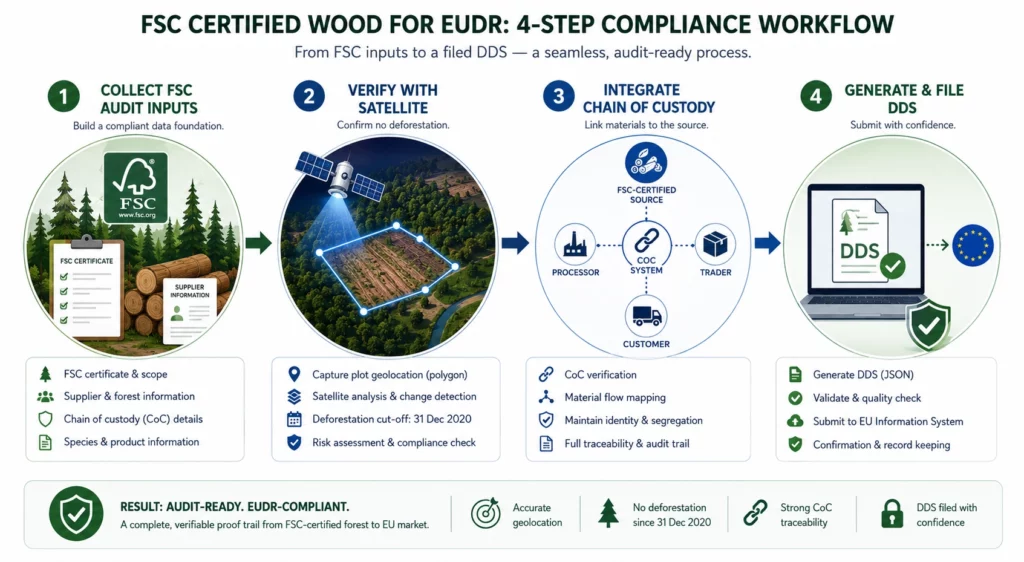
You don’t have to start from scratch. Use your FSC certified wood as the foundation for EUDR and build on top of it.
Audit all FSC-certified inputs for geolocation
FSC tells you how a forest is managed; EUDR needs to know where it is. Build a master list of FSC-certified sources and match each to plot-level GPS or polygon data. The goal: point to a map and say “that’s where the wood came from.”
FSC audits are valuable but not real-time. Use satellite imagery or mobile field visits to verify land-use history especially to prove the forest was intact on the 31 December 2020 cut-off.
Integrate FSC Chain of Custody into your DDS workflow
You already have a CoC make it work for EUDR. Build your DDS process on top of your existing FSC CoC system and use CoC certificates for batch-level documentation. Less duplication, smoother compliance.
Use a platform to manage traceability and documents
FSC paperwork is heavy; add EUDR and it’s a document nightmare. A digital traceability platform stores and syncs FSC certificates, tags each batch to its plot-level origin, auto-generates the DDS, and keeps a version-controlled vault for 5-year retention.
FSC Certified Wood for EUDR: How TraceX Closes the Gap
If you’re evaluating how to operationalize all of the above, here’s how the TraceX EUDR Solutions turns FSC certified wood into EUDR-ready proof capability by capability, mapped to the exact problem each one solves.
GPS mapping & plot verification
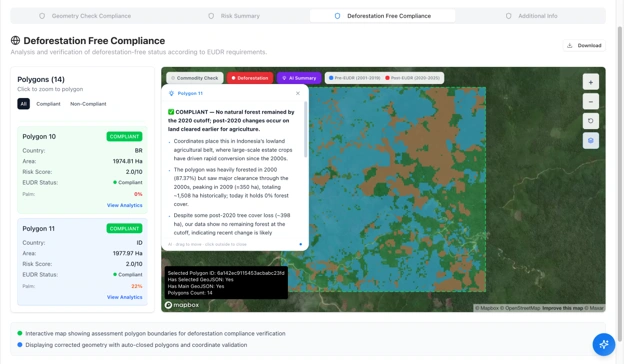
The pain it solves: “We’re FSC certified, but we can’t point to the exact plot.” TraceX captures polygon or point-based GPS data, tags it to every batch, and overlays it with satellite imagery to check for deforestation or degradation the exact geolocation EUDR requires, not just a region or forest name.
Seamless integration with FSC documentation
The pain it solves: duplicate data entry. Upload your FSC CoC certificates, audit summaries and license codes into the TraceX vault; the platform links them to the right batches and shipments so you reuse what you already have inside your DDS.
Auto-generation of the DDS
The pain it solves: manual DDS errors at scale. TraceX pulls GPS data, land-use checks, FSC documentation and legal proof to generate ready-to-submit Due Diligence Statements per EU requirements saving time and removing human error.
Risk scoring + satellite monitoring
The pain it solves: uncertain or FSC Mix sources. TraceX runs satellite-based risk assessments and alerts you if any batch risks non-compliance giving you time to switch sources or mitigate before you ship, not after customs flags it.
Audit-ready traceability vault
The pain it solves: scrambling during audits. All your FSC + EUDR data sits in a version-controlled repository with search, filters and 5-year archiving. When the EU asks for proof, you’re ready in seconds, not weeks.
Want to see how your FSC supply chain stacks up against EUDR?
FSC Certified Wood for EUDR: Certification Alone vs Certification + Platform
When an EU buyer asks for proof, the difference between a paper certificate and a connected traceability system is the difference between a cleared shipment and a blocked one.
EUDR requirement
FSC certificate alone
FSC + TraceX
Plot-level geolocation
Not provided
GPS points / polygons per batch
2020 deforestation-free proof
Not timestamped
Satellite-verified to 31 Dec 2020
Risk assessment
Manual, ad hoc
Automated risk scoring + alerts
DDS generation
Built by hand
Auto-generated, ready to submit
5-year audit retention
Scattered files
Version-controlled vault
FSC Certified Wood for EUDR: Certification + Technology = Real Compliance
FSC certified wood for EUDR is a strong foundation but it’s one piece of the puzzle. To move from “certified” to fully compliant, you need granular geolocation, real-time monitoring and digital due diligence on top of your certification. Whether you export timber, packaging, furniture or flooring, that hybrid approach keeps your products moving, your risk low and your reputation intact in the EU market.
Transparency, trust and EU market access for your FSC supply chain.
Does FSC certification automatically make a product EUDR compliant?
No. FSC certified wood helps demonstrate legality and responsible sourcing, but EUDR additionally requires plot-level GPS data, a risk assessment and a Due Diligence Statement. Certification supports compliance; it doesn’t replace it.
Can I use FSC Chain of Custody documentation in my EUDR DDS?
Yes. FSC CoC records can support your Due Diligence Statement, especially when integrated into a digital traceability system that links each certificate to the right batch and plot.
What’s the easiest way to align FSC certified wood with EUDR rules?
Use a compliance platform to map origin plots, run deforestation checks against the 31 December 2020 cut-off, auto-generate the DDS, and sync your FSC documents — all in one workflow.
Is FSC Mix wood a problem under EUDR?
It can be. FSC Mix blends certified, recycled and controlled sources and isn’t always traceable to a single forest, so those batches usually need extra plot-level verification before they’re EUDR-ready.
When does EUDR apply to wood exporters and importers?
Under Regulation (EU) 2025/2650, the due-diligence and reporting obligations apply from 30 December 2026 for large and medium operators, and from 30 June 2027 for micro and small operators. The deforestation-free cut-off date remains 31 December 2020.
What happens if my FSC certified shipment fails EUDR checks?
If the DDS is rejected or incomplete, the product can’t be placed on or traded within the EU. Penalties can reach at least 4% of EU-wide turnover, plus confiscation of goods and revenues — which is why proof, not just certification, matters.
Start using TraceX
Transparency, Trust, & Success for your Climate Journey.
We use cookies on our website to give you the most relevant experience by remembering your preferences and repeat visits. By clicking “Accept All”, you consent to the use of ALL the cookies. However, you may visit "Cookie Settings" to provide a controlled consent.
This website uses cookies to improve your experience while you navigate through the website. Out of these, the cookies that are categorized as necessary are stored on your browser as they are essential for the working of basic functionalities of the website. We also use third-party cookies that help us analyze and understand how you use this website. These cookies will be stored in your browser only with your consent. You also have the option to opt-out of these cookies. But opting out of some of these cookies may affect your browsing experience.
Necessary cookies are absolutely essential for the website to function properly. These cookies ensure basic functionalities and security features of the website, anonymously.
Cookie
Duration
Description
cookielawinfo-checkbox-analytics
11 months
This cookie is set by GDPR Cookie Consent plugin. The cookie is used to store the user consent for the cookies in the category "Analytics".
cookielawinfo-checkbox-functional
11 months
The cookie is set by GDPR cookie consent to record the user consent for the cookies in the category "Functional".
cookielawinfo-checkbox-necessary
11 months
This cookie is set by GDPR Cookie Consent plugin. The cookies is used to store the user consent for the cookies in the category "Necessary".
cookielawinfo-checkbox-others
11 months
This cookie is set by GDPR Cookie Consent plugin. The cookie is used to store the user consent for the cookies in the category "Other.
cookielawinfo-checkbox-performance
11 months
This cookie is set by GDPR Cookie Consent plugin. The cookie is used to store the user consent for the cookies in the category "Performance".
viewed_cookie_policy
11 months
The cookie is set by the GDPR Cookie Consent plugin and is used to store whether or not user has consented to the use of cookies. It does not store any personal data.
Functional cookies help to perform certain functionalities like sharing the content of the website on social media platforms, collect feedbacks, and other third-party features.
Performance cookies are used to understand and analyze the key performance indexes of the website which helps in delivering a better user experience for the visitors.
Analytical cookies are used to understand how visitors interact with the website. These cookies help provide information on metrics the number of visitors, bounce rate, traffic source, etc.
Advertisement cookies are used to provide visitors with relevant ads and marketing campaigns. These cookies track visitors across websites and collect information to provide customized ads.
Download the 2026 Traceability Scorecard and Benchmark Your Supply Chain Across 10 Critical Capabilities.
Download our eBook
Don’t Wait for an Audit to Find Your EUDR Gaps
The 2026 Simplification Package changes how HS codes, DDS pass-through and geolocation rules apply to you. Get the free guide and 20-point readiness checklist before enforcement catches you unprepared.