EUDR Compliance for Upstream Operators: A Complete Guide for Producers, Farmer Groups & Exporters
Published
, 15 minute read
Share this article
Quick summary: EUDR compliance is mandatory for producers, farmer groups and exporters sourcing regulated commodities. Learn exactly what to do, common pitfalls, and how TraceX automates the process.
EUDR Upstream Operator compliance is now a market-access requirement. EU buyers are inserting Due Diligence Statement (DDS) clauses into purchase orders. If you cannot supply GPS polygon data, satellite-verified deforestation-free status, and a valid TRACES NT submission for every shipment, your EU buyer legally cannot purchase from you regardless of how long the relationship has existed.
An EUDR upstream operator is a producer, farmer group, first processor, or exporter of EUDR-regulated commodities (coffee, cocoa, palm oil, soy, rubber, timber, or cattle) who supplies into the European Union supply chain. Upstream operators bear the heaviest compliance burden under EU Regulation 2023/1115 because EU importers cannot file a Due Diligence Statement (DDS) without plot-level GPS polygon data from the source.
Upstream operators must:
(1) collect GPS polygon coordinates for every farm plot they source from,
(2) verify deforestation-free status since December 31, 2020 using satellite datasets (JRC/Hansen),
(3) compile legality documentation (land titles, KYC, certifications), and
(4) pass this data to EU buyers before goods enter the EU. Non-compliance results in shipment seizure and fines of up to 4% of annual EU turnover. The deadline for large operators is December 30, 2026; SMEs face June 30, 2027.
4% Maximum fine as % of annual EU turnover for non-compliant operators
Dec 31, 2020 Deforestation cut-off date — no tree cover loss permitted after this date
Dec 30, 2026 Large operator compliance deadline (June 30, 2027 for SMEs)
These numbers define the compliance landscape every upstream operator is operating in. The Dec 31, 2020 cut-off is fixed and retroactive it cannot be negotiated or extended.
How prepared is your business for EUDR?
EUDR Operator: Who You Are and Why the Burden Falls on You
The regulation distinguishes between operators (who place goods on the EU market) and traders (who supply within the EU). In practice, the compliance burden flows upstream to origin-country actors who produce, process, and export regulated commodities before the goods ever reach an EU port.
EU importers bear the legal obligation to submit a DDS. But they can only do so if upstream operators provide the plot-level data. If your data is missing, incomplete, or unvalidated, your EU buyer’s DDS fails and your contract is at risk.
EUDR Upstream Operator Categories: Producers
Individual farmers or plantation operators growing regulated commodities on defined land plots. Responsible for allowing GPS polygon capture of their farm boundaries and providing land tenure documentation.
Single-plot farmers to large estate operations
Required to permit geolocation of every production plot
Must supply land rights documentation and KYC records
Are you an EUDR producer? Your compliance journey starts at the source.
EUDR Upstream Operator Categories: Farmer Groups and Co-operatives
Aggregators who pool supply from hundreds to thousands of smallholder members. Co-ops are a critical intermediary they must collect and consolidate plot-level data from individual members before passing it upstream.
Responsible for member data collection and GPS capture programs
Must maintain individual plot records before lots are mixed at aggregation points
Single aggregated polygon for the co-op is not sufficient plot-level data per member required
EUDR Upstream Operator Categories: First Processors
Coffee wet mills, cocoa fermentation centres, palm oil mills, and other primary processing facilities sit between farm-level production and export. They must maintain chain of custody linking processed lots back to specific input plots.
Digital receiving records linking each farmgate delivery to a farm ID and plot GPS data
Lot separation during processing to preserve traceability
Documentation of all input suppliers with their compliance status
EUDR Upstream Operator Categories: Exporters
Companies sourcing, consolidating, and shipping regulated commodities to EU buyers. Exporters are often the entity that assembles the DDS data package on behalf of the EU importer, or provides the structured dataset that enables the importer to file.
GPS polygon data from every farm plot in their supply base
Deforestation screening certificates per plot
Legal compliance documentation from all suppliers
Data formatted and structured for TRACES NT submission
EUDR Operator Compliance Requirements: What You Must Prove
EUDR compliance is not a certificate you file once. It is a data obligation attached to every shipment. The table below maps each requirement to what it means in practice and the specific risk of non-compliance.
Requirement
What It Means
Data Needed
Risk if Missing
GPS Polygon Mapping
Boundary coordinates for every farm plot — not a pin, a polygon
Lat/long polygon per plot
DDS rejected at TRACES; shipment blocked at EU customs
Deforestation-Free Verification
No forest loss on your plots after Dec 31, 2020, proven by satellite
JRC/Hansen satellite clearance report
Fines up to 4% EU turnover; buyer contract termination
Legality Documentation
Production complies with land tenure, labour, and environmental laws
Land titles, KYC docs, certifications
DDS flagged; competent authority audit triggered
Due Diligence Statement (DDS)
Formal TRACES NT submission before goods cross EU border
Full data package per shipment
Goods legally blocked; seizure at port of entry
Chain of Custody
Every farmgate purchase linked to a specific plot ID
Digital transaction records
Cannot connect shipment to GPS data; DDS invalid
Understanding EUDR requirements is the first step toward compliance.
Scale of the Data Challenge for EUDR Upstream Operators
A single mid-size coffee exporter may need GPS polygon data from 2,000 to 10,000 individual smallholder farmers per season.
Without a structured field data collection program, this volume of geolocation capture is operationally impossible to achieve manually before the December 2026 deadline.
Companies using mobile-first digital platforms have completed GPS campaigns of 1,800+ farmers in 6 weeks. Manual approaches have taken 12+ months for comparable volumes.
EUDR Operator Challenges: The 5 Failure Points Blocking EU Market Access
These are the specific failure points TraceX sees consistently across agri-commodity supply chains attempting EUDR readiness. Addressing these before the deadline is the difference between protected EU market access and permanent contract loss.
EUDR Operator Challenge 1: GPS Data Gaps at Farm Level
Most smallholder farmers have never had their land formally GPS-mapped. Paper land records, village boundary estimates, and self-reported plot sizes do not meet the polygon-level standard TRACES NT requires. Collecting GPS polygon data from thousands of geographically dispersed farmers many in low-connectivity areas is the single biggest operational bottleneck for upstream operators.
Offline-capable mobile GPS apps resolve connectivity gaps
Field agent programs can map 200–500 plots per week at scale
Self-reporting with guided apps works for smartphone-equipped farmers
Agent-assisted capture required for non-digital farmers
Farmgate purchase records, weight tickets, and grade assessments are often handwritten, stored locally, and impossible to aggregate into a digital compliance trail. Without digital transaction capture at point of purchase, linking a specific shipment lot to a specific farm plot becomes guesswork which is not audit-grade evidence under EUDR.
EUDR Operator Challenge 3: Aggregation Complexity in Farmer Groups
Co-operatives collect from dozens to hundreds of members. When lots mix at aggregation points, tracing a kilogram of coffee back to a specific plot requires farm-level identity to be assigned before mixing. Most groups do not have this infrastructure and must build it before the deadline.
How can AI simplify EUDR compliance for complex soy supply chains?
Discover how a leading Nigerian commodity trader partnered with TraceX to build an AI-powered traceability and compliance solution that strengthened transparency, streamlined supplier engagement, and prepared its soy supply chain for the EU Deforestation Regulation.
EUDR Operator Challenge 4: Document Fragmentation Across Suppliers
Exporters sourcing from multiple suppliers face a document assembly problem. KYC records, land tenure documents, and certifications exist in different formats, languages, and filing systems across origin countries. Manually assembling a DDS package at shipment time is labour-intensive, error-prone, and incompatible with the volume of EU-bound shipments.
EUDR Operator Challenge 5: TRACES NT Submission Errors
Even operators who have collected the right data frequently submit incorrectly structured DDS records to TRACES NT. The system requires specific XML/JSON data formats. Invalid geolocation formats, incorrect HS codes, and missing fields are the three most common rejection causes each blocking a shipment at EU customs.
Real Cost of EUDR Non-Compliance for Upstream Operators
• Shipment seizures and destruction at EU entry points
• Fines of up to 4% of annual EU turnover per violation
• Public disclosure of non-compliant operators on EU regulatory databases
• Permanent loss of EU buyer contracts buyers reroute to compliant suppliers quickly
• Reputational damage compounding across markets beyond the EU
• Exclusion from EU-adjacent premium markets that mirror EUDR standards
Is Your Supply Chain EUDR-Ready? Find Out Now
TraceX’s free EUDR Readiness Assessment identifies your GPS data gaps, document gaps, and DDS submission risks before they become customs problems.
Used by exporters across India, Africa, and Southeast Asia completion takes under 20 minutes.
EUDR Upstream Operator Compliance in Practice: 3 Real Scenario Examples
The following scenarios show what EUDR upstream operator compliance looks like operationally for different supply chain types. Each example is drawn from actual compliance journeys undertaken by TraceX clients.
EUDR Upstream Operator Scenario 1: The Coffee Exporter in Ethiopia (1,800 Smallholder Farmers)
Situation
Mid-size Ethiopian coffee exporter, 800 MT annual volume, 4 EU roaster buyers, 3 washing stations sourcing from 1,800 smallholders across two regions.
EUDR Challenge
None of the 1,800 farmers have GPS-mapped plots. Washing stations hold paper records. No system linking purchase lots to specific farms.
Compliance Path
Mobile GPS capture campaign by field agents. Digital farmgate records linking each delivery to a farm ID. DDS generation with JRC/Hansen deforestation screening.
EUDR Upstream Operator Scenario 2: The Cocoa Farmer Group in Ghana (400 Member Farms)
Situation
Smallholder cocoa co-operative in Ghana’s Ashanti Region, 400 member farms, supplying a European chocolate manufacturer via export agent.
EUDR Challenge
Co-op has member registration lists but no GPS data. Export agent was submitting DDS based on aggregate estimates — no longer acceptable under plot-level requirement.
Compliance Path
GPS polygon capture for all 400 member plots. Digital farmgate purchase records per member ID. Chain of custody from farm through fermentation, drying, and export aggregation.
EUDR Upstream Operator Scenario 3: The Palm Oil Exporter in Malaysia (4,200 Hectares, Mixed Supplier Base)
Situation
Malaysian palm oil exporter sourcing from 3 large estates and ~35% smallholder supply (via 12 collection agents), totalling approximately 4,200 hectares.
EUDR Challenge
Estate suppliers can provide polygon data. Smallholder supply (35% of EU-eligible volume) cannot. Exclude smallholders and lose a third of EU revenue, or build a compliance programme.
Compliance Path
Estate data from existing RSPO certification. Smallholder GPS capture mobilised through collection agents. AI-powered document parsing for 4,200+ supplier KYC and land title documents.
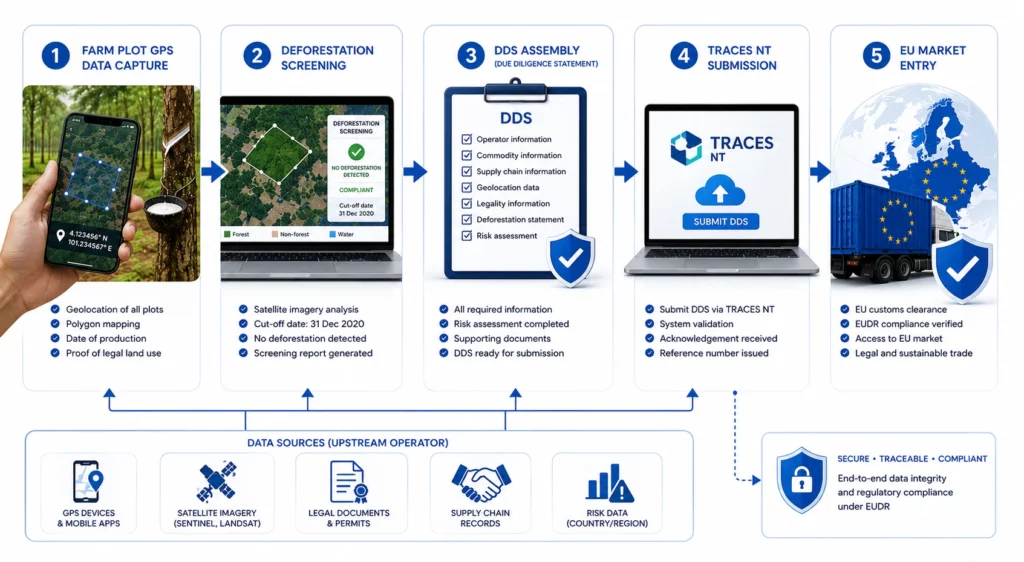
Whether you are starting from zero or closing specific data gaps, this sequence is the proven implementation path for EUDR upstream operator compliance. Each step must be completed before goods can be legally certified for EU market entry.
EUDR Upstream Operator Step 1: Map Your Supply Chain Footprint
Identify every plot, farmer, or supplier in your sourcing area. Create a master registry with name, location, estimated plot size, and commodity produced. This registry defines your compliance scope — you need GPS polygon data for every entity on this list.
Separate estate suppliers (likely have existing data) from smallholder suppliers (likely need capture campaigns)
Prioritise by volume — high-volume suppliers first reduces EU market access risk fastest
Flag any suppliers with known land tenure disputes for early legal review
Deploy field agents with GPS-enabled mobile devices to capture polygon boundaries for each plot. Offline-capable apps are essential — most origin geographies have unreliable connectivity. Where farmers have smartphones, guided self-reporting apps reduce field agent time.
Target 150–300 plots per field agent per week as a realistic benchmark
Polygon, not point — TRACES NT requires boundary coordinates, not a single GPS pin
Capture consent and documentation alongside GPS for the same field visit
EUDR Upstream Operator Step 3: Run Deforestation Risk Screening
Cross-reference your GPS polygon data against global deforestation datasets: JRC Global Forest Cover Change and University of Maryland/Hansen satellite data. Any plot showing tree cover loss after December 31, 2020 requires enhanced investigation and potential removal from EU-bound supply.
Country risk classification affects scrutiny level — high-risk origin countries face enhanced checks
RSPO or FSC certification may satisfy some elements but does not replace TRACES DDS submission
Continuous monitoring is required post-submission — new deforestation events after your DDS filing can invalidate future submissions
EUDR Upstream Operator Step 4: Digitise Transaction and Purchase Records
Link every farmgate purchase to a specific farmer and plot ID in a digital system. This creates the chain of custody from production point to export. Without this linkage, you cannot connect a shipment lot to a specific set of GPS polygon coordinates.
Gather land tenure evidence (title deeds, lease agreements, customary land rights documentation), KYC records for each supplier, and any applicable environmental or agricultural permits. All documents must be digitised and indexed by supplier ID for audit retrieval.
EUDR Upstream Operator Step 6: Generate and Submit Your DDS
Compile the full data package GPS coordinates, deforestation screening results, legal documentation and generate a Due Diligence Statement formatted for TRACES NT submission. Submit before goods cross the EU border. Retain all records for a minimum of five years.
TRACES NT submission must include EORI code, HS codes, and validated geolocation in accepted formats
A single missing field can trigger rejection — validate before submission, not after
Use the DDS reference number to provide downstream operators with the chain they need to comply
EUDR Operator Automation: How TraceX Reduces Compliance Time from Months to Weeks
TraceX’s EUDR Solutions is purpose-built for the operational realities of emerging-market agri supply chains smallholder farmers, low connectivity, multilingual field agents, and fragmented documentation. The platform covers every step of the upstream operator compliance journey.
Compliance Task
Manual Approach
TraceX Platform
Time Saved
GPS Plot Mapping
Field agents with separate GPS devices; weeks of data entry
Offline-first mobile app with guided polygon capture; auto-syncs on connection
6–8 weeks → 5–10 days
Deforestation Screening
Manual cross-reference with downloaded JRC/Hansen datasets
Automated real-time screening against JRC and Hansen; live deforestation alerts
2–4 weeks → <24 hours
Document Collection
Email chains and physical filing; missing docs found at audit
Agentic AI auto-parses KYC, land titles, certs from emails and uploaded docs
AI-generated, TRACES-API-integrated DDS; validated before submission
Days per shipment → same day
Chain of Custody
Paper purchase records; lot identity lost at aggregation
Digital farmgate capture linked to plot ID; forward and reverse traceability
Permanent gap → audit-grade
Your EU Buyers Are Already Asking for DDS. Are You Ready?
TraceX helps producers, farmer groups, and exporters across India, Africa, and Southeast Asia build EUDR-compliant supply chains from GPS capture to TRACES submission.
EUDR Upstream Operator Compliance: Why Acting Now Protects EU Market Access
EUDR has moved from regulatory theory to commercial reality. EU buyers are already inserting DDS requirements into purchase orders. Ports are flagging non-compliant shipments. And upstream operators producers, farmer groups, and exporters sit at the critical data collection point that makes the entire compliance chain work.
The operators who build GPS capture infrastructure, digitise their supply chains, and automate DDS generation now will protect their EU market access and build a competitive advantage with buyers who increasingly want verified, compliant supply chains. Those who wait will lose contracts often permanently, as buyers reroute to already-compliant alternatives.
Frequently Asked Questions (FAQ’s)
Does EUDR apply to exporters outside the EU?
EUDR applies to anyone placing regulated commodities or derived products on the EU market, which includes non-EU exporters selling to EU importers. While EU importers bear the direct legal obligation for DDS submission, they cannot comply without receiving plot-level data from their upstream supply chain partners. In practice, this means EUDR compliance requirements flow directly to origin-country producers, farmer groups, and exporters.
What is a Due Diligence Statement (DDS) and how do I submit one?
A DDS is a formal declaration that an operator has collected information about the product, conducted a risk assessment, and taken risk mitigation steps to ensure the commodity is deforestation-free and legally produced. It is submitted electronically to the EU TRACES NT system before goods enter the EU market. The statement must reference GPS polygon data, deforestation screening results, and legal compliance documentation for every plot in the supply chain.
What happens if my GPS data covers some but not all of my farmer base?
EUDR requires plot-level geolocation data for all sourced commodities, not a sample. If you have data for 70% of your farmer base, you can only certify 70% of your sourced volume as EUDR-compliant. The remaining 30% cannot be sold into EU-bound supply chains until plot mapping is completed. This is why GPS collection campaigns need to be comprehensive rather than representative.
Can farmer co-operatives submit a single DDS for all member farms?
No. The DDS must reference individual plot coordinates for each production area in the supply chain not an aggregate or co-op-level polygon. However, the export operator (the company placing goods on the EU market) can submit a single DDS that covers multiple plots from a co-operative, provided that each plot’s GPS data is included and verified individually. The co-operative’s role is to collect and provide plot-level data to the exporter
How long must EUDR compliance records be kept?
EUDR requires operators to retain all documentation supporting their due diligence, including GPS data, deforestation screening evidence, and legal compliance documents for a minimum of five years. These records must be available for inspection by competent authorities on request. Digital traceability systems significantly reduce the operational burden of maintaining and retrieving these records at audit time.
Start using TraceX
Transparency, Trust, & Success for your Climate Journey.
We use cookies on our website to give you the most relevant experience by remembering your preferences and repeat visits. By clicking “Accept All”, you consent to the use of ALL the cookies. However, you may visit "Cookie Settings" to provide a controlled consent.
This website uses cookies to improve your experience while you navigate through the website. Out of these, the cookies that are categorized as necessary are stored on your browser as they are essential for the working of basic functionalities of the website. We also use third-party cookies that help us analyze and understand how you use this website. These cookies will be stored in your browser only with your consent. You also have the option to opt-out of these cookies. But opting out of some of these cookies may affect your browsing experience.
Necessary cookies are absolutely essential for the website to function properly. These cookies ensure basic functionalities and security features of the website, anonymously.
Cookie
Duration
Description
cookielawinfo-checkbox-analytics
11 months
This cookie is set by GDPR Cookie Consent plugin. The cookie is used to store the user consent for the cookies in the category "Analytics".
cookielawinfo-checkbox-functional
11 months
The cookie is set by GDPR cookie consent to record the user consent for the cookies in the category "Functional".
cookielawinfo-checkbox-necessary
11 months
This cookie is set by GDPR Cookie Consent plugin. The cookies is used to store the user consent for the cookies in the category "Necessary".
cookielawinfo-checkbox-others
11 months
This cookie is set by GDPR Cookie Consent plugin. The cookie is used to store the user consent for the cookies in the category "Other.
cookielawinfo-checkbox-performance
11 months
This cookie is set by GDPR Cookie Consent plugin. The cookie is used to store the user consent for the cookies in the category "Performance".
viewed_cookie_policy
11 months
The cookie is set by the GDPR Cookie Consent plugin and is used to store whether or not user has consented to the use of cookies. It does not store any personal data.
Functional cookies help to perform certain functionalities like sharing the content of the website on social media platforms, collect feedbacks, and other third-party features.
Performance cookies are used to understand and analyze the key performance indexes of the website which helps in delivering a better user experience for the visitors.
Analytical cookies are used to understand how visitors interact with the website. These cookies help provide information on metrics the number of visitors, bounce rate, traffic source, etc.
Advertisement cookies are used to provide visitors with relevant ads and marketing campaigns. These cookies track visitors across websites and collect information to provide customized ads.
Download the 2026 Traceability Scorecard and Benchmark Your Supply Chain Across 10 Critical Capabilities.
Download our eBook
Don’t Wait for an Audit to Find Your EUDR Gaps
The 2026 Simplification Package changes how HS codes, DDS pass-through and geolocation rules apply to you. Get the free guide and 20-point readiness checklist before enforcement catches you unprepared.