EUDR Legality Requirements: Documents, Risk Assessment and Practical Examples
Published
, 8 minute read
Share this article
Quick summary: Understand EUDR legality requirements, the evidence businesses need, how to handle missing farmer documents, and practical examples to strengthen due diligence.
EUDR legality requirements ask businesses to demonstrate that relevant commodities were produced in accordance with the applicable laws of the country of production. Under the EU Deforestation Regulation (EUDR), proving that a product is deforestation-free is not enough: businesses must also assess whether its production was legal. This applies to relevant commodities and products in scope, including coffee, cocoa, rubber, palm oil, soy, wood and cattle-derived products.
The challenge is often evidence. Land-use records, permits, labour information and supplier documents may be spread across cooperatives, local authorities, field teams and email threads. Smallholder farmers may not have formal land titles, while certificates or government documents may cover only part of the required assessment. A reliable approach connects evidence to the right supplier, plot and product, evaluates its limitations, and records why the compliance conclusion is justified.
Key Takeaways
EUDR legality requirements are separate from the deforestation-free test; businesses must assess both.
Evidence must be relevant to the applicable national law and linked to the correct supplier, plot and product.
A missing land title, certificate or other document does not automatically prove illegality—but gaps must be assessed.
Proxy information can support an assessment when evaluated carefully; it does not automatically replace legally required evidence.
Document the reasoning, investigate credible concerns and mitigate risks that cannot be reduced to the required threshold.
Digital traceability can help keep evidence connected, reviewable and ready for compliance checks.
Are your supplier records, plot geolocation, and due diligence evidence ready for scrutiny?
Identify potential gaps before they become compliance challenges.
Download our eBook to assess your EUDR readiness, uncover data gaps, and take proactive steps towards stronger compliance.
Article 3 of Regulation (EU) 2023/1115 requires relevant products to be legally produced as well as deforestation-free. Article 2(40) identifies relevant legislation in areas such as land-use rights, environmental protection, forest-related rules, third-party rights, labour rights, human rights protected under international law, free, prior and informed consent where applicable, tax, anti-corruption, and trade and customs rules.
The precise evidence depends on the country, commodity and sourcing circumstances. There is no single universal document that proves legality in every supply chain. Businesses should identify which national laws apply and what evidence can demonstrate compliance with those laws. The 31 December 2020 cut-off date applies to the EUDR deforestation-free criterion; it is not a blanket cut-off date for legality. A historical land-clearance event may therefore require a separate legal assessment even if it occurred before that date.
Which Documents Can Support EUDR Legality?
Build an evidence file around the legal risks relevant to the product and country of production. Depending on the situation, evidence may include:
Land-use rights: title deeds, leases, government allotments, or legally recognised community or collective land records.
Harvest and production legality: applicable harvest permits, logging or felling approvals, quotas, transport authorisations, or other required permissions.
Environmental compliance: relevant environmental permits, impact assessments, or records required under national law.
Labour and third-party rights: relevant employment, wage, labour-compliance or rights-related records, where applicable.
Traceability: supplier and cooperative records, plot-level geolocation, production details, procurement records and links between source plots and batches.
Official and third-party information: government registers, audit findings, credible local reports or stakeholder information that help assess a specific risk.
Documents should be checked for authenticity, validity, date, scope and consistency. A permit may be genuine but relate to a different plot, period or volume. A supplier declaration may be useful but should not automatically be treated as conclusive proof. The objective is not simply to collect files; it is to establish what each item demonstrates and whether additional verification is needed.
Missed Our Webinar on EUDR Beyond DDS? Catch the Recording!
Watch the webinar recording to understand what lies beyond DDS filing and how to strengthen your EUDR compliance workflow.
Missing records are common in smallholder supply chains. Land rights may be recognised through customary or community arrangements, official registries may be incomplete, and records may exist only on paper or be held by a cooperative or local authority. The absence of a land title does not automatically prove that production is illegal. Equally, missing documentation does not establish that production is legal.
Operators can assess relevant alternative or proxy information where appropriate, such as cooperative membership records, government registers, field-audit findings, credible local reports and interviews with local stakeholders. These sources have limits: cooperative records may confirm membership without establishing land rights; regional reports may not apply to a particular farm; and a sample audit may not represent every producer. Proxy information cannot replace information specifically required by applicable law.
For each source, record who produced it, when it was created, what geography or supplier it covers, how reliable it appears, and what it can or cannot prove. Where evidence conflicts or leaves a material gap, seek corroboration, conduct additional checks or escalate the case for further review.
Learn how to assess available evidence, identify documentation gaps, evaluate legality risks, and strengthen supplier-level compliance.
Six Practical Examples of EUDR Legality Assessment
Historical land clearance: Coffee land was cleared in 2016. The pre-2021 date may be relevant to the deforestation-free assessment, but it does not automatically settle whether the land was cleared in accordance with applicable law. Assess the relevant national law and document the reasoning separately.
Allegations of child labour: An allegation involving cocoa production should be investigated in light of the type of work, the child’s age and circumstances, national law and relevant international protections. Do not dismiss credible concerns or assume every form of family-farm assistance proves a breach.
Certification claims: FSC or another certification may provide useful evidence, but it does not automatically replace EUDR due diligence. Verify the certificate’s validity, scope, chain of custody and connection to the relevant production plots.
No formal land title: A farmer without a formal title may still have a lawful right to use land under the applicable legal framework. Determine what the law requires and whether alternative recognised evidence is available.
Government-issued documents: Official documents can be important, but their authenticity, validity, coverage and consistency with other records should be assessed, especially where credible risk indicators exist.
Labour concerns at a processing facility: A processing-stage allegation requires careful analysis of how it relates to relevant legislation governing production of the commodity. It may not automatically prove that the original commodity was illegally produced, but serious labour or human-rights concerns should still be investigated and considered under other applicable laws and commitments.
Learn how to use certification schemes alongside supplier documentation, plot-level geolocation, deforestation checks, and risk assessments to meet EUDR requirements.
A Risk-Based Workflow for EUDR Legality Requirements
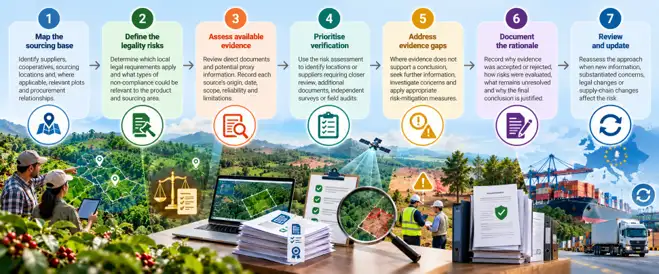
1. Map the supply chain. Identify suppliers, cooperatives, production locations, plots and procurement relationships.
2. Define applicable legal requirements. Determine which country-specific rules and legality risks are relevant to the commodity and sourcing area.
3. Assess available evidence. Review direct documents and appropriate proxy sources, noting their origin, date, scope, reliability and limitations.
4. Prioritise verification. Use identified risks to decide where additional records, independent checks, field audits or follow-up are necessary.
5. Mitigate unresolved risks. Where the assessment does not establish no or only negligible risk, take appropriate mitigation measures. Do not treat an unresolved gap as negligible by default.
6. Document the decision. Record the evidence reviewed, conflicting information, remaining gaps, mitigation and the rationale for the conclusion.
7. Review and update. Reassess when new information, credible allegations, changes in law or supply-chain changes affect the risk profile.
Learn how to gather supplier information, verify plot-level geolocation, assess deforestation and legality risks, implement mitigation measures, and maintain reliable compliance records.
How Digital Traceability Supports Legality Due Diligence
When supplier identities, geolocation, permits and risk notes sit in separate spreadsheets and email threads, teams can struggle to prove that evidence belongs to the right origin. A digital workflow can centralise supplier profiles, connect documents to geo-located plots and batches, flag missing information, and preserve a record of assessment and follow-up actions. This is especially useful for businesses managing many suppliers and smallholders.
TraceX helps organise supplier onboarding, plot-level geolocation, traceability, risk assessment and supporting evidence in a connected EUDR workflow. The platform can improve visibility and consistency, but it does not replace legal analysis, field verification or the operator’s responsibility to assess whether the evidence is adequate.
Fragmented records make it harder to connect legality evidence to the right plot and shipment. TraceX helps businesses organise supplier data, geolocation, supporting documents and risk-assessment workflows so compliance teams can identify gaps earlier and maintain a clearer evidence trail.
Ready to strengthen your EUDR legality process?
See how connected supplier onboarding, plot traceability and evidence management can support a more structured compliance workflow.
EUDR Legality requires relevant products to be produced in accordance with applicable legislation in the country of production, in addition to meeting the deforestation-free criterion.
Does EUDR require a land title for every farm?
No,not as a universal rule. The relevant question is what applicable national law requires and whether the producer’s right to use the land can be established with appropriate evidence.
Does certification guarantee EUDR legality?
No. Certification may support due diligence, but businesses must assess its scope, reliability and connection to the relevant product and production plots.
Can proxy information be used when farmer documents are missing?
Proxy information may contribute to a risk assessment when its relevance and reliability are evaluated. It does not automatically replace information required by applicable law.
What should a business do if legality risk remains unresolved?
If legality risk remains unresolved, seek further information, investigate the concern, document the assessment and apply appropriate mitigation. Products should not proceed where the applicable EUDR conditions are not met.
Start using TraceX
Transparency, Trust, & Success for your Climate Journey.
We use cookies on our website to give you the most relevant experience by remembering your preferences and repeat visits. By clicking “Accept All”, you consent to the use of ALL the cookies. However, you may visit "Cookie Settings" to provide a controlled consent.
This website uses cookies to improve your experience while you navigate through the website. Out of these, the cookies that are categorized as necessary are stored on your browser as they are essential for the working of basic functionalities of the website. We also use third-party cookies that help us analyze and understand how you use this website. These cookies will be stored in your browser only with your consent. You also have the option to opt-out of these cookies. But opting out of some of these cookies may affect your browsing experience.
Necessary cookies are absolutely essential for the website to function properly. These cookies ensure basic functionalities and security features of the website, anonymously.
Cookie
Duration
Description
cookielawinfo-checkbox-analytics
11 months
This cookie is set by GDPR Cookie Consent plugin. The cookie is used to store the user consent for the cookies in the category "Analytics".
cookielawinfo-checkbox-functional
11 months
The cookie is set by GDPR cookie consent to record the user consent for the cookies in the category "Functional".
cookielawinfo-checkbox-necessary
11 months
This cookie is set by GDPR Cookie Consent plugin. The cookies is used to store the user consent for the cookies in the category "Necessary".
cookielawinfo-checkbox-others
11 months
This cookie is set by GDPR Cookie Consent plugin. The cookie is used to store the user consent for the cookies in the category "Other.
cookielawinfo-checkbox-performance
11 months
This cookie is set by GDPR Cookie Consent plugin. The cookie is used to store the user consent for the cookies in the category "Performance".
viewed_cookie_policy
11 months
The cookie is set by the GDPR Cookie Consent plugin and is used to store whether or not user has consented to the use of cookies. It does not store any personal data.
Functional cookies help to perform certain functionalities like sharing the content of the website on social media platforms, collect feedbacks, and other third-party features.
Performance cookies are used to understand and analyze the key performance indexes of the website which helps in delivering a better user experience for the visitors.
Analytical cookies are used to understand how visitors interact with the website. These cookies help provide information on metrics the number of visitors, bounce rate, traffic source, etc.
Advertisement cookies are used to provide visitors with relevant ads and marketing campaigns. These cookies track visitors across websites and collect information to provide customized ads.
Download the 2026 Traceability Scorecard and Benchmark Your Supply Chain Across 10 Critical Capabilities.
Download our eBook
Don’t Wait for an Audit to Find Your EUDR Gaps
The 2026 Simplification Package changes how HS codes, DDS pass-through and geolocation rules apply to you. Get the free guide and 20-point readiness checklist before enforcement catches you unprepared.