Guide to illegal logging prohibition act (ILPA) Due Diligence Requirements
Published
, 13 minute read
Share this article
Quick summary: Australia's ILPA requires due diligence proof for every timber import. Learn the 5 steps to avoid penalties, pass audits, and protect market access with TraceX.
If you import timber, wood products, or processed paper into Australia or if you use imported timber in your manufacturing, you are subject to one of the world’s most prescriptive deforestation compliance regimes. To comply with Australia’s Illegal Logging Prohibition Act, timber importers and domestic processors must take “reasonable steps” to verify their timber is not illegally logged.illegal logging prohibition act (ILPA) due diligence requires a structured approach to risk assessment and supplier verification to ensure compliance.
This means documenting the species, country of origin, applicable laws, supplier verification, and risk assessments, and keeping those records for 5 years. Penalties for non-compliance reach AUD $210,000 for corporations.
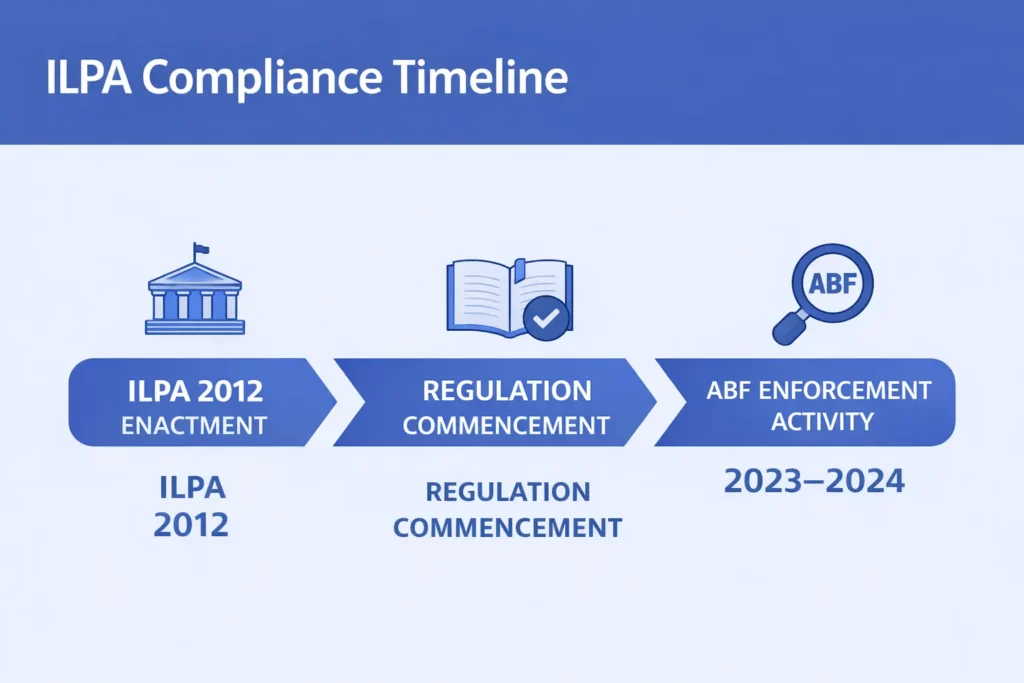
Australia’s Illegal Logging Prohibition Act 2012 (ILPA) and its associated Regulation came into full force, requiring importers and processors to conduct ‘due diligence’ before placing timber products on the Australian market. Yet in 2024, the Australian Border Force flagged that a significant share of timber shipments lacked adequate documentation at customs clearance. The gap between legal obligation and operational reality is wide, and closing it is now a commercial necessity, not a nice-to-have.
This guide gives compliance managers, procurement leads, and sustainability officers a step-by-step framework for meeting illegal logging prohibition act (ILPA) due diligence requirements and explains where digital tools can eliminate the manual burden entirely.
Key Takeaways
Australia’s Illegal Logging Prohibition Act (ILPA) requires all timber importers and processors to perform documented due diligence, face fines up to AUD $210,000, and market access bans.
‘Reasonable steps’ means verifying timber origin, assessing deforestation and species risk, collecting supplier evidence, and maintaining an audit-ready record, not a one-time checklist.
Digital supply chain platforms like TraceX automate evidence collection, GPS-verify farm-level sourcing, and generate audit-ready reports, cutting compliance preparation from weeks to hours.
Want a complete breakdown of global illegal logging laws?
Download our free eBook on Illegal Logging Regulations to understand how major frameworks like EUDR, EUTR, and ILPA impact timber and forest-risk supply chains.
What Is Australia’s Illegal Logging Prohibition Act? (ILPA Explained)
Australia’s Illegal Logging Prohibition Act 2012 (ILPA) prohibits the import and processing of illegally logged timber and timber products. ‘Illegally logged’ means timber harvested in violation of the laws of the country where it was harvested covering forest clearance laws, protected species rules, land tenure legislation, and Indigenous land rights.
The ILPA Regulation 2012 sets out specific due diligence requirements. Every regulated entity must:
Collect information about the timber (species, country and region of harvest, applicable laws)
Conduct a risk assessment of that information
Take steps to reduce any identified risk to a negligible level
Keep records of all due diligence activities for 5 years
AUD $210K – Maximum penalty for corporations found importing illegally logged timber products under ILPA plus potential criminal prosecution for individuals (Australian Department of Agriculture, 2023)
The Department of Agriculture, Fisheries and Forestry (DAFF) is the primary regulator, conducting inspections and issuing infringement notices. The Australian Border Force (ABF) provides border support for customs-point checks.
What Most Compliance Guides Miss
illegal logging prohibition act (ILPA) applies not just to raw timber importers, but to any business that processes regulated timber products including furniture manufacturers, paper importers, flooring distributors, and building product companies. If your product contains timber and it entered Australia as an imported good, ILPA likely applies to you.
From due diligence to documentation – discover how ILPA compliance works in practice.
Who Does illegal logging prohibition act (ILPA) Apply To? Understanding Your Scope
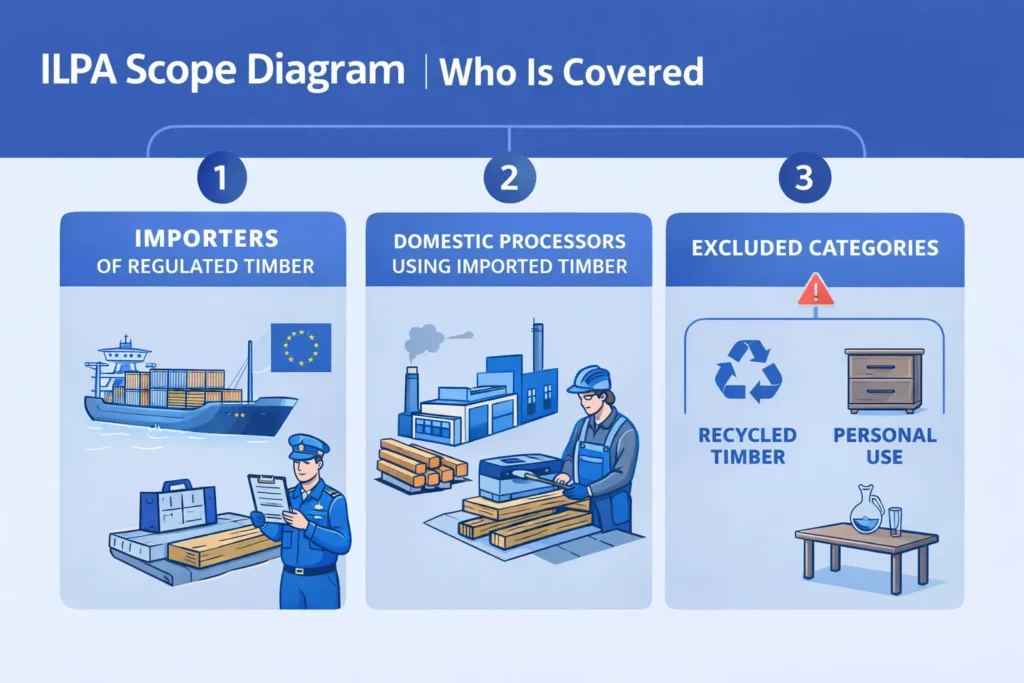
The regulation applies to two categories of entities:
1. Importers of Regulated Timber Products
Any business or individual that imports a ‘regulated timber product’ into Australia. This covers a broad list including solid wood products, plywood, veneer, particleboard, paper and paperboard, furniture with wood components, and flooring products.
2. Processors of Regulated Timber Products
Any business that takes imported regulated timber products and processes them into another product for example, a manufacturer who imports raw timber boards and machines them into furniture components.
Who Is Excluded?
Timber products certified by an approved certification scheme (FSC, PEFC) though certification reduces risk, it does not eliminate the due diligence obligation entirely
Recycled timber products
Timber brought in for personal use, not commercial purposes
Products already regulated under CITES (Convention on International Trade in Endangered Species)
Many mid-sized importers assume that holding an FSC certificate from their supplier eliminates their illegal logging prohibition act (ILPA) obligation. It doesn’t. DAFF’s guidance makes clear that certification is a risk-reduction tool but the importer still holds the due diligence obligation and must maintain their own records. TraceX helps businesses layer certification data with their own GPS-verified supplier evidence for defensible compliance.
What Counts as ‘Reasonable Steps’? The 5-Step Due Diligence Framework
ILPA does not prescribe a single compliance method it requires ‘reasonable steps’ proportionate to the risk level. DAFF guidance and enforcement history reveal what a defensible programme looks like in practice.
Step 1: Know Your Timber’s Origin
You must collect and document the following information for every regulated timber import:
Scientific name (genus and species) of the timber
Country and sub-national region of harvest
Name of the supplier and the applicable laws of the harvest country
For complex supply chains particularly those involving smallholder farmers across multiple regions this step requires structured data collection at the farm or plot level, not just at the exporter level.
Step 2: Assess Country and Species Risk
Not all timber carries the same risk. illegal logging prohibition act (ILPA) requires a risk assessment based on:
Country risk: Is the source country known for high levels of illegal logging? (Australia’s DAFF maintains guidance on high-risk jurisdictions including parts of Southeast Asia, Africa, and South America)
Species risk: Is the species protected or subject to harvest restrictions under domestic or international law?
Operator risk: Does the supplier have a documented compliance history? Are there red flags in their documentation?
According to Forest Policy, 10% of annual timber imports may be illegally logged: approximately US$350 million of imports may be illegally logged.
Step 3: Document Supplier Verification
High-risk assessments require additional verification steps to reduce risk to a negligible level. Accepted methods include:
Third-party audits of supplier operations
GPS polygon mapping of harvest areas verified against satellite deforestation data
Review of government-issued harvesting licences and land titles
Signed supplier declarations with legal liability clauses
This is the step where most compliance programmes break down. Collecting verified documentation from suppliers especially across fragmented, smallholder-dominated supply chains in emerging markets is operationally intensive without digital support.
Step 4: Build an Audit Trail
Every due diligence action must be recorded and retained for 5 years. DAFF inspectors can request records at any time. Your audit trail should include:
All information collected in Step 1
Your risk assessment methodology and conclusions
Evidence of risk-reduction steps taken
Supplier correspondence, declarations, and certification documents
Dates and responsible personnel for each due diligence action
Step 5: Establish an Ongoing Monitoring System
illegal logging prohibition act (ILPA) compliance is not a one-time event. You must monitor your supply chain continuously for:
Changes in supplier status or harvesting areas
New deforestation alerts in source regions
Regulatory changes in timber-producing countries
New DAFF guidance or enforcement priorities
TraceX’s ILPA Solutions automates Steps 1 through 5 in a single system. GPS polygon mapping verified against satellite data covers Step 1 and 3. AI-powered risk scoring using JRC and Hansen datasets covers Step 2. Blockchain-backed audit logs cover Step 4. Real-time deforestation alerts cover Step 5. One platform, one audit-ready report, exportable at any time.
Common ILPA Compliance Failures and How to Avoid Them
Compliance Failure
Risk Consequence
TraceX Fix
Relying solely on supplier-provided certificates without independent verification
High – DAFF does not accept third-party certs as standalone evidence
GPS-verified farm mapping + agentic AI document parsing layers on top of cert data
Incomplete species or origin data at import declaration
ABF shipment hold / infringement notice
Automated species + origin data capture at farmgate with offline mobile apps
No documented risk assessment methodology
Penalty at inspection – no evidence of ‘reasonable steps’
AI-generated risk scores from satellite + JRC/Hansen data with full methodology log
Records stored in spreadsheets – cannot be retrieved quickly
Audit failure – inability to produce 5-year record on demand
Blockchain-backed immutable records – one-click export to PDF, XML, CSV
No ongoing monitoring – treated compliance as a one-time process
New deforestation events in supply chain go undetected until ABF inspection
Real-time Sentinel-2 deforestation alerts with automated supplier notifications
Is your timber due diligence programme audit-ready?
If your supply chain exports to the European Union, you face a dual compliance burden: Australia’s ILPA and the EU Deforestation Regulation (EUDR). While both target illegal logging and deforestation, their scope, data requirements, and enforcement mechanisms differ significantly.
Yes – full EUDR DDS generation + TRACES API submission
For businesses operating across both Australian and EU markets, a unified digital compliance system is the only operationally sustainable approach. Maintaining separate spreadsheet-based processes for each regulation is not scalable and it creates documentation inconsistencies that regulators exploit during audits.
The Dual-Regulation Opportunity
Companies that invest in a robust illegal logging prohibition act compliance system today are in the strongest position to absorb EUDR requirements with minimal additional effort. GPS farm mapping, supplier KYC documentation, and satellite-verified land use data serve both regimes. TraceX was designed from the ground up to meet emerging-market supply chain realities the same infrastructure that handles ILPA due diligence powers EUDR Due Diligence Statement generation.
How Technology Closes the Due Diligence Gap
The operational challenge of illegal logging prohibition act compliance is not understanding the law it’s collecting defensible evidence from complex, multi-tier supply chains where many suppliers operate in remote areas with limited connectivity, digital literacy, and documentation infrastructure.
TraceX ILPA Solutions was built specifically for this problem. The platform serves timber businesses sourcing from smallholder farmers across India, Southeast Asia, and Africa exactly the supply chain contexts where illegal logging prohibition act (ILPA) compliance is hardest.
Key TraceX Capabilities for illegal logging prohibition act (ILPA) Compliance
GPS Polygon Farm Mapping: Geotagged plot boundaries collected via offline-first mobile apps – no connectivity required at the farm level. Data validated against JRC and Hansen satellite deforestation datasets for illegal logging prohibition act (ILPA) risk assessment.
Agentic AI Document Parsing: Automatically extracts species data, harvest licences, land tenure records, and KYC information from supplier emails and uploaded documents – eliminating manual data entry.
Risk Scoring Engine: AI-powered risk scoring at the supplier and plot level, cross-referenced with real-time Sentinel-2 satellite alerts for deforestation events in the harvest area.
Blockchain Audit Trail: Every due diligence action recorded on an immutable ledger – tamper-proof, timestamped, and retrievable on demand for DAFF inspection.
One-Click Audit Reports: Generate audit-ready reports in PDF, XML, or CSV in minutes – covering all illegal logging prohibition act (ILPA) due diligence obligations in a single exportable package.
Multilingual Supplier Portal: Suppliers onboarded in their own language – reducing the language barrier that causes data collection gaps in emerging market supply chains.
2 to 3 minutes – Time for TraceX to process and structure supplier due diligence data from uploaded internal documentation versus 2 to 4 weeks with manual processes.
For procurement and compliance teams managing hundreds of suppliers across multiple geographies, this shift from manual to automated evidence collection is the difference between a compliance programme that works and one that collapses under audit pressure.
Defensible Compliance Is a Competitive Advantage
Australia’s Illegal Logging Prohibition Act is not going away, and enforcement activity is increasing, not decreasing. For timber importers, processors, and agri-commodity businesses sourcing from complex supply chains, the question is not whether to build a due diligence programme, but how to build one that is operationally sustainable at scale.
The businesses that will win in this environment are those that treat illegal logging prohibition act (ILPA) compliance not as a regulatory burden but as a supply chain quality signal to buyers, to banks, to investors, and to regulators. GPS-verified sourcing data, immutable audit trails, and real-time deforestation monitoring do not just satisfy DAFF. They build the kind of supply chain transparency that commands premium pricing and long-term buyer trust.
TraceX has helped build compliance programmes that are audit-ready, scalable, and operationally practical even in the most challenging sourcing environments.
Ready to build an audit-ready illegal logging prohibition act (ILPA) compliance programme?
Identify and mitigate compliance risks – learn how ILPA risk assessment works in practice.
From forest to final product – discover how timber supply chains impact compliance and traceability.
FAQ: illegal logging prohibition act (ILPA) Due Diligence Questions Answered
Is FSC certification enough to meet illegal logging prohibition act (ILPA) due diligence requirements?
No. FSC and PEFC certification reduces risk and is recognised by DAFF as a positive indicator, but it does not eliminate the due diligence obligation. Importers must still collect species and origin information, conduct their own risk assessment, and maintain independent records. Certification is one input into due diligence not a substitute for it.
How long do I need to keep ILPA due diligence records?
A minimum of 5 years from the date of import or processing. DAFF can request records at any time during this period. Records must be sufficient to demonstrate the information collected, the risk assessment conducted, and the risk-reduction steps taken. Digital storage with reliable search and retrieval is strongly recommended.
Does ILPA apply to products that contain a small amount of timber?
Yes, if the product is listed as a ‘regulated timber product’ in the illegal logging prohibition act (ILPA) Regulation, it is subject to due diligence regardless of the percentage of timber content. This includes many furniture, flooring, and paper products where timber is a component rather than the primary material.
What happens if a DAFF inspector finds gaps in my due diligence records?
DAFF can issue an infringement notice (currently AUD $13,320 per offence for corporations), commence formal prosecution proceedings for serious violations, or refer the matter to the Australian Border Force for border-level intervention on future shipments. Repeat non-compliance significantly increases enforcement risk.
Can I use a single due diligence system to meet both ILPA and EU EUDR requirements?
Yes, and this is the most operationally efficient approach. Both regulations require GPS-verified origin data, supplier risk assessments, and audit-ready records. A platform like TraceX that captures GPS polygon coordinates, satellite-verified risk data, and blockchain-backed documentation satisfies the evidentiary requirements of both regimes from a single data collection workflow.
Start using TraceX
Transparency, Trust, & Success for your Climate Journey.
We use cookies on our website to give you the most relevant experience by remembering your preferences and repeat visits. By clicking “Accept All”, you consent to the use of ALL the cookies. However, you may visit "Cookie Settings" to provide a controlled consent.
This website uses cookies to improve your experience while you navigate through the website. Out of these, the cookies that are categorized as necessary are stored on your browser as they are essential for the working of basic functionalities of the website. We also use third-party cookies that help us analyze and understand how you use this website. These cookies will be stored in your browser only with your consent. You also have the option to opt-out of these cookies. But opting out of some of these cookies may affect your browsing experience.
Necessary cookies are absolutely essential for the website to function properly. These cookies ensure basic functionalities and security features of the website, anonymously.
Cookie
Duration
Description
cookielawinfo-checkbox-analytics
11 months
This cookie is set by GDPR Cookie Consent plugin. The cookie is used to store the user consent for the cookies in the category "Analytics".
cookielawinfo-checkbox-functional
11 months
The cookie is set by GDPR cookie consent to record the user consent for the cookies in the category "Functional".
cookielawinfo-checkbox-necessary
11 months
This cookie is set by GDPR Cookie Consent plugin. The cookies is used to store the user consent for the cookies in the category "Necessary".
cookielawinfo-checkbox-others
11 months
This cookie is set by GDPR Cookie Consent plugin. The cookie is used to store the user consent for the cookies in the category "Other.
cookielawinfo-checkbox-performance
11 months
This cookie is set by GDPR Cookie Consent plugin. The cookie is used to store the user consent for the cookies in the category "Performance".
viewed_cookie_policy
11 months
The cookie is set by the GDPR Cookie Consent plugin and is used to store whether or not user has consented to the use of cookies. It does not store any personal data.
Functional cookies help to perform certain functionalities like sharing the content of the website on social media platforms, collect feedbacks, and other third-party features.
Performance cookies are used to understand and analyze the key performance indexes of the website which helps in delivering a better user experience for the visitors.
Analytical cookies are used to understand how visitors interact with the website. These cookies help provide information on metrics the number of visitors, bounce rate, traffic source, etc.
Advertisement cookies are used to provide visitors with relevant ads and marketing campaigns. These cookies track visitors across websites and collect information to provide customized ads.
Download the 2026 Traceability Scorecard and Benchmark Your Supply Chain Across 10 Critical Capabilities.
Download our eBook
Don’t Wait for an Audit to Find Your EUDR Gaps
The 2026 Simplification Package changes how HS codes, DDS pass-through and geolocation rules apply to you. Get the free guide and 20-point readiness checklist before enforcement catches you unprepared.