EUDR Furniture Compliance: How to Stay Market-Ready
Published
, 12 minute read
Share this article
Quick summary: Discover how furniture brands can stay ahead of EUDR compliance regulations with automated traceability, AI-powered risk management, and seamless integration, ensuring sustainability and smooth access to the EU market.
EUDR furniture compliance refers to the legal obligations under EU Regulation 2023/1115 that require furniture brands, importers, and operators placing wood-based products on the EU market to prove that those products are:
• Deforestation-free (no land use change after December 31, 2020)
• Legally sourced in accordance with producer-country laws
• Traceable to exact GPS-level forest plot coordinates
• Documented with a Due Diligence Statement (DDS) submitted via EU TRACES before each shipment
Deadlines: Large & medium operators → December 30, 2026 | SMEs → June 30, 2027
Penalties: Fines up to 4% of EU annual turnover, product seizure, market access ban.
FSC/PEFC certification does NOT replace EUDR obligations
Key Takeaways
EUDR furniture compliance is mandatory for all EU market operators selling wood, leather, or rubber-containing furniture.
You must collect plot-level GPS coordinates, conduct deforestation risk assessments, and submit a DDS via EU TRACES before each shipment.
The December 30, 2026 deadline for large & medium operators is firm. Implementation takes 6–12 months start now.
FSC or PEFC certification does not satisfy EUDR requirements on its own.
Manual spreadsheet processes cannot scale digital traceability platforms are the only viable path.
🌳 10M ha forest lost globally every year
⚠️ 4% Turnover max EUDR fine — per non-compliant batch
📅 Dec 2026 compliance deadline for large operators
EUDR Furniture Compliance: What It Is and Why Your Business Cannot Ignore It
EUDR furniture compliance requires to prove every piece of wood, or rubber in your furniture was not responsible for deforestation after December 31, 2020 or lose EU market access.
EU Regulation 2023/1115 (the EU Deforestation Regulation) creates a legally binding obligation for any business placing forest-linked goods on the EU market. Unlike voluntary ESG pledges, EUDR is enforced with market bans, border seizures, and fines up to 4% of EU annual turnover.
EUDR Furniture Compliance Scope: Which Products Are Covered?
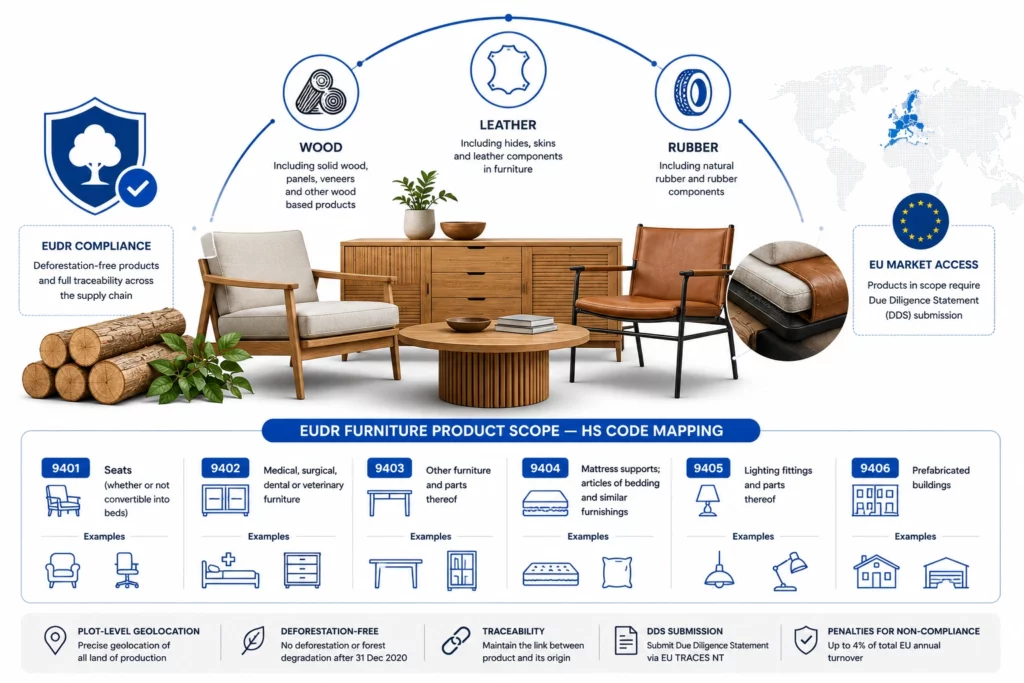
EUDR furniture compliance applies to any product containing a regulated commodity wood, leather, rubber, palm oil at any stage of production. Below is the complete product scope for furniture brands:
HS Code
Product Category
EUDR Applies?
Key Risk Material
9403
All wooden furniture (home/office/outdoor)
✅ Yes
Wood / MDF panels
9403.30
Wooden seats, chairs, stools
✅ Yes
Wood / rubber foam
9401
Upholstered sofas & chairs
✅ Yes
Rubber / wood frame
9404
Mattresses & bedding supports
✅ Yes
Rubber / wood frame
9406
Prefabricated timber buildings
✅ Yes
Wood / timber panels
4421
Miscellaneous wood articles (hangers, woodware)
✅ Yes
Wood
Does FSC certification satisfy EUDR furniture compliance?
No. FSC or PEFC certification can support your risk assessment but does not replace EUDR’s three mandatory requirements: plot-level GPS coordinates, a formal risk assessment, and a DDS submission via EU TRACES per batch. You need all three regardless of certification status.
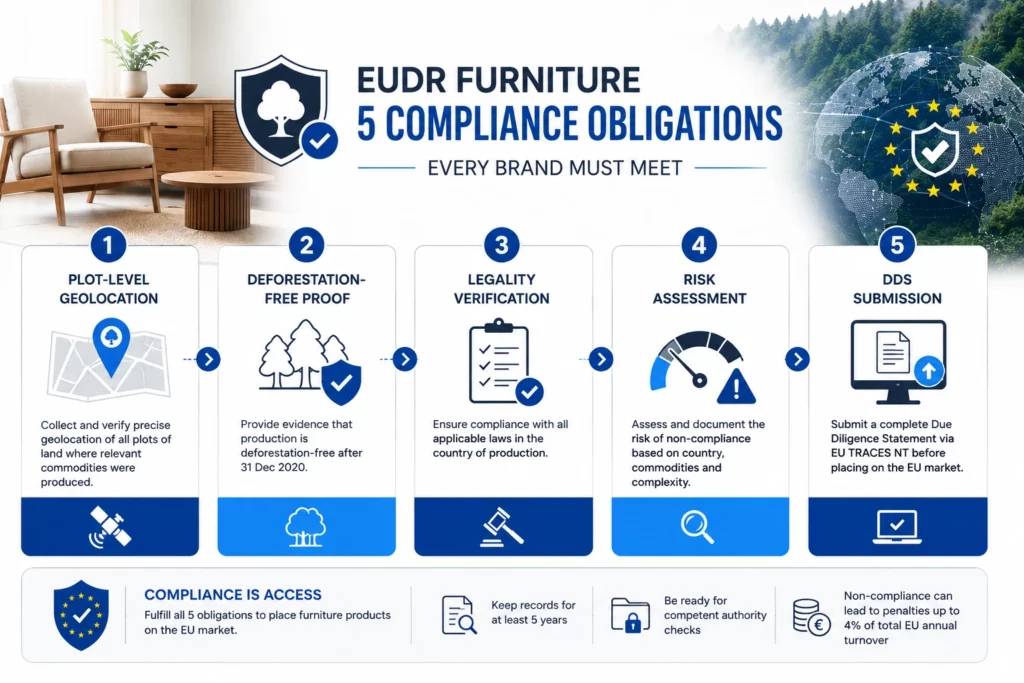
EUDR Furniture Compliance Requirements: The 5 Obligations Every Operator Must Meet
EUDR furniture compliance is built on five non-negotiable obligations. Missing any one of them makes your product legally non-compliant regardless of how sustainable your sourcing claims to be.
EUDR Furniture Compliance Obligation 1: Trace to Plot-Level Geolocation
EUDR requires GPS coordinates in GeoJSON format for every forest plot where your wood was harvested. Country-of-origin certificates are not sufficient. This single requirement eliminates most traditional compliance models.
What to collect: latitude/longitude polygon coordinates per harvest plot
Format required: GeoJSON verify your supplier data format now
Common gap: suppliers in Southeast Asia often lack digital systems to provide this data
Fix: begin digital supplier onboarding immediately this step alone takes 3–6 months
Is your geolocation data EUDR-ready?
Read our blog: “EUDR Geolocation Requirements Explained: A Complete Guide for Businesses.”
Deforestation-free under EUDR means: no land used to produce the commodity was deforested or degraded after December 31, 2020 regardless of whether the deforestation was legal in the country of origin.
Satellite imagery verification is the enforceable standard (paper certificates are insufficient without corroborating land-use data)
The cut-off date applies globally: Indonesian, Vietnamese, and Brazilian sourcing all face the same test
Mixed or commingled wood batches require verified origin for every component in the blend
EUDR Furniture Compliance Obligation 3: Verify Legality of Sourcing
Beyond deforestation, EUDR requires that all raw materials were harvested in accordance with producer-country laws including land tenure rights, labour protections, and environmental regulations. This requires jurisdiction-specific documentation for every source country in your supply chain.
EUDR Furniture Compliance Obligation 4: Conduct a Documented Risk Assessment
Before placing any in-scope product on the EU market, you must formally assess and document supply chain risk, covering:
Deforestation or degradation risk in source regions (based on satellite data)
Supply chain complexity and number of intermediaries
Country-level risk classifications under EUDR benchmarking system
Timber species and known links to illegal logging
Where risks are found, mitigation steps must be documented: additional supplier audits, alternative sourcing, or independent third-party verification.
A successful EUDR strategy doesn’t end with collecting geolocation data it begins with risk assessment.
EUDR Furniture Compliance Obligation 5: Submit a Due Diligence Statement (DDS) via EU TRACES
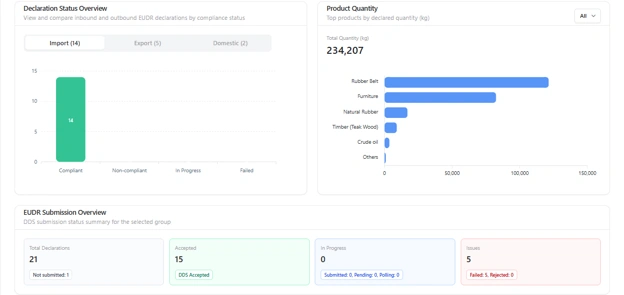
The DDS is the legal declaration confirming EUDR compliance, submitted through the EU TRACES system before each product batch is placed on the EU market. As of the November 2025 regulatory update, DDS submissions must now include the estimated annual quantity of regulated products.
Each component must satisfy due diligence individually. However, your DDS can reference existing DDS records already submitted for a component. This is where manual tracking breaks down a digital traceability platform is the only scalable solution.
EUDR Furniture Compliance Deadlines: Confirmed Timeline for 2026–2027
The EUDR timeline has been revised multiple times. Here is the legally confirmed position as of June 2026:
Dec 30, 2024
Regulation entered into force
Dec 30, 2026
Large & medium operators: full compliance deadline
Jun 30, 2027
Small & micro operators (SMEs): extended deadline
5 Years
Mandatory record-retention period after compliance
Regulation (EU) 2025/2650, published December 23, 2025, confirms the 12-month enforcement delay. However, the core compliance model is unchanged. Companies using the grace period as a pause rather than a runway are taking significant risk.
Should you wait until late 2026 to start EUDR furniture compliance?
No. Supplier onboarding, geolocation data collection, satellite verification, and DDS workflow integration typically require 6–12 months across complex supply chains. Companies that start now have a structural advantage over competitors who begin in Q3 2026 and face data quality failures right at the deadline.
Book a Free EUDR Furniture Readiness Assessment
Map your supply chain gaps, identify high-risk SKUs, and get a compliance roadmap before the December 2026 deadline.
EUDR Furniture Compliance Challenges: Why Furniture Brands Face Unique Risks
EUDR furniture compliance is structurally harder for furniture brands than for single-commodity operators. Here are the five challenges specific to furniture supply chains and how to address each.
A single wooden chair may pass through 5+ intermediaries: timber harvested in Malaysia, processed in Vietnam, assembled in China, and imported into Germany. At each handoff, geolocation data is at risk of being lost, modified, or never collected.
Actionable fix: Map every tier in your supply chain before touching DDS workflows. Know every intermediary by name, country, and data capability before assessing compliance risk.
A sofa contains a wood frame, rubber foam, and potentially leather upholstery. Under EUDR furniture compliance rules, each material may require its own DDS or compliance reference. Existing single-material compliance workflows do not cover composite furniture.
Actionable fix: Build a product-component matrix that maps each SKU to its regulated materials and source countries. Prioritise DDS workflows by material complexity, not product value.
EUDR Furniture Compliance Challenge 3: Mixed and Recycled Wood Verification
Commingled wood batches — where timber from multiple source regions is blended — create one of the hardest EUDR furniture compliance problems. Even a single non-compliant source in a blended batch can render the entire batch non-compliant.
Actionable fix: Implement mass-balance or segregated sourcing models. Require suppliers to maintain batch integrity and provide separate GeoJSON data per origin region.
EUDR Furniture Compliance Challenge 4: Supplier Readiness Gaps in Southeast Asia
Suppliers in Indonesia, Vietnam, and Malaysia the dominant furniture export hubs frequently rely on manual record-keeping and cannot consistently provide GPS coordinates or deforestation-free evidence in EUDR-compatible formats.
Actionable fix: Issue a supplier readiness scorecard with a firm non-compliance replacement deadline. Suppliers who cannot provide EUDR-compatible documentation by a set date are a compliance liability, not a supply chain asset.
EUDR Furniture Compliance Challenge 5: Documentation Scale Without Digital Systems
Managing EUDR furniture compliance documentation across hundreds of product SKUs, multiple source countries, and thousands of annual supplier batches is operationally impossible with spreadsheets or manual systems.
Actionable fix: Deploy a purpose-built EUDR compliance platform with automated DDS creation, satellite geo-verification, supplier onboarding workflows, and EU TRACES integration. TraceX is built specifically for this.
Step 1 — Map your supply chain: Identify every supplier tier from finished furniture back to the harvest plot.
Step 2 — Classify products against EUDR HS codes: Determine which SKUs contain wood, leather, or rubber.
Step 3 — Onboard suppliers with digital traceability tools: Collect GPS coordinates, sustainability certificates, and species data.
Step 4 — Run deforestation risk assessments: Use satellite imagery against the December 31, 2020 cut-off date.
Step 5 — Build your DDS workflow and integrate with EU TRACES: Test on a pilot product line first.
Step 6 — Set up ongoing monitoring and alerts: EUDR compliance is continuous, not a one-time exercise.
Timeline: Allow 6–12 months for full implementation across complex supply chains.
EUDR Furniture Compliance Penalties: Full Cost of Non-Compliance
The cost of EUDR furniture non-compliance extends far beyond a fine. Here is the complete risk picture:
Risk
What It Means for Your Business
Financial Fine
Up to 4% of total EU annual turnover per non-compliant product batch
Border Seizure
Shipments stopped at EU customs; no revenue, mounting demurrage costs
EU Market Ban
Exclusion from EU public procurement and trade financing
Reputational Damage
Regulatory finding published publicly visible to all buyers and partners
Ongoing Scrutiny
Once flagged, all future shipments face elevated inspection frequency
Operational Halt
In severe cases, full suspension of EU-facing operations
4%
Turnover Max financial fine per non-compliant batch
15–30%
of global wood trade estimated to be illegally sourced
Dec
2026 Hard deadline for large & medium furniture operators
6–12
Months Typical implementation time for full EUDR compliance systems
EUDR Furniture Compliance with TraceX: End-to-End Platform for Furniture Brands
TraceX provides furniture brands with purpose-built EUDR compliance infrastructure. Unlike generic supply chain software, TraceX EUDR Solutions is designed around the specific obligations EUDR imposes on multi-material, multi-tier furniture supply chains.
EUDR Furniture Compliance Capabilities in TraceX
Capability
What It Delivers for EUDR Furniture Compliance
Geo-mapping & Satellite Verification
Collect GeoJSON coordinates; verify plots against December 31, 2020 deforestation cut-off
Digital Supplier Onboarding
Onboard Southeast Asian suppliers with mobile-first tools that capture GPS, species, and certifications
Automated DDS Creation
Generate TRACES-compatible Due Diligence Statements automatically, per batch
Composite Product Traceability
Track component-level compliance across multi-material furniture SKUs
Risk Assessment Engine
Country and plot-level deforestation risk scoring with documented mitigation workflow
Real-Time Compliance Alerts
Automated flags for deadline proximity, supplier deviations, and data quality failures
What does ‘deforestation-free’ mean for furniture brands?
A product is deforestation-free under EUDR if no land used to produce its raw materials was deforested or degraded after December 31, 2020. This applies globally: even if deforestation was legal in the country of origin, it still disqualifies the product. For furniture brands, this means verifying every piece of wood, leather, or rubber in every product against satellite-verified land use data.
Does FSC certification satisfy EUDR furniture compliance?
No. FSC and PEFC certification can support your risk assessment but they do not satisfy EUDR’s three mandatory requirements: plot-level GPS coordinates, a documented risk assessment, and a Due Diligence Statement (DDS) submitted via EU TRACES. All three are required regardless of certification status.
What is a Due Diligence Statement (DDS) for furniture?
The DDS is the formal legal declaration submitted to the EU TRACES system confirming your furniture product is deforestation-free, legally sourced, and fully traceable. It must be submitted before each product batch enters the EU market. For composite furniture with multiple wood or leather components, the DDS covers the product as a whole but can reference existing DDS documents for individual components.
What geolocation data does EUDR require for furniture wood?
EUDR requires GPS polygon coordinates in GeoJSON format that identify the exact forest plot where the timber was harvested. Country or region of origin is not sufficient. Where wood has been sourced from multiple plantation plots, all geolocations must be individually documented. This is the most technically demanding EUDR furniture compliance requirement for importers with Southeast Asian supply chains.
Who is responsible for EUDR compliance in a furniture supply chain?
The primary legal responsibility sits with operators the first entities to place an in-scope product on the EU market. This is typically the importer. Downstream traders who resell within the EU must maintain traceability and provide compliance documentation to their buyers. Non-EU suppliers must provide the data EU importers need to complete their own due diligence.
What are the EUDR penalties for furniture brands?
Penalties include financial fines of up to 4% of total EU annual turnover, product confiscation at borders, exclusion from EU public procurement, public disclosure of regulatory findings, and in the most severe cases, full suspension of EU-facing operations. There are no size exemptions all operators regardless of company size face the same obligations, just with different deadlines.
What happens with recycled or mixed wood in furniture?
Recycled and mixed wood batches are one of the most complex EUDR furniture compliance challenges. Even minor commingling of wood from different origins requires verified deforestation-free documentation for every origin in the blend. Brands using recycled wood must implement mass-balance or segregated sourcing models with per-origin GeoJSON data.
How long does it take to achieve EUDR furniture compliance?
Realistically, 6–12 months for furniture brands with complex, multi-tier supply chains. Supplier onboarding, geolocation data collection, satellite verification, risk assessment, DDS workflow integration, and TRACES testing all take time. Companies that begin implementation in late 2026 face serious risk of shipment disruption at the December 2026 deadline.
Start using TraceX
Transparency, Trust, & Success for your Climate Journey.
We use cookies on our website to give you the most relevant experience by remembering your preferences and repeat visits. By clicking “Accept All”, you consent to the use of ALL the cookies. However, you may visit "Cookie Settings" to provide a controlled consent.
This website uses cookies to improve your experience while you navigate through the website. Out of these, the cookies that are categorized as necessary are stored on your browser as they are essential for the working of basic functionalities of the website. We also use third-party cookies that help us analyze and understand how you use this website. These cookies will be stored in your browser only with your consent. You also have the option to opt-out of these cookies. But opting out of some of these cookies may affect your browsing experience.
Necessary cookies are absolutely essential for the website to function properly. These cookies ensure basic functionalities and security features of the website, anonymously.
Cookie
Duration
Description
cookielawinfo-checkbox-analytics
11 months
This cookie is set by GDPR Cookie Consent plugin. The cookie is used to store the user consent for the cookies in the category "Analytics".
cookielawinfo-checkbox-functional
11 months
The cookie is set by GDPR cookie consent to record the user consent for the cookies in the category "Functional".
cookielawinfo-checkbox-necessary
11 months
This cookie is set by GDPR Cookie Consent plugin. The cookies is used to store the user consent for the cookies in the category "Necessary".
cookielawinfo-checkbox-others
11 months
This cookie is set by GDPR Cookie Consent plugin. The cookie is used to store the user consent for the cookies in the category "Other.
cookielawinfo-checkbox-performance
11 months
This cookie is set by GDPR Cookie Consent plugin. The cookie is used to store the user consent for the cookies in the category "Performance".
viewed_cookie_policy
11 months
The cookie is set by the GDPR Cookie Consent plugin and is used to store whether or not user has consented to the use of cookies. It does not store any personal data.
Functional cookies help to perform certain functionalities like sharing the content of the website on social media platforms, collect feedbacks, and other third-party features.
Performance cookies are used to understand and analyze the key performance indexes of the website which helps in delivering a better user experience for the visitors.
Analytical cookies are used to understand how visitors interact with the website. These cookies help provide information on metrics the number of visitors, bounce rate, traffic source, etc.
Advertisement cookies are used to provide visitors with relevant ads and marketing campaigns. These cookies track visitors across websites and collect information to provide customized ads.
Download the 2026 Traceability Scorecard and Benchmark Your Supply Chain Across 10 Critical Capabilities.
Download our eBook
Don’t Wait for an Audit to Find Your EUDR Gaps
The 2026 Simplification Package changes how HS codes, DDS pass-through and geolocation rules apply to you. Get the free guide and 20-point readiness checklist before enforcement catches you unprepared.