Audit-Ready Deforestation Risk Assessments for EUDR: Move Beyond Satellite Images to Defensible Compliance
Published
, 10 minute read
Share this article
Quick summary: Misinterpreting satellite data can cost your business EUDR compliance. Learn the most common forest data misconceptions, how to avoid false positives and false negatives, and how to stay audit-ready with precision mapping.
Audit-Ready Deforestation Risk Assessments for EUDR are assessments that not only flag risk but can prove how each verdict was reached the datasets used, the deforestation cut-off date of 31 December 2020, the commodity context, and the residual uncertainty in an exportable record a competent authority can inspect. A single satellite image cannot do this; audit-readiness comes from multi-source evidence plus a documented, explainable decision trail.
Key takeaways
EUDR does not just ask whether a plot is deforestation-free it asks you to demonstrate how you decided, which is why audit-readiness matters.
Satellite imagery alone produces false positives (plantation harvests, seasonality, cloud cover) and cannot supply the context or evidence trail an audit requires.
Audit-Ready Deforestation Risk Assessments for EUDR combine multiple remote-sensing sources, forest-vs-plantation classification, commodity-specific logic, and legal/social risk overlays.
Explainability beats a black-box verdict: you must be able to show which datasets informed each decision and where uncertainty remains.
Deadlines are firm: 30 December 2026 for large and medium operators, 30 June 2027 for micro and small non-timber operators. [Verify before publish.]
Certifications such as RSPO and FSC support risk mitigation but do not replace due diligence statements, geolocation, or plot-level evidence.
What Audit-Ready Deforestation Risk Assessments for EUDR Actually Require
Audit-Ready Deforestation Risk Assessments for EUDR are the difference between passing an inspection and scrambling to justify a verdict you can no longer explain. In plain terms, an audit-ready deforestation risk assessment is one where every compliance decision compliant, non-compliant, or requires further review is backed by traceable evidence, tied to the 31 December 2020 deforestation cut-off, and reproducible on demand by a competent authority.
Under the EU Deforestation Regulation (Regulation (EU) 2023/1115, as amended by Regulation (EU) 2025/2650), operators placing cattle, cocoa, coffee, palm oil, rubber, soy or wood and their derived products on the EU market must run due diligence that proves goods are deforestation-free and legally produced. The regulation does not accept a screenshot of a map as evidence. It expects a documented risk assessment you can defend line by line. That is the bar audit-ready deforestation risk assessments are built to clear.
With application dates now fixed at 30 December 2026 for large and medium operators and 30 June 2027 for micro and small non-timber operators, the window to move from ad-hoc monitoring to defensible, audit-ready evidence is open now.
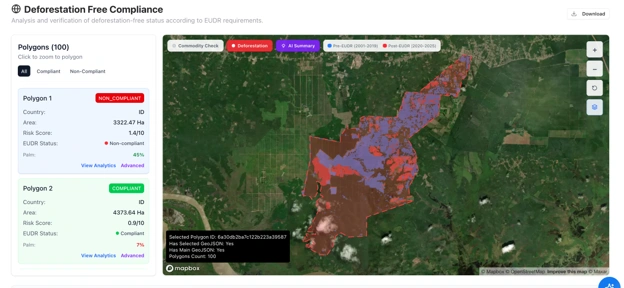
A robust deforestation risk assessment goes beyond satellite images. Learn how to evaluate sourcing locations, validate geolocation data, and build an audit-ready due diligence process.
Why Traditional Forest Monitoring Fails EUDR’s Audit-Ready Standard
Most teams start EUDR compliance believing a satellite feed is enough. It is a reasonable assumption and a costly one. Traditional forest monitoring answers a narrow question did tree cover change? while EUDR asks a much harder set of questions about legality, commodity context, and defensible evidence. Here is where the gap opens.
Satellite Imagery Alone Is Not a Deforestation Risk Assessment
A single image shows a moment, not a history. It cannot tell you whether a change in tree cover was a legal plantation harvest, a seasonal die-back, or genuine illegal conversion after the cut-off date. For an audit-ready deforestation risk assessment, a picture is an input, never the conclusion.
Tree-Cover Loss Is Not the Same as Deforestation
EUDR defines deforestation against a forest baseline and a fixed date. A rubber plantation being harvested loses tree cover but is not deforestation. Treating every loss pixel as non-compliance floods your team with false positives, inflates supplier risk scores, and crucially produces verdicts you cannot defend when an auditor asks why.
Conflicting Data Sources Undermine Defensibility
Different satellites, algorithms, and forest-loss datasets often disagree about the same plot. If your assessment rests on one source and an auditor cites another, you have no way to reconcile them. Defensibility comes from cross-validation, not from picking a favourite dataset and hoping.
The Hidden Challenges Behind Audit-Ready Deforestation Risk Assessments
Beyond the imagery itself, three operational problems quietly break most compliance programs. Audit-ready deforestation risk assessments are designed specifically to close each one.
eudr, eudr compliance, eu deforestation regulation
False Positives Inflate Risk and Cost
Cloud cover, seasonality, fire scars, and tree-crop cycles all masquerade as forest loss. Each false positive triggers manual review, supplier escalation, and delay. At scale, false positives are not a nuisance they are the single largest hidden cost in EUDR compliance.
Rubber and tree-crop harvest cycles read as loss but are legal land use.
Cloud and seasonal canopy changes create phantom disturbances.
Fire scars can register as clearance without any commodity conversion.
Missing Land-Use Context
A satellite sees that tree cover fell. It cannot see plantation harvesting, crop rotation, agricultural conversion, the commodity involved, or the land-use history that determines EUDR compliance. Without that context, an assessment is a guess wearing the costume of evidence.
The Audit Trail Problem
Ask most monitoring tools why a plot was flagged non-compliant and they cannot answer. EUDR requires the opposite: you must be able to explain which datasets informed each decision, where uncertainty exists, and what further due diligence was performed. No audit trail, no audit-ready assessment.
Learn the complete DDS filing process—from collecting supplier data and validating geolocation information to submitting an accurate, audit-ready Due Diligence Statement.
How TraceX Delivers Audit-Ready Deforestation Risk Assessments for EUDR
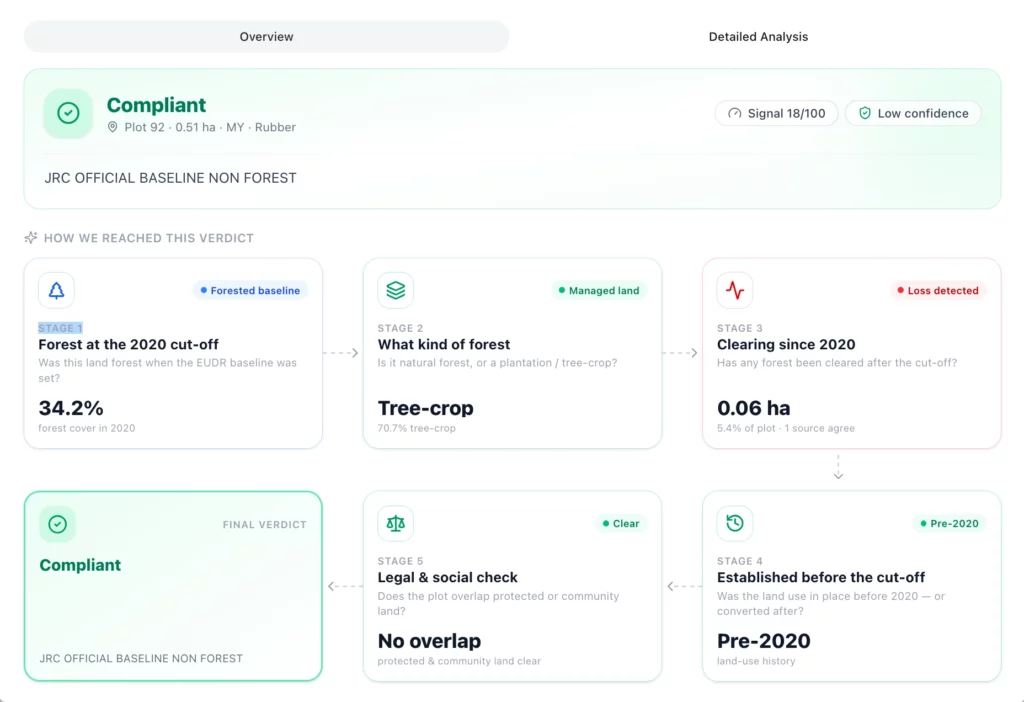
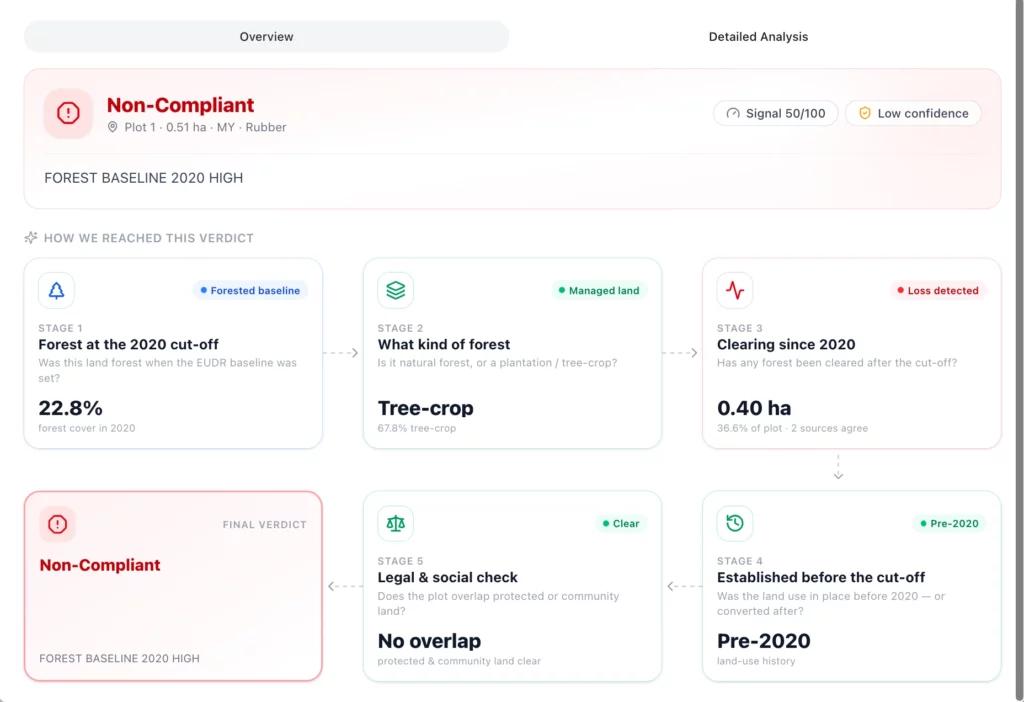
Instead of leaning on one satellite image or a single forest-loss model, TraceX EUDR Solutions builds audit-ready deforestation risk assessments from multiple independent sources. The platform evaluates every sourcing location through five layers of evidence, so confidence is built from agreement across sources rather than trust in any one dataset.
Layer 1 — Historical Forest Baseline
Determine whether land met the EUDR forest definition on 31 December 2020 using historical imagery and canopy reconstruction. Rather than a binary yes/no, the layer produces a confidence-weighted view of forest cover at the cut-off the anchor every downstream verdict is measured against.
Layer 2 — Forest and Land-Use Classification
Separate natural forests, regenerating forests, plantation forests, tree crops, and agricultural land. This distinction is what suppresses false positives for commodities such as rubber, cocoa, and timber, where routine harvesting is not deforestation.
Layer 3 — Multi-Source Disturbance Detection
Cross-validate annual forest-loss datasets, near-real-time alerts, and canopy-probability changes to isolate genuine disturbances from noise cloud, seasonality, or fire scars. Agreement across sources is what makes a flagged disturbance defensible.
Layer 4 — Land Conversion and Commodity Context
Assess whether an observed change is legal plantation harvesting, agricultural rotation, an established plantation, or illegal post-2020 conversion. This aligns the assessment with how EUDR actually evaluates deforestation, instead of penalising every tree-cover change.
Layer 5 — Legal and Social Risk Assessment
Screen sourcing locations against authoritative legal and social datasets to surface overlaps with national parks, nature reserves, Ramsar wetlands, indigenous territories, and community lands. Each overlap carries an area name, overlap percentage, risk explanation, and a due-diligence recommendation strengthening the evidence base without altering the underlying deforestation verdict.
EUDR requires businesses to prove that commodities are produced in accordance with the laws of the country of origin. Learn what legality evidence you need and how to build a stronger due diligence process.
Commodity-Specific Intelligence for EUDR Risk Assessment
A one-size-fits-all model is a false-positive machine. Each EUDR commodity has a different signature on the ground, so audit-ready deforestation risk assessments apply commodity-specific logic rather than a single generic threshold.
Timber / wood — harvest-vs-clearance distinction is the core question.
Book a personalized demo of TraceX EUDR Solutions
and see multi-source geospatial intelligence, commodity-specific analysis, and legal risk screening produce audit-ready deforestation risk assessments for EUDR.
What Every Audit-Ready Deforestation Risk Assessment Delivers
An assessment is only audit-ready if the output itself is inspection-ready. Every assessment should hand an auditor these artefacts:
Evidence artefact
Evidence artefact
Evidence artefact
Compliance verdict
Risk score
Confidence level
Forest baseline analysis
Disturbance timeline
Commodity verification
Legal & social risk flags
Plain-language AI summary
Full audit trail
Exportable reports
Datasets & sources cited
Residual-uncertainty note
Why Defensibility Matters Under EUDR
EUDR does not merely require you to identify risk it requires you to demonstrate how risk was assessed. That is the entire reason audit-ready deforestation risk assessments exist. When a competent authority reviews your due diligence, you should be able to explain:
Why a plot was classified compliant, non-compliant, or requires review.
Which datasets and sources informed the decision.
Where uncertainty exists and how it was handled.
What additional due diligence was performed and why.
A transparent, explainable assessment is worth far more than a confident black-box result. If you cannot show your work, you do not have a defensible assessment you have an opinion.
EUDR requires businesses to identify, assess, and mitigate the risk of deforestation before placing products on the EU market. Learn how to build a structured, evidence-based risk assessment process.
Manual vs Automated EUDR Deforestation Risk Assessment
Spreadsheets and one-off satellite checks do not scale to the plot-level evidence EUDR expects. Audit-Ready Deforestation Risk Assessments for EUDR change the economics of compliance, and the contrast with manual methods is stark:
Use this when comparing tools. If a vendor cannot tick these, the output will not deliver Audit-Ready Deforestation Risk Assessments for EUDR:
Evaluation checklist
Cross-validates multiple remote-sensing sources (not one dataset).
Reconstructs a confidence-weighted forest baseline at 31 December 2020.
Distinguishes plantations and tree crops from natural forest.
Applies commodity-specific logic across all seven EUDR commodities.
Screens legal and social overlays (protected areas, indigenous / community land).
Produces an explainable, exportable audit trail for every verdict.
Feeds plot-level geolocation into your due diligence statement (DDS) workflow.
Scales from smallholder plots to commercial supplier volumes.
Frequently Asked Questions (FAQ’s)
Why isn’t one satellite dataset enough for EUDR?
One dataset shows a single view and cannot reconcile disagreements between sources or separate legal harvesting from illegal conversion. Audit-Ready Deforestation Risk Assessments for EUDR cross-validate multiple sources so each verdict is defensible.
What makes a deforestation risk assessment “audit-ready”?
It can prove how every verdict was reached the datasets used, the 31 December 2020 baseline, commodity context, and residual uncertainty in an exportable record a competent authority can inspect.
How do audit-ready assessments reduce false positives?
By classifying forest versus plantation and tree crops, and by applying commodity-specific logic, so routine harvesting and seasonal change are not mistaken for deforestation.
Do RSPO or FSC certifications satisfy EUDR?
No. Certifications such as RSPO and FSC support risk mitigation but do not replace due diligence statements, geolocation, or plot-level evidence required under EUDR.
Which commodities do EUDR risk assessments need to cover?
All seven regulated commodities cattle, cocoa, coffee, palm oil, rubber, soy and wood plus their derived products, each with commodity-specific analysis.
When must operators comply with EUDR?
30 December 2026 for large and medium operators and traders (and micro/small timber operators); 30 June 2027 for micro and small non-timber operators.
What evidence should an audit-ready report include?
A compliance verdict, risk score, confidence level, forest-baseline analysis, disturbance timeline, commodity verification, legal/social flags, a plain-language summary, and a complete audit trail.
Start using TraceX
Transparency, Trust, & Success for your Climate Journey.
We use cookies on our website to give you the most relevant experience by remembering your preferences and repeat visits. By clicking “Accept All”, you consent to the use of ALL the cookies. However, you may visit "Cookie Settings" to provide a controlled consent.
This website uses cookies to improve your experience while you navigate through the website. Out of these, the cookies that are categorized as necessary are stored on your browser as they are essential for the working of basic functionalities of the website. We also use third-party cookies that help us analyze and understand how you use this website. These cookies will be stored in your browser only with your consent. You also have the option to opt-out of these cookies. But opting out of some of these cookies may affect your browsing experience.
Necessary cookies are absolutely essential for the website to function properly. These cookies ensure basic functionalities and security features of the website, anonymously.
Cookie
Duration
Description
cookielawinfo-checkbox-analytics
11 months
This cookie is set by GDPR Cookie Consent plugin. The cookie is used to store the user consent for the cookies in the category "Analytics".
cookielawinfo-checkbox-functional
11 months
The cookie is set by GDPR cookie consent to record the user consent for the cookies in the category "Functional".
cookielawinfo-checkbox-necessary
11 months
This cookie is set by GDPR Cookie Consent plugin. The cookies is used to store the user consent for the cookies in the category "Necessary".
cookielawinfo-checkbox-others
11 months
This cookie is set by GDPR Cookie Consent plugin. The cookie is used to store the user consent for the cookies in the category "Other.
cookielawinfo-checkbox-performance
11 months
This cookie is set by GDPR Cookie Consent plugin. The cookie is used to store the user consent for the cookies in the category "Performance".
viewed_cookie_policy
11 months
The cookie is set by the GDPR Cookie Consent plugin and is used to store whether or not user has consented to the use of cookies. It does not store any personal data.
Functional cookies help to perform certain functionalities like sharing the content of the website on social media platforms, collect feedbacks, and other third-party features.
Performance cookies are used to understand and analyze the key performance indexes of the website which helps in delivering a better user experience for the visitors.
Analytical cookies are used to understand how visitors interact with the website. These cookies help provide information on metrics the number of visitors, bounce rate, traffic source, etc.
Advertisement cookies are used to provide visitors with relevant ads and marketing campaigns. These cookies track visitors across websites and collect information to provide customized ads.
Download the 2026 Traceability Scorecard and Benchmark Your Supply Chain Across 10 Critical Capabilities.
Download our eBook
Don’t Wait for an Audit to Find Your EUDR Gaps
The 2026 Simplification Package changes how HS codes, DDS pass-through and geolocation rules apply to you. Get the free guide and 20-point readiness checklist before enforcement catches you unprepared.