Food Recalls: How to Cut Scope, Cost and Response Time in 2026
Published
, 10 minute read
Share this article
Quick summary: Food recalls are surging in 2025–2026. See the trends, real scenarios and how batch-level traceability cuts recall scope, cost and response time to hours.
Food recalls are formal actions to remove or correct unsafe products from the market and they are rising in both frequency and size. In 2025, U.S. regulators issued hundreds of recalls linked to 22 deaths, and average recall volume nearly doubled into early 2026. The single biggest lever a business controls is traceability speed: batch- and lot-level records that let you pinpoint affected product in hours instead of days shrink the scope, the cost and the reputational damage of any recall.
Key takeaways
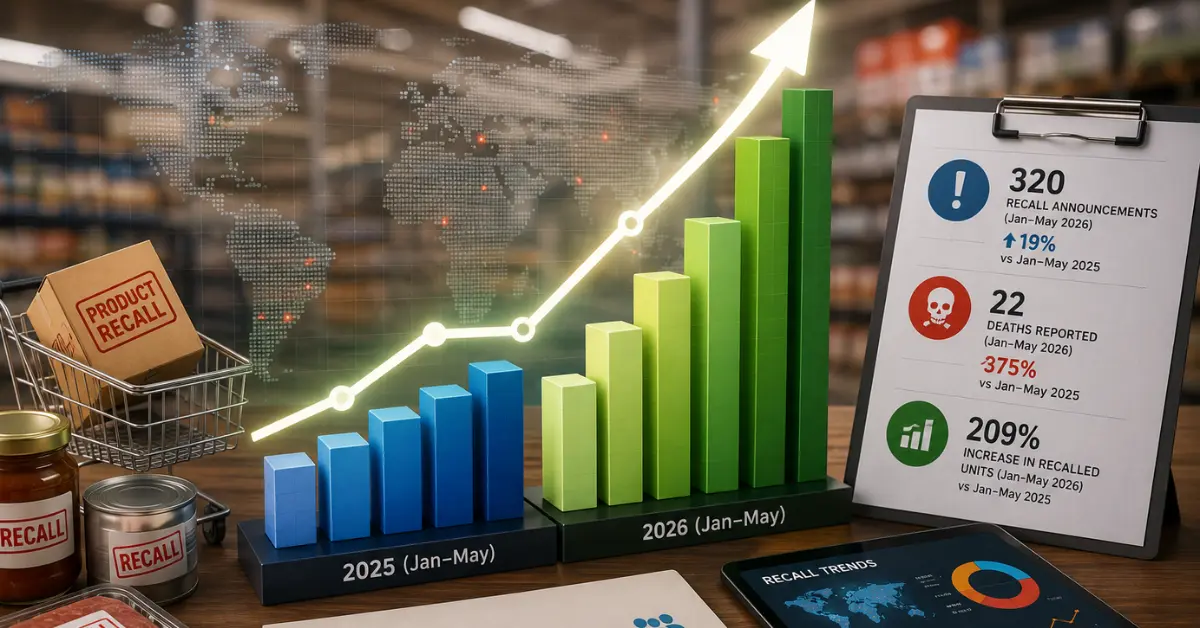
Food recalls are surging: U.S. agencies logged 320 recall announcements in 2025 (PIRG), tied to 1,003 illnesses, 235 hospitalisations and 22 deaths.
Recall size is exploding Sedgwick reports FDA recall volume up 209% in a year, with Q1 2026 units nearly double Q4 2025.
Undeclared allergens (≈39%, most often milk) and Listeria are the top drivers; Listeria caused 21 of 22 outbreak-related deaths in 2025.
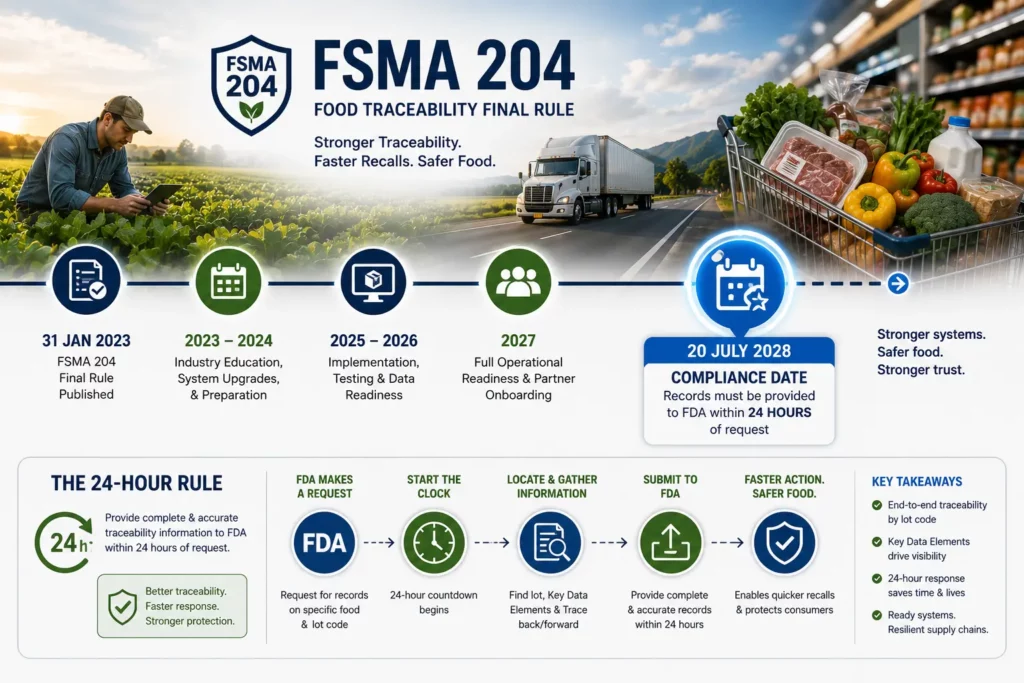
FSMA 204’s compliance date moved to 20 July 2028, but retail mandates (e.g. Walmart, live since Aug 2025) mean recall-ready traceability is already being enforced commercially.
Batch-level traceability is the difference between a targeted lot recall and a brand-damaging nationwide withdrawal.
See how digital traceability can help reduce recall scope, cost and response time.
Instead of manually piecing together records across spreadsheets and systems, teams get a connected, searchable trail to support faster investigations and more targeted recalls.
Food recalls in 2025–2026: why the risk just escalated
Food recalls are no longer an occasional operational headache they are a frontline business risk that is intensifying month over month. If you own food safety, quality or supply chain for a manufacturer, processor or brand, the question is not whether a recall will touch your category, but whether your systems can contain it before it becomes a headline.
The data makes the urgency concrete. The U.S. PIRG counted 320 food recall announcements across the FDA and USDA in 2025, linked to 1,003 illnesses, 235 hospitalisations and 22 deaths. Sedgwick’s 2026 analysis is starker on scale: FDA recalls rose 15.4% to 571 events, while affected volume jumped 209% in a single year to 138.5 million units and average recall size nearly doubled into the first quarter of 2026. A GS1 US survey found 93% of Americans are worried about how often food recalls now occur.
Two patterns should worry any buyer evaluating readiness. First, undeclared allergens most often milk are the leading cause of food recalls, at roughly 39% of announcements. Second, in 17 of 28 outbreaks investigated in 2025, regulators could not pinpoint the specific product responsible. That is a traceability failure, and it is exactly the gap the right platform closes.
Recalls are getting bigger and faster to spread, regulators are under-resourced, and retailers are enforcing traceability ahead of the federal deadline. Every month you run on spreadsheets is a month your worst-case recall gets wider. The cost of waiting is measured in lots you can’t isolate.
Food recalls can quickly become costly when businesses cannot identify the affected batch, its source, or where it was distributed.
Food recalls explained: classes, causes and the real cost to your business
In plain terms, food recalls are formal actions taken by manufacturers, distributors or regulators to pull or correct products that may be unsafe. Regulators sort them into three classes by severity:
Class I — high risk: a reasonable probability of serious harm or death, e.g. products contaminated with Listeria, Salmonella or E. coli.
Class II — medium risk: temporary or reversible health effects, e.g. undeclared allergens or minor labelling errors.
Class III — low risk: unlikely to cause harm but in violation of regulations, e.g. packaging or quality defects.
Most food recalls trace back to microbiological contamination, allergen mislabelling, foreign material, or other safety concerns. The business impact compounds across three fronts: foodsafety (the WHO attributes 600 million illnesses and 420,000 deaths a year to unsafe food); financial loss (a single recall averages around $10 million in direct costs, before lost sales); and brand damage
From supplier and raw-material sourcing to processing, batch tracking and distribution, food traceability helps businesses understand where products come from, how they move through the supply chain, and where they end up.
Food recalls and the FSMA 204 clock: why the extension is not a reprieve
The regulatory backdrop raises the stakes for food recalls further. The FDA’s Food Traceability Rule (FSMA Section 204) requires enhanced records Traceability Lot Codes, Key Data Elements captured at Critical Tracking Events for foods on the Food Traceability List, and the ability to produce those records to the FDA within 24 hours of a request.
The compliance date was pushed from 20 January 2026 to 20 July 2028 (proposed by the FDA in 2025 and codified by Congress in late 2025). But treating that as breathing room is a mistake. The rule itself is unchanged, and major retailers are enforcing their own traceability mandates now Walmart’s supplier requirement has been live since August 2025, with chargebacks already being assessed. Federal enforcement is the floor; retail compliance is the ceiling. Either way, the 24-hour standard rewards businesses that can execute food recalls from clean, connected data rather than a scramble across disconnected spreadsheets.
The FDA Food Safety Modernization Act (FSMA) has made traceability a critical part of food-safety management, particularly for businesses handling foods on the Food Traceability List (FTL).
Food recalls in action: two scenarios that show what traceability changes
The value of readiness is easiest to see through worked examples. In each, the same contamination event produces a very different outcome depending on whether the business can trace to the batch.
Scenario 1 — Listeria in leafy greens
A Listeria-positive result comes back on a lot of packaged spinach. Without batch-level traceability, the safe move is a broad, precautionary withdrawal of all spinach SKUs across every region enormous cost, and unaffected growers punished. With farm-to-shelf lot records, investigators isolate the exact grower lot, the day it was packed and the specific retail destinations, and pull only those units. The recall shrinks from national to a handful of lots, and the brand keeps the shelf. This is precisely how targeted food recalls protect both consumers and revenue.
How Green Earth Strengthened Food Safety & Quality with TraceX
Discover how Green Earth leveraged TraceX’s digital traceability solutions to bring greater transparency, efficiency and control to its vegetable contract farming operations.
From streamlining supply-chain processes to strengthening food safety and quality, see how digital traceability can transform fresh-produce supply chains.
Read the full case study to discover how Green Earth uses TraceX to build a more transparent and traceable food supply chain.
Scenario 2 — Undeclared milk in a multi-ingredient product
An ingredient supplier ships a seasoning that unexpectedly contains milk protein, and it is not declared on the finished product. Because undeclared allergens drive the largest share of food recalls, this is a common, high-liability event. With forward and backward traceability, the manufacturer links the affected supplier lot to every finished batch that used it, identifies which customers received them, and contains the issue within hours instead of guessing and pulling weeks of production. The 2024 Boar’s Head Listeria outbreak, which caused nine deaths, a seven-million-pound recall and an indefinite plant closure, is the cautionary version of what slow, unreliable traceability costs.
Most teams still treat food recalls as a crisis to survive rather than a capability to engineer. The businesses that come through recalls intact have already made traceability boring: every lot has a code, every movement is captured, and a recall query returns location, date, quantity and trading partner in minutes. The TraceX food traceability platform is built to deliver that batch-level lookup across farm-to-fork supply chains so the recall you can’t prevent is at least the recall you can contain.
Food recalls: reactive scramble vs recall-ready traceability
Handled with the right foundation, food recalls become a controlled, defensible process instead of an existential threat. End-to-end, batch-level traceability lets you pinpoint product down to the lot at any stage, detect risks before they reach the consumer, and satisfy regulators and retailers on their timelines. That is the difference between a targeted correction and a business-defining event.
Spreadsheets and disconnected systems can make it difficult to track where products came from, what happened to them, and where they went.
How the TraceX food traceability platform supports recall readiness
The TraceX food traceability platform provides blockchain-backed, end-to-end visibility from farm to fork batch-level lot IDs, real-time movement capture, and one-click backward and forward tracing. It maps the full ingredient journey, flags contamination points, and generates the lot-level records needed for FSMA 204 and retailer audits. The result is faster, narrower, more defensible food recalls. All product-capability statements here are bracketed for product-team sign-off before publishing.
See how the TraceX food traceability platform delivers batch-level lookup.
One-click backward/forward tracing, and FSMA 204-ready records on your own supply chain
Food recalls buyer’s checklist: what recall-ready traceability must do
Use this checklist when evaluating whether your process or a vendor’s platform can withstand today’s food recalls:
Batch/lot granularity: Can you trace any product to a specific lot, harvest or supplier batch at every stage?
Two-way tracing: Instant backward trace (root cause) and forward trace (impact scope) from a single lookup?
24-hour records: Can you produce FSMA 204 Key Data Elements to the FDA and KDE data to retailers like Walmart within a day?
Supplier data capture: Does the system onboard suppliers and capture Critical Tracking Events without manual re-keying?
Recall simulation: Can you run mock recalls to test response time before a real event?
Data integrity: Immutable, auditable records that hold up under regulator and retailer scrutiny?
Frequently Asked Questions
Why are food recalls increasing in 2025 and 2026?
Reporting and detection have improved, retail and regulatory scrutiny has intensified, and supply chains are more complex. In 2025 U.S. regulators logged 320 recall announcements (PIRG), and Sedgwick reported FDA recall volume up 209% year over year with average recall size nearly doubling into Q1 2026.
What are the three classes of food recalls?
Class I (high risk serious harm or death, e.g. Listeria or E. coli), Class II (medium risk temporary or reversible effects, e.g. undeclared allergens), and Class III (low risk regulatory violations such as packaging or labelling defects).
What causes most food recalls?
Undeclared allergens most often milk are the single largest cause (around 39% of 2025 announcements), followed by microbiological contamination (Listeria, Salmonella, E. coli) and foreign material.
How does traceability reduce the cost of a food recall?
Batch-level traceability lets you isolate the exact affected lots instead of pulling entire product lines. That narrows scope, cuts direct and indirect costs (a single recall averages around $10M in direct costs), and limits brand damage.
What is FSMA 204 and when is the deadline?
FSMA Section 204 (the FDA Food Traceability Rule) requires enhanced lot-level records for foods on the Food Traceability List, retrievable within 24 hours. The compliance date was extended to 20 July 2028, but retailer mandates are being enforced now.
How fast should a business be able to execute a food recall?
Fast enough to identify affected lots and produce records within 24 hours the FSMA 204 standard. Reactive, spreadsheet-based systems typically take days to weeks; digital traceability brings this down to minutes or hours.
What should we do if we source a product involved in a recall?
Check the batch or lot number to confirm it’s affected, isolate and stop distributing the product, notify affected customers and the relevant authority, and use your traceability records to scope forward (who received it) and backward (where it came from).
Start using TraceX
Transparency, Trust, & Success for your Climate Journey.
We use cookies on our website to give you the most relevant experience by remembering your preferences and repeat visits. By clicking “Accept All”, you consent to the use of ALL the cookies. However, you may visit "Cookie Settings" to provide a controlled consent.
This website uses cookies to improve your experience while you navigate through the website. Out of these, the cookies that are categorized as necessary are stored on your browser as they are essential for the working of basic functionalities of the website. We also use third-party cookies that help us analyze and understand how you use this website. These cookies will be stored in your browser only with your consent. You also have the option to opt-out of these cookies. But opting out of some of these cookies may affect your browsing experience.
Necessary cookies are absolutely essential for the website to function properly. These cookies ensure basic functionalities and security features of the website, anonymously.
Cookie
Duration
Description
cookielawinfo-checkbox-analytics
11 months
This cookie is set by GDPR Cookie Consent plugin. The cookie is used to store the user consent for the cookies in the category "Analytics".
cookielawinfo-checkbox-functional
11 months
The cookie is set by GDPR cookie consent to record the user consent for the cookies in the category "Functional".
cookielawinfo-checkbox-necessary
11 months
This cookie is set by GDPR Cookie Consent plugin. The cookies is used to store the user consent for the cookies in the category "Necessary".
cookielawinfo-checkbox-others
11 months
This cookie is set by GDPR Cookie Consent plugin. The cookie is used to store the user consent for the cookies in the category "Other.
cookielawinfo-checkbox-performance
11 months
This cookie is set by GDPR Cookie Consent plugin. The cookie is used to store the user consent for the cookies in the category "Performance".
viewed_cookie_policy
11 months
The cookie is set by the GDPR Cookie Consent plugin and is used to store whether or not user has consented to the use of cookies. It does not store any personal data.
Functional cookies help to perform certain functionalities like sharing the content of the website on social media platforms, collect feedbacks, and other third-party features.
Performance cookies are used to understand and analyze the key performance indexes of the website which helps in delivering a better user experience for the visitors.
Analytical cookies are used to understand how visitors interact with the website. These cookies help provide information on metrics the number of visitors, bounce rate, traffic source, etc.
Advertisement cookies are used to provide visitors with relevant ads and marketing campaigns. These cookies track visitors across websites and collect information to provide customized ads.
Download the 2026 Traceability Scorecard and Benchmark Your Supply Chain Across 10 Critical Capabilities.
Download our eBook
Don’t Wait for an Audit to Find Your EUDR Gaps
The 2026 Simplification Package changes how HS codes, DDS pass-through and geolocation rules apply to you. Get the free guide and 20-point readiness checklist before enforcement catches you unprepared.