EUDR Coffee Compliance for Exporters: A Practical Guide to Staying EU Market-Ready
Published
, 13 minute read
Share this article
Quick summary: A practical guide for coffee exporters to meet EUDR requirements, ensure deforestation-free sourcing, complete due diligence, and stay EU market-ready.
EUDR coffee compliance for exporters is no longer a future consideration it is an immediate operational priority for any business supplying coffee to the European Union. Under the EU Deforestation Regulation, exporters must provide verifiable proof that their coffee is deforestation-free, backed by farm-level geolocation data, structured risk assessments, and formal due diligence submissions. For companies sourcing from fragmented smallholder networks and multi-tier trader ecosystems, this represents a fundamental shift in supply chain governance.
If you export coffee to the EU, compliance is no longer optional it is a market access requirement.
The Core Challenges Coffee Exporters Are Facing:
Fragmented Smallholder Sourcing: Difficulty collecting accurate GPS coordinates and polygon mapping across dispersed farms.
Data & Traceability Gaps: Limited farm-to-batch linkage, especially when sourcing through aggregators or cooperatives.
Unclear Risk Assessment Frameworks: Struggling to interpret country risk classifications and apply “negligible risk” standards.
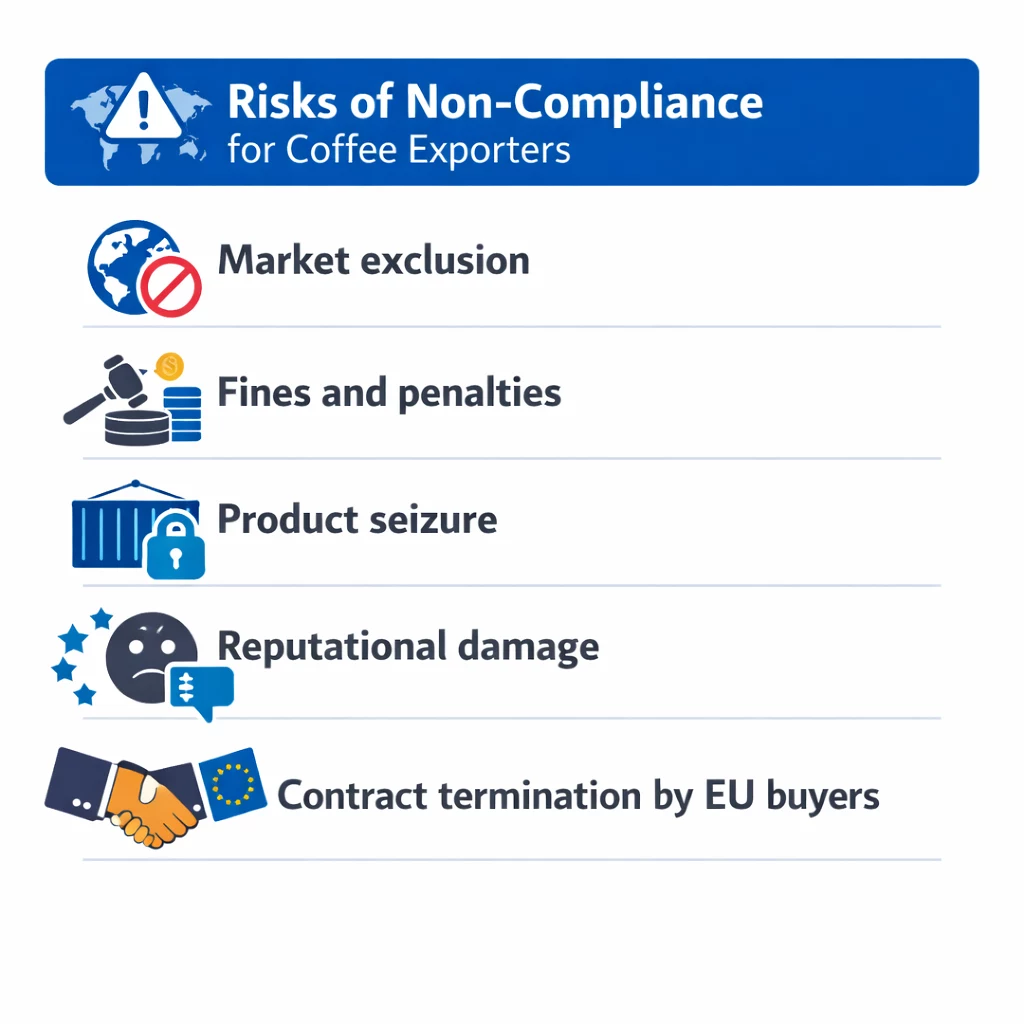
Legal & Commercial Exposure: Risk of shipment rejection, penalties, contract loss, and reputational damage due to incomplete due diligence documentation.
EUDR compliance requires more than paperwork it demands structured traceability, risk governance, and defensible documentation at scale.
TraceX EUDR solutions help coffee exporters digitize farm-level traceability, automate due diligence workflows, and stay fully EU market-ready with audit-ready compliance infrastructure.
What Is EUDR, and Why Coffee Exporters Are Directly Impacted?
The EU Deforestation Regulation (EUDR) is a legally binding regulation adopted by the European Union to ensure that certain commodities placed on or exported from the EU market are not linked to deforestation or forest degradation after a fixed cut-off date.
For coffee exporters, this regulation is not indirect or advisory it directly determines whether your shipments can legally enter the EU market.
Overview of the Regulation
Scope of Commodities (Coffee Included)
EUDR applies to seven primary commodities and their derived products:
Coffee
Cocoa
Soy
Palm oil
Cattle
Timber
Rubber
Coffee is explicitly listed, meaning green coffee beans, roasted coffee, and certain processed coffee products fall within scope.
If you export coffee to the EU you are covered.
Cut-Off Date: December 31, 2020
All coffee placed on the EU market must be proven to be:
Deforestation-free, and
Not produced on land that underwent deforestation or forest degradation after December 31, 2020.
This means exporters must provide geolocation data (GPS coordinates or polygon mapping) to verify that farms were not established on recently deforested land.
There is no exemption based on farm size.
Applicability to Operators & Traders
EUDR distinguishes between:
Operators Companies that first place the commodity on the EU market or export it from the EU.
Traders Companies that make the product available further along the supply chain.
For non-EU coffee exporters:
The EU importer typically acts as the “operator.”
However, exporters must provide all required documentation, geolocation data, and due diligence inputs to enable compliance.
In practice, exporters carry substantial compliance responsibility because EU buyers will demand complete documentation before purchase.
Enforcement Timelines
The regulation entered into force in 2023, with compliance obligations applying after a transition period.
Large companies must comply first, followed by micro and small enterprises after a slightly extended timeline.
Once enforcement begins:
Customs authorities can block non-compliant shipments.
Member states can impose financial penalties.
Products may be withdrawn from the market.
Why Coffee Exporters Are Directly Impacted
EUDR compliance is mandatory for EU market access.
Without:
Farm-level geolocation data
Risk assessment documentation
Due diligence statements
Coffee cannot legally enter the EU.
This shifts compliance from a voluntary sustainability claim to a legally enforceable market condition. Exporters that fail to operationalize traceability and due diligence risk shipment delays, contract losses, and reputational damage.
In short: EUDR transforms coffee traceability from a competitive advantage into a baseline requirement for doing business in Europe.
Ready to Strengthen Your EUDR Coffee Compliance Strategy?
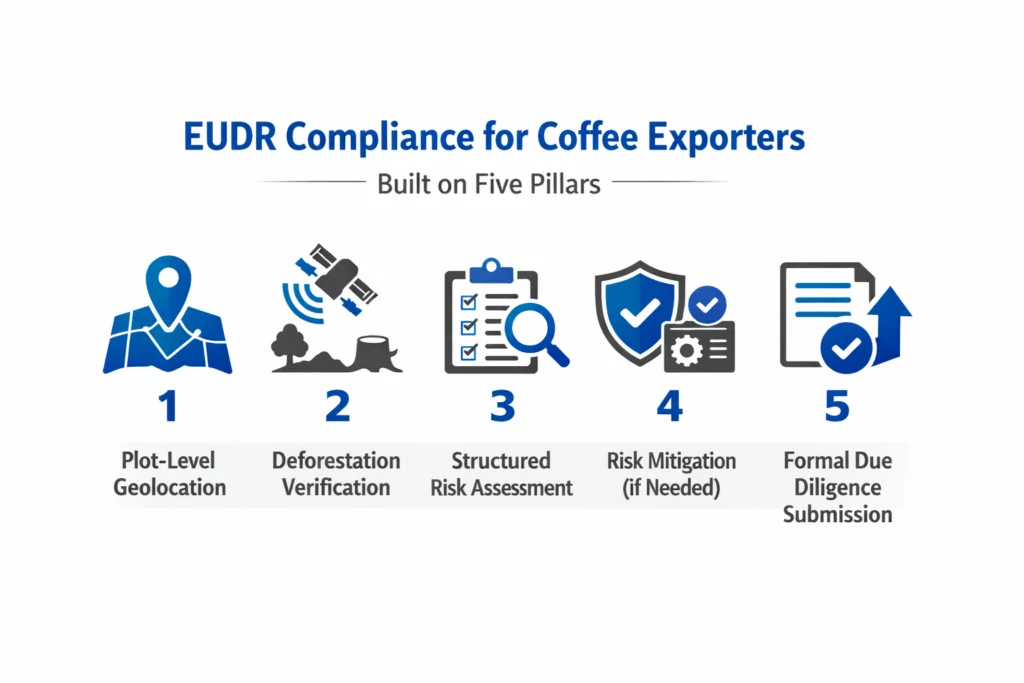
Under the EU Deforestation Regulation (EUDR), coffee exporters must implement structured due diligence systems that prove their products are deforestation-free and legally produced. Below is a breakdown of the core compliance pillars.
GPS coordinates of all farms where coffee is grown
Polygon mapping for larger plots (defining precise land boundaries)
Farm-to-batch linkage, connecting harvested coffee to specific shipment lots
This data allows EU authorities to verify whether coffee originated from land subject to deforestation after the cut-off date (December 31, 2020).
Trader-Level vs Operator-Level Responsibility
EUDR distinguishes between:
Operators Entities placing the product on the EU market for the first time (typically EU importers). Operators carry full due diligence responsibility, including submitting formal due diligence statements.
Traders Entities that further distribute the product within the EU. Their obligations depend on company size but generally include traceability and record-keeping responsibilities.
For non-EU coffee exporters, while they may not legally be the “operator,” they must provide complete geolocation and traceability data to enable EU importers to fulfill their due diligence obligations. In practice, exporters bear significant operational responsibility.
2️.Deforestation-Free Verification
Collecting geolocation data is not enough exporters must verify that coffee production did not occur on land deforested after December 31, 2020.
This requires:
Satellite monitoring to assess land cover changes
Land-use change validation against historical deforestation data
Supporting documentation demonstrating legal production
Certification Limitations
Third-party certifications (e.g., sustainability standards) may support compliance, but they are not sufficient on their own.
EUDR requires:
Plot-specific verification
Structured risk assessment
Formal due diligence documentation
Certification schemes can supplement evidence, but they do not replace the exporter’s obligation to demonstrate negligible deforestation risk.
3. Risk Assessment Framework
Exporters must conduct a formal risk assessment before placing coffee on the EU market.
This includes evaluating:
Country-level risk classification (low, standard, or high risk)
Supplier governance and compliance history
Traceability gaps within the supply chain
Complexity of sourcing networks, especially where intermediaries are involved
The “Negligible Risk” Standard
Coffee can only be placed on the EU market if the operator concludes there is no or negligible risk that it is non-compliant.
If risk cannot be deemed negligible based on evidence and analysis, mitigation measures must be applied before proceeding.
This shifts compliance from documentation gathering to structured risk governance.
4. Risk Mitigation Measures
If the risk assessment identifies more than negligible risk, exporters (and operators) must implement mitigation actions such as:
While many coffee exporters understand the high-level requirements of the EU Deforestation Regulation, what they often underestimate are the operational realities of implementing compliance across fragmented supply chains. We saw this firsthand when a Nigerian commodity trader approached us confident in their documentation, yet unsure how to translate smallholder sourcing, farm mapping, and traceability into a fully EUDR-aligned system.
EUDR is not just a documentation exercise it exposes structural weaknesses that have long existed but were previously manageable. Under a legally enforceable regime, those weaknesses become material risks.
Here are the most common barriers exporters underestimate:
Smallholder Fragmentation
In many coffee-producing countries, sourcing networks include thousands of smallholder farmers spread across multiple regions.
Challenges include:
Lack of standardized record-keeping
Informal land documentation
Limited digital access
Varying levels of compliance awareness
Collecting plot-level geolocation data at scale becomes significantly more complex when farms are small, remote, and loosely organized.
Incomplete Farm Mapping
Many exporters assume they “know their suppliers.” But EUDR requires precise GPS coordinates and in many cases, polygon mapping of actual farm plots.
Common issues:
Coordinates captured inaccurately
Farm boundaries not properly defined
Aggregated coordinates submitted instead of plot-level data
No linkage between farms and specific export batches
Aggregator-Based Sourcing
Coffee often passes through:
Cooperatives
Local traders
Collection agents
Regional aggregators
This creates opacity between the exporter and the original farm.
Under EUDR, indirect sourcing increases:
Traceability gaps
Data inconsistency
Risk classification complexity
Data Digitization Gaps
Even when data exists, it may be:
Stored in spreadsheets
Shared via email
Maintained in paper records
Scattered across departments
This makes:
Risk assessments inconsistent
Audit preparation slow
Due diligence documentation difficult to centralize
Supplier Resistance
Upstream suppliers may push back due to:
Privacy concerns over geolocation data
Increased compliance workload
Fear of market exclusion
Limited technical capacity
Without structured onboarding and clear communication, suppliers may delay or provide incomplete data.
Curious how farm mapping actually works on the ground — especially with smallholder cocoa farmers in Nigeria?
See how geolocation data, polygon mapping, and risk verification were used to build a deforestation-free cocoa supply chain that’s EUDR-ready.
Meeting the requirements of the EU Deforestation Regulation is not simply a documentation exercise it is a structured data governance challenge. While many exporters begin with spreadsheets, email trails, and shared folders, these tools quickly become inadequate under regulatory scrutiny.
Why Spreadsheets Are Insufficient
Spreadsheets may work for internal tracking, but they fall short when compliance must be:
Scalable across thousands of smallholders
Verifiable through structured audit trails
Linked from farm-level geolocation to export batch
Submission-ready for formal due diligence declarations
Under EUDR, compliance must be structured, reproducible, and regulator-ready not manually assembled per shipment.
What Modern EUDR Compliance Requires
1. End-to-End Traceability Platforms
Exporters need centralized systems that connect:
Farm-level geolocation
Supplier records
Risk assessments
Shipment batches
This ensures every export lot can be traced back to verified farm plots with documented compliance evidence.
2. Satellite Integration
Geolocation data must be validated against deforestation cut-off requirements.
This requires:
Satellite monitoring integration
Historical land-use validation
Automated deforestation screening
Manual map checks are neither scalable nor defensible at volume.
3. Automated Documentation
Each shipment placed on the EU market requires structured due diligence documentation.
Modern systems should:
Generate standardized compliance reports
Store mitigation evidence
Retain records for required timeframes
Maintain version history
Automation reduces human error and accelerates customs clearance readiness.
4. Batch-Level Traceability
Coffee is often aggregated from multiple farms. Exporters must ensure:
Clear farm-to-batch linkage
Lot-level compliance validation
Separation of compliant and non-compliant sourcing
Without batch-level control, traceability collapses under aggregation complexity.
5. Audit-Ready Dashboards
Regulators and EU buyers may request evidence at any time.
Exporters need:
Real-time compliance status visibility
Risk classification insights
Supplier readiness tracking
Documentation retrieval within minutes not days
Audit readiness must be built into the system, not reconstructed after the fact.
This is where purpose-built platforms play a critical role. TraceX EUDR Solutions are designed to centralize farm-level geolocation data, integrate risk assessment workflows, enable batch-level traceability, and generate submission-ready due diligence documentation all within a governed compliance framework.
Rather than replacing existing operations, such platforms formalize and structure them, helping coffee exporters transition from spreadsheet-based tracking to defensible, scalable EU market readiness.
Turning EUDR Compliance Into a Competitive Advantage
EUDR coffee compliance is no longer optional for exporters targeting the EU it is a market access requirement. The regulation demands traceability to plot level, verified deforestation-free sourcing, robust due diligence statements, and complete documentation readiness before products enter the EU market. Exporters that act early by strengthening supply chain mapping, investing in geolocation data, digitizing documentation, and aligning with EU importers will not only avoid shipment delays and penalties but also position themselves as low-risk, trusted suppliers. In a tightening regulatory environment, compliance is more than a legal obligation; it is a strategic differentiator that protects revenue, strengthens buyer relationships, and ensures long-term EU market access.
EUDR compliance is now a market access requirement — not just a sustainability initiative. Learn what exporters must document, verify, and submit to stay eligible for the EU market.
We already follow sustainability standards isn’t that enough?
No. Certifications help, but EUDR requires plot-level geolocation data and a formal EU due diligence statement. Existing certifications may support compliance but do not replace legal obligations.
Our EU buyer handles compliance, why should we worry?
EU importers submit the due diligence statement, but they rely entirely on exporter data. Incomplete or inaccurate documentation can result in shipment rejection or contract loss.
We source from smallholders. Is geolocation too complex?
EUDR allows smallholder participation, but farms must still be geolocated. Digital mapping tools and cooperative-level data collection can make this manageable and scalable.
This will increase costs is it really necessary now?
Yes. Non-compliance risks shipment delays, penalties, and loss of EU buyers. Early preparation reduces future costs and avoids last-minute supply chain disruption.
We don’t export directly to the EU. Does this still apply?
If your coffee eventually enters the EU market at any stage, EUDR requirements will cascade upstream. Indirect exporters must still provide compliant data to traders and processors.
Start using TraceX
Transparency, Trust, & Success for your Climate Journey.
We use cookies on our website to give you the most relevant experience by remembering your preferences and repeat visits. By clicking “Accept All”, you consent to the use of ALL the cookies. However, you may visit "Cookie Settings" to provide a controlled consent.
This website uses cookies to improve your experience while you navigate through the website. Out of these, the cookies that are categorized as necessary are stored on your browser as they are essential for the working of basic functionalities of the website. We also use third-party cookies that help us analyze and understand how you use this website. These cookies will be stored in your browser only with your consent. You also have the option to opt-out of these cookies. But opting out of some of these cookies may affect your browsing experience.
Necessary cookies are absolutely essential for the website to function properly. These cookies ensure basic functionalities and security features of the website, anonymously.
Cookie
Duration
Description
cookielawinfo-checkbox-analytics
11 months
This cookie is set by GDPR Cookie Consent plugin. The cookie is used to store the user consent for the cookies in the category "Analytics".
cookielawinfo-checkbox-functional
11 months
The cookie is set by GDPR cookie consent to record the user consent for the cookies in the category "Functional".
cookielawinfo-checkbox-necessary
11 months
This cookie is set by GDPR Cookie Consent plugin. The cookies is used to store the user consent for the cookies in the category "Necessary".
cookielawinfo-checkbox-others
11 months
This cookie is set by GDPR Cookie Consent plugin. The cookie is used to store the user consent for the cookies in the category "Other.
cookielawinfo-checkbox-performance
11 months
This cookie is set by GDPR Cookie Consent plugin. The cookie is used to store the user consent for the cookies in the category "Performance".
viewed_cookie_policy
11 months
The cookie is set by the GDPR Cookie Consent plugin and is used to store whether or not user has consented to the use of cookies. It does not store any personal data.
Functional cookies help to perform certain functionalities like sharing the content of the website on social media platforms, collect feedbacks, and other third-party features.
Performance cookies are used to understand and analyze the key performance indexes of the website which helps in delivering a better user experience for the visitors.
Analytical cookies are used to understand how visitors interact with the website. These cookies help provide information on metrics the number of visitors, bounce rate, traffic source, etc.
Advertisement cookies are used to provide visitors with relevant ads and marketing campaigns. These cookies track visitors across websites and collect information to provide customized ads.
Download the 2026 Traceability Scorecard and Benchmark Your Supply Chain Across 10 Critical Capabilities.
Download our eBook
Don’t Wait for an Audit to Find Your EUDR Gaps
The 2026 Simplification Package changes how HS codes, DDS pass-through and geolocation rules apply to you. Get the free guide and 20-point readiness checklist before enforcement catches you unprepared.