Quick summary: EUDR due diligence statement examples for cocoa, furniture, soy, paper and rubber. Learn when one DDS covers multiple shipments and what data to track.
EUDR DUE DILIGENCE STATEMENT EXAMPLES shows how cocoa, furniture, soy, paper and rubber businesses can manage supplier data, production plots, traceability and DDS requirements under the EUDR.A Due Diligence Statement (DDS) is submitted through the EU Information System by an operator where required under the EUDR. The statement is part of a wider due diligence process: identifying relevant products, collecting required information, assessing risk and taking mitigation measures where required. A reference number is not a substitute for the underlying information and controls.
The five examples focus on the practical data chain: product → supplier → production plot → geolocation → risk assessment → quantity → batch → shipment → declaration reference.
Key Takeaways
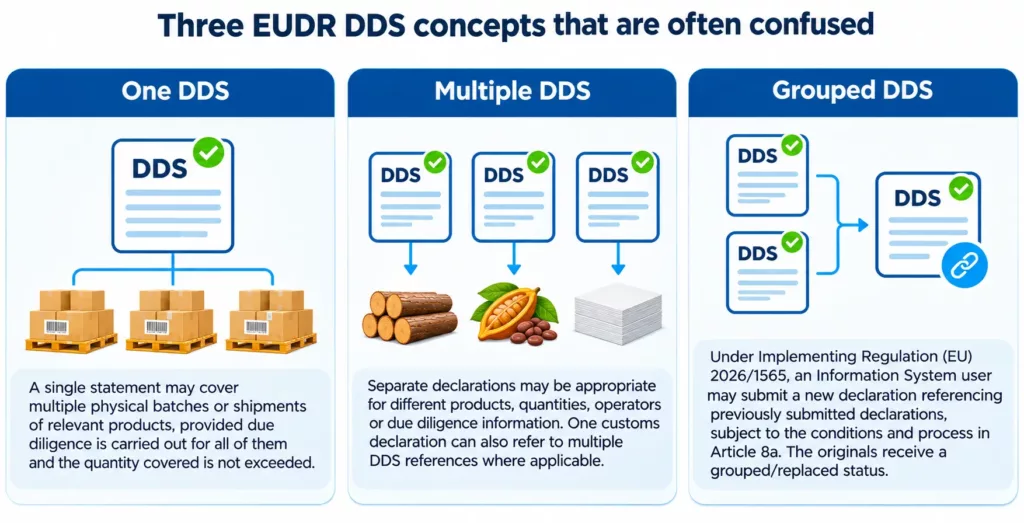
One DDS can cover multiple shipments: A single Due Diligence Statement (DDS) may cover multiple batches or shipments, provided the declared products, quantities and due diligence information meet the applicable requirements.
DDS requirements depend on the business role: Not every exporter, processor, trader or downstream operator is required to submit a separate DDS. Obligations depend on the company’s role under the EUDR and the applicable rules.
Accurate plot-level data is essential: Businesses must collect and maintain the required geolocation information and evidence for the relevant production plots.
Different commodities require different evidence: Cocoa, soy, rubber, wood and other regulated commodities may involve different supplier records, product information and supporting documentation.
Multiple DDSs may be appropriate: Businesses handling different suppliers, products, operators or quantities may need separate declarations depending on their supply-chain structure and regulatory obligations.
DDS grouping can simplify declaration management: The 2026 implementing rules introduce a mechanism to group eligible existing declarations through a new declaration referencing the original DDSs, subject to the applicable conditions.
Traceability must continue beyond declaration submission: Companies need reliable records connecting suppliers, production plots, raw materials, processing activities and finished products.
Digital systems help manage compliance at scale: Supplier onboarding, geolocation validation, risk assessment, evidence management and batch-level traceability can help businesses organise EUDR information and prepare for due diligence.
Download our eBook
Assess your EUDR readiness, uncover data gaps, and take proactive steps towards stronger compliance.
Scope depends on the exact CN code and any “ex” qualifier, not just the industry or product name.
Who is the responsible actor?
Identify whether the business is the upstream operator, downstream operator, trader or authorised representative under the amended rules.
What quantity and products are covered?
The DDS scope and declared quantity must align with the relevant products being placed on the market or exported.
Can sourcing be traced?
Keep the connection between the relevant commodity, production plots, supplier records, processing lots and shipments.
Can an existing declaration be relied on?
Check the reference, product, quantity, legal role and current system rules. Do not reuse a reference by assumption.
5 EUDR DDS Examples
1. Cocoa exporter managing multiple shipments
Business situation
A cocoa exporter in Ghana purchases cocoa beans from several cooperatives. Beans are collected at different buying centres, consolidated at a warehouse and exported to an EU customer in three consignments over several weeks.
What makes this challenging?
One customer order is fulfilled through several physical shipments.
Each consignment may contain cocoa from multiple farms and cooperatives.
Warehouse consolidation can mix cocoa from different sourcing periods.
The exporter needs to reconcile plot information and the quantity covered by its due diligence.
Illustrative information flow
STAGE / RECORD
INFORMATION TO CONNECT
Supplier onboarding
Cooperative, farmer and supplier identity; sourcing relationships.
Plot information
Geolocation of all relevant production plots and supporting production information.
Risk assessment
Deforestation and legality risk assessment; mitigation where required.
Aggregation
Buying-centre receipts, dates, weights, warehouse receipts and inventory movements.
Shipment linkage
Product description, quantity, consignment details and relevant DDS reference.
One DDS or multiple DDS?
Where the same operator is placing relevant cocoa products on the market, one DDS may cover multiple physical shipments over time if the operator has carried out due diligence for all products covered and the declared quantity is sufficient. Once that quantity is exhausted, an additional DDS is required for further quantities. Separate declarations may be needed where the products or due diligence information differ.
Practical example
An exporter declares a defined quantity of cocoa supported by plot and sourcing information. The quantity is dispatched in three consignments. The same DDS reference may be used in the relevant customs declarations for those consignments, provided the legal conditions are met and the declared quantity is not exceeded.
What the business should put in place
Plot-to-cooperative-to-buying-centre mapping.
Warehouse inventory and lot reconciliation.
Batch/lot genealogy for consolidated cocoa.
DDS register linking references to declared quantities and shipments.
Alerts when cumulative dispatched quantity approaches the DDS quantity.
Lesson from this scenario
The key challenge is not generating a reference number. It is proving that the cocoa quantity in each shipment is supported by the relevant sourcing plots and due diligence information.
2. Furniture manufacturer sourcing timber from different origins
Business situation
A furniture manufacturer imports timber components and finished wooden parts from suppliers in several countries. Product lines use different species, production sites and sourcing locations. Some components are purchased directly; others are incorporated into finished furniture.
What makes this challenging?
Timber inputs may have different countries of production, species and plot-level sourcing information.
Wood species information must be collected where required, including common and full scientific names.
A supplier invoice or generic certificate may not establish the plot-to-product link.
The business must determine whether it is the operator placing a relevant product on the EU market or has another role.
Illustrative information flow
STAGE / RECORD
INFORMATION TO CONNECT
Solid wood panels
Confirm product classification, species, production plots, geolocation and legality evidence.
Wooden legs
Species and origin; upstream DDS references where relevant; component/batch traceability.
Plywood components
Annex I scope, applicable species information, production origin and supplier evidence.
Finished furniture
Check whether the finished product is in Annex I and identify the responsible actor.
One DDS or multiple DDS?
Do not combine all timber inputs into one declaration simply because they are used in the same furniture range. Confirm the Annex I scope of the relevant products and the actor responsible for the declaration. Different products, origins or due diligence information may require separate treatment. If relying on upstream information or references, verify that they relate to the relevant products and quantities.
Practical example
A table uses a wooden top from one origin and legs from another. The manufacturer maintains component-level records for species, origin, supplier and relevant upstream due diligence information. It does not assume a reference covering the legs also covers the top.
What the business should put in place
Product-level Annex I classification register.
Species register with accepted common and scientific names where applicable.
Component-to-finished-product bill of materials and batch mapping.
Supplier evidence repository for origin, plot and legality information.
Reference validation before relying on upstream DDS information.
Lesson from this scenario
For wood and furniture, product classification and species information are as important as plot geolocation. A general supplier assurance does not replace the information required for the specific product.
Understand how to identify, document and trace wood species across your supply chain to strengthen EUDR compliance and prepare for due diligence.
3. Soy processor managing multiple production plots
Business situation
A soy processor sources beans from farms and aggregators. Beans are delivered to silos, blended and converted into soy meal and oil. The processor supplies relevant products to EU customers.
What makes this challenging?
Each relevant production plot must be associated with the sourced commodity and its geolocation information.
Silo blending can make it difficult to identify which plots contributed to a processing lot.
Processing changes input-output quantities; mass-balance assumptions must not replace traceability requirements.
Different output products may have different Annex I classifications and legal treatment.
Illustrative information flow
STAGE / RECORD
INFORMATION TO CONNECT
Farm sourcing
Farm IDs and plot polygons for supplying farms.
Aggregator intake
Delivery tickets and weights by supplier/farm.
Silo storage
Silo ID, intake dates, inventory movements and source pool.
Crushing
Processing batch, input quantity, output yields and genealogy.
Dispatch
Product code, quantity, customer, shipment and applicable reference.
One DDS or multiple DDS?
The number of plots alone does not determine the number of declarations. Where multiple plots contribute to a defined quantity of a relevant product, the required plot information must be accounted for. Separate declarations may be appropriate where products, due diligence information or transaction circumstances differ. A single silo or processing run does not automatically determine the DDS structure.
Practical example
Soy from 40 mapped farms is delivered to Silo S-04 over two weeks. The processor preserves intake records linking deliveries to plots, documents silo movements and links the resulting processing batch to its input pool. At dispatch, it can explain the relevant origins and quantities supporting the declaration or reference relied upon.
What the business should put in place
Farm and plot master linked to supplier and delivery IDs.
Geospatial validation and exception handling.
Silo inventory and mixing records.
Processing genealogy linking input lots to output batches.
Reconciliation of receipts, yields, losses, stock and dispatches.
Lesson from this scenario
The critical control is preserving plot-to-batch traceability through aggregation and processing. A list of farms without a defensible link to the product quantity is not enough.
4. Paper manufacturer sourcing pulp from multiple suppliers
Business situation
A paper manufacturer sources imported pulp from several suppliers and combines it with other fibre inputs to produce printing paper, tissue and packaging grades. Pulp blends change by grade, supplier availability and production run.
What makes this challenging?
Paper supply chains can involve several upstream processors and sourcing countries.
Highly processed products may contain wood from multiple species, and the species mix may vary.
Generic descriptions such as hardwood pulp, softwood pulp or mixed fibre may not provide the species-level information required.
Recovered fibre must be distinguished from virgin wood-derived inputs.
Illustrative information flow
STAGE / RECORD
INFORMATION TO CONNECT
Hardwood pulp supplier
Potential species list using common and scientific names, supported by supplier records.
Softwood pulp supplier
Potential species list using accepted nomenclature and sourcing records.
Mixed/recycled fibre supplier
Separate recovered fibre from virgin wood-derived input; identify applicable species for virgin inputs.
Paper production batch
Link pulp lots and blend records to paper grade and production batch.
One DDS or multiple DDS?
First confirm that the pulp or paper product is listed in Annex I and identify the actor responsible for due diligence. Do not assume a supplier DDS automatically covers the finished paper product, or that all paper grades can be grouped together. Product classification, species information, source data, quantities and the actor’s role determine the correct approach.
Practical example
A printing-paper grade uses pulp from Supplier A and Supplier B. The blend changes between production runs. The manufacturer maintains a batch record showing the pulp lots used, suppliers and potential species identified by suppliers. When a supplier changes sourcing or species mix, the manufacturer updates the relevant information before relying on it.
What the business should put in place
Supplier-specific species register with common and scientific names.
Pulp lot-to-paper batch mapping and composition records.
Separation of recovered fibre and virgin wood-derived inputs.
Supplier change notifications for sourcing, species and production locations.
Evidence retention for classification, sourcing and due diligence.
Lesson from this scenario
For paper manufacturers, species data and batch-level material traceability must work together. A static supplier list is not reliable if pulp sources and blends change.
Discover how a leading paper manufacturer digitised wood and pulp traceability with TraceX, connecting sourcing locations, GeoJSON data and deforestation risk assessments to streamline EUDR due diligence. Explore the case study to learn more.
A natural rubber processor sources cup lump and other forms of natural rubber from smallholders, farmer groups and intermediaries. Material is aggregated at collection centres, processed into blocks or sheets and exported to EU customers.
What makes this challenging?
Rubber supply chains can involve many smallholder plots and multiple collection centres.
Plot polygons or coordinates may be incomplete, duplicated, invalid or incorrectly associated with suppliers.
Rubber from multiple plots can be mixed during collection, storage and processing.
Finished rubber products and rubber inputs must be checked against exact Annex I product codes and qualifiers.
Illustrative information flow
STAGE / RECORD
INFORMATION TO CONNECT
Smallholder onboarding
Farmer ID, supplier identity and plot geolocation.
Collection centre
Receipt date, weight, farmer/plot reference and centre ID.
Processing
Input lot, processing batch, output quantity and plant.
Finished product
Product code, grade, quantity and production batch.
Export
Shipment, buyer, quantity and relevant DDS/reference information.
One DDS or multiple DDS?
The number of sourcing locations alone does not decide the number of declarations. First verify the exported product is in Annex I and determine the responsible actor. Multiple plots may be included in the relevant due diligence information for a defined quantity where the rules allow. Separate declarations may be needed where products, information or transaction circumstances differ.
Practical example
A processor receives natural rubber from 120 mapped smallholder plots through four collection centres. The material is processed into two batches. Farmer-to-plot, intake, collection-centre, processing and dispatch records remain connected. Before preparing or relying on a declaration reference, the processor checks product scope and completeness of the relevant plot and quantity information.
What the business should put in place
Plot onboarding with geometry validation and duplicate detection.
Farmer, collection-centre, intake and batch identifiers linked end to end.
Documented mixing and processing genealogy.
Product-code validation against current Annex I.
Exception workflows for missing coordinates and quantity discrepancies.
Lesson from this scenario
Rubber traceability depends on reliable plot onboarding and preserving source identity through aggregation and processing. Geolocation quality is a data-control issue, not just a map-upload task.
These approaches should not be selected simply to reduce filing effort. The correct approach depends on the legal role, product scope, due diligence information, quantity and current EU Information System process.
APPROACH
WHEN IT MAY BE RELEVANT
KEY CONTROL
One DDS
A defined quantity of relevant products is supported by one due diligence information set; the rules and system allow the declaration to cover successive shipments.
Confirm scope, quantity, origins and plot information. Track cumulative quantity; submit a new DDS when the covered quantity is exhausted.
Multiple DDS
Different products, quantities, due diligence information or transaction circumstances call for separate declarations.
Keep each statement’s scope clear. Avoid quantity duplication or gaps.
Grouped DDS
A new declaration references multiple original declarations under Article 8a of Implementing Regulation (EU) 2026/1565.
Follow the exact system workflow. The original declarations receive a grouped/replaced status; retain traceability to the original references.
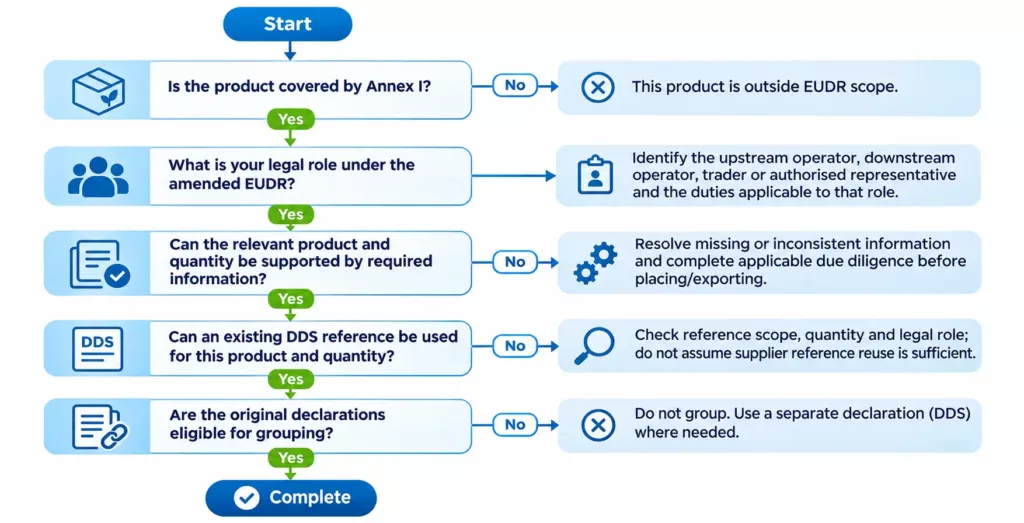
A practical decision sequence
Multiple shipments under one DDS: The European Commission explains that one DDS can cover multiple physical batches or shipments, including successive placements over time. The operator must have conducted due diligence for all covered products. Once the quantity covered by that DDS has been used, a new DDS is required for additional quantities.
Simplify EUDR compliance with DDS consolidation. Discover how businesses can manage multiple Due Diligence Statements through a consolidated approach, streamline declaration management and improve supply chain traceability.
Common DDS challenges and practical controls
CHALLENGE
WHY IT MATTERS
PRACTICAL CONTROL
Unclear product scope
A broad product description may hide different Annex I classifications or exclusions.
Validate exact CN code and any “ex” qualifier for each product.
Incomplete geolocation
Missing or invalid plot data undermines required production-location information.
Use structured plot onboarding, geometry validation and exception workflows.
Supplier data in spreadsheets
Versions, formats and ownership are difficult to control across tiers.
Use standard templates, named data owners and controlled updates.
Quantity mismatch
Procurement, inventory, processing and shipment quantities may not reconcile.
Maintain lot genealogy and input-output reconciliation.
Mixed sourcing
Aggregation can break the link between product quantity and contributing plots.
Record source pools, mixing events, batches and processing events.
Incorrect reference use
A reference may not cover the product, quantity or transaction being handled.
Validate declaration scope and actor obligations before relying on a reference.
Species information gaps
Wood/paper inputs may be described only by generic fibre type.
Collect common and scientific species names where required.
Outdated process
Regulatory amendments and system functions can change filing practice.
Monitor official updates and refresh internal procedures.
How TraceX can support EUDR data management
Managing supplier, plot, batch and shipment information across spreadsheets, ERP systems and disconnected supplier portals can make EUDR due diligence difficult to operate consistently. A connected traceability workflow can help maintain the links between sourcing information and the products moving through the supply chain.
Supplier and producer onboarding with structured data collection.
Plot-level geolocation capture and GeoJSON validation.
Satellite-based deforestation screening to support risk assessment.
Supplier, plot, procurement, inventory and batch traceability.
Centralised due diligence evidence and record management.
Workflows to support DDS data preparation and applicable TRACES processes.
TraceX EUDR Solutions supports EUDR data management and traceability workflows. The responsible economic operator remains accountable for its legal obligations and for the accuracy of information submitted.
Make your DDS process more manageable
If your business handles multiple suppliers, production plots, batches or shipments, TraceX can help connect the information needed for EUDR due diligence.
Product classification checked against the current EUDR Annex I.
Legal role and responsible operator identified under the amended rules.
Supplier and upstream sourcing records collected.
Production plots and geolocation validated where required.
Wood species information collected where applicable.
Risk assessment completed and mitigation performed where required.
Quantity, batch, inventory and shipment records reconciled.
Existing declaration references checked before relying on them.
Current grouping rules checked before submitting a grouped declaration.
Evidence, approvals and system reference numbers retained.
Frequently asked questions
Can one EUDR DDS cover multiple shipments?
Yes. The Commission explains that one DDS can cover multiple physical batches or shipments, including successive placements over time, provided due diligence has been carried out for all relevant products covered. The operator must track the declared quantity; once it is used, a new DDS is required for additional quantities.
Does every shipment require a new DDS?
No. A single DDS may cover multiple shipments where the applicable requirements are met. The same DDS reference may be used in several customs declarations for those shipments. The declared quantity and the underlying due diligence information must cover the goods.
Can multiple DDS be grouped into one declaration?
Implementing Regulation (EU) 2026/1565 adds Article 8a, allowing an Information System user to submit a new DDS or simplified declaration referencing previously submitted declarations, subject to the prescribed conditions. The original declarations receive a status identifying that they are grouped and replaced.
Can a company simply reuse a supplier’s DDS reference?
Do not rely on a reference simply because a supplier provides it. Confirm your role under the amended EUDR, whether the reference relates to the relevant product and quantity, and the record-keeping or verification duties applicable to your business. The 2025 amendments changed the obligations of downstream operators and traders.
What if a shipment includes material from a plot with a deforestation risk?
The responsible operator must assess the relevant information and risk under the applicable due diligence process. Where risk is more than negligible, appropriate mitigation is required before the product can be placed on the market or exported. Investigate the affected plot, products, quantities and traceability links rather than assuming the issue automatically affects unrelated goods.
Start using TraceX
Transparency, Trust, & Success for your Climate Journey.
We use cookies on our website to give you the most relevant experience by remembering your preferences and repeat visits. By clicking “Accept All”, you consent to the use of ALL the cookies. However, you may visit "Cookie Settings" to provide a controlled consent.
This website uses cookies to improve your experience while you navigate through the website. Out of these, the cookies that are categorized as necessary are stored on your browser as they are essential for the working of basic functionalities of the website. We also use third-party cookies that help us analyze and understand how you use this website. These cookies will be stored in your browser only with your consent. You also have the option to opt-out of these cookies. But opting out of some of these cookies may affect your browsing experience.
Necessary cookies are absolutely essential for the website to function properly. These cookies ensure basic functionalities and security features of the website, anonymously.
Cookie
Duration
Description
cookielawinfo-checkbox-analytics
11 months
This cookie is set by GDPR Cookie Consent plugin. The cookie is used to store the user consent for the cookies in the category "Analytics".
cookielawinfo-checkbox-functional
11 months
The cookie is set by GDPR cookie consent to record the user consent for the cookies in the category "Functional".
cookielawinfo-checkbox-necessary
11 months
This cookie is set by GDPR Cookie Consent plugin. The cookies is used to store the user consent for the cookies in the category "Necessary".
cookielawinfo-checkbox-others
11 months
This cookie is set by GDPR Cookie Consent plugin. The cookie is used to store the user consent for the cookies in the category "Other.
cookielawinfo-checkbox-performance
11 months
This cookie is set by GDPR Cookie Consent plugin. The cookie is used to store the user consent for the cookies in the category "Performance".
viewed_cookie_policy
11 months
The cookie is set by the GDPR Cookie Consent plugin and is used to store whether or not user has consented to the use of cookies. It does not store any personal data.
Functional cookies help to perform certain functionalities like sharing the content of the website on social media platforms, collect feedbacks, and other third-party features.
Performance cookies are used to understand and analyze the key performance indexes of the website which helps in delivering a better user experience for the visitors.
Analytical cookies are used to understand how visitors interact with the website. These cookies help provide information on metrics the number of visitors, bounce rate, traffic source, etc.
Advertisement cookies are used to provide visitors with relevant ads and marketing campaigns. These cookies track visitors across websites and collect information to provide customized ads.
Download the 2026 Traceability Scorecard and Benchmark Your Supply Chain Across 10 Critical Capabilities.
Download our eBook
Don’t Wait for an Audit to Find Your EUDR Gaps
The 2026 Simplification Package changes how HS codes, DDS pass-through and geolocation rules apply to you. Get the free guide and 20-point readiness checklist before enforcement catches you unprepared.