Quick summary: EUDR Compliance Challenges for Indian Exporters: explore key risks, data gaps, and compliance hurdles, and learn how exporters can achieve traceability, meet DDS requirements, and maintain seamless EU market access.
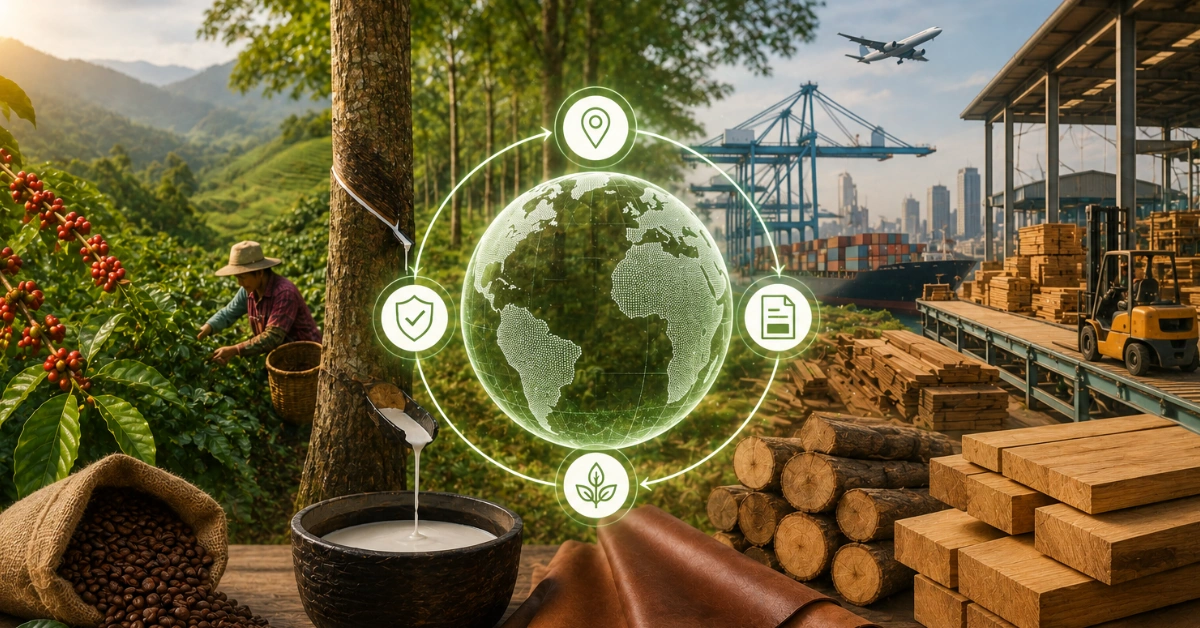
The core EUDR compliance challenges for Indian exporters are farm-level geolocation, farm-to-batch traceability and deforestation-free proof across fragmented, smallholder supply chains. But there is no single challenge, because India exports several EUDR commodities and each breaks the regulation at a different point: shade-grown coffee in the Western Ghats can read as forest on satellite; natural rubber loses plot identity in latex aggregation; leather rests on cattle that are rarely traced to a farm of birth; and wooden handicrafts are assembled from many undocumented timber sources. India’s low-risk classification lightens the paperwork simplified due diligence but not the traceability gap, which must be closed commodity by commodity before the 30 December 2026 deadline.
Key Takeaways
It’s four problems, not one. Coffee, rubber, leather and wood each fracture the regulation at a different point, so a single compliance playbook won’t work.
Low-risk doesn’t mean easy. India’s low-risk status cuts the risk-assessment paperwork, but every commodity still needs geolocation, traceability and a DDS.
The strengths are the sore points. India’s shade-grown coffee, smallholder rubber and vast cattle-hide leather are exactly what EUDR finds hardest to accept.
Segment, then attack the fracture. The winners map each commodity’s specific gap not a generic ‘add traceability’ project and close it before the deadline.
Which of your commodities is least ready for EUDR?
See how TraceX maps smallholders offline and builds commodity-specific, DDS-ready traceability for Indian exporters.
EUDR Compliance Challenges for Indian Exporters: The Shared Baseline
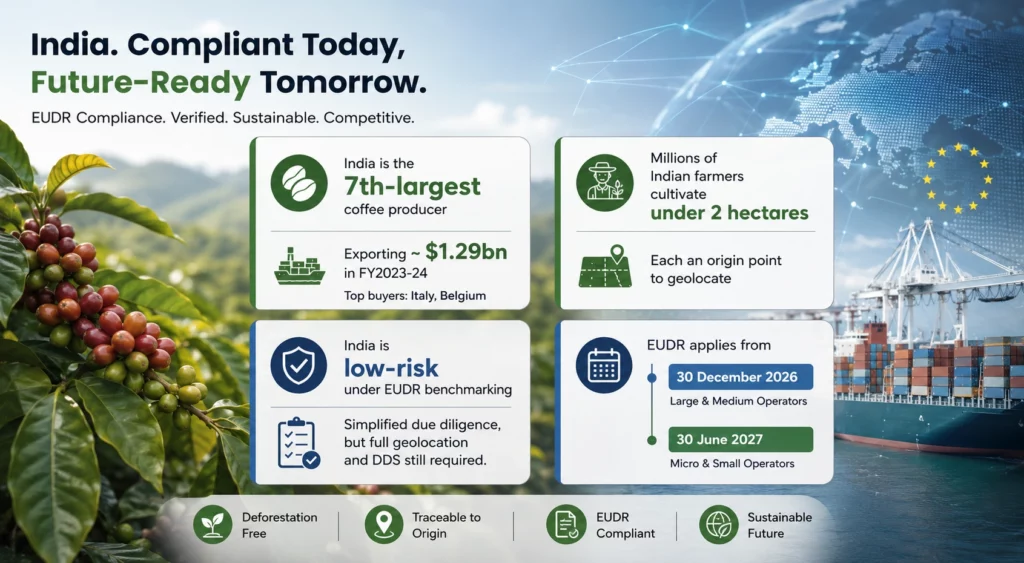
The EUDR compliance challenges for Indian exporters start from a common baseline: every EUDR-covered product placed on the EU market must be traceable to the geolocated plots it came from, proven deforestation-free after 31 December 2020, legally produced, and backed by a Due Diligence Statement (DDS), with records kept for five years. India is classified as a low-risk origin, which means simplified due diligence exporters are spared the full risk-assessment and mitigation steps. It does not mean exemption: geolocation, traceability and the DDS still apply in full.
That baseline collides with how Indian supply chains are actually built. These are not centralised estates but sprawling networks of millions of smallholders, many farming under two hectares, connected through layers of aggregators, cooperatives and traders. Mapping each origin to a GeoJSON polygon and onboarding farmers who may never have entered commercial data on a phone is the shared, structural difficulty. The obligations bite from 30 December 2026 for larger operators and 30 June 2027 for the smallest so the work sits in 2026. But the baseline is where the similarity ends.
Why the EUDR Compliance Challenges for Indian Exporters Are Really Four Problems
Most guides treat this as one challenge “collect geolocation, file a DDS.” That framing hides the real difficulty. India exports several different EUDR commodities, and each one breaks the regulation at a different point, so a single compliance approach fails all of them at once.
Coffee’s problem is optical: India’s prized beans grow under the two-tier shade canopy of the Western Ghats, and that agroforest can read as forest on satellite, exposing the most sustainable farms to false deforestation flags. Rubber’s problem is identity: latex from countless small Kerala holdings is pooled at processing, dissolving the plantation-level trace EUDR requires. And wood’s problem is multiplicity: a single handicraft is assembled from timber sourced through many small, undocumented workshops.
Here is the irony that catches exporters out. India’s low-risk classification feels like relief, but it only removes the risk-assessment paperwork it does nothing to close the traceability gap, which is where every one of these commodities actually fails. And the deeper bind is that India’s most distinctive strengths shade-grown forest coffee, smallholder rubber, are precisely the exports EUDR finds hardest to accept. The EUDR compliance challenges for Indian exporters are therefore not one wall to climb, but four, each needing a different ladder.
EUDR Compliance Challenges for Indian Exporters in the Real World
Coffee: the shade canopy that looks like forest
India is the world’s seventh-largest coffee producer, exporting well over a billion dollars’ worth to buyers led by Italy and Belgium. Its shade-grown beans are a sustainability strength, yet the canopy can trip satellite deforestation flags. What gets over it: farm mapping plus agroforestry ground-truth that distinguishes shade coffee from forest.
Rubber: identity lost in the latex tank
Natural rubber and its derivatives tyres, gloves, latex goods must trace to plantation-level GPS. But latex from thousands of small Kerala holdings is aggregated at processing, so plot identity dissolves before the material is ever exported. What gets over it: plantation-level registration and segregated, traceable lots that survive aggregation.
Wood: one product, many workshops
India’s wooden handicraft exporters assemble products from timber sourced through many small, informal workshops, few of which document origin exactly the fragmentation trade associations have flagged as an EUDR threat. What gets over it: multi-source chain-of-custody that tracks every component from log to finished piece.
How Indian Exporters Can Meet EUDR — Commodity by Commodity
Because the EUDR compliance challenges for Indian exporters differ by commodity, the fix is a segmented one. A platform built for this should do six things.
Onboard smallholders offline. Register farmers and capture GPS plots on mobile in low-connectivity regions, syncing when signal returns
Add agroforestry context for coffee. Layer land-use and ground-truth data over satellite screening so shade-grown coffee isn’t lost to false positives.
Preserve identity through aggregation for rubber. Keep plantation-linked lots segregated through latex processing instead of pooling them into anonymity.
Trace cattle to pasture for leather. Register farms of origin and capture movement records so a hide can be linked back to deforestation-free pasture.
Build multi-source chain-of-custody for wood. Track each timber component from source workshop to finished handicraft.
Generate the DDS and retain records. Compile geolocation and legality evidence into a Due Diligence Statement per consignment, kept for five years.
See How TechnoServe Digitized Farm Operations in Remote Regions
Discover how offline maps, seamless data synchronization, and digital farm management helped improve traceability, compliance, and operational efficiency in low-connectivity environments.
Discover How a Leading Tire Manufacturer Achieved EUDR Compliance
Learn how end-to-end chain of custody, supplier traceability, geolocation mapping, and digital due diligence helped simplify EUDR compliance while maintaining operational efficiency.
EUDR Compliance Challenges for Indian Exporters, by Commodity
Each commodity breaks the regulation at a different point and needs a different fix.
Commodity
Where EUDR breaks for India
What it takes to fix
Coffee
Shade-grown Western Ghats canopy reads as forest; fragmented smallholders
Farm mapping + agroforestry ground-truth to clear false positives
Natural rubber
Latex pooled in aggregation loses plantation identity
Plantation-level GPS + segregated, traceable lots
Wood / handicrafts
Assembled from timber of many small, undocumented workshops
Multi-source chain-of-custody from log to finished piece
Indian exporters face unique EUDR compliance challenges, including fragmented smallholder supply chains, manual supplier onboarding, inconsistent geolocation data, limited visibility into sourcing, and complex documentation requirements. TraceX addresses these challenges through an AI-powered, end-to-end EUDR compliance solution that digitizes farmer and supplier onboarding, enables offline field data collection, captures plot-level geolocation, performs satellite-based deforestation monitoring, automates risk assessments, and establishes a verifiable chain of custody from farm to export. By centralizing compliance data, streamlining supplier collaboration, and generating TRACES-ready Due Diligence Statements, TraceX helps Indian exporters reduce compliance complexity, improve operational efficiency, and confidently access European markets.
Turn the EUDR compliance challenges for Indian exporters into market access.
TraceX onboards smallholders offline, builds commodity-specific traceability across coffee, rubber, leather and wood, and generates DDS-ready proof that keeps your EU market open.
✓A DDS can be generated per consignment and kept for five years.
Frequently Asked Questions (FAQ’s)
Which Indian exports are affected by the EUDR?
Chiefly coffee, natural rubber, leather and cattle products, and wood and wooden handicrafts plus derived goods. Each is an EUDR commodity and must be traceable to geolocated plots and proven deforestation-free after 31 December 2020.
Does India’s low-risk status make EUDR easy?
No. Low-risk means simplified due diligence exporters skip the full risk-assessment and mitigation steps but geolocation, farm-to-batch traceability, the DDS and five-year records all still apply.
Why is coffee hard for Indian exporters under EUDR?
India’s coffee is shade-grown under the Western Ghats canopy, which can look like forest on satellite, and it comes from fragmented smallholders. Both make deforestation-free proof and geolocation harder addressed with farm mapping and ground-truth context.
Why is leather the hardest EUDR commodity for India?
Because cattle are rarely registered to a farm of birth and move between owners before slaughter, so linking a hide back to deforestation-free pasture is far harder than mapping a single crop plot.
When must Indian exporters comply with the EUDR?
From 30 December 2026 for large and medium operators and traders, and from 30 June 2027 for micro and small operators. Records must be retained for five years.
We use cookies on our website to give you the most relevant experience by remembering your preferences and repeat visits. By clicking “Accept All”, you consent to the use of ALL the cookies. However, you may visit "Cookie Settings" to provide a controlled consent.
This website uses cookies to improve your experience while you navigate through the website. Out of these, the cookies that are categorized as necessary are stored on your browser as they are essential for the working of basic functionalities of the website. We also use third-party cookies that help us analyze and understand how you use this website. These cookies will be stored in your browser only with your consent. You also have the option to opt-out of these cookies. But opting out of some of these cookies may affect your browsing experience.
Necessary cookies are absolutely essential for the website to function properly. These cookies ensure basic functionalities and security features of the website, anonymously.
Cookie
Duration
Description
cookielawinfo-checkbox-analytics
11 months
This cookie is set by GDPR Cookie Consent plugin. The cookie is used to store the user consent for the cookies in the category "Analytics".
cookielawinfo-checkbox-functional
11 months
The cookie is set by GDPR cookie consent to record the user consent for the cookies in the category "Functional".
cookielawinfo-checkbox-necessary
11 months
This cookie is set by GDPR Cookie Consent plugin. The cookies is used to store the user consent for the cookies in the category "Necessary".
cookielawinfo-checkbox-others
11 months
This cookie is set by GDPR Cookie Consent plugin. The cookie is used to store the user consent for the cookies in the category "Other.
cookielawinfo-checkbox-performance
11 months
This cookie is set by GDPR Cookie Consent plugin. The cookie is used to store the user consent for the cookies in the category "Performance".
viewed_cookie_policy
11 months
The cookie is set by the GDPR Cookie Consent plugin and is used to store whether or not user has consented to the use of cookies. It does not store any personal data.
Functional cookies help to perform certain functionalities like sharing the content of the website on social media platforms, collect feedbacks, and other third-party features.
Performance cookies are used to understand and analyze the key performance indexes of the website which helps in delivering a better user experience for the visitors.
Analytical cookies are used to understand how visitors interact with the website. These cookies help provide information on metrics the number of visitors, bounce rate, traffic source, etc.
Advertisement cookies are used to provide visitors with relevant ads and marketing campaigns. These cookies track visitors across websites and collect information to provide customized ads.
Download the 2026 Traceability Scorecard and Benchmark Your Supply Chain Across 10 Critical Capabilities.
Download our eBook
Don’t Wait for an Audit to Find Your EUDR Gaps
The 2026 Simplification Package changes how HS codes, DDS pass-through and geolocation rules apply to you. Get the free guide and 20-point readiness checklist before enforcement catches you unprepared.