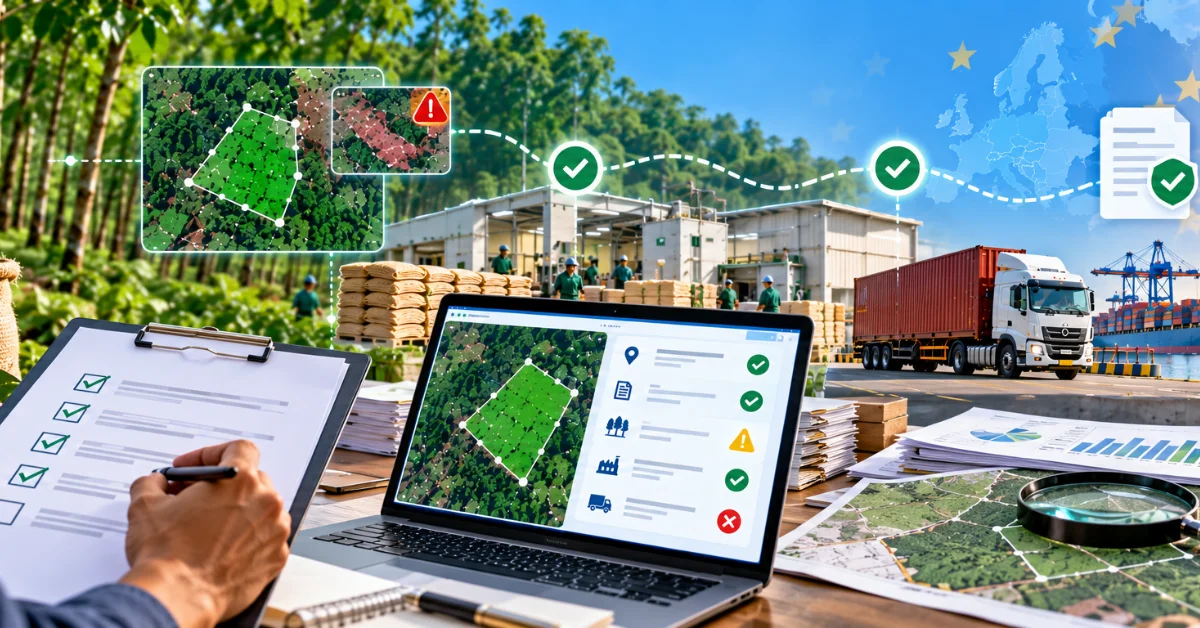
EUDR Gap Analysis: Checklist & Readiness Assessment
Published
, 8 minute read
Share this article
Quick summary: Stress-test your compliance before enforcement begins. This EUDR Gap Analysis Guide helps you identify traceability, geolocation, and due diligence gaps to avoid fines, shipment delays, and market exclusion.
An EUDR gap analysis helps businesses determine whether their current supply-chain data, supplier processes, geolocation, risk assessment, traceability and due diligence controls can support EUDR compliance. The objective is not simply to confirm that a Due Diligence Statement can be submitted. It is to determine whether the evidence behind that statement is complete, reliable, connected and defensible.
Under the EUDR, operators must collect information and evidence, assess the risk of non-compliance and, where necessary, take risk-mitigation measures. Article 9 includes product information, quantity, country of production, geolocation, supplier information and evidence relating to deforestation-free and legal production. Operators must also maintain a due diligence system and relevant records.
That is why an EUDR gap analysis should test the real workflow not just the policy document. The key question is: Can your organization prove the compliance journey for a real EU-bound shipment?
December 2026 is approaching. Is your supply chain actually ready?
Move from spreadsheets and fragmented supplier data to a traceable, audit-ready EUDR workflow with TraceX.
An EUDR gap analysis is a structured review of the difference between your current EUDR processes and the information, risk, traceability, evidence and governance capabilities needed to perform effective due diligence.
A useful assessment looks at the complete chain: Supplier → Farm/Plot → Geolocation → Deforestation & Legality Evidence → Risk Assessment → Mitigation → Raw Material → Batch → Finished Product → Shipment → DDS.
If one link is missing, manual, inconsistent or difficult to verify, the business may have an EUDR readiness gap.
10 Areas to Assess in an EUDR Gap Analysis
Product Scope: Identify which products and HS/CN codes are within scope and which relevant commodities they contain or use.
Supplier Data: Check whether suppliers provide complete, accurate and current information for each relevant product.
Geolocation: Verify that required production geolocation is complete, usable and connected to the relevant source.
Deforestation Risk: Evaluate evidence supporting the deforestation-free requirement and retain the underlying evidence.
Legal Production: Collect and evaluate information supporting legal production in the country of production.
Risk Assessment: Verify that collected information is consistently analysed and that the risk conclusion is documented.
Risk Mitigation: Test what happens when risk is identified: additional evidence, corrective action, supplier engagement and final decision.
Traceability: Connect supplier and origin data to raw material, batches, finished goods and EU-bound shipments.
DDS Readiness: Check whether required information can flow into the DDS process without last-minute spreadsheet consolidation.
Audit Readiness: Test whether the evidence behind a compliance decision can be retrieved quickly and explained.
Discover how businesses can test their EUDR readiness, identify gaps in supplier data, geolocation, risk assessment, traceability, evidence, and DDS workflows, and strengthen compliance before enforcement puts their processes to the test.
Use this checklist as a first readiness screen. A “No” or “Not sure” answer should trigger further investigation.
Do we have a documented process for identifying EUDR-relevant products and scope?
Do we know which suppliers and sourcing locations contribute to each relevant product?
Can suppliers submit complete and usable geolocation data?
Can we validate geolocation before relying on it for risk assessment?
Can we access evidence for deforestation-free and legal production requirements?
Can we assess risk for products with multiple sources or geolocations?
Do we have a documented process for risk mitigation when risk is identified?
Can we link raw materials to batches, finished products and shipments?
Can we retain the evidence behind each risk decision?
Can we demonstrate how a DDS is supported by the underlying due diligence evidence?
How to Conduct an EUDR Gap Analysis
Step 1 — Map Your EUDR Scope: Start with products, commodities, HS/CN codes, markets and shipment flows.
Step 2 — Map Supplier and Origin Data: Identify where supplier, farmer, plantation, plot and production information lives. Look for missing fields and manual handoffs.
Step 3 — Test Geolocation Readiness: Check whether required geolocation is complete, correctly formatted and connected to the relevant production source.
Step 4 — Test Risk Assessment: Review how your organization evaluates deforestation, legality and other relevant risk factors.
Step 5 — Test Risk Mitigation: Take a real exception and follow it through. Can your team collect evidence, document actions and record the final decision?
Step 6 — Test Traceability: Select a real EU-bound shipment and trace it backwards from finished product to batch, raw material, supplier and production location.
Step 7 — Test DDS and Audit Readiness: Ask someone outside the original process to retrieve the evidence. If this requires multiple spreadsheets and emails, you have a readiness gap.
Strengthen Soy Supply Chain Traceability with AI-Powered Compliance.Discover how a leading Nigerian commodity trader used AI-powered traceability to strengthen supplier visibility, verify deforestation-free soy sourcing, improve sustainability data, and prepare its supply chain for EUDR compliance.
A common mistake is to evaluate EUDR readiness by asking whether a company has a DDS process, supplier questionnaire or satellite assessment tool. These are components of the workflow not proof that the workflow works.
Select one actual EU-bound shipment and ask:
Where did the relevant commodity originate?
Which supplier provided it?
Which farms or plots contributed to it?
What are the relevant geolocations?
What evidence supports deforestation-free production?
What evidence supports legal production?
How was the risk assessed?
Was risk mitigation required?
Which raw-material batch entered production?
Which finished product and shipment did it become part of?
Where is the evidence supporting the final decision?
If answering these questions takes days of manual reconciliation, the problem is not simply a documentation gap. It is a process and data-architecture gap.
Common EUDR Gaps and Their Business Impact
EUDR Gap
Business Impact
What to Strengthen
Incomplete supplier data
Delayed onboarding and manual follow-up
Structured supplier data collection and validation
Invalid or missing geolocation
Risk assessment cannot be completed reliably
Geolocation validation and origin-level controls
Fragmented evidence
Slow reviews and weak audit response
Centralized evidence and decision trail
Multiple origins or sources
Complex risk assessment and traceability
Source-level data and traceability
Weak RM-to-FG linkage
Difficult to prove product provenance
Batch and production traceability
Manual DDS preparation
Errors, delays and duplicated effort
Connected due diligence and shipment workflows
EUDR Gap Analysis Is the Starting Point—Not the End
A gap analysis tells you where weaknesses are. The next step is to close them through better data collection, validation, risk workflows, traceability and evidence management.
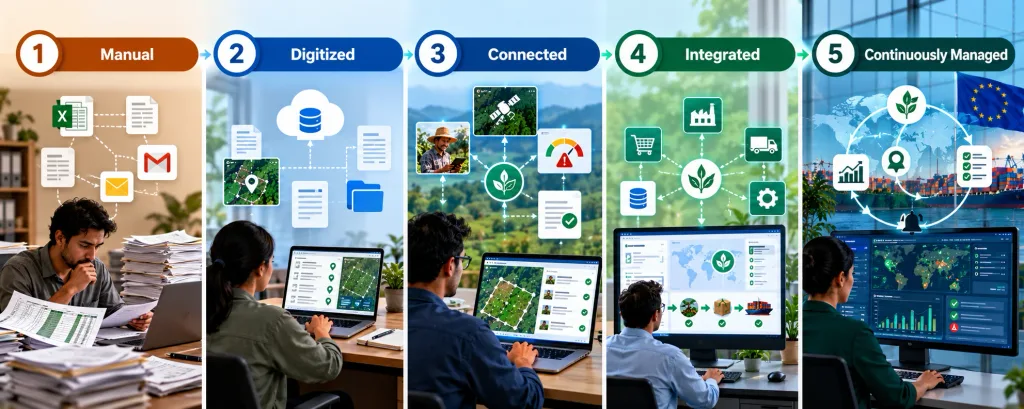
Digital EUDR platforms can move organizations from periodic compliance preparation to a connected operational process. Instead of managing supplier data, geolocation, risk assessments, documents, raw materials and shipments in separate systems, businesses can connect the journey and create a reusable evidence trail.
TraceX EUDR Solutions helps businesses connect supplier onboarding, farm and plot data, geolocation, deforestation risk assessment, compliance evidence, risk mitigation, procurement, raw-material traceability, production, finished goods and shipment workflows in one connected EUDR environment.
Why an EUDR Gap Analysis Matters Now
EUDR implementation is moving beyond a simple question of whether companies understand the regulation. The European Commission has continued updating the regulatory framework and digital tools supporting implementation, including changes to product scope and the Information System.
The strongest preparation is not a one-time compliance exercise. It is a repeatable ability to identify gaps, assess risk, close exceptions, maintain evidence and demonstrate the reasoning behind each compliance decision.
Conclusion: Find the Gaps. Fix the Risks. Be EUDR Ready.
An EUDR gap analysis gives businesses a practical way to move from assumptions to evidence. It reveals whether supplier data is complete, whether geolocation can support risk assessment, whether deforestation and legality evidence can be demonstrated, whether raw materials can be traced into finished products, and whether the organization can defend its due diligence decisions.
The goal is not simply to say that your company is EUDR ready. The goal is to be able to prove it.
Frequently Asked Questions (FAQ’s)
What is an EUDR gap analysis?
It assesses the difference between a company’s current processes and the information, risk assessment, mitigation, traceability and evidence capabilities needed for EUDR due diligence.
What should an EUDR gap analysis include?
It should assess product scope, supplier data, geolocation, deforestation and legality evidence, risk assessment, risk mitigation, traceability, DDS readiness and audit readiness.
Why is supplier data important for EUDR?
Supplier and origin information forms part of the information and evidence operators need to collect and analyse under the EUDR.
Can an EUDR gap analysis replace due diligence?
No. It is a readiness and improvement exercise and does not replace applicable due diligence obligations.
How often should EUDR readiness be reviewed?
EUDR requires operators to review their due diligence system at least annually and update it when relevant developments could affect it.
Can software help close EUDR gaps?
Yes. Digital systems can connect supplier data, geolocation, risk assessment, evidence, mitigation, traceability and shipment workflows.
Start using TraceX
Transparency, Trust, & Success for your Climate Journey.
We use cookies on our website to give you the most relevant experience by remembering your preferences and repeat visits. By clicking “Accept All”, you consent to the use of ALL the cookies. However, you may visit "Cookie Settings" to provide a controlled consent.
This website uses cookies to improve your experience while you navigate through the website. Out of these, the cookies that are categorized as necessary are stored on your browser as they are essential for the working of basic functionalities of the website. We also use third-party cookies that help us analyze and understand how you use this website. These cookies will be stored in your browser only with your consent. You also have the option to opt-out of these cookies. But opting out of some of these cookies may affect your browsing experience.
Necessary cookies are absolutely essential for the website to function properly. These cookies ensure basic functionalities and security features of the website, anonymously.
Cookie
Duration
Description
cookielawinfo-checkbox-analytics
11 months
This cookie is set by GDPR Cookie Consent plugin. The cookie is used to store the user consent for the cookies in the category "Analytics".
cookielawinfo-checkbox-functional
11 months
The cookie is set by GDPR cookie consent to record the user consent for the cookies in the category "Functional".
cookielawinfo-checkbox-necessary
11 months
This cookie is set by GDPR Cookie Consent plugin. The cookies is used to store the user consent for the cookies in the category "Necessary".
cookielawinfo-checkbox-others
11 months
This cookie is set by GDPR Cookie Consent plugin. The cookie is used to store the user consent for the cookies in the category "Other.
cookielawinfo-checkbox-performance
11 months
This cookie is set by GDPR Cookie Consent plugin. The cookie is used to store the user consent for the cookies in the category "Performance".
viewed_cookie_policy
11 months
The cookie is set by the GDPR Cookie Consent plugin and is used to store whether or not user has consented to the use of cookies. It does not store any personal data.
Functional cookies help to perform certain functionalities like sharing the content of the website on social media platforms, collect feedbacks, and other third-party features.
Performance cookies are used to understand and analyze the key performance indexes of the website which helps in delivering a better user experience for the visitors.
Analytical cookies are used to understand how visitors interact with the website. These cookies help provide information on metrics the number of visitors, bounce rate, traffic source, etc.
Advertisement cookies are used to provide visitors with relevant ads and marketing campaigns. These cookies track visitors across websites and collect information to provide customized ads.
Download the 2026 Traceability Scorecard and Benchmark Your Supply Chain Across 10 Critical Capabilities.
Download our eBook
Don’t Wait for an Audit to Find Your EUDR Gaps
The 2026 Simplification Package changes how HS codes, DDS pass-through and geolocation rules apply to you. Get the free guide and 20-point readiness checklist before enforcement catches you unprepared.