Quick summary: Learn what a Battery Digital Product Passport (DPP) is, why it’s essential for regulatory compliance, and how it ensures traceability, sustainability, and lifecycle transparency for EV, industrial, and large-format batteries.
As batteries power everything from electric vehicles to consumer electronics, regulators are demanding unprecedented transparency into how they’re made, sourced, and managed across their lifecycle. A Battery Digital Product Passport (DPP) is a digital record mandated under the EU Battery Regulation that stores verified data about a battery’s origin, materials, carbon footprint, performance, and lifecycle events. It enables traceability, compliance, sustainability reporting, and circular economy use cases such as reuse and recycling.
Yet most battery supply chains remain complex, global, and opaque making it difficult for manufacturers to prove compliance, sustainability, or ethical sourcing. A Battery Digital Product Passport (DPP) addresses this challenge by creating a standardized, digital record that tracks a battery’s materials, origin, performance, and compliance data from raw material extraction through end-of-life turning regulatory pressure into an opportunity for trust, traceability, and circularity.
Key Takeaways
Battery Digital Product Passports (DPPs) are becoming essential tools for regulatory compliance, traceability, and sustainability in the battery industry.
They provide digital, machine-readable records capturing battery identity, supplier data, material composition, carbon footprint, lifecycle performance, and end-of-life information.
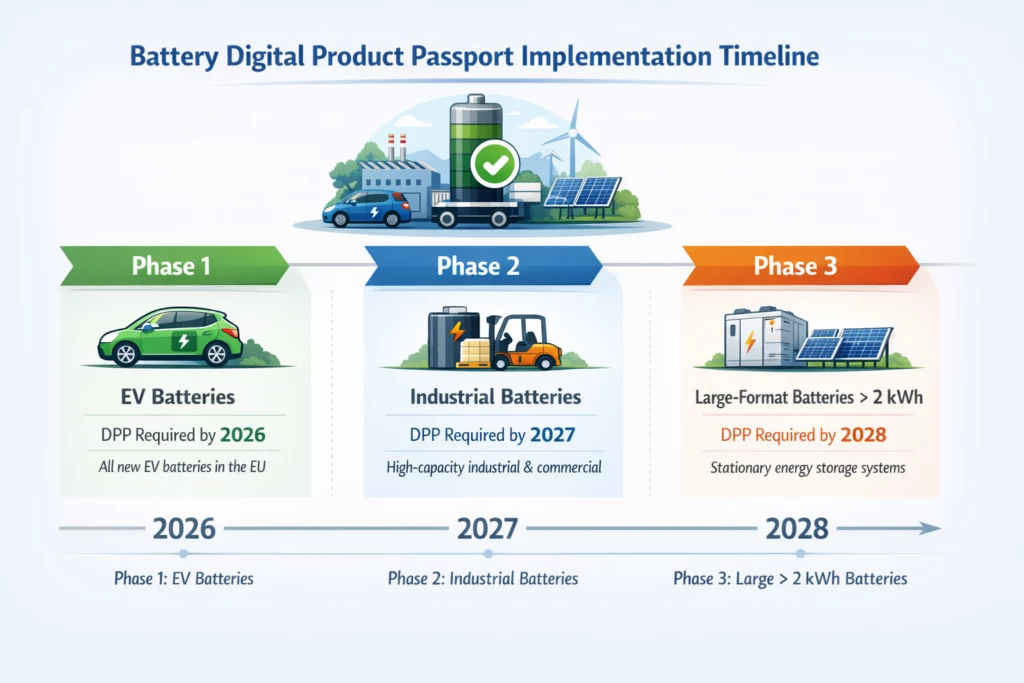
DPPs are required for EV batteries, industrial batteries, and large-format rechargeable batteries (>2 kWh), with phased implementation from 2026 to 2028 under the EU Battery Regulation.
Implementing DPPs involves event-based traceability, GS1-standardized identifiers, and interoperability to link batteries to suppliers and lifecycle events.
Common challenges include fragmented supplier data, manual reporting, missing identifiers, and difficulty tracking post-sale events.
Digital platforms from TraceX address these issues by automating supplier onboarding, capturing lifecycle events via EPCIS, providing multi-tier dashboards, and generating audit-ready, DPP-compliant outputs, enabling scalable, reliable, and circular battery supply chains.
Turn regulatory compliance into a competitive advantage with Battery Digital Product Passports.
“DPP Explained: From Compliance to Competitive Edge” and discover how to streamline supplier data, enable lifecycle traceability, and leverage DPPs to drive transparency, sustainability, and business growth.
Battery Digital Product Passports (DPPs) are no longer a future concept they are becoming a regulatory and commercial necessity. Several converging forces are accelerating their adoption, particularly in Europe, where batteries are now one of the most tightly regulated product categories.
Enforcement of the EU Battery Regulation (EU 2023/1542)
The EU Battery Regulation fundamentally changes how batteries are placed on the market. Unlike previous directives, it introduces binding, product-level requirements for sustainability, safety, traceability, and circularity across the entire battery lifecycle. Battery DPPs are the mechanism through which much of this information must be made available covering material composition, carbon footprint, sourcing, performance, and end-of-life obligations. As enforcement timelines approach, companies without structured battery data and traceability systems face significant compliance risk.
Rising Demand for EV, Industrial, and Energy-Storage Batteries
Demand for batteries is growing rapidly across electric vehicles, industrial equipment, grid-scale energy storage, and consumer applications. This scale-up is increasing supply chain complexity and intensifying scrutiny on how batteries are sourced and produced. As volumes rise, so do concerns around raw material availability, ethical sourcing, and environmental impact making standardized, digital transparency through Battery DPPs essential for managing growth responsibly.
Regulatory Pressure on Carbon Footprint, Sourcing, and Recyclability
Regulators are no longer satisfied with high-level sustainability claims. Battery manufacturers must now provide verifiable, data-backed evidence of:
Carbon footprint calculations across the battery lifecycle
Responsible sourcing of critical raw materials such as lithium, cobalt, and nickel
Recyclability, recycled content, and end-of-life handling
Battery DPPs enable this by linking supplier data, lifecycle events, and compliance documentation into a single, auditable digital record.
Buyer and OEM Requirements for Verifiable Battery Transparency
Beyond regulation, market forces are driving Battery DPP adoption. OEMs, fleet operators, and large buyers increasingly require transparent, traceable battery data to manage their own regulatory exposure, sustainability goals, and brand risk. Batteries without verifiable provenance, carbon data, or compliance evidence are becoming harder to sell especially in regulated markets like the EU.
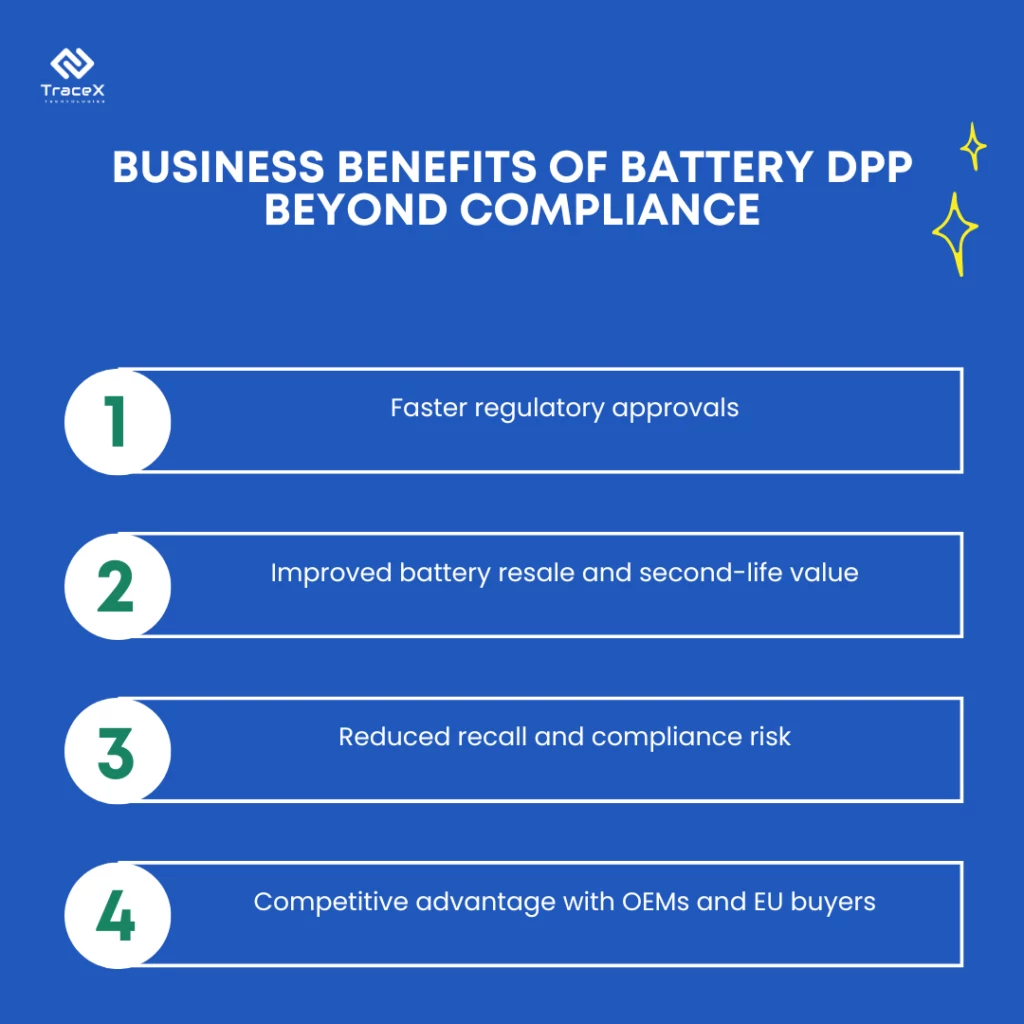
Battery DPPs matter now because they sit at the intersection of regulation, market demand, and supply chain risk. They are quickly becoming the price of entry for selling batteries in Europe and a competitive differentiator for companies that invest early in transparency, traceability, and digital readiness.
Not sure if your batteries fall under Digital Product Passport requirements? Read our blog on the Scope of Digital Product Passports to find out which battery types are covered, the phased implementation timeline, and what data you’ll need to comply.
Want to see how DPPs actually work in practice? Explore our blog on DPP Architecture to learn how event-based traceability, GS1 identifiers, and lifecycle data create a scalable, compliant system.
What Is a Battery Digital Product Passport?
A Battery Digital Product Passport (DPP) is a digital, standardized record that captures all relevant information about a battery throughout its lifecycle from raw material sourcing to end-of-life management. It is designed to be machine-readable, interoperable, and accessible to multiple stakeholders, providing a single source of truth for compliance, sustainability, and traceability.
Let’s break down the core elements:
1. Digital, Machine-Readable Passport Linked to Each Battery or Battery Batch
Unlike traditional paper-based declarations or static certificates, a Battery DPP is digital and structured for automated processing. It can be linked either to:
Individual batteries (serial-number level) for high-value or high-risk applications, like EVs or aerospace batteries
Batches of batteries (lot-level) for industrial, consumer, or energy-storage applications
This linkage ensures that every product in the supply chain can be uniquely identified, traced, and verified. Machine-readability enables seamless integration with digital supply chain systems, DPP platforms, and regulatory portals, allowing stakeholders to query or validate battery data programmatically.
2. Stores Lifecycle, Compliance, and Sustainability Data
A Battery DPP is more than a basic label it consolidates comprehensive information across the battery lifecycle, including:
Material composition: Cathode, anode, electrolyte, casing, and other components
Origin of materials: Mines, refineries, and processing sites for critical minerals (lithium, cobalt, nickel, etc.)
Manufacturing and assembly data: Production sites, batch IDs, and process parameters
Sustainability metrics: Carbon footprint, recycled content, energy consumption, and water usage
Compliance records: Safety certifications, chemical restrictions, conflict mineral reporting, and regulatory declarations
End-of-life information: Recyclability instructions, collection schemes, and remanufacturing options
By capturing this information digitally, the Battery DPP provides traceable, auditable evidence that batteries meet regulatory and market requirements.
3. Accessible to Regulators, OEMs, Recyclers, and Downstream Users
A key principle of the Battery DPP is controlled accessibility:
Regulators can verify compliance with EU Battery Regulation, ESPR, and other sustainability mandates
OEMs and battery assemblers can confirm raw material sourcing, supplier compliance, and performance characteristics
Recyclers and waste operators can access end-of-life handling instructions and material composition data
Downstream users and consumers can verify sustainability claims, such as recycled content or carbon footprint
This multi-stakeholder accessibility improves supply chain transparency and supports circular economy objectives.
4. Built on Standardized Identifiers and Interoperable Data Models
Battery DPPs rely on standardized identifiers and data models to ensure interoperability across complex global supply chains:
GS1 Global Location Numbers (GLNs) for suppliers and production sites
Global Trade Item Numbers (GTINs) or serial numbers for individual batteries or modules
EPCIS event standards to capture lifecycle events such as production, shipment, transformation, and recycling
DPP data models aligned with EU ESPR requirements, ensuring regulatory compliance and compatibility with digital platforms
Standardization ensures that battery data can flow seamlessly between manufacturers, regulators, recyclers, and other stakeholders, enabling automated verification and reporting.
Which Batteries Require a Digital Product Passport?
The EU Battery Regulation (EU 2023/1542) introduces mandatory Digital Product Passports (DPPs) for certain categories of batteries to improve traceability, sustainability, and circularity. Not all batteries are covered immediately; the regulation applies in a phased approach, targeting batteries with the highest environmental impact and market significance first.
1. Electric Vehicle (EV) Batteries
Scope:
All rechargeable batteries used in electric vehicles, including passenger cars, buses, trucks, and two-wheelers.
Why DPPs are required:
EV batteries contain critical and high-value raw materials such as lithium, cobalt, nickel, and graphite.
Tracking origin, composition, carbon footprint, and recyclability is essential for regulatory compliance, responsible sourcing, and circularity.
EV batteries often have long service lives and complex multi-tier supply chains, making digital traceability critical.
2. Industrial Batteries
Scope:
Batteries used in industrial machinery, forklifts, backup power systems, and off-grid energy storage.
Why DPPs are required:
These batteries are typically large, high-capacity, and composed of materials with significant ESG and environmental risk.
Industrial users and regulators need verifiable data on safety, carbon footprint, and recyclability to ensure compliance and optimize end-of-life management.
3. Large-Format Rechargeable Batteries (>2 kWh)
Scope:
Any large-format rechargeable battery exceeding 2 kWh, which may include stationary storage, energy-storage systems (ESS), and high-capacity consumer applications.
Why DPPs are required:
High energy content batteries pose greater environmental and safety risks, making traceability and compliance verification crucial.
These batteries are often reused, refurbished, or recycled, requiring DPPs to track lifecycle, materials, and performance metrics.
Why Early Preparation Matters
Regulatory compliance: Avoid penalties and delays when DPPs become mandatory.
Supply chain transparency: Multi-tier supplier and material data is complex; early work reduces gaps.
Circularity & sustainability: Batteries are high-value assets; tracking materials enables reuse, recycling, and ESG reporting.
Market access: OEMs and buyers increasingly demand DPP-aligned data for procurement and sustainability claims.
What Data Is Required in a Battery Digital Product Passport (DPP)?
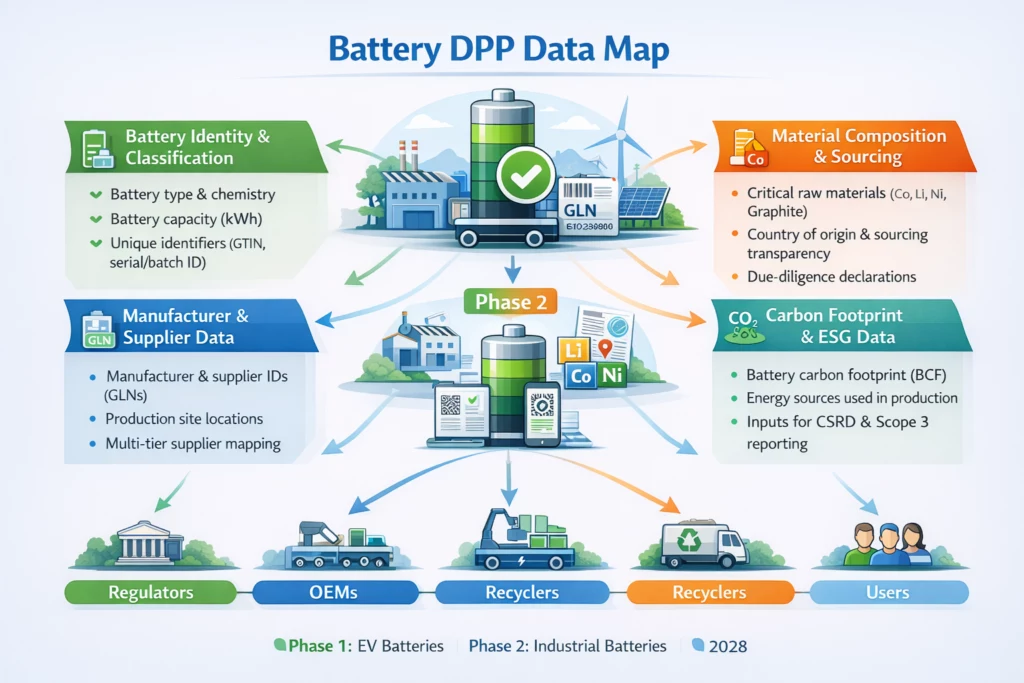
Battery DPPs are designed to capture all relevant information across the battery lifecycle, making the product traceable, verifiable, and compliant with EU regulations. The required data can be grouped into five key categories:
1. Battery Identity & Classification
Purpose: To uniquely identify the battery and understand its characteristics for regulatory, safety, and lifecycle tracking.
Key Data Points:
Battery type: Lithium-ion, solid-state, lead-acid, or other chemistries. This classification is critical for safety, recycling, and regulatory categorization.
Chemistry & capacity: Cathode, anode, electrolyte types, and nominal energy capacity (kWh or Ah) to assess environmental impact and recycling potential.
Unique identifiers: GTINs (Global Trade Item Numbers), serial numbers, or batch IDs. These ensure each battery or batch can be tracked across the supply chain, enabling traceability from production to end-of-life.
Why It Matters: Without unique identification and classification, it is impossible to reliably link the battery to its manufacturing data, materials, or compliance records.
2. Manufacturer & Supplier Data
Purpose: To provide transparency into the origin and responsibility of the battery throughout its supply chain.
Key Data Points:
Manufacturer and supplier identities: Identified via GS1 Global Location Numbers (GLNs) for standardization and interoperability.
Production site locations: Physical locations where the battery or components are produced, essential for regulatory audits and risk assessment.
Multi-tier supplier mapping: Identifying Tier-2 and Tier-3 suppliers, especially for critical raw materials, to meet EU supply chain due diligence requirements.
Why It Matters: Multi-tier supplier data ensures compliance with ESPR, EUDR, and due-diligence laws, while also reducing ESG and operational risk in battery production.
3. Material Composition & Sourcing
Purpose: To ensure responsible sourcing of materials, enable traceability, and support circular economy objectives.
Key Data Points:
Critical raw materials: Cobalt, lithium, nickel, graphite, and other key minerals must be documented, including percentages in the battery.
Country of origin and sourcing transparency: Identifies where materials are extracted or processed, supporting conflict-free and deforestation-free claims.
Due-diligence declarations: Certifications, audits, and supplier attestations to prove ethical sourcing and regulatory compliance.
Why It Matters: Battery production has significant ESG and environmental implications. Transparent material sourcing enables regulatory compliance, sustainability reporting, and customer confidence.
4. Carbon Footprint & ESG Data
Purpose: To quantify environmental impact and provide data for regulatory and sustainability reporting.
Key Data Points:
Battery carbon footprint (BCF): Total greenhouse gas emissions across the lifecycle, from material extraction to assembly.
Energy sources used in production: Renewable vs. non-renewable energy usage in manufacturing.
Inputs for CSRD and Scope 3 reporting: Data feeds ESG reporting frameworks and ensures transparency for corporate sustainability disclosures.
Why It Matters: With increasing pressure from regulators and stakeholders, carbon and ESG metrics are essential for compliance, market access, and meeting corporate climate goals.
5. Performance & Lifecycle Data
Purpose: To enable circularity, reuse, repair, and safe recycling of batteries.
Key Data Points:
State of Health (SoH): Current performance and capacity degradation over time.
Repair, reuse, and refurbishment history: Records of maintenance, refurbishment, or reuse to track product lifecycle extensions.
End-of-life and recycling data: Instructions for collection, recycling, or disposal, including material recovery potential and compliance with EU waste regulations.
Why It Matters: Lifecycle data supports circular economy goals, reduces waste, and ensures regulatory compliance for end-of-life management under ESPR.
In short, the Battery DPP is both a regulatory tool and a strategic asset, enabling traceability, transparency, and long-term sustainability in increasingly complex battery supply chains.
Battery DPP Architecture: How It Works
A Battery Digital Product Passport (DPP) is not just a static record it’s a dynamic, event-driven system designed to track the battery across its entire lifecycle. Its architecture relies on event-based traceability and standardized identifiers to ensure compliance, transparency, and interoperability.
1. Event-Based Traceability (EPCIS-Aligned)
Event-based traceability is at the heart of Battery DPPs. Instead of relying solely on periodic reports or static declarations, the DPP records discrete, verifiable events throughout the battery’s lifecycle:
Key Lifecycle Events:
Manufacturing events: Creation of battery cells, modules, or packs, capturing details like production site, batch, and process conditions.
Assembly events: Integration of cells into modules or packs, including serial numbers and assembly locations.
Shipping and logistics events: Transport between suppliers, warehouses, and OEMs, capturing timestamps, carriers, and handling conditions.
Usage events (optional for smart batteries): Performance metrics, state-of-health (SoH), and operational history.
Recycling and end-of-life events: Collection, refurbishment, dismantling, and material recovery processes.
Benefits:
Timestamped, verifiable data: Each event is recorded with a precise timestamp, making the data auditable.
Transparency across tiers: Enables downstream users, recyclers, and regulators to see exactly where and how a battery has been handled.
Regulatory alignment: Supports EU Battery Regulation, ESPR, and other sustainability reporting frameworks that require traceable lifecycle data.
EPCIS (Electronic Product Code Information Services) is the international standard that structures these events in a machine-readable, interoperable format, allowing seamless data exchange between supply chain partners and regulators.
2. GS1 Standards as the Foundation
GS1 standards provide the global identifiers and protocols necessary to make Battery DPPs operational across complex, multi-tier supply chains.
Key GS1 Components:
GTINs (Global Trade Item Numbers) for batteries: Each battery or battery batch receives a unique GTIN, ensuring it can be precisely identified in any system.
GLNs (Global Location Numbers) for suppliers and sites: Every supplier, production facility, and assembly site has a unique GLN, allowing consistent identification across tiers.
EPCIS for lifecycle event capture: EPCIS events link GTINs and GLNs to lifecycle actions, creating a full, timestamped history of each battery.
Benefits of GS1 Alignment:
Interoperability: Standardized identifiers allow batteries and events to be recognized across multiple systems and platforms.
Data consistency: Reduces errors from duplicate or inconsistent supplier or product records.
Regulatory readiness: Standardized event capture ensures audit-ready, verifiable data that meets EU DPP requirements.
Scalability: Supports multi-tier supply chains and millions of batteries without manual intervention.
3. How It Works in Practice
Battery Identification: Each battery or batch is assigned a GTIN and linked to its supplier GLN.
Event Recording: EPCIS events are captured for manufacturing, assembly, transport, and end-of-life processes.
Data Integration: Events feed into a centralized DPP platform, creating a digital, machine-readable passport.
Stakeholder Access: Regulators, OEMs, recyclers, and downstream users can query the DPP to verify compliance, trace materials, or plan reuse/recycling.
Lifecycle Updates: Any change such as repair, refurbishment, or recycling is captured as a new event, keeping the DPP current throughout the battery’s lifecycle.
How Battery DPPs Enable Compliance with Key Regulations
EU Battery Regulation
Mandatory DPP data disclosure
Carbon footprint thresholds and reporting
ESPR & Circular Economy Requirements
Product durability, reuse, and recyclability
Lifecycle transparency
ESG, CSRD & Due Diligence
Supplier-level accountability
Verified sustainability claims
What are the Common Challenges in Battery DPP Implementation
Implementing a Battery Digital Product Passport (DPP) is a major step toward compliance, transparency, and circularity. However, many manufacturers face persistent challenges that can slow adoption and compromise the quality of the DPP data.
1. Fragmented Supplier Data Across Tiers
The Challenge: Battery supply chains are global and multi-tiered, involving raw material extraction, processing, component manufacturing, and final assembly. Often, manufacturers only have visibility into Tier-1 suppliers, while Tier-2 and Tier-3 data remains incomplete or inaccessible.
Impact:
Inability to trace critical raw materials like lithium, cobalt, and nickel.
Gaps in regulatory compliance and ESG reporting.
Reduced credibility of sustainability and provenance claims.
Without full upstream visibility, the DPP cannot provide reliable lifecycle data, leaving manufacturers exposed to regulatory and reputational risk.
2. Manual Reporting and Spreadsheets
The Challenge: Many organizations rely on emails, surveys, or spreadsheets to collect and consolidate supplier and battery data. While workable at small scales, this approach is error-prone and inefficient for multi-tier supply chains.
Impact:
High risk of missing, outdated, or inconsistent data.
Difficulty aggregating information from multiple suppliers.
Time-consuming reporting that slows DPP updates and regulatory submissions.
Battery DPPs require dynamic, machine-readable, and auditable data manual methods cannot reliably meet these needs.
3. Lack of Standardized Identifiers
The Challenge: Without standardized identifiers like GTINs (Global Trade Item Numbers) for batteries and GLNs (Global Location Numbers) for suppliers and sites, tracking products across systems becomes inconsistent and error-prone.
Impact:
Duplicate or conflicting records in ERP and compliance systems.
Difficulty linking battery batches to lifecycle events, materials, or suppliers.
Compromised interoperability with regulators, recyclers, and OEMs.
Standardized identifiers are the backbone of a DPP. They enable traceability, interoperability, and automated reporting across complex supply chains.
4. Difficulty Tracking Lifecycle Events Post-Sale
The Challenge: Battery DPPs are intended to follow the product throughout its entire lifecycle, including use, refurbishment, and end-of-life. Tracking these post-sale events can be challenging, especially for batteries deployed in EVs, industrial systems, or energy storage applications.
Impact:
Missing or incomplete data on battery state-of-health (SoH), usage patterns, or refurbishment history.
Limited visibility for recycling operators and regulators.
Inability to fully support circular economy objectives.
Lifecycle event tracking is essential for regulatory compliance, safety, sustainability reporting, and circularity. Without it, the DPP is incomplete and less useful to stakeholders.
How Digital Platforms Enable Battery DPPs at Scale
Implementing a Battery Digital Product Passport (DPP) requires complex, multi-tier supply chain data, lifecycle event tracking, and compliance with EU regulations. Digital platforms solve these challenges by automating data collection, standardizing identifiers, and providing audit-ready outputs, making DPPs scalable across thousands of batteries and suppliers.
Digital Supplier Onboarding
Platforms streamline the onboarding of suppliers from Tier-1 to Tier-3 through structured forms, templates, and automated guidance.
Benefits:
Reduces manual emails and spreadsheets
Ensures consistent data capture across all suppliers
Quickly identifies missing or inconsistent information
Enables multi-tier supplier participation without heavy IT burden
Automated Carbon and Material Data Capture
Platforms can automatically collect material composition and carbon footprint data directly from suppliers or connected systems.
Benefits:
Tracks critical raw materials (lithium, cobalt, nickel, graphite)
Captures Battery Carbon Footprint (BCF) and energy source data
Supports ESG and CSRD reporting
Reduces errors and improves accuracy for regulatory compliance
Multi-Tier Traceability Dashboards
Interactive dashboards provide visibility into entire supply chains, from raw material extraction to battery assembly and shipping.
Benefits:
Maps Tier-2 and Tier-3 suppliers
Monitors key lifecycle events in real-time
Identifies supply chain risks and gaps
Facilitates compliance with EU Battery Regulation and ESPR
Audit-Ready Reporting for Regulators
Platforms generate machine-readable, standardized reports that can be directly shared with regulators or auditors.
Benefits:
Reduces preparation time for inspections or compliance audits
Ensures traceable, verifiable evidence for all regulatory requirements
TraceX solutions enhances these platform capabilities with AI-driven automation and standardized event capture:
AI-powered supplier data validation: Automatically checks supplier submissions for completeness, consistency, and regulatory alignment, reducing manual review.
EPCIS-powered lifecycle tracking: Captures manufacturing, assembly, shipping, use, and recycling events in a standardized, timestamped format for full traceability.
DPP-ready outputs aligned with EU regulations: Generates structured, machine-readable Battery DPPs that meet ESPR, EU Battery Regulation, and other sustainability reporting requirements.
With TraceX, manufacturers can scale Battery DPP implementation across multiple suppliers and battery types, ensuring regulatory compliance, traceability, and circularity without overwhelming their teams or supply chain partners.
Battery DPPs as the Key to Traceability and Compliance
Battery Digital Product Passports (DPPs) provide a digital, machine-readable record of every battery’s lifecycle, from raw material sourcing to end-of-life management. By capturing supplier data, material composition, carbon footprint, performance metrics, and recycling information in a standardized and interoperable format, DPPs enable regulatory compliance, multi-tier traceability, and circular economy practices. For battery manufacturers, OEMs, recyclers, and regulators, DPPs are no longer optional they are essential tools for transparency, risk management, and sustainable growth in the evolving battery market.
Curious about how DPPs work and why they matter? Read our blog on Digital Product Passports to understand their role in traceability, compliance, and battery lifecycle management.
Struggling to navigate EU sustainability requirements for batteries? Check out our blog on ESPR and DPPs to learn how Digital Product Passports support regulatory compliance and supply chain transparency.
Frequently Asked Questions (FAQ’s)
Is a Battery Digital Product Passport mandatory?
Yes. Battery DPPs are mandatory under the EU Battery Regulation for eligible batteries placed on the EU market.
Who is responsible for creating the Battery DPP?
The battery manufacturer or entity placing the battery on the EU market is responsible.
Can Battery DPPs be managed manually?
No. Battery DPPs require automated, event-based digital systems to ensure accuracy and compliance.
Start using TraceX
Transparency, Trust, & Success for your Climate Journey.
We use cookies on our website to give you the most relevant experience by remembering your preferences and repeat visits. By clicking “Accept All”, you consent to the use of ALL the cookies. However, you may visit "Cookie Settings" to provide a controlled consent.
This website uses cookies to improve your experience while you navigate through the website. Out of these, the cookies that are categorized as necessary are stored on your browser as they are essential for the working of basic functionalities of the website. We also use third-party cookies that help us analyze and understand how you use this website. These cookies will be stored in your browser only with your consent. You also have the option to opt-out of these cookies. But opting out of some of these cookies may affect your browsing experience.
Necessary cookies are absolutely essential for the website to function properly. These cookies ensure basic functionalities and security features of the website, anonymously.
Cookie
Duration
Description
cookielawinfo-checkbox-analytics
11 months
This cookie is set by GDPR Cookie Consent plugin. The cookie is used to store the user consent for the cookies in the category "Analytics".
cookielawinfo-checkbox-functional
11 months
The cookie is set by GDPR cookie consent to record the user consent for the cookies in the category "Functional".
cookielawinfo-checkbox-necessary
11 months
This cookie is set by GDPR Cookie Consent plugin. The cookies is used to store the user consent for the cookies in the category "Necessary".
cookielawinfo-checkbox-others
11 months
This cookie is set by GDPR Cookie Consent plugin. The cookie is used to store the user consent for the cookies in the category "Other.
cookielawinfo-checkbox-performance
11 months
This cookie is set by GDPR Cookie Consent plugin. The cookie is used to store the user consent for the cookies in the category "Performance".
viewed_cookie_policy
11 months
The cookie is set by the GDPR Cookie Consent plugin and is used to store whether or not user has consented to the use of cookies. It does not store any personal data.
Functional cookies help to perform certain functionalities like sharing the content of the website on social media platforms, collect feedbacks, and other third-party features.
Performance cookies are used to understand and analyze the key performance indexes of the website which helps in delivering a better user experience for the visitors.
Analytical cookies are used to understand how visitors interact with the website. These cookies help provide information on metrics the number of visitors, bounce rate, traffic source, etc.
Advertisement cookies are used to provide visitors with relevant ads and marketing campaigns. These cookies track visitors across websites and collect information to provide customized ads.
Download the 2026 Traceability Scorecard and Benchmark Your Supply Chain Across 10 Critical Capabilities.
Download our eBook
Don’t Wait for an Audit to Find Your EUDR Gaps
The 2026 Simplification Package changes how HS codes, DDS pass-through and geolocation rules apply to you. Get the free guide and 20-point readiness checklist before enforcement catches you unprepared.