Food Traceability: The Complete Guide to Food Safety, Recalls & Supply Chain Transparency
Published
, 9 minute read
Share this article
Quick summary: Food traceability explained: how lot-level tracking powers food safety, faster recalls and supply chain transparency — plus a buyer's checklist for 2026.
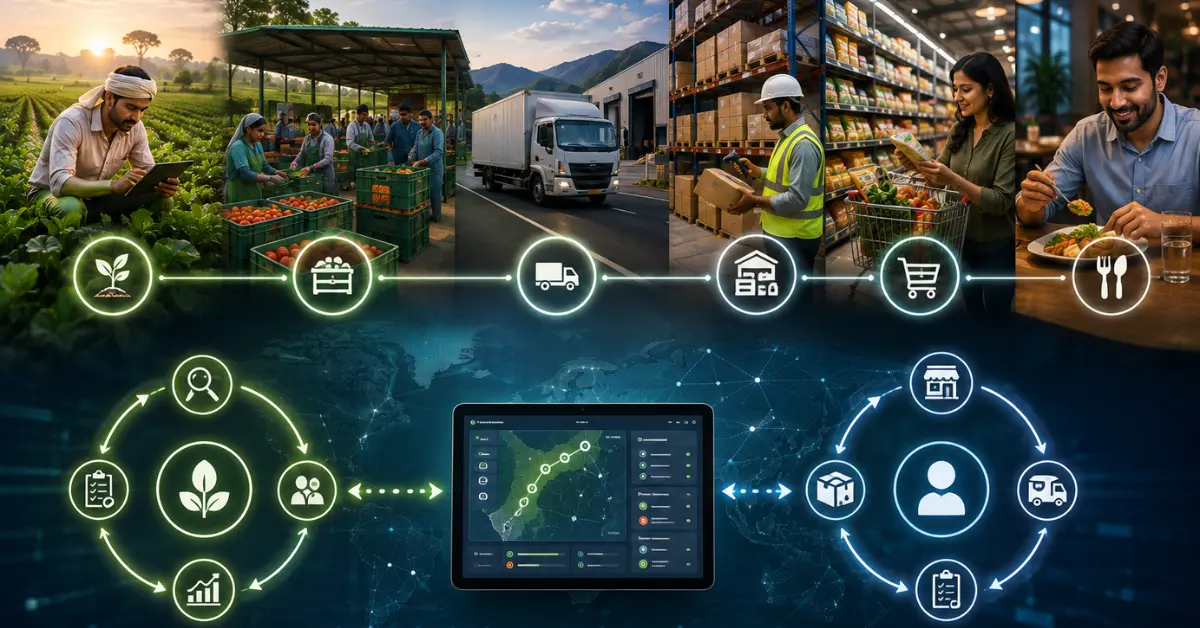
Food traceability is the ability to track and trace food products and their ingredients across the entire supply chain from farm to processing to distribution and retail while preserving lot-level identity and transaction history. Done well, it powers three outcomes buyers now demand: rapid, targeted recalls; audit-ready regulatory compliance (FSMA 204, EU); and verifiable supply chain transparency. Spreadsheet-based tracking can no longer meet these expectations.
Key takeaways
Food traceability is the capability to trace any product to its lot at every stage; transparency is what you disclose from that data.
It underpins faster, narrower recalls the difference between pulling 2% and 100% of inventory.
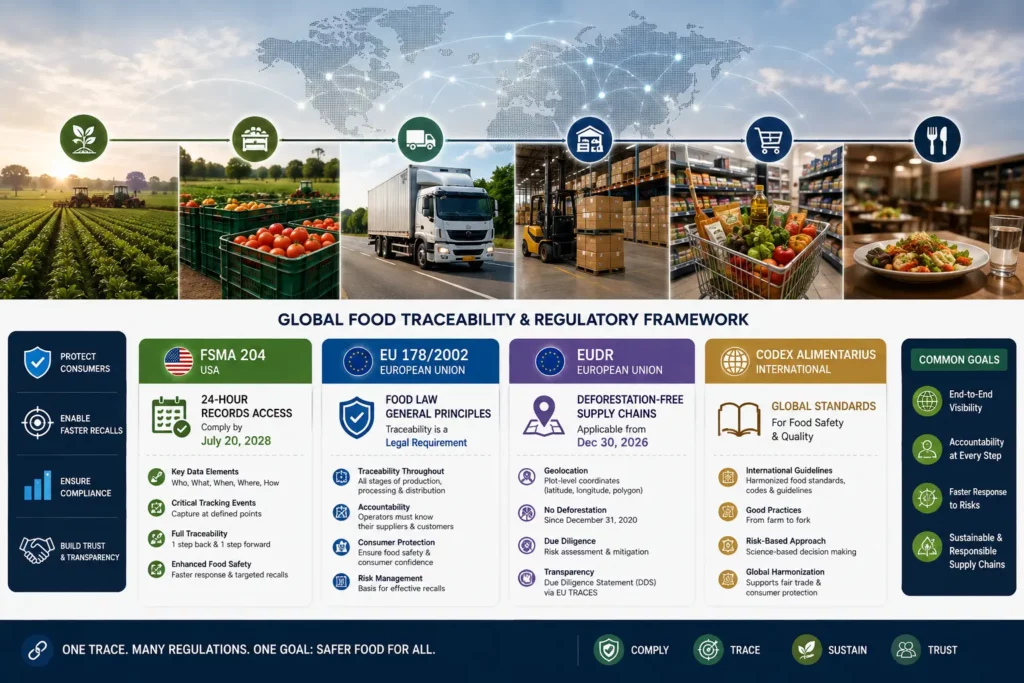
Regulators have codified it: FSMA 204 (records within 24 hours; compliance date now 20 July 2028), EU General Food Law 178/2002, EUDR and global Codex standards.
A modern food traceability system combines QR/barcodes, IoT, cloud platforms and (optionally) blockchain but only if it preserves lot-level identity.
Buyers now treat traceability maturity as a procurement checkpoint; weak systems lose contracts, not just audits.
See how end-to-end digital traceability can transform your food supply chain.
Get the visibility to trace products from source to customer, strengthen food-safety controls, improve recall readiness and maintain a reliable digital record across your operations.
Food traceability is the structured, system-based ability to track and trace products and ingredients across the supply chain. It is operational and data-driven. Transparency is different: it is what you choose to disclose to regulators, buyers or consumers. In short, traceability is the capability; transparency is the communication. Without strong traceability underneath, transparency is marketing rather than verifiable proof and buyers can tell the difference.
Most food safety regimes are built on the “one-step-forward, one-step-back” principle: every operator must know their immediate supplier and immediate customer for each lot. That is the floor. Robust traceability goes further, preserving identity across aggregation, transformation and distribution, and operating on two levels: internal traceability (linking raw-material lots to production batches inside your facility) and external traceability (supplier-to-processor-to-distributor-to-retailer transfers). When these two don’t integrate, traceability breaks at aggregation points exactly where recalls go wrong.
When an incident hits, two questions matter. Backward tracing answers “where did this come from?” for root-cause analysis; forward tracing answers “where did it go?” to scope which customers and batches are affected. A capable traceability system answers both in minutes.
From sourcing and procurement to processing, storage and distribution, traceability helps food businesses know where products came from, what happened to them, and where they went.
Why food traceability is now a buyer’s due-diligence checkpoint
Food traceability has moved from a back-office function to a frontline business risk and to a question buyers ask before they sign. The pressure is measurable. U.S. regulators logged 320 recall announcements in 2025 (PIRG), tied to 22 deaths, while Sedgwick reports FDA recall volume up 209% year over year. The WHO attributes 600 million illnesses and 420,000 deaths a year to unsafe food. In that climate, the ability to isolate an affected lot fast is the difference between a contained correction and a brand-defining event.
This is where food traceability pays back. It enables reduced recall scope through precise lot-level identification, faster backward tracing to the contamination source, targeted forward tracing to affected distributors, and lower operational and reputational damage. It also underwrites the transparency buyers and consumers now expect: where a product was grown, whether it was ethically sourced, and whether the claims can be verified.
Beyond recalls and audits, traceability is also an operational resilience play. In multi-tier networks, disruptions come from contamination, supplier non-compliance, climate and geopolitical shocks, transport delays and fraud or mislabelling. Connected, interoperable records let you see where product is, flag supplier risk earlier, and reroute or contain issues before they cascade turning a fragile chain into one buyers trust enough to keep sourcing from.
Why now the urgency in one line
Recalls are bigger and faster to spread, retailers are enforcing traceability ahead of the federal deadline, and procurement teams are scoring suppliers on it. Weak food traceability now costs contracts, not just audit findings.
Food traceability regulations you’re being evaluated against
Regulatory expectations around food traceability are getting stricter, more digital and more harmonised. Three frameworks matter most for buyers evaluating readiness:
United States — FSMA 204
The FDA Food Traceability Rule (FSMA Section 204) requires enhanced, structured records for foods on the Food Traceability List — Key Data Elements (lot codes, product, quantity, location, dates) captured at Critical Tracking Events (growing, receiving, transforming, shipping) retrievable within 24 hours of an FDA request. The compliance date was extended to 20 July 2028, but major retailers (e.g. Walmart, since August 2025) are enforcing their own traceability mandates now, with chargebacks already live.
European Union — 178/2002 and EUDR
The EU General Food Law (EC 178/2002) codifies the one-step-forward, one-step-back principle. On top of that, the EU Deforestation Regulation (EUDR) raises the bar further for in-scope commodities requiring plot-level geolocation, risk assessment and a due diligence statement elevating food traceability from lot-level tracking to farm-level geospatial verification.
Global — Codex and trade documentation
Codex Alimentarius (FAO/WHO) embeds traceability in food-hygiene and risk-management frameworks and informs national law and trade disputes. Exporters also juggle health certificates, certificates of origin, phytosanitary documents and importer-specific requirements hard to manage without a digital food traceability system.
Traceability requirements are becoming increasingly important across global food supply chains. From supplier records and batch identification to recall preparedness and compliance documentation, businesses need systems that can provide reliable, accessible evidence.
There is no single tool that fits every supply chain. Effective food traceability usually layers several technologies the test is not the technology itself, but how well it preserves lot-level identity and enables rapid two-way tracing.
Technology
Best for
Strength
Limitation
Barcode / QR
Small-mid processors, exporters starting out
Low-cost, lot-level tracking; consumer-facing QR
Manual scanning; not real-time alone
RFID / IoT
Perishables, cold chain, long-distance logistics
Automated capture; temperature & location alerts
Higher hardware cost; needs connectivity
Blockchain
Multi-party, export, fraud-prone commodities
Tamper-resistant, shared audit trail
Complex; doesn’t fix poor upstream data
Cloud platform
Multi-tier, high-SKU, export-driven businesses
Centralised dashboards, ERP/API, audit-ready
Requires integration and adoption
The buyers who win are the ones who made food traceability boring: every lot has a code, every movement is captured, and a trace query returns location, date, quantity and trading partner in minutes. The TraceX food traceability platform unifies internal and external traceability on one system mobile field capture, geo-tagging, scan-and-transfer workflows, ERP integrations and optional blockchain so compliance infrastructure becomes a commercial differentiator rather than a cost centre.
Food traceability in action: from a coffee value chain to a recall
A real deployment shows the payoff. In the Araku Valley, TraceX and TechnoServe implemented end-to-end digital food traceability for coffee produced by over 3,500 farmers digitising farmer onboarding, geo-mapping, harvest data and batch-level tracking so buyers could verify origin, production methods and compliance with confidence. That is traceability turned into market access.
The same foundation changes a crisis. Imagine a Listeria-positive result on one lot of packaged greens. Without lot-level records, the safe move is a broad, precautionary recall across every region. With farm-to-shelf traceability, investigators isolate the exact grower lot, pack date and retail destinations and pull only those units shrinking the recall from national to a handful of lots and keeping the brand on the shelf.
TraceX Food Traceability Solutions help businesses build end-to-end visibility across the food supply chain, connecting suppliers, procurement, raw materials, processing, batch records, inventory and distribution in one digital platform. This enables businesses to trace products back to their source and forward to the customer, strengthen food-safety and compliance processes, improve recall readiness, and replace fragmented records with a connected, searchable traceability trail.
See how the TraceX food traceability platform delivers lot-level visibility, CTE/KDE capture, one-click tracing and ERP integration on your own supply chain.
ERP / API connectivity: integrates with SAP, Oracle, Dynamics and logistics partners; mobile-first field capture.
Supplier onboarding: digitises upstream data (incl. smallholders) without manual re-keying.
Frequently Asked Questions
What is the difference between food safety and food traceability?
Food safety prevents contamination and ensures products are safe to consume. Food traceability tracks products through the supply chain so you can manage recalls and identify the source of risk. The two work together traceability makes safety measurable and defensible.
Is food traceability legally required?
Yes. Most major markets (U.S., EU and others) mandate traceability under food-safety law. Requirements vary by country and product category but are legally enforceable and increasingly enforced commercially by retailers.
What is FSMA 204 and when is the deadline?
FSMA Section 204 (the FDA Food Traceability Rule) requires enhanced lot-level records KDEs captured at CTEs for foods on the Food Traceability List retrievable within 24 hours. The compliance date is now 20 July 2028, but retailer mandates apply sooner.
How does blockchain improve food traceability?
Blockchain creates tamper-resistant, shared records across supply chain partners, strengthening data integrity and multi-party trust. It does not replace structured data capture it secures the transactions you already record.
How much does a food traceability system cost?
It depends on supply chain complexity, integrations and hardware. ROI is typically driven by reduced recall costs, retained contracts and improved compliance efficiency rather than the licence fee alone.
How long does implementation take?
Basic systems can go live in roughly 8–12 weeks. Enterprise-scale, multi-tier deployments may take 3–12 months depending on scope and integrations.
How does food traceability reduce recall cost?
By isolating the exact affected lots instead of pulling entire product lines. Batch-level traceability narrows scope, cuts direct and indirect costs, and limits brand damage often the difference between recalling 2% and 100% of inventory.
Start using TraceX
Transparency, Trust, & Success for your Climate Journey.
We use cookies on our website to give you the most relevant experience by remembering your preferences and repeat visits. By clicking “Accept All”, you consent to the use of ALL the cookies. However, you may visit "Cookie Settings" to provide a controlled consent.
This website uses cookies to improve your experience while you navigate through the website. Out of these, the cookies that are categorized as necessary are stored on your browser as they are essential for the working of basic functionalities of the website. We also use third-party cookies that help us analyze and understand how you use this website. These cookies will be stored in your browser only with your consent. You also have the option to opt-out of these cookies. But opting out of some of these cookies may affect your browsing experience.
Necessary cookies are absolutely essential for the website to function properly. These cookies ensure basic functionalities and security features of the website, anonymously.
Cookie
Duration
Description
cookielawinfo-checkbox-analytics
11 months
This cookie is set by GDPR Cookie Consent plugin. The cookie is used to store the user consent for the cookies in the category "Analytics".
cookielawinfo-checkbox-functional
11 months
The cookie is set by GDPR cookie consent to record the user consent for the cookies in the category "Functional".
cookielawinfo-checkbox-necessary
11 months
This cookie is set by GDPR Cookie Consent plugin. The cookies is used to store the user consent for the cookies in the category "Necessary".
cookielawinfo-checkbox-others
11 months
This cookie is set by GDPR Cookie Consent plugin. The cookie is used to store the user consent for the cookies in the category "Other.
cookielawinfo-checkbox-performance
11 months
This cookie is set by GDPR Cookie Consent plugin. The cookie is used to store the user consent for the cookies in the category "Performance".
viewed_cookie_policy
11 months
The cookie is set by the GDPR Cookie Consent plugin and is used to store whether or not user has consented to the use of cookies. It does not store any personal data.
Functional cookies help to perform certain functionalities like sharing the content of the website on social media platforms, collect feedbacks, and other third-party features.
Performance cookies are used to understand and analyze the key performance indexes of the website which helps in delivering a better user experience for the visitors.
Analytical cookies are used to understand how visitors interact with the website. These cookies help provide information on metrics the number of visitors, bounce rate, traffic source, etc.
Advertisement cookies are used to provide visitors with relevant ads and marketing campaigns. These cookies track visitors across websites and collect information to provide customized ads.
Download the 2026 Traceability Scorecard and Benchmark Your Supply Chain Across 10 Critical Capabilities.
Download our eBook
Don’t Wait for an Audit to Find Your EUDR Gaps
The 2026 Simplification Package changes how HS codes, DDS pass-through and geolocation rules apply to you. Get the free guide and 20-point readiness checklist before enforcement catches you unprepared.