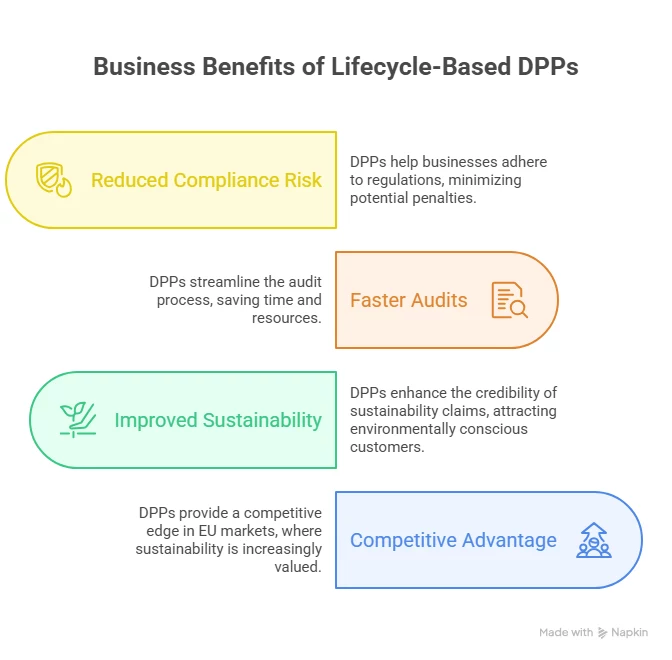
Quick summary: The Role of DPP in Product Lifecycle explains how Digital Product Passports track products from design to end-of-life, enable ESPR compliance, and support traceability and circular economy goals.
Regulations, recalls, and sustainability claims now require proof across the entire lifecycle. Product lifecycle transparency is no longer optional it’s a regulatory and commercial requirement. The Role of DPP in Product Lifecycle is to provide a single, verifiable digital record that tracks a product from design and sourcing through manufacturing, distribution, use, and end-of-life.
Digital Product Passports link materials, suppliers, transformation events, and sustainability attributes using standardized identifiers and event-based data. This lifecycle visibility enables regulatory compliance under ESPR, supports circular economy goals, improves traceability, and ensures that product claims remain auditable, up-to-date, and defensible across global supply chains.
As sustainability regulations, consumer scrutiny, and due diligence laws expand, companies are expected to prove not just what a product is, but how it was designed, sourced, made, used, and disposed of. Yet most organizations still manage lifecycle data in disconnected systems across suppliers, functions, and regions. This fragmentation creates compliance risk and weakens trust. Digital Product Passports (DPPs) address this gap by unifying lifecycle data into a single, verifiable digital record that travels with the product end to end.
Key takeaways
Digital Product Passports (DPPs) are built around the full product lifecycle because compliance, sustainability, and circularity risks occur at every stage not just at origin.
DPPs track products from design and material selection through sourcing, manufacturing, distribution, use, and end-of-life using consistent identifiers and event-based data.
Companies often fail by treating DPPs as static documents, missing upstream supplier data, or retrofitting compliance too late.
Lifecycle-ready DPPs require digital platforms that enable interoperable, real-time traceability.
The most effective approach is to prepare early by mapping lifecycle stages, standardizing data, digitizing suppliers, and automating access.
DPP Explained – From Compliance to Competitive Edge
Discover how Digital Product Passports go beyond regulation to drive transparency, efficiency, and market trust.
A Digital Product Passport (DPP) is a structured, machine-readable digital record that contains verified information about a product across its entire lifecycle from design and material sourcing to manufacturing, distribution, use, and end-of-life. DPPs link physical products to digital data using persistent identifiers such as product, batch, or serial IDs, enabling consistent traceability across systems and suppliers.
The European Union mandates DPPs under the Ecodesign for Sustainable Products Regulation (ESPR) to make sustainability claims verifiable, reduce environmental impact, and support circular economy objectives such as repair, reuse, and recycling. Regulators require access to reliable product data, while businesses and consumers need transparency to make informed decisions.
Unlike traditional labels, PDFs, or static disclosures, DPPs are dynamic and event-based. They are continuously updated as products move through the value chain, ensuring information remains current, auditable, and interoperable across regulatory, commercial, and digital platforms.
DPPs enable brands to capture value from resale, services, and circular models, potentially doubling a product’s lifetime value beyond the initial sale by tracking usage and ownership changes. The global DPP market is projected to grow from $185.9 million in 2024 to $1,780.5 million by 2030 (CAGR 45.7%), driven by new revenue streams like verified resale and trade-ins. Consumer willingness to pay premiums for sustainable, DPP-backed products stands at 64% among Gen Z and Millennials.
The product lifecycle is central to Digital Product Passports (DPPs) because EU regulations are shifting from linear, point-in-time compliance to continuous, lifecycle-based accountability. Traditional compliance models focus on isolated checkpoints such as country of origin or final product attributes without visibility into how materials were transformed, handled, or maintained over time. This approach no longer meets regulatory or market expectations.
Automation via DPPs can boost process efficiency by 15-32%, including data generation and overhead reductions for SMEs through scalable services. In resale programs like Patagonia’s Worn Wear and H&M Resell, DPPs expedite inspections, automate authentication, and lower operational costs by prefilling data. This supports ongoing revenue from repairs and refurbishments while curbing fraud
Origin-only data is insufficient because sustainability risks and environmental impacts occur at multiple stages: raw material extraction, processing, manufacturing, distribution, use, and end-of-life. Without lifecycle data, companies cannot substantiate claims related to durability, recyclability, carbon footprint, or responsible sourcing. Regulators and buyers increasingly require proof of how products change, not just where they come from.
Under the Ecodesign for Sustainable Products Regulation (ESPR), the EU Battery Regulation, and upcoming textiles and electronics requirements, DPPs are designed to capture this full lifecycle. They mandate traceability of materials, transformation events, repairability information, and end-of-life handling. Lifecycle accountability ensures that sustainability, safety, and circularity claims remain verifiable throughout the product’s existence not just at the point of sale.
Understand how end-to-end supply chain traceability enables compliant, scalable Digital Product Passports. Read the blog on Supply Chain Traceability for DPPs
Learn how lifecycle data, repairability, and recycling transparency turn DPPs into circularity enablers. Read the blog on DPPs and the Circular Economy
What is the Role of DPP in each Stage of the Product Lifecycle
How do DPPs influence product design?
DPPs influence product design by embedding material, durability, and recyclability data at the design stage, ensuring products meet eco-design, circularity, and regulatory requirements before manufacturing begins.
At the design stage, DPPs capture material composition, durability, recyclability, and hazardous substance data before a product is manufactured. This aligns product development with eco-design and circularity requirements under ESPR by embedding sustainability criteria into design decisions early. Designers can assess material trade-offs, recyclability constraints, and future compliance risks upfront, reducing costly redesigns later.
How do DPPs improve manufacturing traceability?
DPPs improve manufacturing traceability by recording supplier data, material origins, and transformation events in real time, creating a continuous, auditable record across production stages.
During sourcing and manufacturing, DPPs enable source-level traceability by linking raw materials, suppliers, and production sites through standardized identifiers. They record transformation events how materials are processed, combined, or converted at batch or serial level. This event-based traceability prevents data loss during processing and creates a verifiable record of how the product was made.
Distribution & Market Access
In distribution, DPPs connect products to logistics units, batches, destinations, and markets, enabling compliance checks before shipment. Authorities and buyers can verify regulatory requirements such as ESPR, Battery Regulation, or textiles mandates without manual document review. DPPs also support faster recalls and market surveillance by precisely identifying affected batches or units.
How do consumers use DPPs?
Consumers use DPPs to access trusted product information such as materials, repair options, and sustainability attributes via QR codes or digital interfaces throughout the product’s use phase.
During the use phase, DPPs provide QR-code or digital access to verified product information for consumers, service providers, and regulators. This includes repair instructions, maintenance guidance, spare parts availability, and warranty data. Transparent, lifecycle-backed information builds trust and supports longer product lifespans through informed use and repair.
How do DPPs support circular economy goals?
DPPs support circular economy goals by enabling repair, reuse, and recycling through verified end-of-life data, material transparency, and EPR-aligned lifecycle tracking.
At end-of-life, DPPs enable reuse, repair, recycling, and disposal decisions by providing recyclers and waste operators with accurate material and component data. This supports Extended Producer Responsibility (EPR) schemes and closes the loop by feeding end-of-life data back into future product design and compliance reporting.
What are the Common Mistakes Companies Make with Lifecycle DPPs
Many companies struggle with Digital Product Passports not because of regulation complexity, but due to fundamental implementation mistakes that undermine lifecycle traceability. The most common errors include:
Treating DPPs as static PDFs or disclosures.
Some organizations approach DPPs as a documentation exercise uploading sustainability data into a fixed file or portal. This fails to meet ESPR expectations, which require dynamic, continuously updated lifecycle data. Static formats cannot reflect product transformations, repairs, or end-of-life events, making them non-compliant and quickly outdated.
Missing upstream supplier data.
Lifecycle DPPs depend on source-level inputs such as material origin, supplier identity, and processing details. Many companies lack structured data from Tier 2 and Tier 3 suppliers, creating blind spots. Without upstream visibility, sustainability claims become unverifiable, and compliance risk increases especially under regulations like the Battery Regulation and textiles DPPs.
Inconsistent identifiers across lifecycle stages.
Using different product codes, batch numbers, or location identifiers at design, manufacturing, logistics, and sales stages breaks data continuity. These identifier mismatches prevent reliable data linking and force manual reconciliation, weakening traceability and audit readiness.
Late-stage compliance retrofits.
Waiting until regulations are enforced to “bolt on” DPPs leads to rushed implementations, higher costs, and fragile systems. Lifecycle DPPs must be designed early integrated into product design, supplier onboarding, and operational systems to scale reliably and avoid repeated rework as regulations evolve.
Avoiding these mistakes requires treating DPPs as digital lifecycle infrastructure, not as a one-time compliance deliverable.
How Digital Platforms Enable Lifecycle-Ready DPPs
Digital platforms play a critical role in turning Digital Product Passports (DPPs) from regulatory concepts into operational, lifecycle-ready systems. Rather than relying on static documents or fragmented tools, platforms from TraceX are designed to operationalize DPP requirements across complex, multi-tier supply chains.
Event-based lifecycle tracking is foundational. TraceX Compliance platform captures key lifecycle events, material sourcing, production transformations, batch creation, shipment, use-phase updates, and end-of-life actions as they occur. This creates a living digital record that reflects how a product evolves over time, which is essential for ESPR, Battery Regulation, and textiles DPP compliance.
To maintain continuity, TraceX platform uses persistent product, batch, and location identifiers aligned with global standards. These identifiers ensure that data collected at design, manufacturing, logistics, and post-market stages remains consistently linked, eliminating traceability breaks caused by mismatched codes or manual reconciliation.
TraceX is built on an interoperable, GS1-aligned architecture, enabling seamless integration with supplier systems, ERPs, PLMs, certification bodies, and regulatory access points. This standards-based approach avoids vendor lock-in and ensures DPP data can be shared securely with regulators, partners, and consumers as requirements evolve.
Finally, TraceX solutions deliver real-time audit readiness. Compliance evidence, supplier data, batch histories, and lifecycle records are continuously updated and available on demand, reducing audit preparation time, minimizing non-conformities, and protecting market access.
See how TraceX enables lifecycle-wide DPP traceability
Preparing for DPPs: A Step-by-Step Lifecycle Approach
Preparing for Digital Product Passports (DPPs) requires a structured, lifecycle-first approach that embeds traceability into everyday operations rather than treating compliance as a one-time task. Each step builds the foundation for scalable, audit-ready DPP implementation.
1. Map lifecycle stages and data owners
Start by identifying every stage of the product lifecycle design, sourcing, manufacturing, distribution, use, and end-of-life, and clearly assigning data ownership. This includes internal teams (design, procurement, sustainability, IT) and external partners such as suppliers, processors, and logistics providers. Clear ownership prevents data gaps and accountability issues later.
2. Define required data per stage
Next, determine what data must be captured at each lifecycle stage to meet ESPR and product-specific DPP requirements. This may include material composition at design, supplier and origin data during sourcing, batch and transformation data in manufacturing, and repair or recycling information post-sale. Defining this upfront avoids over-collection or missing critical compliance data.
3. Standardize identifiers and events
Consistent identifiers are essential for lifecycle traceability. Standardize product, batch, location, and asset identifiers preferably using GS1-aligned standards and define key lifecycle events (e.g., transformation, shipment, repair). This ensures data from different systems and partners can be reliably linked without manual reconciliation.
4. Digitize supplier onboarding
Supplier data is the most common weak point in DPP readiness. Digitizing supplier onboarding enables structured data capture, validation, and updates from Tier 1 to upstream suppliers. This step ensures source-level traceability and reduces dependence on spreadsheets, emails, and inconsistent formats.
5. Automate reporting and access
Finally, automate how DPP data is accessed and shared with regulators, buyers, and consumers. Automated reporting ensures data is always current, auditable, and role-specific, whether for compliance checks, QR-code access, or market surveillance while minimizing ongoing operational effort.
Together, these steps transform DPP preparation from a reactive compliance exercise into a resilient lifecycle traceability system that scales with regulatory and market demands.
DPPs Are Lifecycle Infrastructure, Not Compliance Add-Ons
The success of Digital Product Passports depends on lifecycle traceability, not last-minute documentation. DPPs work only when product data flows continuously from design and sourcing through use and end-of-life, creating a single source of truth that regulators, partners, and consumers can trust. This marks a clear shift from static compliance files to intelligent, event-driven systems that deliver ongoing visibility and insight. Companies that act early by embedding DPPs into their core data and supply-chain architecture will reduce compliance risk, move faster as regulations evolve, and turn transparency into a lasting competitive advantage.
Get a clear breakdown of current and upcoming Digital Product Passport requirements. Read the blog on DPP Regulations
Learn how interoperable, standards-aligned architectures make DPPs future-proof. Read the blog on DPP Architecture
See how the Ecodesign for Sustainable Products Regulation shapes DPP obligations across industries. Read the blog on ESPR and DPP Compliance
Frequently Asked Questions (FAQ’s)
What is the role of DPP in the product lifecycle?
The role of DPP in the product lifecycle is to provide a single, verifiable digital record that tracks product data across design, sourcing, manufacturing, distribution, use, and end-of-life.
Why is lifecycle traceability required for DPP compliance?
Lifecycle traceability is required because EU regulations such as ESPR and the Battery Regulation demand proof of sustainability, safety, and circularity at every stage—not just at origin or point of sale.
How do DPPs support circular economy goals?
DPPs support the circular economy by enabling repair, reuse, recycling, and Extended Producer Responsibility (EPR) through accurate, lifecycle-based product data.
Start using TraceX
Transparency, Trust, & Success for your Climate Journey.
We use cookies on our website to give you the most relevant experience by remembering your preferences and repeat visits. By clicking “Accept All”, you consent to the use of ALL the cookies. However, you may visit "Cookie Settings" to provide a controlled consent.
This website uses cookies to improve your experience while you navigate through the website. Out of these, the cookies that are categorized as necessary are stored on your browser as they are essential for the working of basic functionalities of the website. We also use third-party cookies that help us analyze and understand how you use this website. These cookies will be stored in your browser only with your consent. You also have the option to opt-out of these cookies. But opting out of some of these cookies may affect your browsing experience.
Necessary cookies are absolutely essential for the website to function properly. These cookies ensure basic functionalities and security features of the website, anonymously.
Cookie
Duration
Description
cookielawinfo-checkbox-analytics
11 months
This cookie is set by GDPR Cookie Consent plugin. The cookie is used to store the user consent for the cookies in the category "Analytics".
cookielawinfo-checkbox-functional
11 months
The cookie is set by GDPR cookie consent to record the user consent for the cookies in the category "Functional".
cookielawinfo-checkbox-necessary
11 months
This cookie is set by GDPR Cookie Consent plugin. The cookies is used to store the user consent for the cookies in the category "Necessary".
cookielawinfo-checkbox-others
11 months
This cookie is set by GDPR Cookie Consent plugin. The cookie is used to store the user consent for the cookies in the category "Other.
cookielawinfo-checkbox-performance
11 months
This cookie is set by GDPR Cookie Consent plugin. The cookie is used to store the user consent for the cookies in the category "Performance".
viewed_cookie_policy
11 months
The cookie is set by the GDPR Cookie Consent plugin and is used to store whether or not user has consented to the use of cookies. It does not store any personal data.
Functional cookies help to perform certain functionalities like sharing the content of the website on social media platforms, collect feedbacks, and other third-party features.
Performance cookies are used to understand and analyze the key performance indexes of the website which helps in delivering a better user experience for the visitors.
Analytical cookies are used to understand how visitors interact with the website. These cookies help provide information on metrics the number of visitors, bounce rate, traffic source, etc.
Advertisement cookies are used to provide visitors with relevant ads and marketing campaigns. These cookies track visitors across websites and collect information to provide customized ads.
Download the 2026 Traceability Scorecard and Benchmark Your Supply Chain Across 10 Critical Capabilities.
Download our eBook
Don’t Wait for an Audit to Find Your EUDR Gaps
The 2026 Simplification Package changes how HS codes, DDS pass-through and geolocation rules apply to you. Get the free guide and 20-point readiness checklist before enforcement catches you unprepared.