Quick summary: Learn how the DPP Technology Stack enables scalable ESPR compliance. Explore traceability platforms, supplier data onboarding, ERP/PLM integration, and audit-ready systems for Digital Product Passports.
ESPR compliance isn’t about filling out more forms it’s about whether your technology can keep up. Many companies still rely on spreadsheets, PDFs, and email-based data collection, but these break down the moment you scale across hundreds of SKUs, suppliers, and markets. The DPP Technology Stack enables scalable compliance with ESPR Digital Product Passport requirements by connecting traceability, data management, and interoperability systems.
It includes traceability platforms for multi-tier product and batch-level data capture, structured supplier data onboarding and validation, and integrations with ERP, PLM, and sustainability systems to maintain a single source of truth. Secure registries and optional blockchain layers support data integrity and auditability. Together, these components ensure accurate, real-time, and interoperable product data flows, making ESPR compliance continuous, scalable, and future-ready.
They can’t handle real-time updates, delegated acts, or audit-ready traceability. The pain point is real: without the right DPP technology stack, product data becomes fragmented, unverifiable, and outdated, putting EU market access at risk. In the ESPR era, the wrong tech doesn’t just slow compliance; it can stop your products at the border.
Key Takeaways
A DPP Technology Stack is the integrated set of systems that enables ESPR Digital Product Passport compliance by capturing, validating, and sharing product, supply chain, and sustainability data at scale.
Its core components include traceability platforms for multi-tier data capture, supplier onboarding and validation workflows, ERP/PLM and sustainability system integrations, and secure registries for auditability.
When these technologies work together, they create interoperable, real-time DPPs and prevent data silos across SKUs and regions.
Common mistakes like relying on spreadsheets or disconnected pilots undermine scalability.
Platforms from TraceXpower ESPR-ready DPP stacks through compliance-by-design, deep integration, and future-ready scalability.
eBook “DPP Explained: From Compliance to Competitive Edge” to understand ESPR requirements, DPP data architecture, and how leading companies are turning compliance into a growth strategy.
A DPP technology stack is the set of interconnected digital systems that work together to capture, validate, store, and share all data required for an ESPR Digital Product Passport. This includes product identity, material composition, supply chain origin, sustainability metrics, and compliance evidence managed at product or batch level and made accessible to regulators, buyers, and consumers.
It’s important to distinguish data content from data infrastructure. Data content is what information is required (e.g., carbon footprint, supplier details), while the technology stack defines how that information is collected, structured, updated, and exchanged across systems and stakeholders.
ESPR requires DPPs to be scalable, interoperable, and audit-ready, which is why manual tools and disconnected systems are no longer sufficient. A robust DPP technology stack enables real-time updates as delegated acts evolve, ensures consistent data across suppliers and markets, and creates verifiable, traceable records that stand up to regulatory scrutiny.
Explore DPP Architecture: Learn how structured data and interoperable systems make Digital Product Passports scalable and audit-ready.
What are the Core Components of the ESPR DPP Technology Stack
Traceability Platforms for Multi-Tier Data Capture
Traceability platforms form the backbone of the DPP ecosystem, enabling companies to collect and connect product and sustainability data across multiple supply chain tiers. These platforms capture product- and batch-level data spanning raw material sourcing, processing, manufacturing, and distribution. By linking each stage of the value chain, they deliver the end-to-end visibility required under ESPR, ensuring product data is complete, consistent, and verifiable. A robust DPP traceability solution also supports continuous updates, audit readiness, and scalable ESPR supply chain visibility across SKUs and regions.
Feature
Function in the DPP Ecosystem
Batch-Level Tracking
Ensures data represents the actual product, not just a generic model.
Supplier Onboarding
Digital tools to help Tier-2/3 suppliers enter data easily.
Audit-Ready Logs
A “history” of every data change, essential for regulatory checks.
Interoperable APIs
The ability to “push” this data to the EU Central Registry or a consumer QR code.
Supplier Data Onboarding and Validation
Most DPP data originates outside the brand’s direct control, making supplier onboarding a critical component of ESPR compliance. Structured onboarding workflows standardize how suppliers submit product, material, and ESG data, reducing variability and errors. Built-in validation rules, evidence capture, and documentation checks ensure data accuracy before it enters the DPP system. This approach closes data gaps, minimizes manual follow-ups, and significantly reduces compliance and audit risk.
Supplier data for DPPs is collected through structured digital onboarding workflows that standardize submissions, validate inputs, and require supporting evidence to ensure accuracy and completeness.
ERP, PLM, and Sustainability System Integration
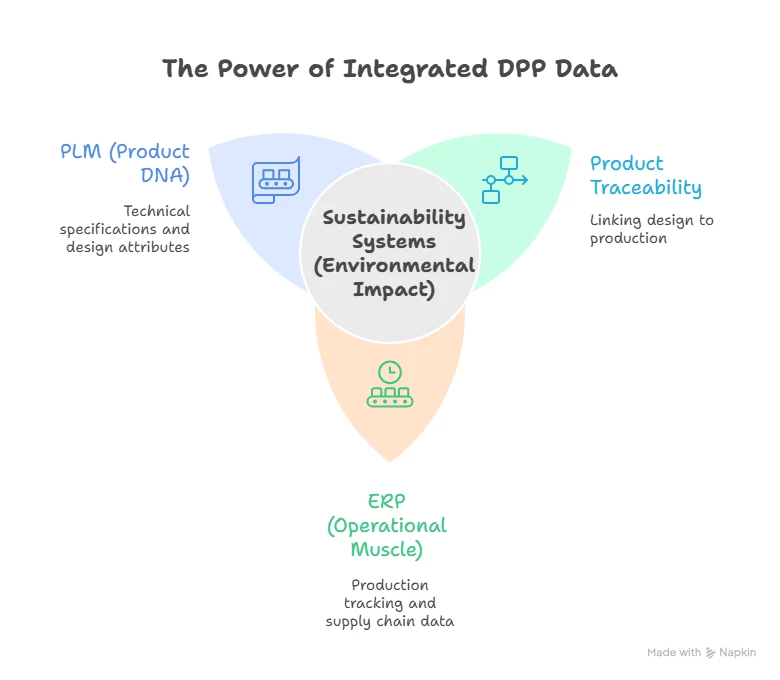
DPPs cannot function as standalone tools. Integration with ERP, PLM, and sustainability systems ensures that product specifications, supplier information, lifecycle data, and ESG metrics flow automatically into the DPP without manual re-entry. API-based integrations enable real-time synchronization and updates, while manual uploads increase the risk of inconsistencies and outdated records. Seamless DPP ERP integration creates a single source of truth, aligning Digital Product Passports with existing enterprise operations.
Secure Registries and Blockchain (Optional but Strategic)
Secure registries play a key role in access control, data integrity, and auditability, ensuring that only authorized stakeholders can view or update DPP data. While blockchain is not mandatory under ESPR, it can add strategic value in complex or high-risk supply chains by providing immutability, verifiable data histories, and increased trust. Regulators primarily expect accurate, traceable, and auditable data blockchain is optional and should be used where it strengthens verification without adding unnecessary complexity.
How These Technologies Work Together
An effective ESPR Digital Product Passport is created through the orchestration of multiple technologies, not isolated tools. The process begins with supplier input, where raw material, component, and ESG data is collected through structured onboarding workflows. This data is then validated using predefined rules, evidence checks, and documentation requirements to ensure accuracy and completeness before it enters the system.
Once validated, the data flows into traceability platforms and integrated ERP, PLM, and sustainability systems, where it is structured at product or batch level and linked across materials, suppliers, and lifecycle stages. APIs enable real-time, system-to-system data exchange, allowing DPP records to update automatically as delegated acts evolve or new data fields become mandatory.
By centralizing data within an interoperable architecture, these technologies prevent data silos across SKUs, suppliers, and regions, ensuring a single source of truth that is scalable, audit-ready, and compliant with ESPR requirements.
Common Technology Mistakes in DPP Implementations
One of the most common mistakes in DPP implementations is over-reliance on documents and spreadsheets. While PDFs and Excel files may work for limited pilots, they cannot support real-time updates, version control, or audit-ready traceability across thousands of products and suppliers. This approach quickly leads to outdated, inconsistent data and high compliance risk under ESPR.
Another major issue is disconnected systems and manual compliance updates. When ERP, PLM, ESG tools, and supplier data sources operate in silos, teams are forced to reconcile data manually every time requirements change. As delegated acts evolve, manual updates become unsustainable, increasing the likelihood of errors and missed obligations.
Finally, many companies launch pilot projects that fail to scale. These pilots often focus on a single product line or region without considering multi-SKU complexity, supplier diversity, or future regulatory expansion. Without a scalable, interoperable technology foundation, pilots stall—turning DPP compliance into a recurring firefight rather than a sustainable capability.
What to Look for in a DPP Technology Platform
Choosing the right DPP technology platform is a strategic decision that directly impacts compliance, scalability, and long-term operational efficiency. At a minimum, the platform should deliver end-to-end traceability by design, enabling seamless tracking of product and batch-level data across raw materials, processing, manufacturing, and distribution. This ensures full visibility and audit readiness under ESPR requirements.
A strong DPP platform must be standards-aligned and GS1-compatible, supporting global product identifiers such as GTIN and Digital Link to ensure consistent product identification across supply chains and markets. This alignment is critical for interoperability with regulators, trading partners, and downstream systems.
An API-first, interoperable architecture is essential to connect ERP, PLM, sustainability tools, and supplier systems without manual data re-entry. This allows real-time updates as delegated acts evolve and prevents data silos that increase compliance risk.
Finally, the platform should be built for multi-supplier, multi-region ecosystems, capable of onboarding diverse suppliers, handling regulatory variation, and scaling across thousands of SKUs. For organizations serious about ESPR readiness, the right DPP platform transforms compliance from a cost center into a foundation for transparency, trust, and competitive advantage.
How TraceX Powers the ESPR DPP Technology Stack
The TraceX platform is designed as a compliance-by-design environment, purpose-built to support digital product passport requirements at scale under the ESPR framework. It combines integrated traceability and supplier onboarding to capture product, material, and sustainability data across multiple supply chain tiers, ensuring data continuity from origin to finished product. Structured onboarding workflows and built-in validation rules help standardize supplier inputs and improve data quality from the start.
The platform features an ERP- and PLM-ready architecture, enabling seamless integration with existing enterprise systems through APIs. This allows product specifications, lifecycle data, and ESG metrics to remain synchronized without manual re-entry, creating a single source of truth for DPP data.
Unlike retrofitted compliance tools, TraceX embeds regulatory requirements directly into data flows, ensuring continuous, audit-ready compliance. Its scalable architecture is built to adapt as ESPR delegated acts expand, allowing companies to future-proof their DPP strategy while reducing regulatory risk and operational complexity.
DPP Compliance Is a Technology Decision
DPP compliance under ESPR is ultimately shaped by early technology stack choices. Decisions around data architecture, interoperability, and system integration determine whether compliance efforts scale smoothly or become costly and fragmented over time. A weak foundation leads to manual workarounds, audit fatigue, and higher regulatory risk as requirements evolve.
Modern DPP platforms should be viewed as strategic infrastructure, not short-term compliance tools. When embedded into core product and supply chain systems, they deliver continuous visibility, trusted data, and operational intelligence benefits that extend well beyond regulatory reporting.
Most importantly, the right technology prepares organizations for future EU sustainability regulations, from circular economy reporting to carbon and due diligence requirements. By investing early in a scalable DPP technology stack, companies can reduce long-term risk, accelerate market access, and turn compliance into a durable competitive advantage.
Your Complete DPP Guide: Understand everything from ESPR compliance to data architecture and best practices for Digital Product Passports.
A DPP Technology Stack is a set of interconnected systems that capture, validate, store, and share product, supply chain, and sustainability data required for ESPR Digital Product Passports.
Is blockchain required for ESPR Digital Product Passports?
No. Blockchain is not mandatory under ESPR, but it can be used optionally to enhance data integrity, traceability, and auditability in complex supply chains
Why are ERP and PLM integrations important for DPP compliance?
ERP and PLM integrations ensure DPP data stays synchronized with existing product and lifecycle systems, reducing manual work, errors, and compliance risk while maintaining a single source of truth.
Start using TraceX
Transparency, Trust, & Success for your Climate Journey.
We use cookies on our website to give you the most relevant experience by remembering your preferences and repeat visits. By clicking “Accept All”, you consent to the use of ALL the cookies. However, you may visit "Cookie Settings" to provide a controlled consent.
This website uses cookies to improve your experience while you navigate through the website. Out of these, the cookies that are categorized as necessary are stored on your browser as they are essential for the working of basic functionalities of the website. We also use third-party cookies that help us analyze and understand how you use this website. These cookies will be stored in your browser only with your consent. You also have the option to opt-out of these cookies. But opting out of some of these cookies may affect your browsing experience.
Necessary cookies are absolutely essential for the website to function properly. These cookies ensure basic functionalities and security features of the website, anonymously.
Cookie
Duration
Description
cookielawinfo-checkbox-analytics
11 months
This cookie is set by GDPR Cookie Consent plugin. The cookie is used to store the user consent for the cookies in the category "Analytics".
cookielawinfo-checkbox-functional
11 months
The cookie is set by GDPR cookie consent to record the user consent for the cookies in the category "Functional".
cookielawinfo-checkbox-necessary
11 months
This cookie is set by GDPR Cookie Consent plugin. The cookies is used to store the user consent for the cookies in the category "Necessary".
cookielawinfo-checkbox-others
11 months
This cookie is set by GDPR Cookie Consent plugin. The cookie is used to store the user consent for the cookies in the category "Other.
cookielawinfo-checkbox-performance
11 months
This cookie is set by GDPR Cookie Consent plugin. The cookie is used to store the user consent for the cookies in the category "Performance".
viewed_cookie_policy
11 months
The cookie is set by the GDPR Cookie Consent plugin and is used to store whether or not user has consented to the use of cookies. It does not store any personal data.
Functional cookies help to perform certain functionalities like sharing the content of the website on social media platforms, collect feedbacks, and other third-party features.
Performance cookies are used to understand and analyze the key performance indexes of the website which helps in delivering a better user experience for the visitors.
Analytical cookies are used to understand how visitors interact with the website. These cookies help provide information on metrics the number of visitors, bounce rate, traffic source, etc.
Advertisement cookies are used to provide visitors with relevant ads and marketing campaigns. These cookies track visitors across websites and collect information to provide customized ads.
Download the 2026 Traceability Scorecard and Benchmark Your Supply Chain Across 10 Critical Capabilities.
Download our eBook
Don’t Wait for an Audit to Find Your EUDR Gaps
The 2026 Simplification Package changes how HS codes, DDS pass-through and geolocation rules apply to you. Get the free guide and 20-point readiness checklist before enforcement catches you unprepared.