EUDR Guide: How to Stay Audit-Ready Before the 2026 Deadline

EUDR compliance platform, eudr deforestation, eudr, eudr traceability, traceability in eudr, eu deforestation free supply chains

EUDR — the EU Deforestation Regulation (Regulation EU 2023/1115) requires any company placing cattle, cocoa, coffee, oil palm, rubber, soya, or wood (and their derived products) on the EU market to prove those goods are deforestation-free, legally produced, and traceable to the exact plot of land where they were grown. In plain terms: if you can’t geolocate the origin of every batch and file a valid Due Diligence Statement (DDS) in the EU’s TRACES system, your shipment doesn’t enter the EU. This guide breaks down what EUDR demands, who has to comply, what it costs to get wrong, and how to make compliance scalable instead of a fire drill.

EUDR Deadline is Closer Than You Think

Don’t wait until customs blocks your shipment — file your DDS today.

Key Takeaways

EU importers/operators and the non-EU producers and exporters who supply them across 7 commodities and hundreds of derived products. 

What: Plot-level geolocation, a risk assessment, and a Due Diligence Statement (DDS) submitted in TRACES before goods are placed on the EU market. 

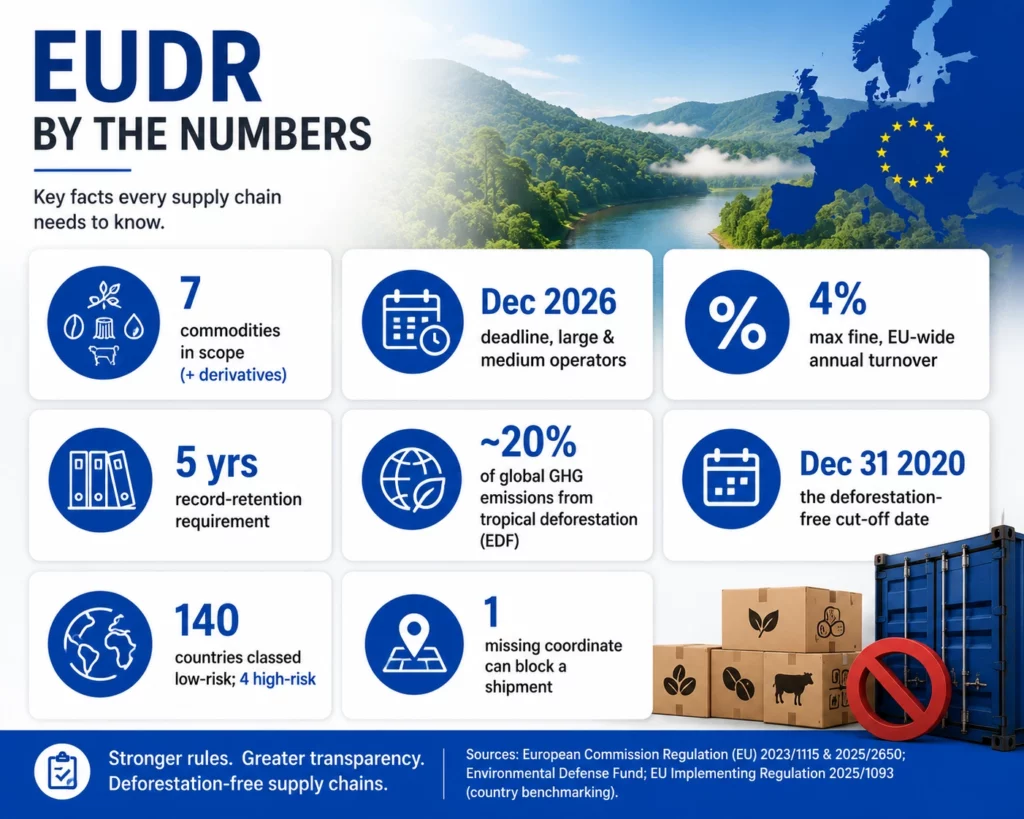
When: 30 December 2026 for large and medium operators; 30 June 2027 for micro and small enterprises (Regulation (EU) 2025/2650). 

The risk: Fines up to 4% of EU-wide annual turnover, seized goods, and blocked shipments if a single data point is missing. 

The fix: A digital traceability platform from TraceX that captures plot data, runs satellite risk checks, and auto-generates audit-ready DDS files.

eudr, eudr compliance, eu deforestation regulation

EUDR is a supply-chain problem, not a paperwork problem

One-line summary: the hard part of EUDR isn’t understanding the law it’s producing plot-level proof from fragmented, offline supply chains fast enough to keep shipments moving.

If you’re a procurement lead, sustainability officer, or compliance manager, the regulation itself is the easy part. The pain shows up when you try to operationalize it:

  • Your ERP wasn’t built for this. It stores supplier addresses and invoices not GPS polygons, land-use history, or deforestation cut-off checks.
  • Farm-level data doesn’t exist yet. Smallholders pool harvests at collection points, and origin coordinates are lost before the commodity enters the formal chain.
  • A single bad data point blocks the shipment. TRACES validates structure and completeness one missing or malformed coordinate rejects the DDS.
  • Audits never stop. You must store traceability and due-diligence records for five years and produce them on demand.

Every section below maps these pains to what the regulation requires and to the capability that closes the gap.

eudr, eudr compliance, eu deforestation regulation

What EUDR requires: the three pillars of due diligence

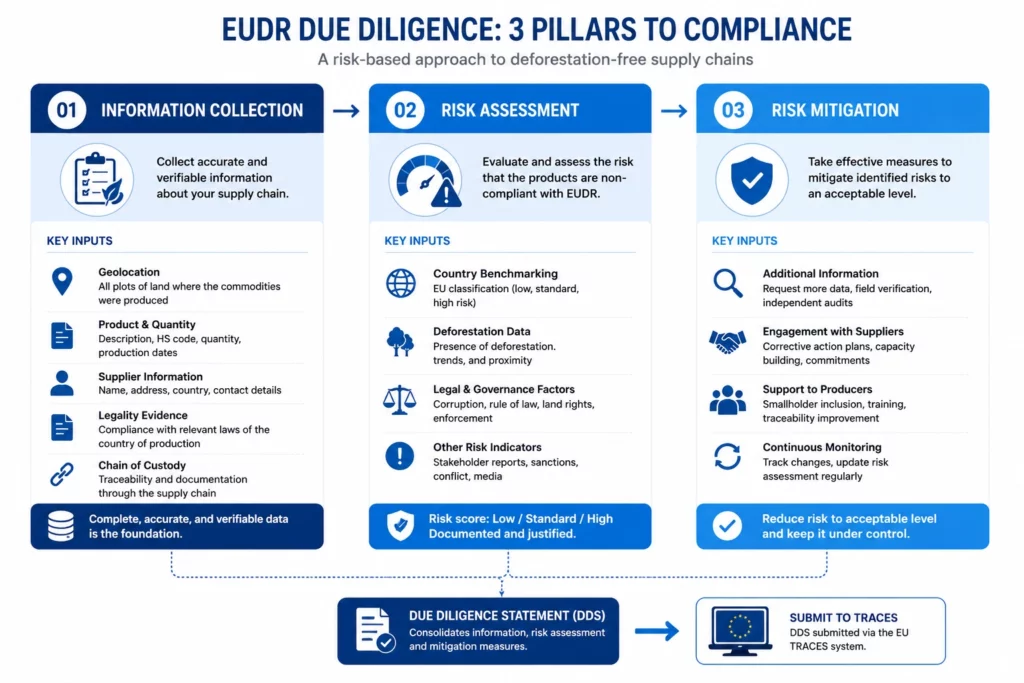
EUDR due diligence is an end-to-end process collect the data, assess the risk, mitigate what’s left that ends with a DDS in TRACES.

1. Information collection

Before a product is placed on the EU market, operators must gather and keep:

  • Plot-level geolocation point coordinates for smallholdings, polygon boundaries for larger plots.
  • Production date or time window of harvest.
  • Legality documentation proving the goods were produced in line with the source country’s land-use, environmental, and labor laws.

2. Risk assessment

Evaluate the likelihood that the product is linked to deforestation or illegal production, using country risk classification (140 low-risk countries; Belarus, Myanmar, North Korea and Russia high-risk; all others standard), supplier history, and satellite verification against the 31 December 2020 cut-off.

Are you confident in your EUDR risk assessment process?

Read our blog: “EUDR Risk Assessment Explained: How to Identify and Mitigate Supply Chain Risks.”

3. Risk mitigation

Where any non-negligible risk remains, take action: independent audits, additional documentation, supplier training, or ongoing satellite monitoring then file the DDS confirming negligible risk.

Do you understand what due diligence really means under EUDR?

Read our blog: “EUDR Due Diligence Explained: What Businesses Need to Know.”

What is a DDS and where does it go? 

A Due Diligence Statement (DDS) is the declaration that your product is deforestation-free, legally produced, and low-risk. It must be submitted in TRACES, the EU’s electronic gateway, before goods reach the market. No DDS = no EU market access. Even a delay can trigger shipment holds, rejections, or penalties.

Compliance is Non-Negotiable

Losing EU market access isn’t an option. Save hours, cut audit risks, and stay compliant with TraceX.
eudr, eudr compliance, eu deforestation regulation

Who must comply with EUDR and by when

Every actor that places in-scope goods on the EU market is responsible, and the binding deadlines are now Dec 2026 and Jun 2027.

Whether you’re a coffee trader in Kenya, a cocoa exporter in Côte d’Ivoire, a furniture maker in Vietnam, or a soy importer in the EU, EUDR applies. Even finished products chocolate bars, soluble coffee, wooden desks fall in scope if they contain an in-scope commodity.

Who Obligation Compliance deadline
Large & medium operators / traders
Full due diligence + DDS in TRACES
30 December 2026
Micro & small enterprises (non-timber)
Simplified one-time declaration may apply
30 June 2027
Non-EU producers & exporters
Provide traceability data to EU buyers
Tied to your buyer’s deadline
Aggregators & cooperatives
Preserve plot-level origin through aggregation
Tied to operator deadline

The cost of getting EUDR wrong

Non-compliance isn’t a fine line item it’s lost EU market access.

  • Financial: fines up to 4% of your total EU-wide annual turnover (member states may set higher).
  • Seized goods & profits: authorities can confiscate non-compliant commodities and the revenue from them.
  • Public-funding freeze: exclusion from public procurement and funding for up to a year.
  • Market exclusion: in serious cases, a ban on selling the infringing products across the EU.
  • Lost simplifications: repeat offenders lose access to simplified due-diligence procedures.

Don't wait until customs blocks your shipment

How TraceX makes EUDR compliance scalable and audit-ready

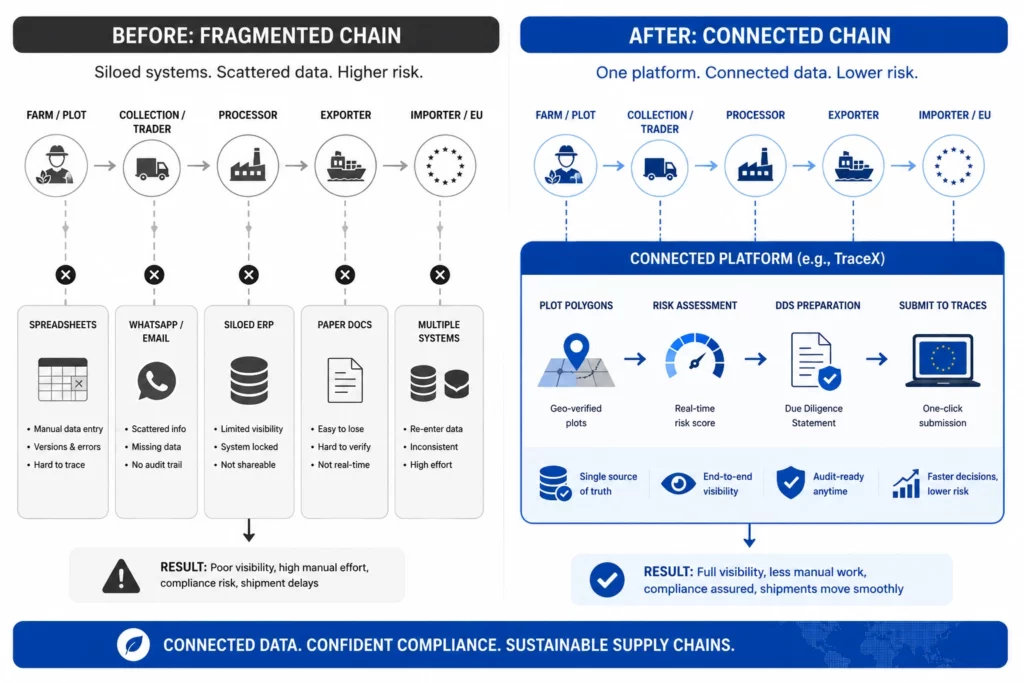
TraceX’s EUDR Solutions is blockchain and satellite powered, AI-driven platform that captures plot data, automates risk scoring, and files DDS directly to TRACES closing each gap the regulation creates.

Onboard suppliers and capture GPS-verified plots even offline

Pain it solves: missing farm-level geolocation. Producers capture precise point or polygon coordinates from a mobile app (offline-first for low-connectivity regions); AI validates plot geometry to prevent DDS rejection, and KYC plus legality documents are stored against each plot.

How do tyre manufacturers turn geolocation data into practical EUDR compliance?

A leading tyre manufacturer sourcing natural rubber from multiple agricultural regions faced the challenge of proving that its supply chain was deforestation-free and aligned with EUDR requirements.

By leveraging GeoJSON mapping technology, the company improved traceability, strengthened supply chain visibility, and enhanced its ability to manage geospatial data across complex sourcing networks.

Read the full case study to learn how GeoJSON mapping helped transform EUDR readiness in the tyre industry.

Run satellite-based deforestation risk assessment automatically

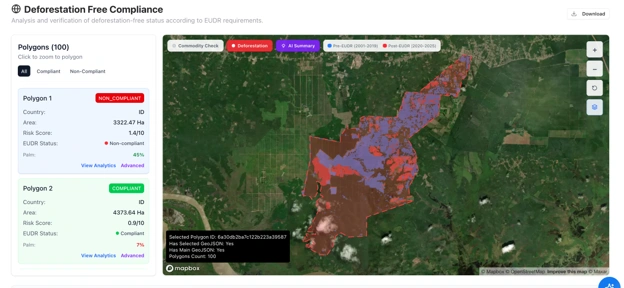
Pain it solves: manual, error-prone risk checks. TraceX analyzes land history, forest-cover loss, and land-use change against JRC and Hansen satellite datasets and the 31 December 2020 cut-off, then assigns a risk score aligned to country benchmarking flagging issues before they reach customs.

eudr, eudr compliance, eu deforestation regulation

Generate and file a TRACES-ready DDS in one click

Pain it solves: data that can’t be submitted in the form TRACES requires. The platform converts validated plot, supplier, and risk data into a fully EUDR-compliant Due Diligence Statement (JSON/XML) and integrates with the EU’s TRACES system, so compliance happens before the commodity is on the water not at the border.

Pain it solves: audit readiness and recordkeeping. Blockchain creates a tamper-proof trail; traceability, supplier profiles, and DDS data are centralized with instant access to audit-ready reports year-round so a random inspection doesn’t unravel your operation.

Preserve plot-level traceability through aggregation

Pain it solves: smallholder pooling that severs chain of custody. Batch-level traceability maintains the link between every mixed lot and its validated, deforestation-free source plots the single biggest obstacle to EUDR-compliant traceability in tropical supply chains.

Not sure how to file an EUDR Due Diligence Statement (DDS)?

Read our blog: “How to File an EUDR Due Diligence Statement (DDS): A Step-by-Step Guide.”

Manual EUDR compliance vs. a traceability platform

Spreadsheets and ERP exports can’t scale to shipment-level DDS a purpose-built platform can.

Capability Spreadsheets / ERP exports TraceX EUDR platform
Plot-level GPS / polygon capture
Manual, often missing
Mobile, offline-first, AI-validated
Deforestation risk checks
Not possible natively
Automated (JRC + Hansen satellite data)
DDS generation & TRACES filing
Manual re-entry, rejection-prone
One-click JSON/XML, TRACES-integrated
Aggregation traceability
Chain of custody broken
Batch-level link preserved
5-year audit trail
Scattered files & drives
Immutable, centralized, audit-ready
Scales to many suppliers
Breaks down at volume
Built for multi-origin supply chains

Outcome: teams that move from manual tracking to digital traceability cut audit risk, avoid DDS rejections, and protect EU market access through the 2026–2027 transition.

Map your fastest path to EUDR compliance

Frequently Asked Questions (FAQ's)

What is EUDR in simple terms?

EUDR is the EU Deforestation Regulation. It bans the sale or export of cattle, cocoa, coffee, oil palm, rubber, soya, and wood in the EU unless companies can prove the goods are deforestation-free, legally produced, and traceable to the plot of land where they were grown.

Under Regulation (EU) 2025/2650, large and medium operators must comply by 30 December 2026, and micro and small enterprises by 30 June 2027. The earlier December 2025 date was postponed by one year.

Any operator or trader placing in-scope commodities on the EU market, plus the non-EU producers and exporters who supply them. Aggregators and cooperatives are included because they must preserve plot-level origin data.

A DDS is the mandatory declaration submitted in the EU’s TRACES system confirming that a product is deforestation-free, legally produced, and carries negligible risk. Without a valid DDS, goods cannot legally enter the EU market.

Fines of up to 4% of EU-wide annual turnover, confiscation of goods and profits, exclusion from public funding, and in serious cases a ban on selling the products across the EU market.

TraceX digitizes supplier onboarding and plot mapping, runs satellite-based deforestation risk checks, generates TRACES-ready DDS files in one click, and stores an immutable five-year audit trail making EUDR compliance scalable across global supply chains.

Stay Ahead: Explore These Related EUDR Topics

Get your free trial

Request for a Demo Session

food traceability, food supply chain, blockchain traceability, agriculture traceability software

How Mature Is Your Traceability Program?

Download the 2026 Traceability Scorecard and Benchmark Your Supply Chain Across 10 Critical Capabilities.

Activate Free Trial Now

The EUDR clock is ticking. Get ahead — free for 14 days

Generate DDS, validate geolocations, and file to TRACES with AI doing the heavy lifting. No credit card. No setup hassle.

food traceability, food supply chain

Are you EUDR Due-Diligence Ready?

Your essential compliance guide

food traceability, food supply chain

Please leave your details with us and we will connect with you for relevant positions.

[hubspot type=form portal=8343454 id=e6eb5c02-8b9e-4194-85cc-7fe3f41fe0f4]
food traceability, food supply chain

Please fill the form for all Media Enquiries, we will contact you shortly.

[hubspot type=form portal=8343454 id=a77c8d9d-0f99-4aba-9ea6-3b5c5d2f53dd]
food traceability, food supply chain

Kindly fill the form and our Partnership team will get in touch with you!

[hubspot type=form portal=8343454 id=b8cad09c-2e22-404d-acd4-659b965205ec]