Aggregation Risk in Oilseed Supply Chains: The Compliance Threat
Published
, 17 minute read
Share this article
Quick summary: Aggregation Risk in Oilseed Supply Chains: understand how uncontrolled blending, silo-level tracking gaps, and weak chain-of-custody controls expose companies to EUDR violations, shipment delays, and audit escalation and how to build defensible, digitally controlled aggregation systems.
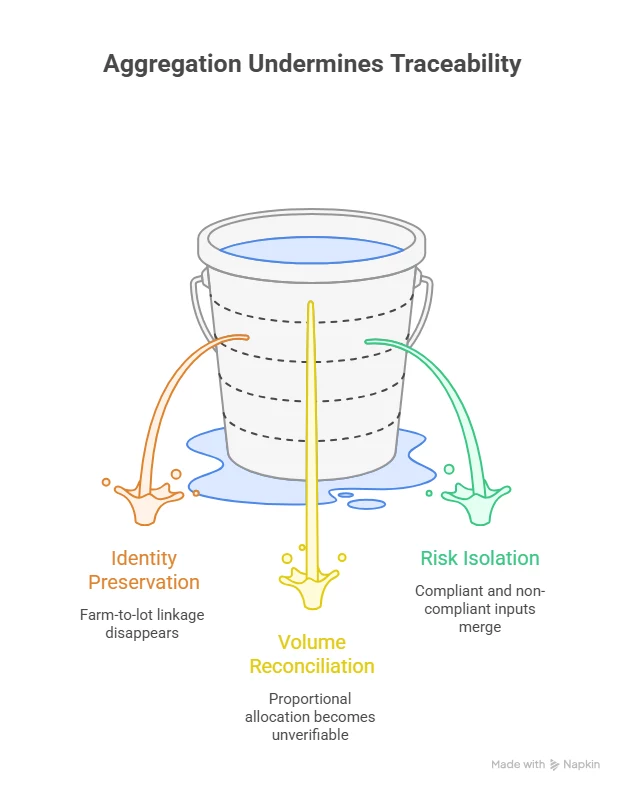
Most oilseed companies focus their traceability investments at the farm level, mapping polygons, onboarding suppliers, collecting sustainability declarations, and validating geolocation data. On paper, everything looks compliant. Until the crop reaches aggregation. Aggregation Risk in Oilseed Supply Chains is where traceability quietly breaks down.
Aggregation Risk: Core Pain Points
Origin Integrity Loss (Importers, Crushers, Traders) When farm lots are pooled at silos or warehouses, traceable identity dissolves making it impossible to isolate compliant volumes from non-compliant ones.
Blending Amplifies Risk (Exporters, Feed & Food Manufacturers) A small percentage of unverified input can contaminate entire batches, exposing EU-bound shipments to DDS rejection and audit escalation.
ERP Visibility ≠ Regulatory Defensibility (Enterprise Processors) Inventory systems track volume, not proportional farm attribution, creating operational clarity but compliance blind spots.
Aggregation Managed as Logistics, Not Control (Scaling Agribusinesses) Pooling is treated as throughput optimization instead of a regulatory checkpoint where compliance is either preserved or lost.
TraceX digital traceability solutions enable lot-level intake capture, proportional allocation logic, and real-time risk visibility, transforming aggregation from a compliance vulnerability into a defensible control system.
The question isn’t whether your farms are mapped. The real question is: Can your traceability survive aggregation?
Key Takeaways
Aggregation is the hidden fault line in oilseed traceability.
While companies focus on mapping farms and collecting supplier declarations, compliance risk materializes when volumes are pooled, blended, and stored.
Physical mixing often outpaces digital recording, silo-level tracking creates false confidence, and even a small portion of unverified soy can contaminate an entire shipment once origin attribution is lost.
Procurement teams assume approved traders reduce risk, and compliance teams rely on declarations but without digitally controlled, lot-level custody, companies inherit upstream opacity they cannot quantify or defend.
The future of oilseed compliance will not be won at the farm; it will be won at aggregation, where defensibility depends on structured digital controls, proportional allocation logic, and real-time risk visibility.
What Aggregation Actually Means in Practice
On paper, supply chains look linear:
Farm → Aggregator → Trader → Processor → Buyer
In reality, aggregation breaks that linear logic.
It mixes volumes, obscures origin, and weakens traceability often long before compliance checks begin.
From farm sourcing to crushing, blending, and export, discover how traceability must survive aggregation in modern oilseed supply chains.
Regulatory reality says: If risk cannot be isolated, 100% of output is exposed.
Why?
Because:
Mixing destroys attribution
Attribution is required for compliance
Without attribution, defensibility disappears
So the risk does not remain contained; it spreads across the entire batch.
That is why aggregation amplifies exposure.
What Procurement & Compliance Leaders Miss
In most organizations, procurement and compliance operate with confidence, but often based on assumptions that no longer hold under modern regulations like EUDR.
Let’s unpack it.
What Procurement Teams Think
“We source from approved traders.”
From a procurement perspective:
The trader is vetted
Contracts are signed
Commercial terms are agreed
Supplier onboarding is completed
The relationship feels controlled.
But procurement approval is not origin verification.
Traders are commercial intermediaries. They are not the origin.
Most traders aggregate:
Multiple farms
Multiple regions
Multiple cooperatives
Multiple harvest lots
Approval at the trader level does not guarantee traceability at the farm level.
What Compliance Teams Assume
“Supplier declarations are sufficient.”
Compliance often relies on:
Self-declarations
Sustainability statements
Certification references
Contractual assurances
These documents create procedural comfort.
But declarations are static.
Regulations like EUDR require:
Polygon-level geolocation
Volume reconciliation
Deforestation cut-off validation
Structured chain-of-custody logic
A signed declaration does not prove proportional allocation.
It proves intent, not defensibility.
The Structural Reality
Traders aggregate from multiple upstream sources.
That means:
Compliant and non-compliant volumes may be mixed
Farm-level identity may not be preserved
Volume attribution may be unclear
Risk may vary within a single shipment
If you do not have digital lot-level custody, you cannot answer:
Which farm contributed to this shipment?
What percentage of the volume is verified?
Can compliant volume be isolated?
Does shipment volume reconcile with farm production?
Without those answers, you inherit upstream opacity.
And opacity equals unquantified risk.
Why This Is Dangerous
Procurement believes risk is managed because the trader is approved.
Compliance believes risk is managed because documentation exists.
But neither team sees the structural blind spot:
Aggregation without lot-level custody.
You may not see the risk internally But regulators and buyers will.
What Digitally Controlled Aggregation Looks Like
Aggregation does not have to destroy traceability.
But it must be engineered, not assumed.
Digitally controlled aggregation treats mixing as a governed process, not a physical inevitability.
Think of it like financial accounting:
You would never merge accounts without recording debits and credits.
Traceability must follow the same logic.
Digital Intake Capture
The first control point is at the collection.
Instead of bulk intake with paper logs:
Each incoming lot is digitally tagged
Farmer identity is linked to that lot
Polygon-level geolocation is attached
Volume is recorded at the source
This preserves the origin before aggregation begins.
Without this step, every downstream control collapses.
TraceX Context
TraceX Traceability Solutions enables mobile-based supplier onboarding and GPS-verified polygon mapping at the point of collection. Each incoming load is digitally registered with farm-to-lot linkage, creating a structured data foundation before material enters storage.
Scan-and-Transfer Workflows
Aggregation risk increases at custody changes.
Each time material moves:
From farm to collector
Collector to silo
Silo to crusher
Crusher to exporter
Custody must be recorded digitally.
Controls include:
Scan-based transfer logging
Timestamped digital signatures
Volume reconciliation at every movement
This prevents invisible mixing and undocumented blending.
TraceX Context
TraceX implements scan-and-transfer workflows that capture every custody change in real time. Each transfer updates the chain-of-custody records and maintains immutable traceability across the value chain.
Controlled Mixing Documentation
Mixing cannot be avoided in bulk commodities.
But it must be documented.
Controlled mixing requires:
Proportional origin calculation
Clear allocation logic
Documented blending ratios
Risk inheritance modeling
If 20% of a batch carries an elevated risk, that exposure must be mathematically visible.
Without proportional allocation, mixing erases compliance defensibility.
TraceX Context
TraceX applies structured aggregation logic where blended volumes retain proportional origin traceability. Risk inheritance rules are automatically calculated, ensuring that compliance exposure is quantified, not guessed.
Real-Time Risk Visibility
Aggregation is not just about volume.
It is about risk exposure.
Digitally controlled systems provide:
Aggregated lot risk scoring
Supplier risk overlays
Automated alerts when high-risk volumes are mixed
Scenario simulations before blending occurs
This allows operators to prevent contamination before it happens.
TraceX Context
TraceX delivers AI-powered risk scoring and deforestation validation, enabling real-time visibility into aggregated lot exposure. Alert triggers flag high-risk mixing events before shipments are finalized, protecting DDS integrity and market access.
Ready to Control Aggregation Before It Controls You?
See how TraceX transforms silo-level opacity into lot-level defensibility.
Intake records are handwritten; silo storage is mixed without digital tracking. No plot-level coordinates at intake.
Severe: Likely to face EU market bans. One “dirty” batch results in the seizure of the entire silo.
Level 2
Declaration-Based
Relies on “Trader Declarations” (self-signed PDFs). Aggregators claim compliance but have no evidence of the original farm plots.
High: Inadequate for EUDR/FSMA 204. Auditors now require “Truth over Testimony”—digital proof, not just a signature.
Level 3
Digital Onboarding
Farmers are digitally registered with GPS points. Verification is done after intake, often leading to retroactive compliance gaps.
Medium: “Traceability-to-Plot” exists, but “Chain-of-Custody” is weak. Risk of laundering between mapped and unmapped plots.
Level 4
Lot-Level Control
Digital custody workflows use Traceability Lot Codes (TLCs). Every load is scanned at the gate and linked to a specific farm polygon before offloading.
Low: Minimal risk of mixing. System maintains a “Mass-Balance” or “Identity Preserved” ledger that is audit-ready.
Level 5
Real-Time Validation
Continuous Compliance: At the gate, AI auto-validates the farm polygon against satellite data. If a plot is deforested, the truck is blocked before unloading.
Minimal: Compliance is automated. Provides the “Negligible Risk” status required for seamless EU market entry.
Aggregation Is the New Compliance Battlefield
In modern regulated supply chains, compliance risk no longer begins or ends at the farm.
Farm-level mapping is necessary but insufficient.
The real compliance vulnerability emerges at aggregation points, where volumes are blended, stored, and transferred. This is where original identity is either preserved through structured digital controls or permanently lost.
Companies that digitize aggregation:
Maintain lot-level traceability even after blending
Quantify and isolate risk before export
Protect verified volumes from contamination
Provide defensible, audit-ready data to regulators
Safeguard premium buyer relationships
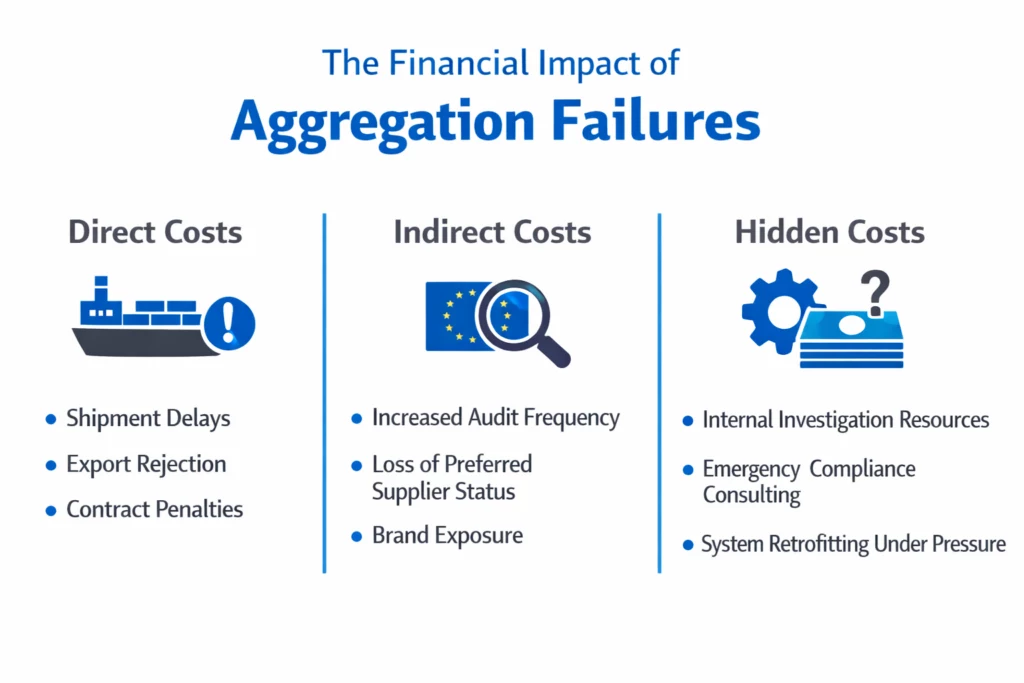
Companies that ignore aggregation controls:
Discover traceability gaps during audits
Face shipment delays or DDS rejection
Experience contract escalations from buyers
Rush to retrofit systems under regulatory pressure
The future of oilseed compliance will not be decided by who maps farms first.
It will be decided by who controls aggregation intelligently and digitally.
Control Aggregation or Accept Exposure
In today’s regulatory environment, traceability is not tested at the point of origin it is tested at the point of aggregation. Farms may be mapped and verified, but once volumes are pooled without structured controls, compliance becomes an assumption instead of evidence. Aggregation is the structural pivot where defensibility is either preserved or destroyed. Companies that implement digital lot preservation, proportional allocation, and real-time risk visibility can confidently defend every exported tonne. Those that do not are not managing compliance; they are absorbing unmeasured exposure. In oilseed supply chains, controlling aggregation is no longer optional; it is the defining factor between regulatory resilience and operational vulnerability.
Discover why traditional supplier approval processes fail under deforestation regulations and how procurement leaders can prevent aggregation-driven compliance risk.
Farm mapping is only the beginning. Understand how to build a supply chain traceability framework that preserves origin integrity through pooling, blending, and export.
Farm mapping is only the first step. Once oilseeds are pooled in silos or blended during storage and processing, farm-level identity can be lost. Without controlled aggregation and proportional allocation tracking, you cannot defend which farm contributed to which shipment. Compliance fails at mixing points not at onboarding.
Our traders are approved and certified. Doesn’t that reduce the risk?
Trader approval reduces commercial risk, not traceability risk. Most traders aggregate from multiple upstream sources. Unless lot-level custody and volume reconciliation are digitally preserved, certification or supplier declarations cannot guarantee shipment-level defensibility under regulatory scrutiny.
Our ERP tracks inventory accurately. Why isn’t that sufficient?
ERP systems track quantity, not origin integrity. They can tell you how much stock is in a silo but not which farms contributed to it, what percentage is high-risk, or whether the batch can be proportionally traced. Inventory control does not equal regulatory-grade traceability.
Only a small portion of our volume is high risk. Can’t we manage that separately?
Not after mixing. Once compliant and non-compliant volumes are pooled without digital allocation logic, the entire batch becomes exposed. Risk is multiplicative, not additive. Even 10–20% unverified input can compromise 100% of the shipment if origin cannot be isolated.
Isn’t digital aggregation control too complex for bulk commodities?
Controlled aggregation does not mean eliminating blending it means documenting it properly. With digital intake capture, scan-and-transfer workflows, proportional allocation logic, and real-time risk scoring, companies can maintain defensible traceability even in high-volume oilseed systems. The complexity already exists in the supply chain digital control simply makes it visible and manageable.
Start using TraceX
Transparency, Trust, & Success for your Climate Journey.
We use cookies on our website to give you the most relevant experience by remembering your preferences and repeat visits. By clicking “Accept All”, you consent to the use of ALL the cookies. However, you may visit "Cookie Settings" to provide a controlled consent.
This website uses cookies to improve your experience while you navigate through the website. Out of these, the cookies that are categorized as necessary are stored on your browser as they are essential for the working of basic functionalities of the website. We also use third-party cookies that help us analyze and understand how you use this website. These cookies will be stored in your browser only with your consent. You also have the option to opt-out of these cookies. But opting out of some of these cookies may affect your browsing experience.
Necessary cookies are absolutely essential for the website to function properly. These cookies ensure basic functionalities and security features of the website, anonymously.
Cookie
Duration
Description
cookielawinfo-checkbox-analytics
11 months
This cookie is set by GDPR Cookie Consent plugin. The cookie is used to store the user consent for the cookies in the category "Analytics".
cookielawinfo-checkbox-functional
11 months
The cookie is set by GDPR cookie consent to record the user consent for the cookies in the category "Functional".
cookielawinfo-checkbox-necessary
11 months
This cookie is set by GDPR Cookie Consent plugin. The cookies is used to store the user consent for the cookies in the category "Necessary".
cookielawinfo-checkbox-others
11 months
This cookie is set by GDPR Cookie Consent plugin. The cookie is used to store the user consent for the cookies in the category "Other.
cookielawinfo-checkbox-performance
11 months
This cookie is set by GDPR Cookie Consent plugin. The cookie is used to store the user consent for the cookies in the category "Performance".
viewed_cookie_policy
11 months
The cookie is set by the GDPR Cookie Consent plugin and is used to store whether or not user has consented to the use of cookies. It does not store any personal data.
Functional cookies help to perform certain functionalities like sharing the content of the website on social media platforms, collect feedbacks, and other third-party features.
Performance cookies are used to understand and analyze the key performance indexes of the website which helps in delivering a better user experience for the visitors.
Analytical cookies are used to understand how visitors interact with the website. These cookies help provide information on metrics the number of visitors, bounce rate, traffic source, etc.
Advertisement cookies are used to provide visitors with relevant ads and marketing campaigns. These cookies track visitors across websites and collect information to provide customized ads.
Download the 2026 Traceability Scorecard and Benchmark Your Supply Chain Across 10 Critical Capabilities.
Download our eBook
Don’t Wait for an Audit to Find Your EUDR Gaps
The 2026 Simplification Package changes how HS codes, DDS pass-through and geolocation rules apply to you. Get the free guide and 20-point readiness checklist before enforcement catches you unprepared.