EUDR Compliance: Requirements, Due Diligence and Practical Steps
Published
, 12 minute read
Share this article
Quick summary: Understand EUDR compliance requirements, 2026–2027 application dates, supplier data, plot geolocation, risk assessment and declarations—and how digital traceability can support your workflow.
EUDR compliance means meeting the obligations that apply to relevant products under the European Union Deforestation Regulation (Regulation (EU) 2023/1115), as amended. In-scope products must meet the deforestation-free and legal-production conditions, and the responsible supply-chain actor must follow the due diligence or declaration route that applies to its role.
For businesses sourcing or trading cattle, cocoa, coffee, oil palm, rubber, soya and wood, compliance is not simply collecting certificates or submitting a form. Teams need reliable information about products and production locations, evidence that can be checked, and a process for addressing risks. The exact obligations depend on the product’s Annex I classification, the company’s role and size, and the applicable dates and transitional rules.
Key Takeaways
Confirm whether each product is listed in Annex I using its exact product code, composition and relevant commodity not just its commercial name.
Identify the legal entity’s role and size category before deciding which EUDR duties apply.
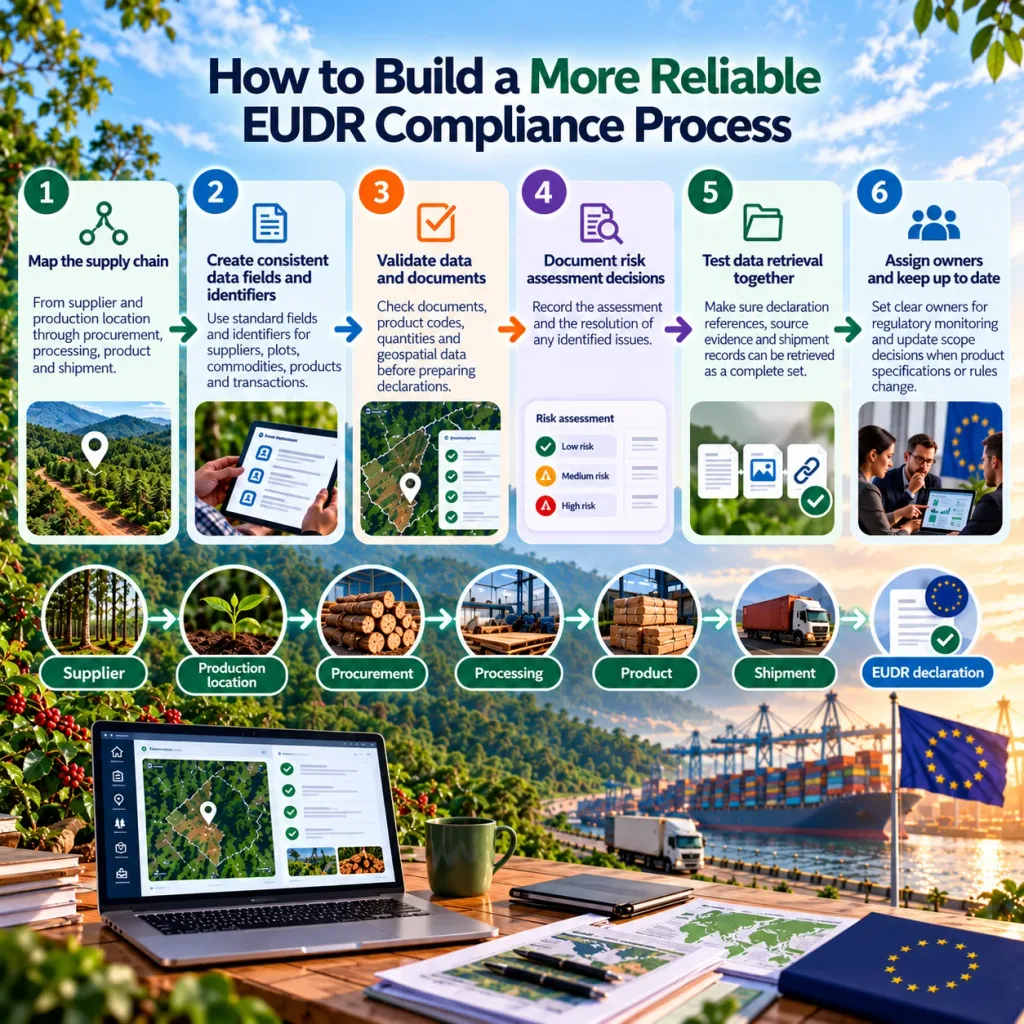
Collect and connect supplier, product, quantity, country-of-production, geolocation and legality information where required.
Assess deforestation and legality risks, document the evidence and take required action where risk is more than negligible.
Check whether a full Due Diligence Statement (DDS), a simplified declaration, or another role-specific requirement applies.
Use the transition period to validate data, test traceability and clarify responsibilities rather than postponing readiness.
Are your supplier records, plot geolocation, and due diligence evidence ready for scrutiny? Identify potential gaps before they become compliance challenges.
Download our eBook to assess your EUDR readiness, uncover data gaps, and take proactive steps towards stronger compliance.
EUDR Application Dates: What Businesses Should Know
The European Commission’s current overview identifies different application dates by business category. Do not treat the date as universal: certain micro and small operators already covered by the EU Timber Regulation have the earlier date, and products newly added to scope by the 2026 delegated regulation have a separate later timeline.
Category / product situation
Application date
Large and medium operators
30 December 2026
Most micro and small operators
30 June 2027
Micro and small operators already covered by the EU Timber Regulation (EUTR)
30 December 2026
Products newly added to EUDR scope by Commission Delegated Regulation (EU) 2026/2102
30 December 2027, according to the European Commission
These dates should be checked against the current official EUDR page and the precise product and company category. A transitional period or a later application date does not automatically remove the need to maintain evidence, map product flows or prepare for obligations that will apply later.
Discover how to use the available preparation time to strengthen supplier data collection, validate geolocation, and close compliance gaps before the applicable deadlines.
1. Confirm product scope and business responsibilities
Start with Annex I of the Regulation and the applicable amendments. Product codes, the commodity actually used and product composition can determine whether an item is in scope. Where a code is prefixed by “ex”, only the described portion of that code may be covered. Record the rationale for each scope decision and review it when product specifications or legislation change.
Next, identify the legal entity and its role in the supply chain. Operator, downstream operator, trader and eligible micro or small primary operator routes may carry different requirements following the amendments. Avoid assuming that every company must submit a new DDS for every transaction.
Learn which commodities and product categories are in scope, understand the role of HS/CN codes, and identify whether your products may be subject to EUDR requirements.
Article 9 sets out information requirements for due diligence. Depending on the product and applicable rules, records can include product description and quantity, country of production, supplier and buyer details, production-period information, geolocation of relevant plots and evidence of legal production. Build a standard data-collection process with clear owners, mandatory fields and a method for resolving missing or inconsistent information.
3. Establish plot-level geolocation and traceability
Geolocation links the commodity to its production location and supports checks against the deforestation-free requirement. Validate coordinates and polygon files, retain stable plot identifiers and connect the plots to suppliers, procurement lots, processing batches, products and shipments. If material from several origins is combined, preserve the source-level records needed to assess each relevant input and explain the resulting product’s traceability.
4. Assess deforestation and legality risks
Risk assessment should consider the collected information alongside relevant contextual evidence, including the sourcing country and region, supply-chain complexity, possible mixing with unknown-origin material and credible indications of non-compliance. Certification and third-party reports may support an assessment but should not be treated as an automatic substitute for the checks required from the responsible business.
Learn how to evaluate supplier data, verify plot-level geolocation, identify potential risks, and implement appropriate mitigation measures.
Where the applicable due diligence process identifies more than negligible risk, the responsible operator must take appropriate mitigation measures and reassess the risk before proceeding. Keep a record of evidence reviewed, gaps identified, actions taken, decisions made and the rationale behind those decisions. A defensible record explains not only the conclusion but how the business reached it.
6. Prepare the applicable declaration and retain records
Where a DDS or simplified declaration is required, prepare it through the EU Information System in accordance with the route that applies to the responsible actor. Capture the relevant reference or identifier and link it to the product and transaction records. A reference number alone does not prove that the underlying information is accurate or that all applicable obligations have been fulfilled. Confirm the current record-retention and handover duties for each role.
Learn which records to maintain, how to organise supplier data and due diligence evidence, and how to ensure documents are accessible when required.
EUDR Regulatory Updates: Delay, Simplification and Scope Changes
EUDR implementation has changed through amendments and supporting measures. Compliance teams should track both the overall application timeline and the more detailed changes to roles, declarations and Annex I product scope. The three TraceX articles below cover different parts of this picture and can be used together as a focused regulatory-update reading path.
EUDR Delay Confirmed: The Compliance Race Isn’t Over — Understand the revised application timeline and how to use the additional preparation period to close supplier-data gaps, test workflows and improve ongoing traceability.
Latest EUDR Delegated Act: Is Your Product Still in Scope? — Check the product-scope changes to Annex I and understand why HS/CN codes, the commodity used and product composition matter. Newly added products have a separate application timeline.
For a practical reading order, start with the delay article for the timeline, read the simplification article for changes to responsibilities, check the delegated-act article for product scope, and then use the transitional-period article to evaluate inventory and evidence scenarios. Revisit the official European Commission guidance whenever a legal interpretation or product-scope decision affects a shipment.
Missed Our Webinar on EUDR Beyond DDS? Catch the Recording
Watch the webinar recording to understand what lies beyond DDS filing and how to strengthen your EUDR compliance workflow.
Suppliers may provide inconsistent identifiers, incomplete documents or data in different formats. Define required fields and resolve gaps before declaration preparation.
Invalid or disconnected geolocation
Coordinates may be missing, incorrectly formatted or linked to the wrong plot. Validate geospatial files early and preserve their connection to the relevant supplier and product.
Broken links between sourcing and shipments
Purchase orders, processing batches, invoices and shipment references may live in separate systems. Use consistent identifiers to connect them and retrieve evidence quickly.
Manual and repetitive workflows
Spreadsheets and email can make version control, exception handling and audit trails difficult. Standardised workflows can reduce re-entry and reveal missing data earlier.
Unclear ownership
Supplier onboarding, document review, risk assessment and declaration preparation may involve different teams. Assign responsibility for collection, validation, approval and maintenance.
Discover practical strategies to overcome these challenges, strengthen supply-chain transparency, and prepare your business for compliance.
Read our EUDR Compliance Challenges Guide to identify potential gaps and build a more reliable compliance process.
Strengthening EUDR Compliance: Gap Analysis, Enforcement Readiness and Penalties
An EUDR gap analysis helps businesses identify what is missing from their current compliance processes. Assess supplier data, plot-level geolocation, legality documents, risk assessments and due diligence records to prioritise gaps and develop a clear action plan before placing relevant products on the EU market.
Preparing for EUDR enforcement means ensuring your business can demonstrate compliance through accurate, accessible and verifiable evidence. Establish clear responsibilities, maintain complete documentation, address identified risks and ensure your team can respond effectively to requests from competent authorities.
Failure to comply with EUDR requirements can result in penalties and other enforcement measures under the regulation and applicable national rules. Understanding potential consequences, including fines and restrictions on relevant products, can help businesses prioritise compliance controls, address gaps early and strengthen their due diligence processes.
Learn about potential penalties, enforcement measures, and practical steps to strengthen your EUDR compliance.
Digital compliance software can connect supplier onboarding, geolocation, traceability, evidence management, risk workflows and declaration preparation. When appropriately integrated with procurement or ERP systems, it can reduce duplicate data entry and help teams identify missing information earlier. Evaluate solutions against your actual workflow: bulk supplier onboarding, polygon validation, source-to-shipment traceability, exception management, audit trails, role-specific workflows and supported EU Information System functions.
TraceX helps businesses organise supplier and plot information, connect traceability records and support EUDR due diligence workflows. In a product evaluation, ask to walk through a representative product and shipment from supplier-data collection and geolocation validation to risk review, declaration preparation and evidence retrieval. Confirm the integrations and submission functions available for your configuration. Software can support the process, but it does not guarantee compliance or replace the responsible organisation’s obligations.
Questions Buyers Should Ask Before Choosing EUDR Compliance Software
Can the platform trace a shipment back to its production locations?
Ask for a live demonstration that connects the shipment to its product, batch, supplier and relevant plots, including how mixed-origin inputs and missing links are handled.
How does it validate geolocation and flag data gaps?
Check supported formats, polygon validation rules, duplicate detection, exception handling and the process for reviewing alerts. Ask how the platform records the evidence and outcome of each review.
Will it fit our existing procurement and ERP workflows?
Review available integrations, data ownership, import/export formats, permissions and how the platform avoids duplicate records. Confirm what is supported today rather than assuming every integration or submission step is included.
Can we retrieve evidence for an audit or customer request?
Test whether the team can retrieve supplier documents, geolocation, risk decisions, mitigation records and declaration references for a selected batch without manually reconstructing the file from multiple systems.
Does software guarantee compliance?
No. Software can support data quality, traceability and workflow control. The organisation remains responsible for confirming which legal requirements apply and for ensuring that the information and decisions are accurate.
EUDR Compliance Checklist
Confirm Annex I scope and the relevant company role and application date.
Identify supplier, plot, product, batch and shipment data owners.
Collect and validate required supplier, geolocation and legality evidence.
Document risk assessment, mitigation and approval decisions where required.
Confirm the applicable DDS or simplified declaration route and capture its reference or identifier.
Test traceability and evidence retrieval using a real product or shipment scenario.
Review regulatory updates and reassess affected product codes and inventory assumptions.
Conclusion: Make EUDR Compliance Part of Daily Operations
Reliable EUDR compliance depends on connected data, documented decisions and clear ownership from supplier onboarding to shipment-level evidence. The revised timeline creates preparation time, but the practical work remains: confirm product scope, understand role-specific responsibilities, validate geolocation and legality records, and make evidence retrievable. A digital platform can help coordinate these tasks and improve consistency while the organisation remains accountable for the obligations that apply to it.
Frequently Asked Questions (FAQ’s)
Does the EUDR delay mean we can pause preparation?
No. Use the available time to confirm product scope, collect supplier and plot data, resolve gaps and test workflows. Supplier onboarding and geospatial validation can take time, and later changes may require updates to product and evidence records.
Is a DDS reference number enough to prove compliance?
No. DDS reference number is not enough, a reference is one part of the record. The underlying information, applicable due diligence, risk decisions and supporting evidence must also be accurate and retrievable.
Are all products made from a covered commodity automatically in scope?
No. EUDR scope depends on the relevant products listed in Annex I and the precise commodity and product code. Review the current legal text, including amendments and “ex” code descriptions, rather than relying only on a commercial product name.
Do the same declaration obligations apply to every actor?
No, the obligations depend on the actor’s role, size and circumstances under the amended rules. Confirm whether the applicable route requires a DDS, a simplified declaration, registration, record retention or passing on reference information.
Can spreadsheets be used?
Spreadsheets may support simple tracking, but complex supplier networks, polygon files, changing product scope and shipment-level traceability can make validation, version control and audit retrieval harder. Evaluate software based on scale, complexity and integration needs.
How should we handle inventory acquired before the application date?
Do not assume that the warehouse or purchase date alone settles the question. Review the applicable transitional rules and maintain evidence of when the relevant product was placed on the EU market, its production and source records, and any downstream processing or mixing. Apply the rule to the actual facts and product category.
Start using TraceX
Transparency, Trust, & Success for your Climate Journey.
We use cookies on our website to give you the most relevant experience by remembering your preferences and repeat visits. By clicking “Accept All”, you consent to the use of ALL the cookies. However, you may visit "Cookie Settings" to provide a controlled consent.
This website uses cookies to improve your experience while you navigate through the website. Out of these, the cookies that are categorized as necessary are stored on your browser as they are essential for the working of basic functionalities of the website. We also use third-party cookies that help us analyze and understand how you use this website. These cookies will be stored in your browser only with your consent. You also have the option to opt-out of these cookies. But opting out of some of these cookies may affect your browsing experience.
Necessary cookies are absolutely essential for the website to function properly. These cookies ensure basic functionalities and security features of the website, anonymously.
Cookie
Duration
Description
cookielawinfo-checkbox-analytics
11 months
This cookie is set by GDPR Cookie Consent plugin. The cookie is used to store the user consent for the cookies in the category "Analytics".
cookielawinfo-checkbox-functional
11 months
The cookie is set by GDPR cookie consent to record the user consent for the cookies in the category "Functional".
cookielawinfo-checkbox-necessary
11 months
This cookie is set by GDPR Cookie Consent plugin. The cookies is used to store the user consent for the cookies in the category "Necessary".
cookielawinfo-checkbox-others
11 months
This cookie is set by GDPR Cookie Consent plugin. The cookie is used to store the user consent for the cookies in the category "Other.
cookielawinfo-checkbox-performance
11 months
This cookie is set by GDPR Cookie Consent plugin. The cookie is used to store the user consent for the cookies in the category "Performance".
viewed_cookie_policy
11 months
The cookie is set by the GDPR Cookie Consent plugin and is used to store whether or not user has consented to the use of cookies. It does not store any personal data.
Functional cookies help to perform certain functionalities like sharing the content of the website on social media platforms, collect feedbacks, and other third-party features.
Performance cookies are used to understand and analyze the key performance indexes of the website which helps in delivering a better user experience for the visitors.
Analytical cookies are used to understand how visitors interact with the website. These cookies help provide information on metrics the number of visitors, bounce rate, traffic source, etc.
Advertisement cookies are used to provide visitors with relevant ads and marketing campaigns. These cookies track visitors across websites and collect information to provide customized ads.
Download the 2026 Traceability Scorecard and Benchmark Your Supply Chain Across 10 Critical Capabilities.
Download our eBook
Don’t Wait for an Audit to Find Your EUDR Gaps
The 2026 Simplification Package changes how HS codes, DDS pass-through and geolocation rules apply to you. Get the free guide and 20-point readiness checklist before enforcement catches you unprepared.