EUDR Downstream Operators: What Manufacturers and Retailers Must Do Before December 2026
Published
, 12 minute read
Share this article
Quick summary: Learn what downstream operators must do under EUDR, including traceability, DDS verification, and compliance steps for manufacturers and retailers to avoid risks and ensure market access.
EUDR downstream operators are companies that place products on the EU market containing regulated commodities cocoa, coffee, soy, rubber, palm oil, timber, or cattle derivatives already covered by an upstream Due Diligence Statement (DDS). Under Regulation (EU) 2025/2650, they no longer submit their own DDS, but they must register in the EU TRACES system, and the first downstream operator in the chain must collect and retain DDS reference numbers from suppliers. All must keep audit-ready traceability records for five years and act on substantiated non-compliance concerns. Large and medium operators must comply by 30 December 2026; penalties can reach at least 4% of total annual EU turnover.
EUDR downstream operators the manufacturers, processors, and retailers who buy regulated commodities after someone else has already placed them on the EU market spent two years assuming the deforestation regulation was mostly an upstream problem. Regulation (EU) 2025/2650, published in the EU Official Journal on 23 December 2025, settled the question: it is a distinct compliance category with its own obligations, its own deadline, and its own penalties.
In plain terms: if your product contains cocoa, coffee, soy, palm oil, rubber, timber, or cattle derivatives, and you were not the first company to place that commodity on the EU market, you are a downstream operator. The amendment removed your duty to file a full Due Diligence Statement but replaced blanket paperwork with targeted accountability: TRACES registration, DDS reference collection at the first downstream tier, five-year record-keeping, and a duty to act on red flags.
The runway to 30 December 2026 is your preparation window. After that, enforcement begins with defined audit rates, a penalty benchmark of at least 4% of annual EU turnover, blocked shipments, and public enforcement notices. This guide covers who qualifies, exactly what changed, the five roadblocks companies are hitting, and a step-by-step compliance checklist.
Key Takeaways
The 2025 amendment cut downstream paperwork no full DDS, no independent risk assessment but liability did not move: you remain accountable for verifying supplier compliance and staying audit-ready.
The ‘first downstream operator’ role is pivotal: whoever first buys a commodity already placed on the EU market must collect and store the upstream DDS reference numbers.
TRACES registration is a new, mandatory obligation and it’s an ongoing data-maintenance duty, not a one-time form.
Defined check rates (3% standard, 9% high-risk origins) and a penalty benchmark of at least 4% of EU turnover make enforcement quantifiable for the first time.
Under the substantiated-concern rule, non-SME downstream operators must verify due diligence was carried out before placing a flagged product on the market ignorance is not a defense.
EUDR Downstream Operators Defined: Who Qualifies Under Regulation 2025/2650
A downstream operator is any entity that places on the market, or exports, products made from relevant commodities already covered by a DDS or simplified declaration filed upstream. The simplest test: if the commodity in your product already carried a DDS when you bought it, you sit downstream. If you imported it from origin yourself, you are the primary operator with full due diligence obligations.
The category cuts across sectors:
Food and beverage — chocolate brands, coffee roasters, and oat-milk producers handling cocoa, coffee, and soy.
Retail and FMCG — supermarkets and own-brand sellers touching palm oil, rubber, and cattle derivatives.
Apparel and footwear — brands using natural-rubber soles or leather.
Furniture and timber goods — flat-pack furniture and flooring companies handling wood products.
Cosmetics and personal care — formulations containing palm-oil derivatives.
Automotive and manufacturing — tyre makers and industrial processors using natural rubber and soy.
Size matters too: non-SME downstream operators carry the substantiated-concern verification duty, while SMEs face lighter obligations. Classify your entity early the obligations attach to the classification.
Not sure whether your business qualifies as a downstream operator? Explore practical examples across different industries to understand your role, responsibilities, and compliance obligations under EUDR.
EUDR Downstream Operator Rules: What Changed Under Regulation (EU) 2025/2650
Original EUDR (2023/1115)
After Regulation (EU) 2025/2650
Net effect
Full DDS submitted for every product placement, at every chain tier
No DDS submission downstream only the first upstream placer files
Lighter
DDS references maintained and passed along the entire chain
Only the first downstream operator collects and retains DDS reference numbers
Lighter
Independent risk assessment at each tier
No independent risk assessment; reliance on the upstream DDS permitted
Lighter
No formal registration requirement
Mandatory registration in the EU TRACES information system
New duty
Compliance deadline 30 Dec 2025
30 Dec 2026 (large/medium); 30 Jun 2027 (micro/small)
Extended
Check rates unspecified
3% standard-risk / 9% high-risk annual checks defined
Stricter
No explicit penalty formula
Fines of at least 4% of total annual EU turnover as maximum benchmark
Stricter
Less paperwork, zero permission to disengage. Traceability data must still flow through your chain, your suppliers must be verifiable, and you must be able to produce the evidence when a competent authority asks.
Without end-to-end traceability, demonstrating that your commodities are deforestation-free becomes significantly more challenging. Learn how robust traceability supports geolocation, due diligence, risk assessment, and audit readiness under EUDR.
EUDR Downstream Operators’ Five Biggest Compliance Challenges in 2026
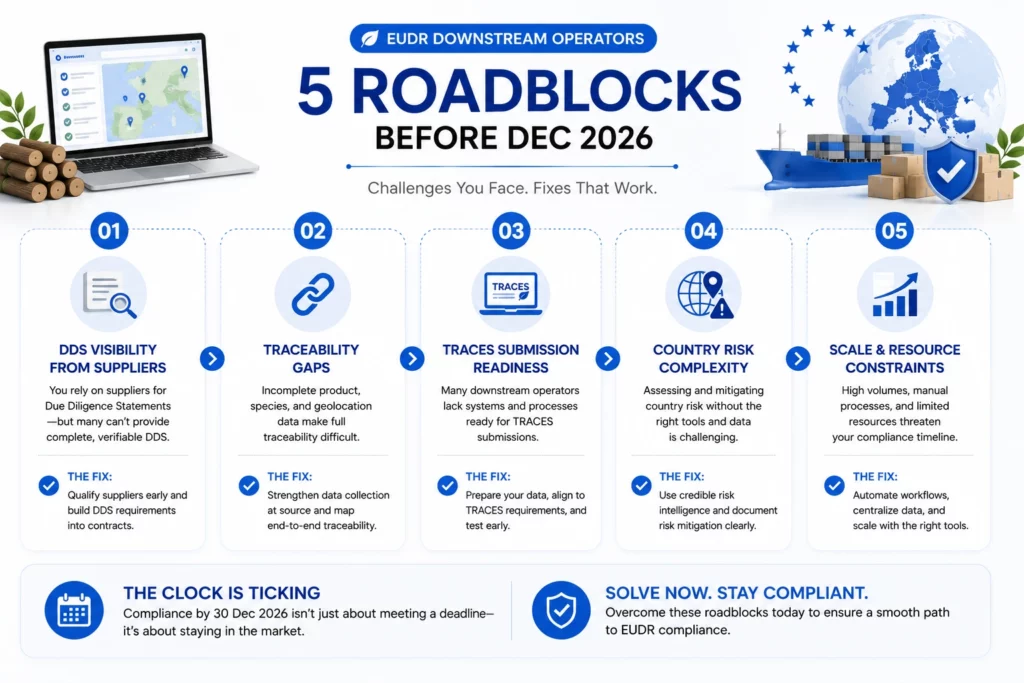
Simplified obligations sound reassuring. In practice, companies are hitting five distinct roadblocks each capable of derailing readiness before enforcement begins:
1. No visibility into which suppliers have filed a DDS
Sourcing through aggregators, cooperatives, and traders often means no line of sight into whether any upstream operator actually filed. You cannot be audit-ready if you cannot verify your DDS reference numbers exist.
Effective due diligence is the cornerstone of EUDR compliance. Learn how to collect supplier information, assess deforestation risk, verify compliance, and maintain the documentation needed to support your Due Diligence Statement.
Coffee and cocoa routinely pass through four to six intermediaries before reaching a manufacturer. Every handoff is a potential data gap and the regulation expects traceability back to the farm plot, not just to the trader you bought from.
3. TRACES registration treated as a one-time form
Registration is an operational commitment: compliance data must stay active, updated, and linked to live supplier documentation. Stale records are a finding waiting to happen.
4. Country risk reclassification shifting exposure overnight
The EU benchmarks each origin as low, standard, or high risk. A move to high risk pushes your audit exposure toward the 9% annual check rate and reclassifications arrive without warning.
5. Compliance cost versus operational scale
Large retailers and manufacturers source from hundreds or thousands of suppliers across dozens of origins. Manual compliance at that scale is operationally impossible yet many teams are still attempting it through spreadsheets and email threads.
EUDR Downstream Operator Compliance Checklist: Four Steps Before 30 December 2026
Step 1: Register in the EU TRACES information system
Create your organization profile and map every product line containing regulated commodities.
Assign a named compliance owner accountable for ongoing data maintenance.
Integrate your ERP or procurement system via API to automate data flows.
The EU Information System is the official platform for submitting EUDR Due Diligence Statements (DDS). Learn how it works, what information you’ll need, and how to prepare for a smooth submission.
Store supplier records digitally with a minimum five-year retention period.
For high-risk origins, confirm risk assessments and mitigation measures were documented upstream.
Track expiry dates on certifications, permits, and land records.
Ensure geolocation data (coordinates or polygons) is retrievable for key origin plots.
Step 4: Prepare for competent authority checks
Know your country risk profile and the audit rate it implies (3% standard, 9% high-risk).
Build a documented non-compliance response protocol for rejected or missing DDS references.
Run an internal EUDR gap assessment well before the deadline to stress-test audit readiness.
Maintain an escalation path: substantiated concerns must be reported to your member state’s competent authority.
The substantiated-concern rule deserves emphasis: where verified evidence indicates a product in your chain is non-compliant, a non-SME downstream operator must confirm due diligence was carried out before placing it on the market. Ignorance is not a defense.
EUDR Downstream Operator Compliance with TraceX: Five Capabilities That Close the Gaps
TraceX’s AI-powered EUDR solutions maps directly onto the obligations above turning a supplier-chasing exercise into a managed data pipeline:
Automated supplier onboarding and DDS reference collection. GPS-verified plot mapping, KYC and certification capture, and multilingual Smart Assessment Questionnaires collect DDS references without manual follow-up closing the single biggest downstream gap.
Blockchain-backed chain-of-custody traceability. Every batch carries an immutable, time-stamped record from farm polygon to factory gate, meeting the evidence standard competent authorities will apply to high-risk chains.
Real-time country risk monitoring. When EU benchmarks update, the platform reassesses your supplier portfolio automatically and flags affected products before shipments are impacted.
Direct TRACES integration. API connectivity keeps registration data current, formats due diligence records for submission, and produces one-click audit reports with geolocation, risk, and certification data.
AI-powered risk scoring on EU-aligned datasets. JRC and Hansen satellite data drive continuous plot-level deforestation analysis — live visibility instead of annual snapshots.
A leading tyre manufacturer needed deforestation-free verification across a fragmented network of smallholder rubber farmers in Southeast Asia, with no existing polygon mapping or DDS infrastructure. TraceX deployed mobile-first GPS polygon capture, validated GeoJSON data against JRC satellite imagery, and generated TRACES-compatible records resulting in 100% of sourced rubber plots mapped and verified deforestation-free post-2020, with a full audit trail available for inspection.
EUDR Downstream Operator Readiness: Manual Process vs. Automated Platform
Compliance task
Manual / spreadsheet approach
Automated platform (TraceX)
DDS reference collection
Chased over email per supplier per batch; gaps found only at audit
Captured at supplier onboarding, validated per batch, gaps flagged on a live dashboard
Multi-tier traceability
Visibility stops at the direct supplier; 4–6 intermediary tiers opaque
Blockchain-backed chain of custody from farm polygon to factory gate
TRACES registration & upkeep
One-time form treated as done; data goes stale
Direct API integration keeps records current with expiry alerts
Country risk monitoring
Reclassifications discovered after shipments are affected
Automated portfolio re-assessment the moment EU benchmarks change
Audit readiness at scale
Impossible past a few hundred suppliers; headcount scales with volume
AI-assisted onboarding, multilingual SAQs, and risk scoring scale without headcount
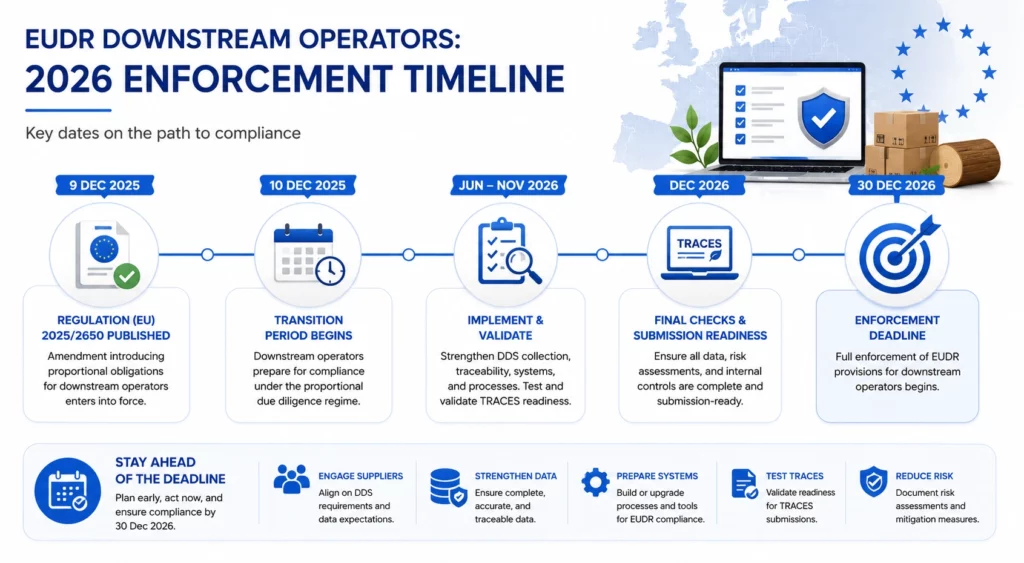
EUDR Downstream Operator Timeline: The Dates That Matter
29 June 2023 — EUDR (Regulation EU 2023/1115) entered into force.
23 December 2025 — Amending Regulation (EU) 2025/2650 published in the Official Journal.
30 April 2026 — Commission’s simplification review report due; further amendments possible.
30 December 2026 — compliance deadline for large and medium operators. This is your deadline.
30 June 2027 — deadline for micro and small enterprises.
Most companies underestimate how long compliant supplier data infrastructure takes to build. Supplier onboarding, DDS reference collection, polygon mapping, and TRACES integration are not weekend projects teams starting in Q3 2026 will be scrambling; teams starting now will be audit-ready with a competitive story to tell buyers.
Sourcing regulated commodities without knowing where your DDS reference gaps are? TraceX maps your supplier network, flags missing references, and builds your audit-ready traceability file in weeks not months.
Do downstream operators need to submit a DDS under the new rules?
No. Under Regulation (EU) 2025/2650, the DDS obligation rests solely with the upstream operator who first places the product on the EU market. However, the first downstream operator in the chain must collect and retain the DDS reference numbers or simplified declaration IDs from its suppliers.
I manufacture chocolate from purchased cocoa — am I downstream or primary?
If the cocoa was already placed on the EU market with a DDS when you bought it, you are a downstream operator. If you import directly from origin, you are the primary operator with full DDS filing obligations.
What if my supplier cannot provide a DDS reference number?
The product is effectively unverifiable and should not be placed on the EU market. Notify the supplier of the requirement, consider alternative sourced batches, and document the gap. If a substantiated concern about non-compliance arises, report it to your member state’s competent authority.
Does EUDR apply to commodities produced before 31 December 2020?
The deforestation-free requirement applies only to land deforested after 31 December 2020, so pre-cut-off production falls outside that test — but legal-production requirements (land tenure, permits) apply regardless of date.
How do I register in the EU TRACES system?
Set up an operator account, link your legal entity details, and map the regulated product lines you handle. The system stores DDS reference numbers and traceability status. Platforms like TraceX integrate with TRACES via API to automate registration data and keep it current.
What are the penalties for non-compliance?
Member states must apply penalties that are proportionate and dissuasive; the regulation benchmarks maximum fines at a level of at least 4% of total annual EU turnover. Additional consequences include shipment seizures, temporary market-access bans, and public enforcement notices.
Start using TraceX
Transparency, Trust, & Success for your Climate Journey.
We use cookies on our website to give you the most relevant experience by remembering your preferences and repeat visits. By clicking “Accept All”, you consent to the use of ALL the cookies. However, you may visit "Cookie Settings" to provide a controlled consent.
This website uses cookies to improve your experience while you navigate through the website. Out of these, the cookies that are categorized as necessary are stored on your browser as they are essential for the working of basic functionalities of the website. We also use third-party cookies that help us analyze and understand how you use this website. These cookies will be stored in your browser only with your consent. You also have the option to opt-out of these cookies. But opting out of some of these cookies may affect your browsing experience.
Necessary cookies are absolutely essential for the website to function properly. These cookies ensure basic functionalities and security features of the website, anonymously.
Cookie
Duration
Description
cookielawinfo-checkbox-analytics
11 months
This cookie is set by GDPR Cookie Consent plugin. The cookie is used to store the user consent for the cookies in the category "Analytics".
cookielawinfo-checkbox-functional
11 months
The cookie is set by GDPR cookie consent to record the user consent for the cookies in the category "Functional".
cookielawinfo-checkbox-necessary
11 months
This cookie is set by GDPR Cookie Consent plugin. The cookies is used to store the user consent for the cookies in the category "Necessary".
cookielawinfo-checkbox-others
11 months
This cookie is set by GDPR Cookie Consent plugin. The cookie is used to store the user consent for the cookies in the category "Other.
cookielawinfo-checkbox-performance
11 months
This cookie is set by GDPR Cookie Consent plugin. The cookie is used to store the user consent for the cookies in the category "Performance".
viewed_cookie_policy
11 months
The cookie is set by the GDPR Cookie Consent plugin and is used to store whether or not user has consented to the use of cookies. It does not store any personal data.
Functional cookies help to perform certain functionalities like sharing the content of the website on social media platforms, collect feedbacks, and other third-party features.
Performance cookies are used to understand and analyze the key performance indexes of the website which helps in delivering a better user experience for the visitors.
Analytical cookies are used to understand how visitors interact with the website. These cookies help provide information on metrics the number of visitors, bounce rate, traffic source, etc.
Advertisement cookies are used to provide visitors with relevant ads and marketing campaigns. These cookies track visitors across websites and collect information to provide customized ads.
Download the 2026 Traceability Scorecard and Benchmark Your Supply Chain Across 10 Critical Capabilities.
Download our eBook
Don’t Wait for an Audit to Find Your EUDR Gaps
The 2026 Simplification Package changes how HS codes, DDS pass-through and geolocation rules apply to you. Get the free guide and 20-point readiness checklist before enforcement catches you unprepared.