SBTi FLAG Guidance Explained: Everything You Need to Know
Published
, 10 minute read
Share this article
Quick summary: Learn all about SBTi FLAG guidance, including sector coverage, timelines, energy and industry targets, and how it connects to DCF commitments. Simplify your corporate decarbonization strategy today.
SBTi FLAG Guidance provides a framework for companies, especially in energy-intensive and industrial sectors, to set science-based decarbonization targets aligned with global climate goals. It offers sector-specific methodologies, timelines, and milestones to ensure emissions reductions are measurable, verifiable, and consistent with the Paris Agreement. By differentiating from standard SBTi targets, FLAG guidance enables businesses to track progress, report transparently, and integrate with deforestation and conversion-free commitments (DCF). Understanding FLAG guidance is essential for organizations aiming to achieve credible, science-based climate action while maintaining regulatory compliance and investor confidence.
The Science Based Targets initiative (SBTi) is a globally recognized framework helping companies set ambitious, science-aligned climate goals. Within this, the FLAG (Financial, Land-use, and Greenhouse-gas) Guidance provides specialized methodologies for sectors where traditional targets may be less applicable, such as energy-intensive industries and hard-to-abate sectors. FLAG ensures that emissions reductions are measurable, credible, and aligned with the Paris Agreement, bridging the gap between global climate science and actionable corporate strategies.
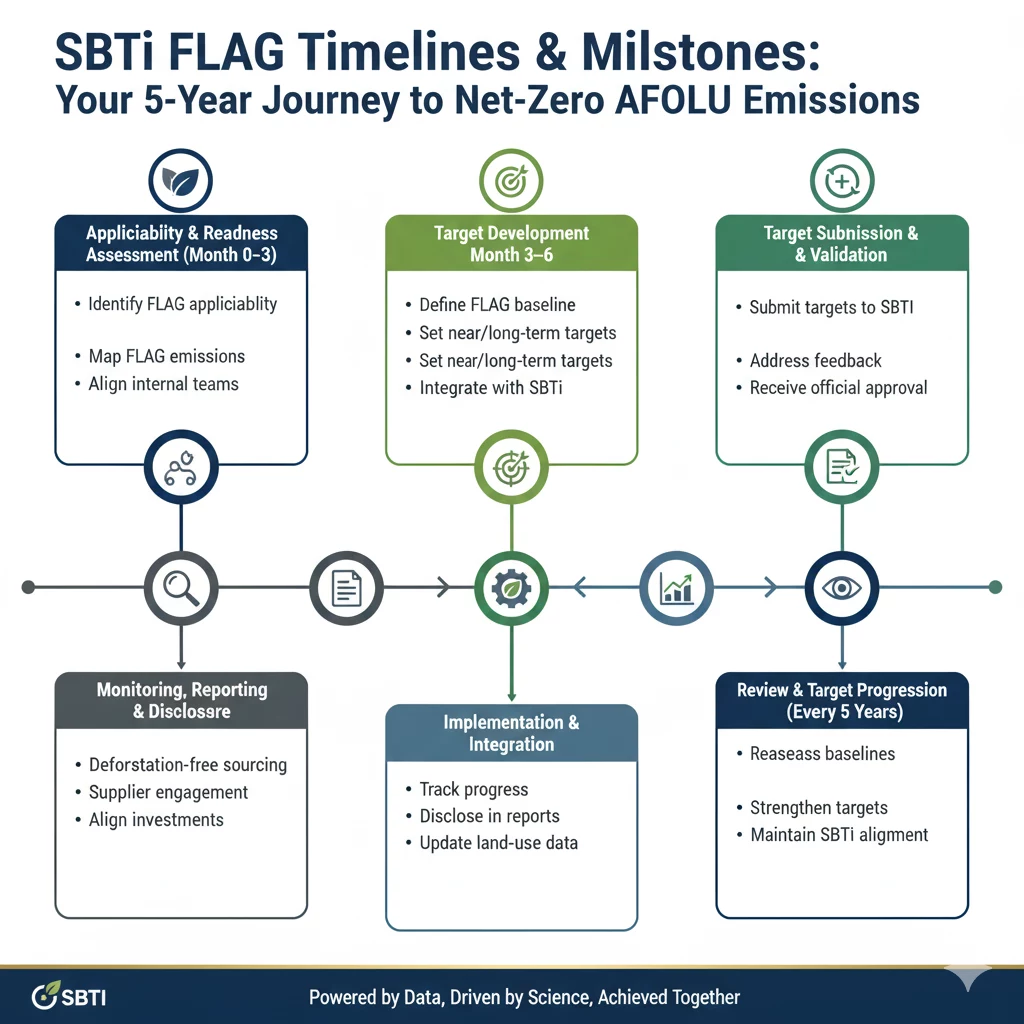
As investors, regulators, and consumers increasingly demand transparency and accountability in climate action, FLAG guidance becomes a critical tool for companies to demonstrate credible, science-based decarbonization. This blog offers a comprehensive guide to SBTi FLAG Guidance, breaking down its core components for practical application. It explores sector coverage, explaining which industries and emission scopes the guidance is designed for, ensuring businesses understand where and how it applies. It delves into targets, detailing how organizations can define, measure, and validate science-based reduction goals that align with climate science. The discussion on timelines and milestones highlights the key steps, reporting intervals, and checkpoints necessary to maintain credibility and track progress. Finally, the blog examines integration with DCF commitments, showing how FLAG guidance connects with broader corporate sustainability and decarbonization strategies, enabling companies to align operational actions with long-term climate commitments.
Key Takeaways
SBTi FLAG Guidance is a science-based framework that helps companies in land-intensive sectors reduce emissions from forests, land use, and agriculture while protecting natural ecosystems.
Unlike standard SBTi Energy & Industry targets, FLAG specifically addresses biogenic emissions, removals, and land-use change.
It applies to sectors such as agriculture, food, forestry, paper, bio-based materials, and commodities reliant on land use.
Integrating FLAG with deforestation free and conversion free (DCF) commitments enables companies to align land-based emissions reductions with credible carbon removals, strengthening compliance, investor confidence, and long-term climate credibility.
What is FLAG Guidance?
FLAG guidance (Financial-sector and Land-use aligned guidance) is a specialized framework developed by the Science Based Targets initiative (SBTi) to help companies, especially in high-impact sectors, set ambitious, science-based emission reduction targets. Unlike traditional SBTi targets that often focus on overall corporate emissions, FLAG guidance provides tailored methodologies for sectors with complex decarbonization pathways, such as energy-intensive industries, land-use activities, and financial portfolios.
By adopting FLAG guidance, companies gain a clear, credible roadmap to align their operations with the Paris Agreement goals, ensuring their targets are robust, measurable, and scientifically grounded. It helps businesses identify sector-specific levers for decarbonization, integrate emissions across scopes, and navigate emerging regulatory and market expectations.
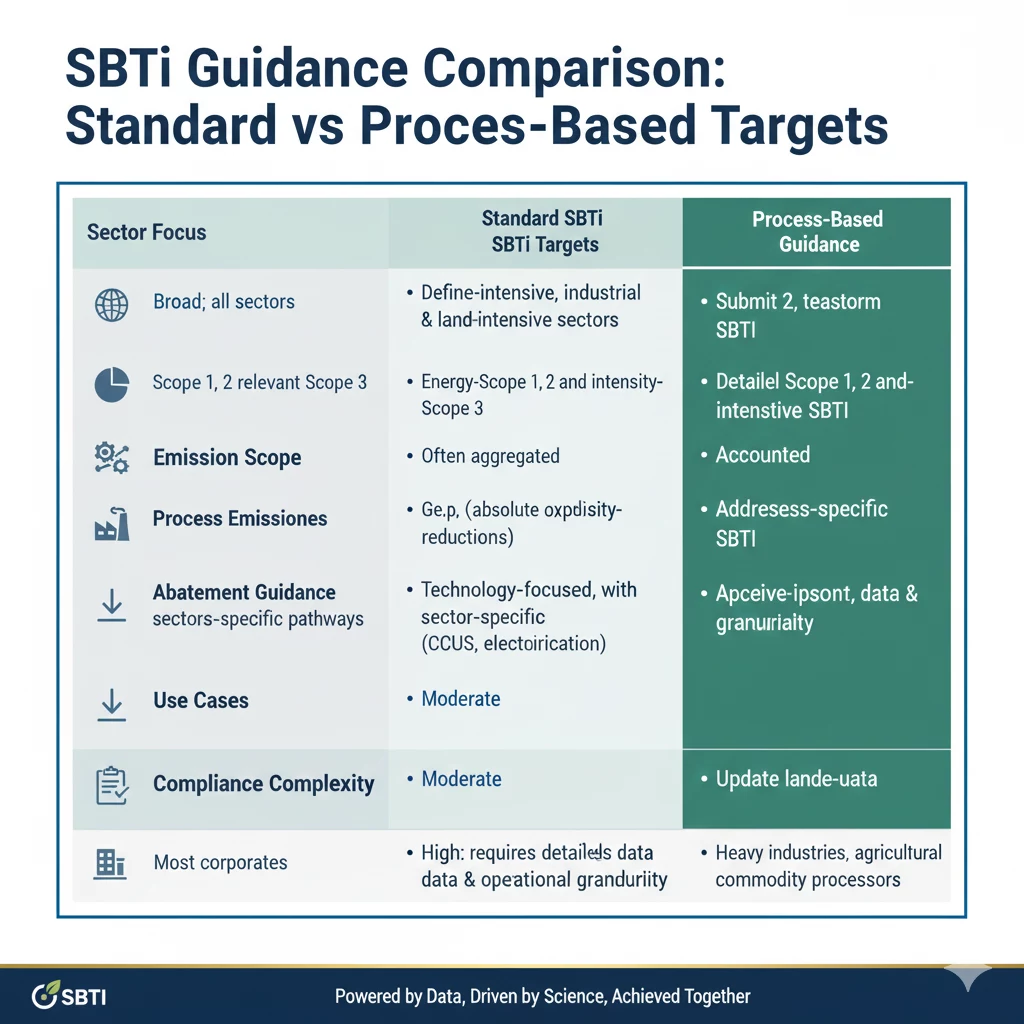
Quick Comparison: FLAG vs Traditional SBTi Targets
Scope: FLAG is sector-specific and addresses unique operational or portfolio challenges.
Methodology: Provides tailored pathways for hard-to-abate emissions.
Integration: FLAG explicitly connects with corporate sustainability frameworks like DCF commitments.
Check if your sector falls under FLAG guidance and start aligning your targets with science-based standards today.
The Science Based Targets initiative (SBTi) has long provided frameworks for companies across sectors to set science-based emission reduction goals aligned with the Paris Agreement. Traditional SBTi targets focus on overall emission reduction trajectories for companies, often emphasizing absolute reductions in Scope 1, 2, and relevant Scope 3 emissions.
In contrast, FLAG (Forest, Land, and Agriculture Guidance) is a specialized subset designed for energy-intensive and industrial sectors, addressing the unique challenges of high-emission, process-heavy industries. FLAG provides more granular, sector-specific guidance, including:
Pathways for industrial process emissions that are harder to abate (e.g., cement, steel, aluminum).
Accounting for value-chain emissions and operational nuances specific to energy-intensive activities.
Integration of low-carbon technology adoption into target-setting, such as electrification, hydrogen, and carbon capture.
Relevance for Energy & Industrial Sectors
Energy-intensive industries face challenges that generic SBTi targets may not fully address:
Cement and steel: Process emissions from calcination and smelting are substantial and require specific abatement strategies.
Oil & gas: Lifecycle emissions, including methane leaks and downstream fuel use, are complex to track.
Chemicals & fertilizers: Process emissions and product-use emissions (e.g., N₂O from fertilizers) require detailed accounting.
FLAG provides tailored decarbonization pathways, including sector-specific benchmarks and trajectories aligned with science-based climate goals. It ensures that companies in these sectors set realistic, achievable, and verifiable targets that go beyond traditional absolute or intensity reductions.
Examples of FLAG in Action
Several companies have successfully adopted FLAG guidance to strengthen their climate strategies:
CementCo Ltd.: Implemented process-specific decarbonization targets using FLAG, achieving early adoption of low-carbon clinker substitutes.
SteelWorks International: Used FLAG guidance to integrate energy efficiency improvements and partial electrification into their 2030 emission reduction targets.
Global Fertilizer Inc.: Applied FLAG’s N₂O emission accounting to create validated, science-based fertilizer production targets.
These examples illustrate how FLAG helps companies align operational realities with science-based commitments, while improving credibility with investors and regulators.
What Sectors does FLAG Cover?
Sectors Covered Under FLAG Guidance
The SBTi FLAG (Forest, Land, and Agriculture Guidance) is designed to help companies in sectors where emissions are high, complex, or difficult to abate. It provides sector-specific pathways and methodologies for science-based target setting. Key sectors covered include:
Cement and Concrete: High process and energy-related CO₂ emissions from clinker production.
Steel and Metals: Emissions from smelting, refining, and process energy usage.
Chemicals and Fertilizers: Process emissions from production (e.g., N₂O, CO₂) and feedstock use.
Oil & Gas: Scope 1 and 2 emissions, plus downstream combustion and fugitive emissions.
Pulp, Paper & Forestry Products: Direct emissions from production, land-use change, and supply chain impacts.
Agriculture & Land-Use Commodities: Emissions from livestock, fertilizers, deforestation, and land conversion activities.
Why These Sectors Require FLAG Guidance
FLAG guidance is critical for these sectors because standard SBTi frameworks may not adequately capture sector-specific emission sources. Companies in these industries face challenges such as:
Process-specific emissions: Traditional SBTi targets focus on energy-related CO₂ reductions, whereas FLAG accounts for emissions inherent to production processes (e.g., cement calcination, steel smelting).
High Scope 3 emissions: Supply-chain and product-use emissions can be significant, especially for chemicals, oil & gas, and agricultural commodities.
Deforestation and land-use impacts: Agriculture, forestry, and commodity-driven sectors need precise measurement of land-use change and associated emissions.
Complex mitigation pathways: Industries like steel and cement require integration of advanced technologies such as carbon capture, utilization, and storage (CCUS), low-carbon feedstocks, and electrification.
By following FLAG guidance, companies can:
Set verified, science-based emission targets aligned with the Paris Agreement.
Demonstrate credible climate action to investors, regulators, and buyers.
Mitigate reputational and regulatory risks, especially under EU Deforestation Regulation (EUDR) and related frameworks.
How FLAG Guidance Connects to DCF Commitments
FLAG guidance and Deforestation and Conversion Free (DCF) commitments are closely linked because both focus on credible, measurable decarbonization in land-based and hard-to-abate value chains. FLAG guidance defines how companies should set science-based targets for emissions and removals from forestry, agriculture, and land use (FLAG), while DCF provides a structured framework to finance and claim high-integrity decarbonization outcomes, particularly in areas where direct emissions reductions are complex or long-term.
By aligning FLAG targets with DCF commitments, companies ensure that any use of decarbonization credits complements rather than replaces real emissions reductions in their value chains. FLAG establishes the emissions baseline, reduction pathway, and land-use priorities, while DCF helps channel investment into verified mitigation and removal activities that support those pathways. This integration is critical as regulators and investors increasingly scrutinize claims around offsets, removals, and nature-based solutions.
Integrating FLAG with DCF also strengthens regulatory and investor confidence. Science-based FLAG targets demonstrate compliance with SBTi expectations, while DCF alignment shows financial commitment to credible decarbonization beyond business-as-usual. Together, they support transparent disclosures under CSRD, ISSB, and climate-related financial reporting frameworks, reducing greenwashing risk and improving capital market credibility.
Practical alignment tips for companies include:
Use FLAG guidance to define land-use emissions baselines and reduction trajectories before engaging in DCF-aligned credit strategies.
Prioritize in-value-chain mitigation (e.g., regenerative agriculture, deforestation-free sourcing) and use DCF credits only for residual emissions.
Harmonize data systems so FLAG emissions data, land-use metrics, and DCF credit documentation feed into a single reporting workflow.
Ensure third-party verification for both FLAG target progress and DCF-linked decarbonization activities.
When combined, FLAG guidance and DCF commitments create a coherent, science-aligned approach to land-use decarbonization one that meets rising regulatory standards, satisfies investor scrutiny, and supports long-term climate credibility.
TraceX sustainability and compliance solutions help organizations move from fragmented data to climate-aligned action by digitizing supply chains, land-use records, and emissions-relevant activity data at the source. By enabling farm and supplier mapping, verifiable traceability, and automated compliance documentation, TraceX supports accurate emissions accounting, deforestation-free sourcing, and auditable ESG reporting. This data foundation strengthens climate action targets by linking real-world operational practices to measurable climate outcomes helping companies set credible targets, demonstrate progress, and stay aligned with evolving global sustainability and regulatory expectations.
Ready to turn sustainability data into climate action?
See how traceability and compliance technology can power credible, audit-ready climate targets.
SBTi FLAG Guidance marks a critical shift in how companies address emissions linked to land use, agriculture, and forestry. As land-based emissions increasingly dominate corporate climate footprints, aligning with FLAG is no longer optional for affected sectors it is essential for credibility, compliance, and long-term resilience. Companies that act early gain clearer emissions visibility, stronger investor confidence, and smoother alignment with CSRD, DCF, and deforestation-free sourcing requirements. Understanding your exposure, building land-use data systems, and integrating FLAG into your broader decarbonization strategy are the next practical steps toward science-based climate leadership.
Master Scope 3 Emissions Read our complete guide to identifying, calculating, and reducing Scope 3 emissions across your value chain.
Set Science-Based Targets with Confidence Explore our step-by-step blog on setting and validating SBTi-aligned targets for your organization.
Is SBTi FLAG Guidance mandatory for all companies?
No. FLAG Guidance is mandatory only for companies whose land-based emissions account for 20% or more of total Scope 1–3 emissions or that operate in FLAG-covered sectors.
Can companies have both FLAG and standard SBTi targets?
Yes. FLAG targets complement energy and industry targets by covering land-use, agriculture, forestry, and removals, ensuring full emissions coverage.
What data is required to comply with FLAG Guidance?
Companies need activity data on land use, agricultural production, sourcing regions, deforestation risk, and emissions or removals associated with AFOLU-related activities.
Start using TraceX
Transparency, Trust, & Success for your Climate Journey.
We use cookies on our website to give you the most relevant experience by remembering your preferences and repeat visits. By clicking “Accept All”, you consent to the use of ALL the cookies. However, you may visit "Cookie Settings" to provide a controlled consent.
This website uses cookies to improve your experience while you navigate through the website. Out of these, the cookies that are categorized as necessary are stored on your browser as they are essential for the working of basic functionalities of the website. We also use third-party cookies that help us analyze and understand how you use this website. These cookies will be stored in your browser only with your consent. You also have the option to opt-out of these cookies. But opting out of some of these cookies may affect your browsing experience.
Necessary cookies are absolutely essential for the website to function properly. These cookies ensure basic functionalities and security features of the website, anonymously.
Cookie
Duration
Description
cookielawinfo-checkbox-analytics
11 months
This cookie is set by GDPR Cookie Consent plugin. The cookie is used to store the user consent for the cookies in the category "Analytics".
cookielawinfo-checkbox-functional
11 months
The cookie is set by GDPR cookie consent to record the user consent for the cookies in the category "Functional".
cookielawinfo-checkbox-necessary
11 months
This cookie is set by GDPR Cookie Consent plugin. The cookies is used to store the user consent for the cookies in the category "Necessary".
cookielawinfo-checkbox-others
11 months
This cookie is set by GDPR Cookie Consent plugin. The cookie is used to store the user consent for the cookies in the category "Other.
cookielawinfo-checkbox-performance
11 months
This cookie is set by GDPR Cookie Consent plugin. The cookie is used to store the user consent for the cookies in the category "Performance".
viewed_cookie_policy
11 months
The cookie is set by the GDPR Cookie Consent plugin and is used to store whether or not user has consented to the use of cookies. It does not store any personal data.
Functional cookies help to perform certain functionalities like sharing the content of the website on social media platforms, collect feedbacks, and other third-party features.
Performance cookies are used to understand and analyze the key performance indexes of the website which helps in delivering a better user experience for the visitors.
Analytical cookies are used to understand how visitors interact with the website. These cookies help provide information on metrics the number of visitors, bounce rate, traffic source, etc.
Advertisement cookies are used to provide visitors with relevant ads and marketing campaigns. These cookies track visitors across websites and collect information to provide customized ads.
Download the 2026 Traceability Scorecard and Benchmark Your Supply Chain Across 10 Critical Capabilities.
Download our eBook
Don’t Wait for an Audit to Find Your EUDR Gaps
The 2026 Simplification Package changes how HS codes, DDS pass-through and geolocation rules apply to you. Get the free guide and 20-point readiness checklist before enforcement catches you unprepared.