EUDR Soy Compliance: Why Your Deforestation Exposure Isn’t in the Soy Aisle
Published
, 6 minute read
Share this article
Quick summary: Discover essential insights into EUDR compliance for soy sourcing. Learn how to navigate regulations, enhance traceability, and promote sustainable practices in your supply chain.
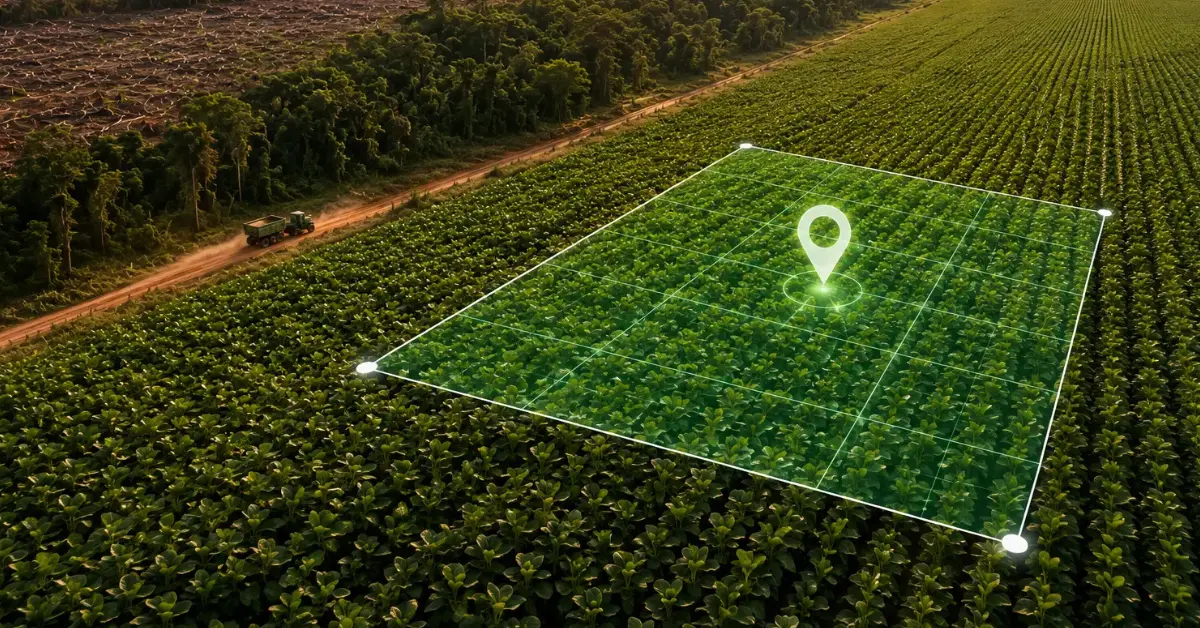
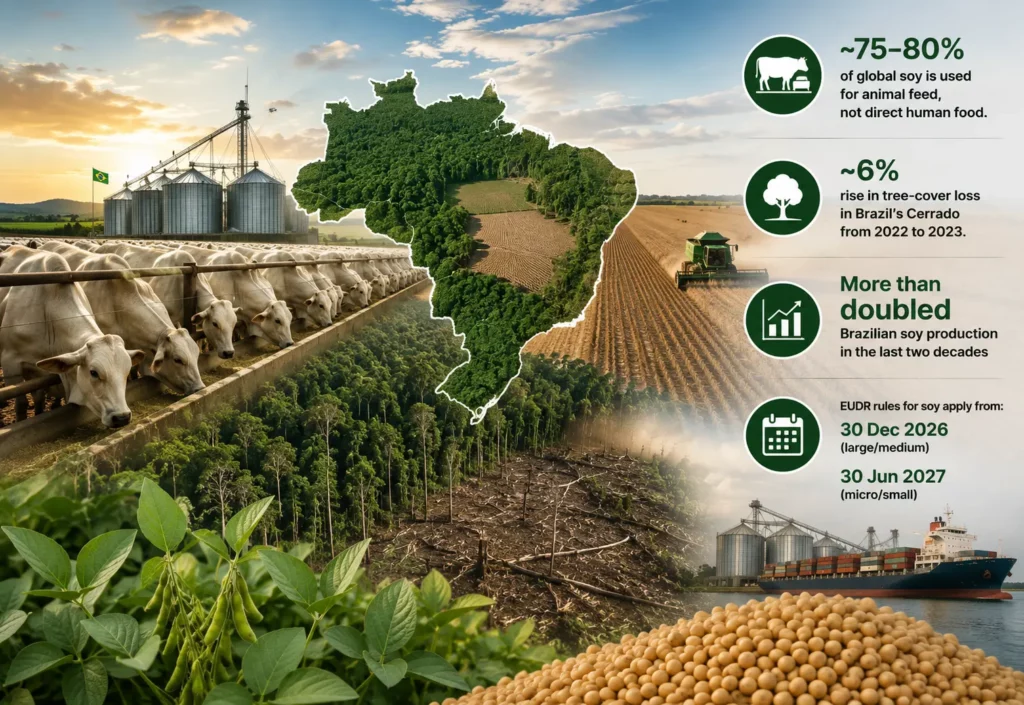
EUDR soy compliance means proving that soy and any soy-derived product placed on the EU market was not grown on land deforested after 31 December 2020, backed by plot-level geolocation, legality checks, and a filed due diligence statement (DDS). It applies from 30 December 2026 for large and medium operators and 30 June 2027 for micro and small ones. Soy is uniquely hard because most of it is invisible: the majority goes to animal feed and derivatives like lecithin and oil, so meat, dairy, egg, and processed-food brands carry EUDR soy exposure without ever buying a soybean directly.
EUDR soy is the compliance challenge most companies underestimate because they are looking in the wrong place. When a business audits its EU Deforestation Regulation exposure, it checks what it buys as a named commodity. But soy rarely arrives with its own label. It arrives as the chicken, the pork, the cheese, the farmed salmon, and the emulsifier in the snack bar. That is why EUDR soy is less a sourcing question than a visibility question.
In plain terms, EUDR soy compliance means proving your soy and soy-derived products are deforestation-free and traceable to the plot where the beans were grown. The rules are the same as for other commodities; what differs is how well soy hides. This guide focuses on that difference.
Key takeaways
EUDR soy requires deforestation-free proof, plot-level geolocation, legality, and a filed DDS from 30 December 2026.
Most soy is embedded: it reaches you as animal feed or as lecithin and oil in processed foods, not as soybeans.
Soy commingles early at crushers and aggregation points, making farm-level traceback harder than for coffee or cocoa.
“Legal” Cerrado soy can still fail EUDR legality and deforestation-free are separate tests, both required.
Simplify EUDR Compliance for Your Soy Supply Chain
From supplier onboarding and plot geolocation verification to deforestation risk assessments and Due Diligence Statement (DDS) preparation, TraceX helps organizations build transparent, audit-ready soy supply chains.
The obligations are concrete. To place soy on the EU market you must show it was not grown on land cleared after 31 December 2020, provide plot-level geolocation, verify legality of production, and file a due diligence statement. These apply from 30 December 2026 for large and medium operators and 30 June 2027 for micro and small ones. Miss them and the shipment is excluded from the EU — not fined, excluded.
Why EUDR Soy Is Different: The Exposure You Cannot See
Here is the reframe. Unlike coffee or cocoa, which mostly reach consumers recognisably, an estimated [75–80%] of the world’s soy is crushed into meal for animal feed feeding the poultry, pork, dairy, and farmed fish that brands actually sell. Much of the rest becomes oil and lecithin woven into processed foods. So a company can have zero “soy” on its purchase orders and still carry heavy deforestation exposure through the beef, dairy, and protein it sources. The first task is therefore not sourcing it is discovery: finding where soy is hiding in your products.
The second difference is structural. Soy is commingled early pooled at crushers and aggregation points before it ever reaches a brand so by the time it is “soybean oil” or “soymeal,” farm-level origin is already blurred. That makes soy traceback harder than for commodities that stay whole longer, and it is why chain-of-custody has to start at the plot, not the port.
The Cerrado Trap: When Legal Soy Still Fails EUDR
Most soy-linked deforestation is now in the Cerrado, the tropical savannah southeast of the Amazon, where soy-driven land conversion has accelerated as production doubled. Here is the trap that catches many operators: under Brazil’s Forest Code, a great deal of Cerrado clearing is entirely legal. But EUDR runs two separate tests legality and deforestation-free and a lot depends on passing both. Legally cleared Cerrado soy grown on land converted after 31 December 2020 is still non-compliant. “We sourced it legally” is not a defence under the regulation.
Certifications such as RTRS or ProTerra help with sustainability and risk mitigation, but the same nuance holds: they do not replace EUDR’s geolocation, plot-level evidence, or DDS obligations, which must be met independently.
Where Your EUDR Soy Risk Hides and What to Do
Mapping exposure by what you actually sell is the fastest way to see the true scope of your exposure:
What you sell
Hidden soy exposure
What EUDR soy requires
Soybeans / meal / oil
Direct
Geolocation + DDS at plot level
Poultry, pork, eggs
Feed (high)
Trace feed soy to origin farms
Dairy, farmed fish
Feed (high)
Trace feed soy to origin farms
Processed foods
Lecithin, oil
Identify soy inputs, verify origin
Cosmetics, biofuel
Soy derivatives
Map derivative back to plot
How TraceX Turns Soy Exposure Into Provable Compliance
The pain is now clear: soy hides in feed and derivatives, commingles early, and carries a legality-versus-deforestation trap. The capability that answers it is an end-to-end EUDR compliance platform that maps soy direct and embedded back to plot-level geolocation, runs satellite deforestation checks against the 2020 cut-off, verifies legality separately, and auto-generates a structured DDS for TRACES. The benefit: EU market access protected, embedded exposure surfaced before it becomes a rejected shipment, and defensible proof rather than certificates alone
Find the soy you didn’t know you had
See how TraceX surfaces embedded soy across your products and proves every gram deforestation-free.
The proof point: a Nigerian commodity trader used TraceX’s AI-powered EUDR platform to strengthen transparency, streamline supplier engagement, and prepare its soy supply chain for the regulation turning compliance into a competitive advantage.
Before your next EU shipment or product launch, confirm you can:
Find embedded soy in feed, lecithin, and oil across every product line, not just soybean SKUs
Capture plot-level GPS geolocation for every soy origin, including feed soy
Prove no deforestation after 31 December 2020 even where clearing was legal
Verify legality as a separate test from deforestation-free status
Maintain chain-of-custody through crushers and aggregation points
Generate and file a structured due diligence statement to TRACES
Frequently Asked Questions
What does EUDR soy compliance require?
Proof that soy and soy-derived products are not grown on land deforested after 31 December 2020, backed by plot-level geolocation, legality verification, and a filed due diligence statement.
Why is soy harder to comply with than coffee or cocoa?
Because most soy is embedded in animal feed and derivatives rather than sold as soybeans, and it commingles early at crushers so exposure is hidden and farm-level traceback is structurally harder.
Does legally sourced Cerrado soy automatically meet EUDR?
No. EUDR applies two separate tests legality and deforestation-free. Legally cleared Cerrado land converted after 31 December 2020 still produces non-compliant soy.
Do RTRS or ProTerra certifications satisfy EUDR for soy?
No. They support sustainability and risk mitigation but do not replace geolocation, plot-level evidence, or the due diligence statement
We use cookies on our website to give you the most relevant experience by remembering your preferences and repeat visits. By clicking “Accept All”, you consent to the use of ALL the cookies. However, you may visit "Cookie Settings" to provide a controlled consent.
This website uses cookies to improve your experience while you navigate through the website. Out of these, the cookies that are categorized as necessary are stored on your browser as they are essential for the working of basic functionalities of the website. We also use third-party cookies that help us analyze and understand how you use this website. These cookies will be stored in your browser only with your consent. You also have the option to opt-out of these cookies. But opting out of some of these cookies may affect your browsing experience.
Necessary cookies are absolutely essential for the website to function properly. These cookies ensure basic functionalities and security features of the website, anonymously.
Cookie
Duration
Description
cookielawinfo-checkbox-analytics
11 months
This cookie is set by GDPR Cookie Consent plugin. The cookie is used to store the user consent for the cookies in the category "Analytics".
cookielawinfo-checkbox-functional
11 months
The cookie is set by GDPR cookie consent to record the user consent for the cookies in the category "Functional".
cookielawinfo-checkbox-necessary
11 months
This cookie is set by GDPR Cookie Consent plugin. The cookies is used to store the user consent for the cookies in the category "Necessary".
cookielawinfo-checkbox-others
11 months
This cookie is set by GDPR Cookie Consent plugin. The cookie is used to store the user consent for the cookies in the category "Other.
cookielawinfo-checkbox-performance
11 months
This cookie is set by GDPR Cookie Consent plugin. The cookie is used to store the user consent for the cookies in the category "Performance".
viewed_cookie_policy
11 months
The cookie is set by the GDPR Cookie Consent plugin and is used to store whether or not user has consented to the use of cookies. It does not store any personal data.
Functional cookies help to perform certain functionalities like sharing the content of the website on social media platforms, collect feedbacks, and other third-party features.
Performance cookies are used to understand and analyze the key performance indexes of the website which helps in delivering a better user experience for the visitors.
Analytical cookies are used to understand how visitors interact with the website. These cookies help provide information on metrics the number of visitors, bounce rate, traffic source, etc.
Advertisement cookies are used to provide visitors with relevant ads and marketing campaigns. These cookies track visitors across websites and collect information to provide customized ads.
Download the 2026 Traceability Scorecard and Benchmark Your Supply Chain Across 10 Critical Capabilities.
Download our eBook
Don’t Wait for an Audit to Find Your EUDR Gaps
The 2026 Simplification Package changes how HS codes, DDS pass-through and geolocation rules apply to you. Get the free guide and 20-point readiness checklist before enforcement catches you unprepared.