Causes of Deforestation: The Global Drivers and the One Your Business Actually Controls
Published
, 6 minute read
Share this article
Quick summary: Causes of deforestation explained — agriculture, logging, infrastructure, and mining — plus the one cause your business controls: untraceable sourcing under EUDR.
The main causes of deforestation are agricultural expansion (the dominant driver), logging, infrastructure and urban development, and mining nearly all driven by global demand for food, resources, and land. Agriculture alone accounts for the majority of tropical forest loss. But there is a business dimension the usual list misses: a meaningful share of deforestation is embedded in traded commodities beef, soy, palm oil, cocoa, coffee, timber, and rubber so companies sourcing them carry deforestation on their books. Under the EU Deforestation Regulation (EUDR), the cause a business can actually act on is its own untraceable sourcing.
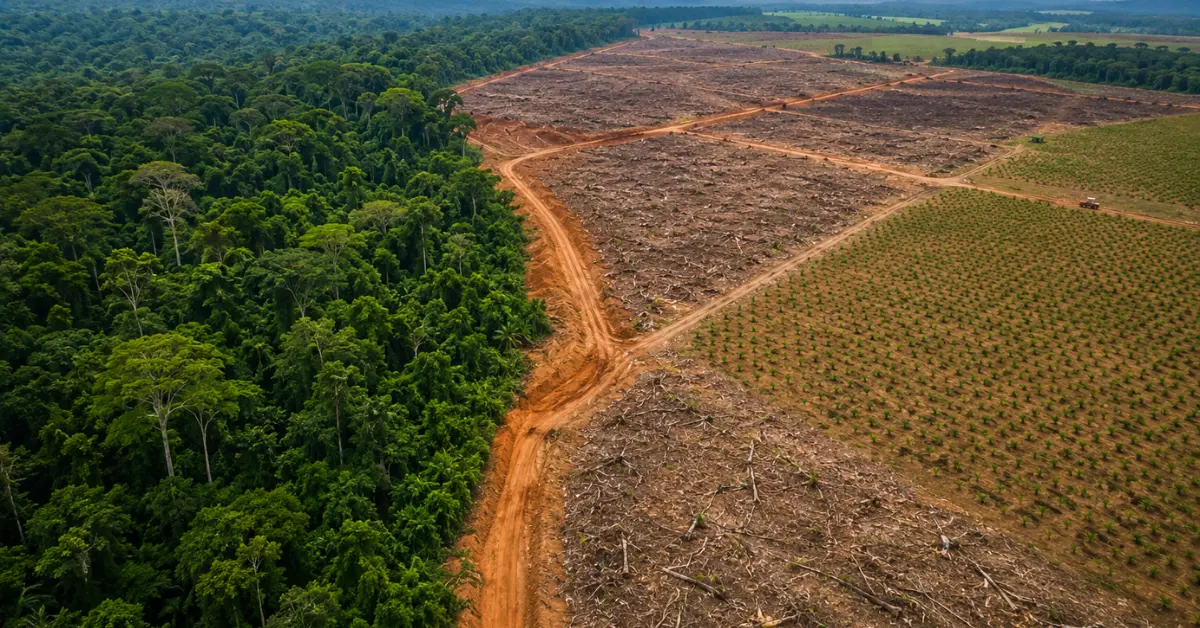
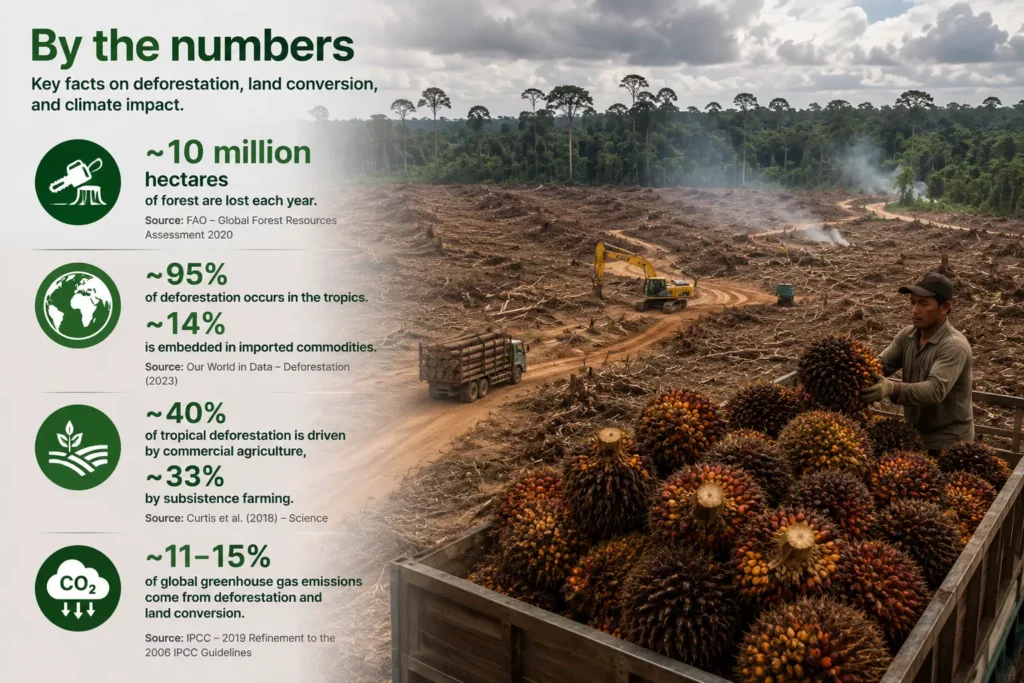
The causes of deforestation are usually told as a story about faraway places chainsaws in the Amazon, fires in Southeast Asia, someone else’s problem. Forests are disappearing fast: roughly 10 million hectares are lost each year, releasing stored carbon, erasing biodiversity, and undermining the livelihoods of millions. But that framing hides the part that matters most to any business that buys agricultural goods because a slice of that loss is sitting inside its own supply chain.
In plain terms, the causes of deforestation are the human activities that clear or degrade forests chiefly agriculture, logging, infrastructure, and mining. Understanding them is step one. Step two, the one this guide is really about, is recognising which of those causes a company can actually do something about.
Key takeaways
The proximate causes of deforestation are agricultural expansion, logging, infrastructure/urbanisation, and mining with agriculture the single largest driver.
The systemic driver behind them is demand: forest loss is embedded in everyday traded commodities.
For sourcing businesses, that embedded deforestation is now a legal and financial risk under EUDR, not a distant externality
The one cause a company can directly control is supply-chain invisibility which traceability and geolocation eliminate.
Build a Deforestation-Free Supply Chain with Confidence
Understanding the causes of deforestation is only the first step. TraceX helps organizations map sourcing regions, verify farm geolocations, monitor forest risks, and automate due diligence to create transparent, deforestation-free supply chains.
Four activities do most of the clearing, and they rarely act alone:
Agricultural expansion (the dominant cause): Clearing land for crops and cattle is the single largest driver large-scale commercial agriculture accounts for an estimated [40%] of tropical deforestation and local subsistence farming for another [33%]. Soy, palm oil, cattle pasture, cocoa, and coffee lead the way.
Logging: Legal and illegal logging for timber and paper removes forest directly and opens roads that trigger further clearing.
Infrastructure and urban development: Roads, settlements, dams, and industrial projects fragment forests and unlock previously inaccessible land.
Mining: Extraction strips forest at the site and, through the access roads it requires, drives secondary deforestation well beyond it.
Beyond the Obvious Causes of Deforestation: The Demand No One Names
Here is the reframe. Each proximate cause above is really a symptom of one systemic force: demand. According to Our World in Data, around 95% of deforestation occurs in the tropics, and an estimated 14% is driven by consumers in distant markets importing beef, vegetable oils, cocoa, coffee, and paper grown on cleared land. In other words, a large share of forest loss is embedded deforestation baked into commodities that cross borders and end up in products, portfolios, and balance sheets far from the forest edge.
That changes who the causes of deforestation belong to. If your business sources beef, soy, palm oil, cocoa, coffee, timber, or rubber, a portion of global deforestation is, in accounting terms, yours whether or not you can see it.
Why the Causes of Deforestation Are Now a Business Liability
Governments have shifted deforestation from a voluntary concern to binding law. The EU Deforestation Regulation (EUDR) requires companies placing beef, soy, palm oil, cocoa, coffee, wood, or rubber on the EU market to prove the goods are not linked to land cleared after 31 December 2020 with plot-level geolocation, legality checks, and a filed due diligence statement. It applies from 30 December 2026 for large and medium operators and 30 June 2027 for micro and small ones. Non-compliance means market exclusion, not a modest fine, and the reputational and financing consequences compound quickly.
So the causes of deforestation are no longer only an environmental question. For a sourcing business they are a regulatory, financial, and reputational one and the exposure is proportional to how little you can see of your own supply chain.
The One Cause of Deforestation You Can Actually Control
You cannot personally stop a rancher in another hemisphere. But you can eliminate the condition that lets embedded deforestation hide: invisibility. The pain is that commodities enter fragmented, smallholder-heavy supply chains with no verifiable origin, so cleared-land product gets laundered into compliant-looking goods. The capability that answers it is an end-to-end EUDR compliance platform that captures farm geolocation, runs satellite deforestation checks, verifies legality, and auto-generates a due diligence statement. The benefit: deforestation-free sourcing you can prove, market access protected, and risk removed from the balance sheet.
Take the one cause you can control off your balance sheet
See how TraceX makes embedded deforestation visible and provable across your supply chain.
The proof point: a Nigerian trading firm sourcing cocoa and cashew used TraceX’s EUDR platform to eliminate data-collection errors from farmers and agents, achieve end-to-end traceability, and safeguard EU compliance.
Causes of Deforestation: Who Gets Blamed vs. What a Business Can Do
Cause
Usually blamed on
What a sourcing business can do
Agricultural expansion
Farmers, ranchers
Map plots, verify no clearing after 2020
Logging
Timber operators
Prove legality; trace wood/paper origin
Infrastructure
Governments
Screen sourcing regions for risk
Mining
Extractive industry
Assess supplier proximity to hotspots
Embedded demand
“Someone else”
Trace your own commodities end to end
Deforestation-Risk Checklist for Sourcing Businesses
Whatever commodities you buy, confirm you can:
Identify which of your commodities carry deforestation risk (beef, soy, palm, cocoa, coffee, wood, rubber)
Capture plot-level GPS geolocation for every sourcing origin
Prove no deforestation on that land after 31 December 2020
Run satellite monitoring to flag risk before it reaches you
Generate and file a due diligence statement for EUDR
Treat certifications as a complement to not a substitute for geolocation and DDS
Frequently Asked Questions
What is the single biggest cause of deforestation?
Agricultural expansion. Clearing land for crops and cattle commercial and subsistence combined accounts for the majority of tropical forest loss, far ahead of logging, infrastructure, or mining.
How do the causes of deforestation affect businesses?
A share of deforestation is embedded in traded commodities like beef, soy, palm oil, cocoa, coffee, and timber. Companies sourcing them carry that exposure and under EUDR it becomes a legal and financial liability, not just an environmental concern.
How does EUDR change the causes of deforestation for companies?
From 30 December 2026, regulated commodities sold into the EU must be proven deforestation-free with geolocation and a due diligence statement. This makes untraceable sourcing the cause a business controls a direct market-access risk.
What can a business actually do about the causes of deforestation?
Make its supply chain visible: map sourcing plots, run satellite monitoring, verify legality, and prove deforestation-free origin turning an invisible externality into managed, reportable data.
We use cookies on our website to give you the most relevant experience by remembering your preferences and repeat visits. By clicking “Accept All”, you consent to the use of ALL the cookies. However, you may visit "Cookie Settings" to provide a controlled consent.
This website uses cookies to improve your experience while you navigate through the website. Out of these, the cookies that are categorized as necessary are stored on your browser as they are essential for the working of basic functionalities of the website. We also use third-party cookies that help us analyze and understand how you use this website. These cookies will be stored in your browser only with your consent. You also have the option to opt-out of these cookies. But opting out of some of these cookies may affect your browsing experience.
Necessary cookies are absolutely essential for the website to function properly. These cookies ensure basic functionalities and security features of the website, anonymously.
Cookie
Duration
Description
cookielawinfo-checkbox-analytics
11 months
This cookie is set by GDPR Cookie Consent plugin. The cookie is used to store the user consent for the cookies in the category "Analytics".
cookielawinfo-checkbox-functional
11 months
The cookie is set by GDPR cookie consent to record the user consent for the cookies in the category "Functional".
cookielawinfo-checkbox-necessary
11 months
This cookie is set by GDPR Cookie Consent plugin. The cookies is used to store the user consent for the cookies in the category "Necessary".
cookielawinfo-checkbox-others
11 months
This cookie is set by GDPR Cookie Consent plugin. The cookie is used to store the user consent for the cookies in the category "Other.
cookielawinfo-checkbox-performance
11 months
This cookie is set by GDPR Cookie Consent plugin. The cookie is used to store the user consent for the cookies in the category "Performance".
viewed_cookie_policy
11 months
The cookie is set by the GDPR Cookie Consent plugin and is used to store whether or not user has consented to the use of cookies. It does not store any personal data.
Functional cookies help to perform certain functionalities like sharing the content of the website on social media platforms, collect feedbacks, and other third-party features.
Performance cookies are used to understand and analyze the key performance indexes of the website which helps in delivering a better user experience for the visitors.
Analytical cookies are used to understand how visitors interact with the website. These cookies help provide information on metrics the number of visitors, bounce rate, traffic source, etc.
Advertisement cookies are used to provide visitors with relevant ads and marketing campaigns. These cookies track visitors across websites and collect information to provide customized ads.
Download the 2026 Traceability Scorecard and Benchmark Your Supply Chain Across 10 Critical Capabilities.
Download our eBook
Don’t Wait for an Audit to Find Your EUDR Gaps
The 2026 Simplification Package changes how HS codes, DDS pass-through and geolocation rules apply to you. Get the free guide and 20-point readiness checklist before enforcement catches you unprepared.