EUDR Packaging Requirements: What’s in Scope and How to Prove It
Published
, 9 minute read
Share this article
Quick summary: EUDR packaging requirements explained: see which wood and paper packaging is in scope after the July 2026 Delegated Act, and how to prove compliance.
EUDR packaging requirements hinge on one question: is your packaging a product in its own right, or is it used only to carry, protect or support another product? Under the Delegated Act adopted on 13 July 2026, packaging of any material, single-use or reusable used solely to transport or protect goods is out of scope. Wood- or paper-based packaging sold as a product still needs a full Due Diligence Statement with geolocation and deforestation-free proof before it enters the EU market.
EUDR packaging requirements are the due diligence obligations under Regulation (EU) 2023/1115 that decide whether wood- and paper-based packaging can legally be placed on the EU market. For packaging manufacturers, importers and procurement teams, the hard part is rarely the paperwork itself it is working out whether EUDR packaging requirements apply to your specific format at all. A Delegated Act adopted on 13 July 2026 sharpened that line considerably, and getting it wrong in either direction is costly: unnecessary due diligence on exempt packaging, or a blocked shipment on packaging you wrongly assumed was outside the rules.
KEY TAKEAWAYS
EUDR packaging requirements apply to wood- and paper-based packaging placed on the EU market as a product in its own right not to packaging used only to carry, protect or support another good.
The 13 July 2026 Delegated Act (adopted, pending Official Journal publication) formally clarifies this carrier-packaging exemption. Treat it as provisional until it enters into force.
Application: 30 December 2026 (large/medium operators and traders), 30 June 2027 (micro/small); newly-added products 30 December 2027. Deforestation cut-off: 31 December 2020.
Packaging made entirely from recovered/recycled waste falls outside traceability-to-origin obligations; virgin wood fibre does not.
FSC, PEFC and similar certifications support risk mitigation but do not replace geolocation, plot-level evidence, or the Due Diligence Statement.
See how TraceX can help you digitise traceability, streamline compliance workflows and connect critical supply-chain data in one platform.
EUDR packaging requirements flow from wood being one of seven regulated commodities. Here is who is affected and why.
Seven commodities are regulated: cattle, cocoa, coffee, oil palm, rubber, soya and wood.
Paper, paperboard and corrugated board are wood-derived, so they sit inside the wood commodity chain (CN chapters 44, 47 and 48).
The trigger is placing an in-scope wood product on the EU market not whether you call yourself a “forestry” business.
Because paper and board are derived from wood pulp, packaging built on virgin wood fibre falls squarely inside the wood commodity chain. That is why EUDR packaging requirements reach so many businesses that never considered themselves forestry operators. A corrugated-box manufacturer that produces and sells boxes as its own finished product is placing a wood-derived product on the market and must meet the full EUDR packaging requirements, including a valid Due Diligence Statement (DDS) submitted before the goods are sold.
When EUDR packaging requirements apply and when they don’t
The scope line is one distinction: packaging as a product vs packaging as a carrier.
In scope: wood/paper packaging sold as a product in its own right (e.g. a box or pallet manufacturer).
Out of scope: packaging any material, single-use or reusable used only to carry, protect or support another product.
Also out: packaging made entirely from recovered/recycled waste; printed books and newspapers (removed by Reg (EU) 2025/2650).
The Delegated Act adopted on 13 July 2026 confirms that packaging used exclusively to transport or protect another good is outside scope, regardless of material. It is adopted but not yet in force it passes to the European Parliament and Council for scrutiny before publication in the Official Journal, so treat it as provisional. Two examples make the split concrete. A coffee roaster’s kraft bag that holds roasted beans is a carrier: the bag itself is likely out of scope, even though the coffee inside stays fully regulated. But a company that manufactures and sells those kraft bags as its product must satisfy EUDR packaging requirements for the bags.
Timing matters as much as scope. EUDR packaging requirements apply from 30 December 2026 for large and medium operators and traders, and from 30 June 2027 for micro and small operators; products newly added to Annex I get until 30 December 2027. The deforestation cut-off is 31 December 2020 relevant wood harvested from land deforested after that date cannot be placed on the market, no matter how good the paperwork looks.
EUDR delegated acts can introduce important details on implementation, due diligence, traceability and compliance requirements. Stay ahead by understanding what the latest and upcoming delegated acts could mean for your supply chain.
How to meet EUDR packaging requirements: the evidence you need
Where the rules apply, a defensible Due Diligence Statement rests on three pillars.
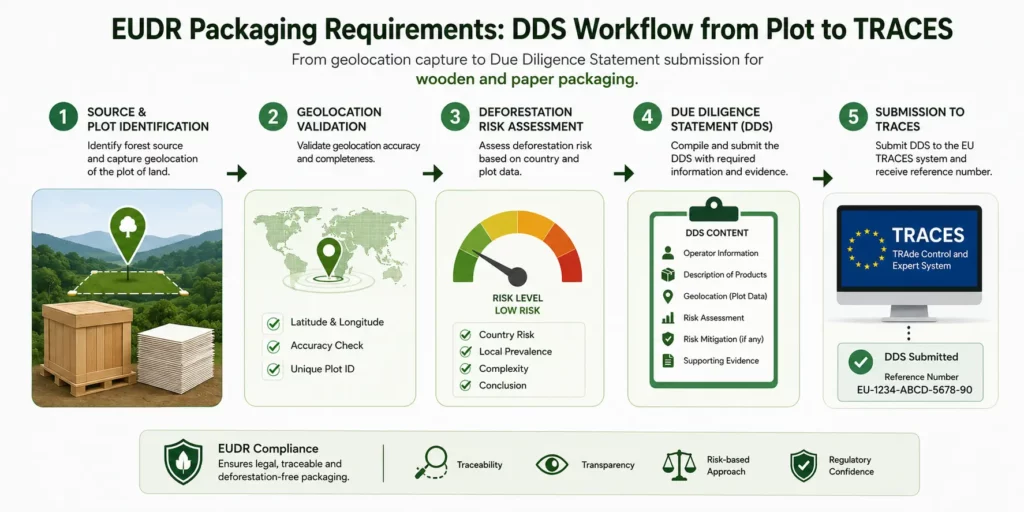
Geolocation: coordinates for every plot where the wood was harvested (polygons above 4 ha).
Deforestation-free proof: verifiable evidence against the 31 December 2020 cut-off.
Risk assessment: documented assessment and mitigation where risk is non-negligible, filed via the EU TRACES-based Information System.
FSC, PEFC and similar certifications strengthen your risk mitigation, but they do not replace the geolocation, plot-level evidence or the DDS that EUDR packaging requirements demand. A furniture importer bringing goods packed in wooden crates, for example, needs plot-level data on any crate it places on the market as a product a certificate or a compliant-looking label alone will not clear customs. This is where manual compliance quietly falls apart, and where a purpose-built platform earns its place.
EUDR compliance requires more than collecting supplier information. Businesses need to collect traceability data, verify geolocation, assess deforestation and legality risks, and maintain evidence before placing relevant products on the EU market.
Most teams discover their real EUDR exposure only when a customer asks for a DDS reference number. The fix is to map every SKU to its HS/CN code first, then attach supplier geodata to the codes that are actually in scope so scope changes become a filter, not a fire drill.
TraceX EUDR Solutions is built to capture plot-level geolocation, run deforestation risk checks against the 2020 cut-off, and generate TRACES-ready Due Diligence Statements for in-scope wood- and paper-based packaging.
For companies managing EUDR-regulated commodities through packaged products, TraceX EUDR Solutions helps connect packaging and product records with suppliers, farm-level geolocation, batches, chain-of-custody data and compliance evidence. The platform enables businesses to collect and validate supplier and plot information, assess deforestation and legality risks, maintain traceability through processing and distribution, and organise the data needed for Due Diligence Statements. This creates a connected digital record from commodity origin → farm plot → supplier → batch → packaged product → DDS, helping businesses improve EUDR visibility, reduce manual data reconciliation and maintain stronger audit-ready compliance records.
See how TraceX maps your packaging SKUs to HS codes, captures plot-level geolocation and generates TRACES-ready Due Diligence Statements.
EUDR packaging requirements: manual tracking vs a traceability platform
Spreadsheets hold until Annex I moves and it has already changed twice before the regulation even applies.
Meeting EUDR packaging requirements by spreadsheet breaks down the moment supplier lists, geolocation files and Annex I mappings start to shift. A purpose-built platform keeps product-to-HS-code mapping, supplier geodata and DDS generation in one auditable place, so a scope change becomes a filtered view instead of a from-scratch re-run.
Task
Manual / spreadsheet
TraceX platform
Scope mapping
SKUs matched to HS codes by hand; re-done on every Annex I change
Coordinates collected over email, stored in loose files
Plot-level geodata captured and validated in one system
Deforestation risk
Manual cross-check against cut-off date
Automated risk check against 31 Dec 2020 cut-off
DDS generation
Built manually, high error rate, hard to audit
TRACES-ready DDS generated with an audit trail
Supplier follow-up
Chased ad hoc; gaps found late
Supplier data requests tracked to completion
Read your packaging line by line against the amended Annex I now. The businesses that treat EUDR packaging requirements as a supplier-data problem not a last-minute customs problem are the ones that keep shipping through 2027 and beyond.
Buyer’s checklist: evaluating EUDR compliance software for packaging
Use this when comparing platforms. A tool that cannot do these is not solving the packaging problem.
☐Maps every SKU to its HS/CN code and flags which packaging is actually in scope.
☐Captures and validates plot-level geolocation (polygons for plots above 4 ha).
☐Runs deforestation risk checks against the 31 December 2020 cut-off.
☐Generates TRACES-ready Due Diligence Statements with reference and verification numbers.
☐Handles Annex I changes without re-doing the whole scoping exercise.
☐Tracks supplier data requests to completion and surfaces gaps early.
☐Keeps a defensible audit trail for competent-authority checks.
Frequently Asked Questions
Does EUDR apply to all packaging?
No. Packaging used only to carry, protect or support another product is out of scope under the 13 July 2026 Delegated Act regardless of material. EUDR packaging requirements apply where wood- or paper-based packaging is placed on the market as a product in its own right, such as boxes or pallets sold by a packaging manufacturer.
Is my wooden pallet in scope?
A pallet used only to move another product is a carrier and is out of scope. A pallet manufacturer selling pallets as its product is placing an in-scope wood product on the market and must meet EUDR packaging requirements, including a Due Diligence Statement.
What about recycled cardboard packaging?
Packaging made entirely from recovered or recycled waste is exempt from tracing fibre back to origin. If it contains any virgin wood fibre, that virgin content is in scope and must be covered by due diligence.
Is FSC certification enough for EUDR?
No. FSC and PEFC support risk mitigation but do not replace geolocation, plot-level evidence or the DDS. Certification alone will not satisfy EUDR packaging requirements or clear a shipment.
When do EUDR packaging requirements start?
30 December 2026 for large and medium operators and traders (and micro/small already under the EU Timber Regulation), and 30 June 2027 for other micro and small operators. Products newly added to Annex I apply from 30 December 2027.
Is the July 2026 Delegated Act final?
It was adopted on 13 July 2026 but is not yet in force. It goes to the European Parliament and Council for scrutiny before Official Journal publication. Prepare on the adopted text, but treat the packaging clarification as provisional.
What evidence do I need for an in-scope packaging DDS?
Geolocation coordinates for every harvest plot, verifiable deforestation-free proof against the 31 December 2020 cut-off, and a documented risk assessment all submitted through the EU TRACES-based Information System before the goods enter the market.
Start using TraceX
Transparency, Trust, & Success for your Climate Journey.
We use cookies on our website to give you the most relevant experience by remembering your preferences and repeat visits. By clicking “Accept All”, you consent to the use of ALL the cookies. However, you may visit "Cookie Settings" to provide a controlled consent.
This website uses cookies to improve your experience while you navigate through the website. Out of these, the cookies that are categorized as necessary are stored on your browser as they are essential for the working of basic functionalities of the website. We also use third-party cookies that help us analyze and understand how you use this website. These cookies will be stored in your browser only with your consent. You also have the option to opt-out of these cookies. But opting out of some of these cookies may affect your browsing experience.
Necessary cookies are absolutely essential for the website to function properly. These cookies ensure basic functionalities and security features of the website, anonymously.
Cookie
Duration
Description
cookielawinfo-checkbox-analytics
11 months
This cookie is set by GDPR Cookie Consent plugin. The cookie is used to store the user consent for the cookies in the category "Analytics".
cookielawinfo-checkbox-functional
11 months
The cookie is set by GDPR cookie consent to record the user consent for the cookies in the category "Functional".
cookielawinfo-checkbox-necessary
11 months
This cookie is set by GDPR Cookie Consent plugin. The cookies is used to store the user consent for the cookies in the category "Necessary".
cookielawinfo-checkbox-others
11 months
This cookie is set by GDPR Cookie Consent plugin. The cookie is used to store the user consent for the cookies in the category "Other.
cookielawinfo-checkbox-performance
11 months
This cookie is set by GDPR Cookie Consent plugin. The cookie is used to store the user consent for the cookies in the category "Performance".
viewed_cookie_policy
11 months
The cookie is set by the GDPR Cookie Consent plugin and is used to store whether or not user has consented to the use of cookies. It does not store any personal data.
Functional cookies help to perform certain functionalities like sharing the content of the website on social media platforms, collect feedbacks, and other third-party features.
Performance cookies are used to understand and analyze the key performance indexes of the website which helps in delivering a better user experience for the visitors.
Analytical cookies are used to understand how visitors interact with the website. These cookies help provide information on metrics the number of visitors, bounce rate, traffic source, etc.
Advertisement cookies are used to provide visitors with relevant ads and marketing campaigns. These cookies track visitors across websites and collect information to provide customized ads.
Download the 2026 Traceability Scorecard and Benchmark Your Supply Chain Across 10 Critical Capabilities.
Download our eBook
Don’t Wait for an Audit to Find Your EUDR Gaps
The 2026 Simplification Package changes how HS codes, DDS pass-through and geolocation rules apply to you. Get the free guide and 20-point readiness checklist before enforcement catches you unprepared.