Information Collection Requirements for the Australian Illegal Logging Prohibition Act (ILPA)
Published
, 16 minute read
Share this article
Quick summary: Understand the information collection requirements of the Australian Illegal Logging Prohibition Act (ILPA), including supplier data, risk assessment, and due diligence.
What Timber Importers & Processors Must Collect, Verify, and Report
Here’s a question compliance teams across Australia’s timber industry are grappling with right now: if an audit lands on your desk tomorrow, could you produce the full set of ILPA-required documentation for every regulated timber product you imported in the last five years? If the answer involves spreadsheets, email inboxes, and a nervous call to your logistics team, you’re not alone, but you’re also not protected. ILPA’s information collection requirements are detailed, supplier-dependent, and spread across your entire upstream supply chain. Getting them wrong means enforcement action. Getting them right requires a system.
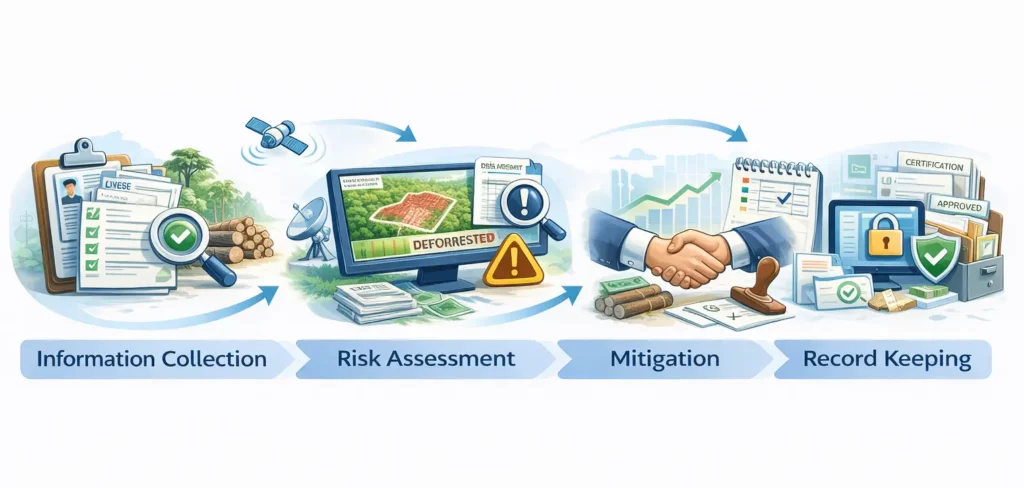
Under the Australian Illegal Logging Prohibition Act 2012 and its Regulations, importers of regulated timber products and processors of raw logs must collect a defined set of information spanning harvest origin, species identity, legal authorization, supplier identity, and chain of custody before importing or processing. This due diligence system requires you to not just gather documents but assess legality risk and store records for a minimum of five years. Non-compliance carries penalties of up to AUD $222,000 for corporations.
This guide breaks down exactly what information you must collect, from which points in your supply chain, with what level of verification and what best-practice documentation looks like under Australian Department of Agriculture scrutiny.
Key Takeaways
ILPA requires importers and domestic processors to conduct due diligence – collecting specific supplier, harvest, and legality documentation – before placing timber products on the Australian market.
The information requirements span 11+ data categories, from harvest location coordinates to species-level legality documentation, and must be stored for 5 years.
Manual data collection leaves companies exposed to audit risk; platforms like TraceX automate the collection, verification, and storage of ILPA-required documentation across complex, multi-tier supply chains.
Want a complete breakdown of global illegal logging laws?
Download our free eBook on Illegal Logging Regulations to understand how major frameworks like EUDR, EUTR, and ILPA impact timber and forest-risk supply chains.
Why ILPA Compliance Is a Data Problem, Not Just a Legal One
AUD $222KMax corporate penalty per violation under ILPA Regulations
5 YearsMinimum record retention for all due diligence documentation
137+Regulated product codes spanning timber, paper, furniture & more
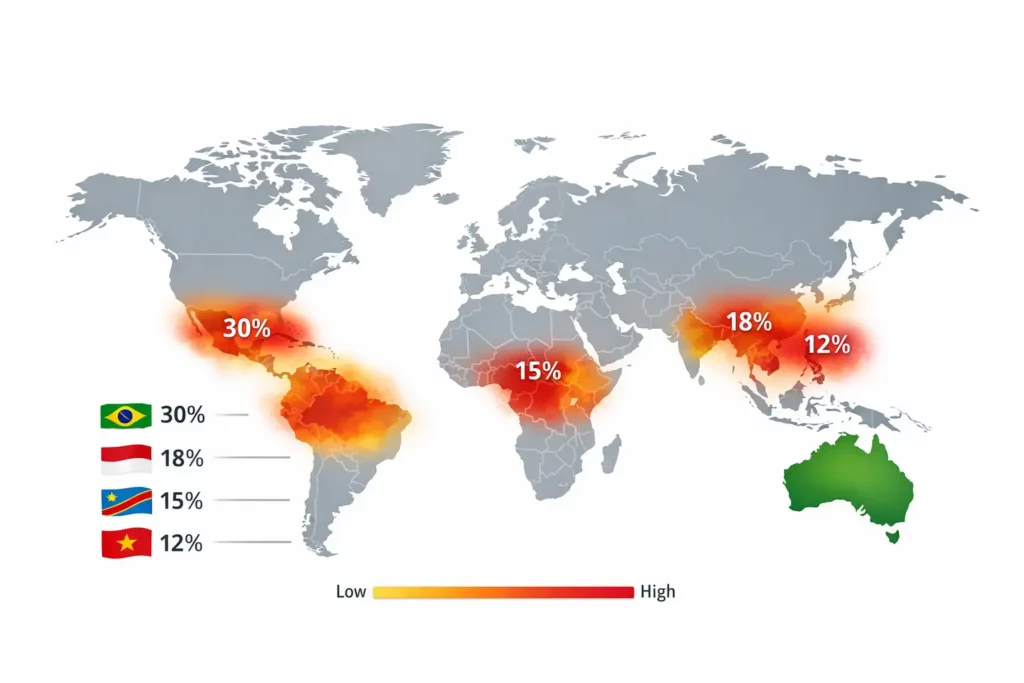
~15%Global timber illegally logged World Bank / UNODC estimates
ILPA was enacted to ensure Australian importers and processors don’t inadvertently fund illegal deforestation. But the law’s teeth are in the detail. It doesn’t just prohibit the import of illegally logged timber it requires you to prove you took reasonable steps to determine legality. That proof is an information collection and assessment exercise.
The Department of Agriculture enforces ILPA through a risk-based compliance program. Auditors will ask: What information did you collect? From whom? How did you assess the legality risk? What did you do when the picture wasn’t clear? Without documented, verifiable answers, you’re exposed even if the timber itself was legally sourced.
ILPA compliance is not a checkbox exercise; it’s a risk-calibrated information management process. The Regulations require your due diligence system to be proportionate to the level of risk your supply chain carries. Low-risk, certified suppliers require less documentation depth. High-risk origins (based on FAO governance data, Transparency International CPI scores, and species-specific export restrictions) demand greater verification rigour. This means your information collection system must be dynamic, not a static form.
Explore our complete guide to the Australian Illegal Logging Prohibition Act and learn what it means for timber importers and processors. Read the Complete ILPA Guide
Who Must Comply? Importers vs. Domestic Processors
ILPA creates two distinct compliance obligations one for importers, one for domestic processors of Australian raw logs. The information collection requirements differ between them.
Obligation Type
Who It Applies To
Trigger Point
Core Requirement
Importer Due Diligence
Any entity importing a regulated timber product into Australia
Check HS code against Schedule 1 of the Regulations
Exemptions
Products with <5% regulated timber content; recycled wood with no new material
Must document exemption basis
Keep records proving exemption criteria are met
The critical distinction: importers must act before the goods cross Australian customs. Domestic processors must act before processing begins. In both cases, the due diligence system must be documented and reproducible – auditors will assess your system, not just individual shipments.
Many importers assume that sourcing from a country with an existing Bilateral Agreement (e.g., Indonesia under the FLEGT framework) automatically satisfies illegal logging prohibition act (ILPA) requirements. It doesn’t; while such agreements evidence lower risk, they don’t eliminate the information-collection obligation. You still need to collect the core data set; you simply have a stronger basis for concluding legality.
What Information Must You Collect? The 11-Category Framework
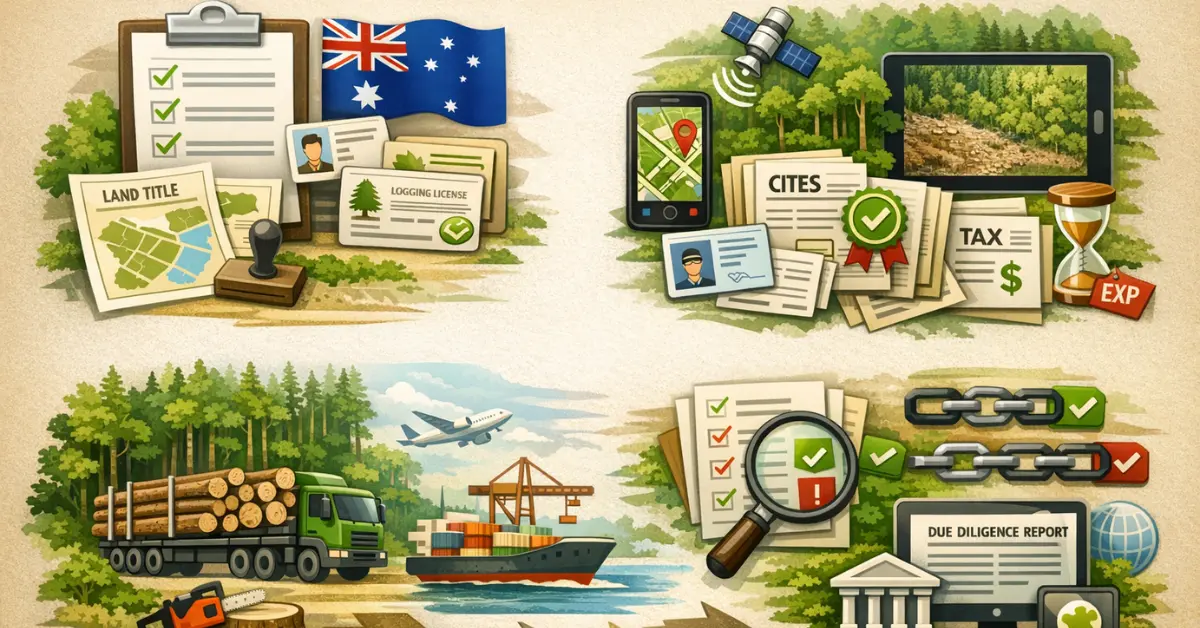
The Australian Illegal Logging Prohibition Regulation 2012 specifies the information a due diligence system must include. We’ve organized it into 11 operational categories to make implementation practical.
Regulators review your system against these categories. Missing even one can trigger a ‘system deficiency’ finding, which escalates the enforcement response.
Category 1: Product Description
You must be able to describe the regulated timber product precisely, covering trade name, common name, and scientific species name. This is not optional. illegal logging prohibition act (ILPA) requires species-level identification because the legality of harvest often depends on whether a specific species is protected under the source country’s laws, CITES listings, or regional forestry regulations.
Trade name and common name of the product
Scientific name (genus and species) of all timber species present
Description of the product form (solid wood, veneer, plywood, paper, etc.)
HS (Harmonized System) tariff code confirming it is a regulated product
Category 2: Country of Harvest
The country where the timber was harvested not processed, not exported from, is foundational to legality risk assessment. In complex supply chains involving re-processing through third countries, you must trace back to the point of original harvest.
Country of harvest (ISO country code acceptable)
Sub-national region or state of harvest (where available and relevant to legality)
Coordinates or geographic identifiers for the harvest area (increasingly expected for high-risk origins)
Category 3: Supplier Identity and Contact Details
You must document who supplied the timber product to you, the direct supplier as well as maintain information enabling you to trace back through the supply chain where necessary.
Full legal name and trading name of the immediate supplier
Business address and country of registration
Contact details (email, phone) for the responsible person
Business registration or tax ID number (where available)
Category 4: Volume and Quantity
Quantification enables traceability and acts as a cross-reference against shipping documentation. Discrepancies between declared and actual volumes are a red flag for illegal substitution.
Volume in cubic metres or weight in tonnes (as applicable to the product type)
Quantity of units (for processed products like furniture or flooring)
Consistency check: volume declared must align with Bill of Lading and customs entry
Category 5: Legal Authorization for Harvest
This is the heart of illegal logging prohibition act (ILPA) due diligence. You must collect documentation that establishes the timber was legally harvested under the laws of the country of harvest. Relevant documents vary by jurisdiction but commonly include:
Timber concession or harvesting licence issued by the competent authority
Forest management plan or approved harvest permit
CITES export permits (for CITES-listed species)
FLEGT licence (where source country has an operational VPA with the EU – relevant for Indonesia)
PEFC or FSC chain of custody certificate (reduces risk but doesn’t eliminate collection requirement)
Don’t just collect the document – verify it. illegal logging prohibition act (ILPA) due diligence standard expects you to take ‘reasonable steps’ to confirm that licences and permits are genuine and currently valid. This means cross-referencing against the issuing authority’s online register where available, and flagging documents that cannot be independently verified for enhanced scrutiny.
Category 6: Chain of Custody Documentation
For timber that has passed through multiple processing or export stages, you need documentation that maintains an auditable link from forest to your facility.
Transaction records (commercial invoices, purchase orders) at each stage
Transport documentation (Bill of Lading, airway bill, CMR waybill) covering each leg
Packing lists with species and volume consistent with harvest documentation
Third-party inspection or verification reports (SGS, Bureau Veritas, Intertek)
Phytosanitary certificates and Australian biosecurity import permits
Category 7: Exporter Information
The exporter (who may differ from the harvester or first processor) must also be identified, particularly where there’s a risk of mixing legally and illegally sourced timber in the export country.
Full legal name and trading address of the exporter
Export licence number (where the source country requires export licensing)
Country of export (which may differ from country of harvest – important for re-processed goods)
Category 8: Source Country Legal Framework Assessment
Your due diligence system must demonstrate that you’ve assessed the legal framework governing timber harvesting in the source country. This is the risk-assessment backbone of illegal logging prohibition act (ILPA) compliance.
Summary of source country’s forestry legislation and enforcement capacity
Assessment tools used: FAO Forest Resources Assessment, Transparency International CPI, Forest Governance Index
Documentation of any bilateral agreements or recognized certification schemes applicable
Assessment of species-specific export restrictions under source country law
Category 9: Risk Assessment Record
Having collected the information above, you must formally assess and document the risk that the timber was illegally logged. This assessment must be proportionate to the risk identified.
Basis for risk rating – which information points drove the assessment
Any risk mitigation measures applied (enhanced verification, third-party audit, hold on import pending resolution)
Sign-off by responsible compliance officer with date
Category 10: Certification and Third-Party Verification
Certification doesn’t replace illegal logging prohibition act (ILPA) information collection but it does significantly reduce the depth of verification required and strengthens your risk assessment.
FSC (Forest Stewardship Council) certificate number and validity date
PEFC certificate number and chain of custody coverage
SFI (Sustainable Forestry Initiative) certification where applicable
Third-party audit or verification report (particularly important for high-risk origins without recognised certification)
Category 11: Record Retention Metadata
Finally, illegal logging prohibition act (ILPA) requires that your due diligence records be retained for a minimum of five years and be produced on request during an inspection. Your records must be accessible, organized, and retrievable.
Date due diligence was conducted for each shipment
Name of the person who conducted the due diligence
Date of import (or processing)
Unique shipment or batch reference number enabling linkage to all supporting documents
Storage location or system reference for all collected documentation
Automating illegal logging prohibition act (ILPA) Information Collection?
TraceX helps timber importers collect, verify, and store all 11 categories of illegal logging prohibition act (ILPA)-required information – automatically, at scale, across your entire supplier network.
illegal logging prohibition act (ILPA) uses a proportionality principle: the depth of verification required is calibrated to the risk level of your supply chain. The Regulations don’t prescribe a single verification standard they require ‘reasonable steps’, which the Department of Agriculture interprets through a risk lens.
Risk Level
Typical Indicators
Minimum Verification Depth
Documentation Required
Negligible
FSC/PEFC certified, EU FLEGT licence, temperate origin, Tier 1 supplier
Mixed certification, moderate governance risk, new supplier
Third-party verification or additional supplier documentation
All above + verification report + species legality check
High
High-risk origin, no certification, new supplier, complex chain
Independent third-party audit or hold pending resolution
Full document set + audit report + risk assessment sign-off + mitigation record
The Department of Agriculture publishes commodity-specific risk guidance that changes over time. Tropical hardwoods from certain SE Asian origins, for instance, have historically attracted heightened scrutiny. Subscribing to Department updates and adjusting your risk calibration accordingly is part of a robust due diligence system.
What Does an Audit-Ready illegal logging prohibition act (ILPA) Record Look Like?
When the Department of Agriculture conducts a compliance audit, inspectors will assess your due diligence system as a whole not just spot-check individual documents. They want to see that your system is documented, consistently applied, and produces retrievable records.
System Documentation Requirements
A written description of your due diligence system (policies, procedures, responsible roles)
Documented risk assessment methodology, including the sources and tools used
Internal review and update process – how often do you revisit your system?
Training records showing staff responsible for illegal logging prohibition act (ILPA) compliance are trained
Shipment-Level Record Requirements
A complete file per shipment or batch, containing all 11 information categories above
Linkage between the due diligence record and the customs entry (import declaration number)
Evidence of legality risk assessment with outcome and any mitigation actions
Storage in a system that allows retrieval within a reasonable timeframe on request
What Inspectors Actually Look For
Based on Department of Agriculture published compliance guidance, the most common system deficiencies found during illegal logging prohibition act (ILPA) audits include: (1) inability to identify species to scientific name, (2) harvest location documented only at country level with no sub-national detail, (3) legality documentation not independently verified, (4) risk assessment not documented – assessment done informally but no written record exists, (5) records stored in emails and folders with no retrieval system. Address all five and you’re already ahead of most of the market.
How TraceX Solves the Illegal Logging Prohibition Act (ILPA) Information Collection Challenge
The core operational challenge in ILPA compliance isn’t understanding what to collect it’s collecting it reliably, consistently, and verifiably across suppliers who may be in Southeast Asia, Central Africa, or South America, operating in different languages, with varying document quality.
TraceX’s Regulatory Compliance Platform was purpose-built for this exact problem. Here’s how it maps to ILPA requirements:
ILPA Information Category
TraceX Capability
Species and product description
Structured supplier onboarding captures species at genus/species level with standardised taxonomy
Country and region of harvest
GPS polygon-based geotagging of harvest plots, validated against satellite and government datasets
Supplier identity
Digital supplier registry with KYC document capture and business verification
Legal authorization for harvest
Agentic AI parses uploaded permits, licences, and CITES documents – auto-extracts validity dates and flags expirations
Chain of custody documentation
End-to-end transaction records from farmgate to import with blockchain-backed immutability
Certification verification
Automated check against FSC, PEFC, and FLEGT certificate registries
Risk assessment
Automated risk scoring using country governance indices, species protection data, and supplier history
Record retention (5 years)
Cloud-based, audit-ready archive with one-click export (PDF, XML, CSV) for regulatory inspection
The result: compliance teams spend less time chasing supplier documents and more time on risk decisions. Audit preparation that once took weeks can be produced in hours.
Information Collection Is Your Compliance Foundation
The Australian Illegal Logging Prohibition Act isn’t asking for perfection it’s asking for a documented, systematic, risk-proportionate approach to information collection and legality assessment. The 11 categories we’ve outlined above are the building blocks of a compliant due diligence system. Miss one, and you have a system gap. Miss several, and you have enforcement exposure.
The companies that navigate ILPA audits without incident share a common trait: they’ve built a system, not just assembled a folder of documents. They know where their timber comes from, at species level, with verified legal authorization, across every tier of their supply chain.
For most importers, building that system manually across dozens or hundreds of suppliers in high-risk geographies is operationally unsustainable. That’s the gap TraceX was built to close.
Ready to Build a Defensible ILPA Compliance System?
TraceX’s Regulatory Compliance Platform collects, verifies, and stores all ILPA-required information automatically – across your entire supplier network, from farm to port.
Illegal logging remains one of the biggest threats to global forests and sustainable timber trade. Learn how it impacts ecosystems, supply chains, and regulatory compliance. Read the Illegal Logging Explained
The timber industry involves a complex network from forest harvesting to final products. Discover how the timber value chain works and the key stakeholders involved. Understand the Timber Value Chain
Traceability is essential for ensuring timber is legally sourced and deforestation-free. Learn how traceability systems improve transparency across timber supply chains. Discover Timber Traceability
Frequently Asked Questions (FAQ’s)
What is the difference between ‘regulated timber products’ and ‘raw logs’ under ILPA?
Regulated timber products are defined by reference to the Harmonized System tariff codes listed in Schedule 1 of the Australian Illegal Logging Prohibition Regulation 2012 covering solid wood, plywood, flooring, paper, and furniture, among others. Raw logs are a separate category; domestic processors of Australian raw logs face their own due diligence obligations. If you’re importing processed wood products, you fall under the importer obligations. If you’re processing logs felled in Australia, you’re subject to processor obligations. Some operators face both.
Is FSC certification sufficient to satisfy illegal logging prohibition act (ILPA)due diligence?
FSC certification significantly reduces the verification burden under ILPA but does not eliminate the information collection obligation. You still need to collect the core data set and conduct a risk assessment but for FSC-certified timber from a certified chain of custody, the risk rating will almost always be negligible or low, requiring minimal additional verification. The certificate number, validity date, and chain of custody coverage must be recorded.
How do I collect ILPA-required information from suppliers who resist or can’t provide documents?
A supplier’s inability or unwillingness to provide required documentation is itself a risk indicator that must be recorded and assessed. The Illegal logging prohibition act (ILPA) does not require you to refuse to import it requires you to make a risk-proportionate decision. If documentation is missing, you must document what steps you took to obtain it, why it couldn’t be obtained, and what alternative verification measures you applied. If risk cannot be adequately mitigated, the appropriate response is to delay import until it can be.
What records do I need to keep and for how long?
All due diligence records across all 11 information categories must be retained for a minimum of five years from the date of import or processing. Records must be produced on request during a Department of Agriculture inspection. There’s no prescribed format, but records must be retrievable and must link to the specific shipment or batch they cover. Digital systems are preferable to paper; they enable faster retrieval and are less susceptible to loss.
What are the penalties for Illegal Logging Prohibition Act (ILPA) non-compliance?
Penalties under the Australian Illegal Logging Prohibition Act 2012 and its associated Regulations include: civil penalties of up to AUD $222,000 for corporations and AUD $44,400 for individuals for regulated conduct violations; criminal penalties for knowingly importing illegally logged timber; and infringement notices for lower-level system deficiencies. The Department of Agriculture takes a graduated enforcement approach first-time system deficiencies may attract a compliance notice; repeat or deliberate violations escalate to formal enforcement action.
Start using TraceX
Transparency, Trust, & Success for your Climate Journey.
We use cookies on our website to give you the most relevant experience by remembering your preferences and repeat visits. By clicking “Accept All”, you consent to the use of ALL the cookies. However, you may visit "Cookie Settings" to provide a controlled consent.
This website uses cookies to improve your experience while you navigate through the website. Out of these, the cookies that are categorized as necessary are stored on your browser as they are essential for the working of basic functionalities of the website. We also use third-party cookies that help us analyze and understand how you use this website. These cookies will be stored in your browser only with your consent. You also have the option to opt-out of these cookies. But opting out of some of these cookies may affect your browsing experience.
Necessary cookies are absolutely essential for the website to function properly. These cookies ensure basic functionalities and security features of the website, anonymously.
Cookie
Duration
Description
cookielawinfo-checkbox-analytics
11 months
This cookie is set by GDPR Cookie Consent plugin. The cookie is used to store the user consent for the cookies in the category "Analytics".
cookielawinfo-checkbox-functional
11 months
The cookie is set by GDPR cookie consent to record the user consent for the cookies in the category "Functional".
cookielawinfo-checkbox-necessary
11 months
This cookie is set by GDPR Cookie Consent plugin. The cookies is used to store the user consent for the cookies in the category "Necessary".
cookielawinfo-checkbox-others
11 months
This cookie is set by GDPR Cookie Consent plugin. The cookie is used to store the user consent for the cookies in the category "Other.
cookielawinfo-checkbox-performance
11 months
This cookie is set by GDPR Cookie Consent plugin. The cookie is used to store the user consent for the cookies in the category "Performance".
viewed_cookie_policy
11 months
The cookie is set by the GDPR Cookie Consent plugin and is used to store whether or not user has consented to the use of cookies. It does not store any personal data.
Functional cookies help to perform certain functionalities like sharing the content of the website on social media platforms, collect feedbacks, and other third-party features.
Performance cookies are used to understand and analyze the key performance indexes of the website which helps in delivering a better user experience for the visitors.
Analytical cookies are used to understand how visitors interact with the website. These cookies help provide information on metrics the number of visitors, bounce rate, traffic source, etc.
Advertisement cookies are used to provide visitors with relevant ads and marketing campaigns. These cookies track visitors across websites and collect information to provide customized ads.
Download the 2026 Traceability Scorecard and Benchmark Your Supply Chain Across 10 Critical Capabilities.
Download our eBook
Don’t Wait for an Audit to Find Your EUDR Gaps
The 2026 Simplification Package changes how HS codes, DDS pass-through and geolocation rules apply to you. Get the free guide and 20-point readiness checklist before enforcement catches you unprepared.