Quick summary: Explore the serious consequences of EUDR non-compliance, including financial penalties, operational disruptions, and reputational damage. Learn how robust traceability systems and proactive regulatory engagement can help businesses avoid these risks and strengthen their sustainability practices.
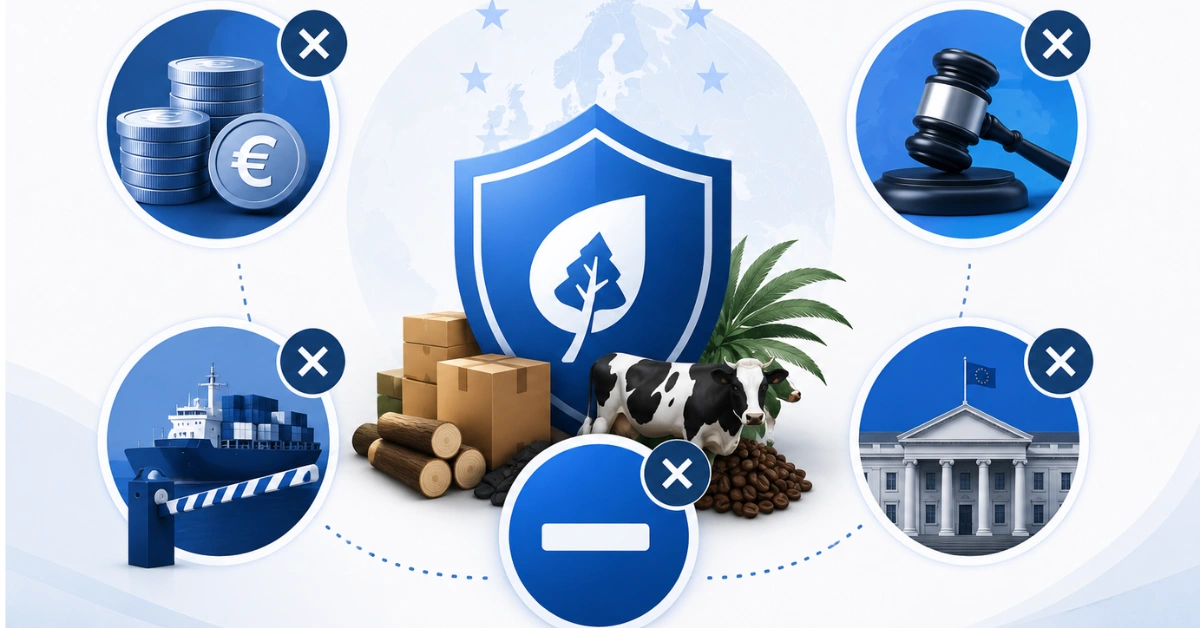
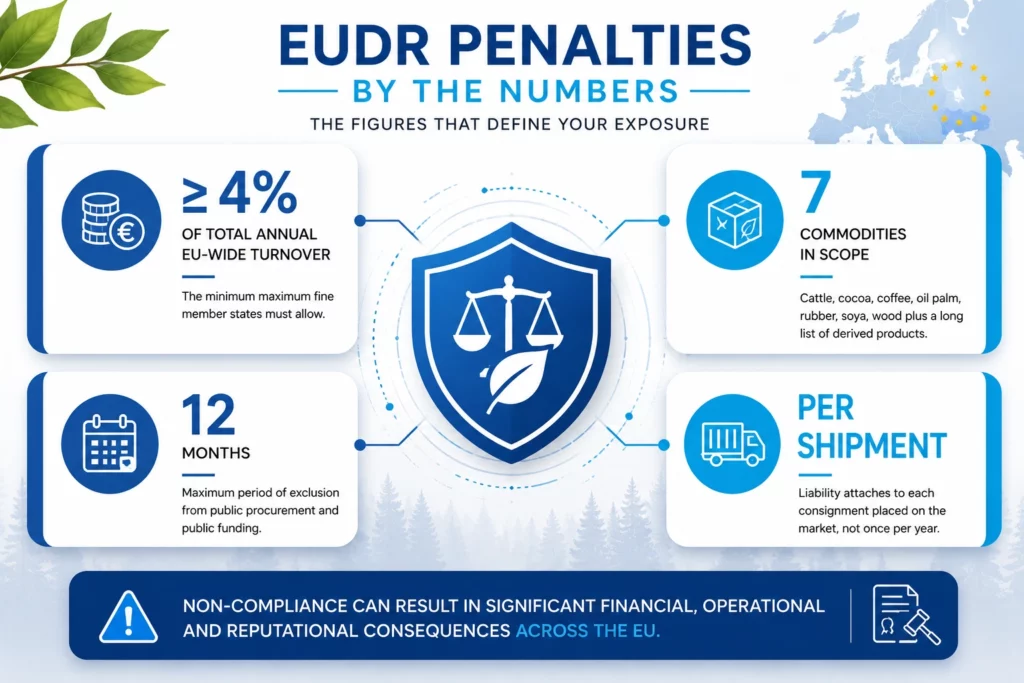
EUDR penalties are the sanctions the EU Deforestation Regulation (EU 2023/1115) imposes on operators and traders that place non-compliant commodities on the EU market. They include fines of at least 4% of a company’s total annual EU-wide turnover, confiscation of the products and the revenue earned from them, temporary exclusion from public procurement and public funding, a temporary ban on selling or exporting the products, and public naming of the offender. Penalties scale with the value of the goods and the environmental damage, and they apply per shipment so a single missing or false due diligence statement can trigger them.
EUDR penalties are now a board-level risk for any company that imports, sells, or exports cattle, cocoa, coffee, oil palm, rubber, soya, or wood and their derived products into the European Union. If you are responsible for compliance, procurement, or supply-chain operations, the question is no longer whether the regulation applies to you it is how exposed you are, how the fines are calculated, and what evidence you need to avoid them.
This guide breaks down exactly what the EUDR penalties are, who is liable, how enforcement works in practice, and the specific capabilities you need in place to stay deforestation-free and audit-ready.
EUDR penalties are the financial and commercial sanctions EU member states must impose when a company cannot prove the commodities it placed on the market are deforestation-free, legally produced, and backed by a valid due diligence statement.
Get My Free EUDR Compliance Assessment
No obligation. Assessment delivered by our EUDR specialists
The fastest way to underestimate EUDR penalties is to assume they only hit producers abroad. They don’t. Liability sits with the EU-facing business.
EUDR penalties for operators
An operator is the company that first places a relevant product on the EU market or exports it. Operators carry the full due diligence obligation collecting geolocation data, assessing risk, and filing the due diligence statement and therefore the fullest penalty exposure.
EUDR penalties for traders
Non-SME traders who make products available further down the chain carry their own due diligence and record-keeping duties. “I only resold it” is not a defence a trader that cannot reference a valid upstream due diligence statement is exposed to the same categories of penalty.
The five EUDR penalties for non-compliance, explained
Member states set the exact figures, but the regulation requires every country to make penalties “effective, proportionate and dissuasive” and to include at least the following.
1. EUDR fines of at least 4% of EU turnover
The headline sanction. The maximum fine must be set at no less than 4% of the company’s total annual turnover across the EU, and it scales with the environmental damage caused and the value of the commodities involved. For a mid-sized importer this can dwarf the margin on the goods themselves.
2. Confiscation of the products
Authorities can seize the non-compliant commodities and derived products outright meaning the inventory you paid for never reaches a customer.
3. Confiscation of the revenue
Beyond the goods, member states can confiscate the revenue gained from the relevant transaction, removing any profit motive for cutting corners.
4. Temporary market and procurement bans
Offenders can be temporarily prohibited from placing products on the market or exporting them, and excluded for up to 12 months from public procurement processes and access to public funding a commercial penalty that often outweighs the fine.
5. Public naming of the offender
Member states publish the offending company’s name and the nature of the infringement. For a B2B brand selling on sustainability credentials, the reputational hit compounds the financial one.
EUDR penalties at a glance: operators vs. traders
How the obligations and exposure differ by role:
Dimension
Operator
Non-SME trader
Core duty
Full due diligence + file the statement
Due diligence + reference upstream statement
Geolocation data
Must collect to plot of land
Must verify it exists upstream
Fine exposure
Up to / above 4% EU turnover
Up to / above 4% EU turnover
Confiscation
Goods + revenue
Goods + revenue
Market / export ban
Yes
Yes
Public naming
Yes
Yes
When EUDR penalties start applying
Enforcement is tied to the regulation’s application dates. Based on the timeline available at the time of writing, obligations apply to large and medium operators and traders from late December 2026, with a later date for micro and small enterprises. Because these dates have been adjusted before, verify the current position with an up-to-date source but do not treat any extension as a reason to delay readiness, since the evidence you need takes months to assemble.
How to avoid EUDR penalties: the compliance evidence you need
Avoiding EUDR penalties comes down to one thing: being able to prove, per shipment, that your commodities are deforestation-free and legally produced. That is an evidence and data problem long before it is a legal one. Here is what “ready” actually looks like and where a EUDR Solutions from TraceX removes the manual burden.
Plot-level geolocation you can defend
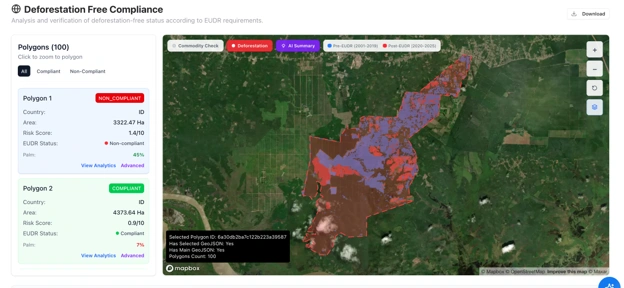
The pain: EUDR requires geolocation coordinates polygons for larger plots for every source of every batch. Spreadsheets of GPS points from hundreds of smallholders fall apart under audit.
The capability: TraceX captures and maps plot-level geolocation against deforestation cut-off dates, so each consignment carries verifiable coordinates. The benefit: you can answer “where exactly did this come from?” in seconds, not weeks the single most common cause of a failed due diligence statement.
See how a leading global tire manufacturer digitized thousands of farm polygons to build an audit-ready EUDR compliance program. Read the case study to discover how large-scale GeoJSON mapping improved traceability, supplier collaboration, and regulatory readiness.
Automated deforestation risk assessment
The pain: manually cross-checking coordinates against forest-cover and risk data for thousands of plots is impossible at scale.
The capability: TraceX layers satellite/deforestation datasets over your supplier plots and flags risk automatically. The benefit: you concentrate effort on the genuinely risky lots and document a defensible risk assessment for the rest.
Due diligence statements without the scramble
The pain: the due diligence statement is the legal artefact regulators check first, and a missing or inaccurate one is exactly what triggers penalties.
The capability: TraceX assembles the underlying data and generates submission-ready due diligence statements. The benefit: the document that stands between you and a 4% fine is produced from a single source of truth, not stitched together by email.
Supplier data collection that smallholders can actually use
The pain: your exposure is only as good as the data your most remote supplier can provide.
The capability: TraceX collects supplier and farm data through low-friction mobile/field tools. The benefit: complete, first-party data from origin the foundation every other control depends on.
See where your supply chain is exposed.
Book a TraceX EUDR readiness walkthrough and get a per-commodity view of your penalty risk and the evidence gaps to close first.
EUDR penalties are severe, commercial, and per-shipment but they are also avoidable with the right evidence in place. The companies that stay out of trouble are the ones that can prove origin, assess risk, and produce a clean due diligence statement on demand.
Frequently Asked Questions (FAQ’s)
How much can EUDR penalties cost?
Fines must be set at a maximum of at least 4% of a company’s total annual EU-wide turnover, on top of confiscation of the goods and the revenue from them. The figure scales with the value of the commodities and the environmental damage.
Do EUDR penalties apply to traders or only operators?
Both. Operators carry the fullest due diligence duty, but non-SME traders that cannot reference a valid upstream due diligence statement face the same categories of penalty.
Can my products be banned from the EU market?
Yes. Member states can temporarily prohibit you from placing the products on the market or exporting them, and exclude you from public procurement and funding for up to 12 months.
What triggers an EUDR penalty most often?
A missing, late, or inaccurate due diligence statement usually because the underlying geolocation or supplier data could not be produced or verified.
How do companies avoid EUDR penalties in practice?
By collecting plot-level geolocation and supplier data, running an automated deforestation-risk assessment, and generating accurate due diligence statements from a single source of truth which is what a platform like TraceX is built to do.
Start using TraceX
Transparency, Trust, & Success for your Climate Journey.
We use cookies on our website to give you the most relevant experience by remembering your preferences and repeat visits. By clicking “Accept All”, you consent to the use of ALL the cookies. However, you may visit "Cookie Settings" to provide a controlled consent.
This website uses cookies to improve your experience while you navigate through the website. Out of these, the cookies that are categorized as necessary are stored on your browser as they are essential for the working of basic functionalities of the website. We also use third-party cookies that help us analyze and understand how you use this website. These cookies will be stored in your browser only with your consent. You also have the option to opt-out of these cookies. But opting out of some of these cookies may affect your browsing experience.
Necessary cookies are absolutely essential for the website to function properly. These cookies ensure basic functionalities and security features of the website, anonymously.
Cookie
Duration
Description
cookielawinfo-checkbox-analytics
11 months
This cookie is set by GDPR Cookie Consent plugin. The cookie is used to store the user consent for the cookies in the category "Analytics".
cookielawinfo-checkbox-functional
11 months
The cookie is set by GDPR cookie consent to record the user consent for the cookies in the category "Functional".
cookielawinfo-checkbox-necessary
11 months
This cookie is set by GDPR Cookie Consent plugin. The cookies is used to store the user consent for the cookies in the category "Necessary".
cookielawinfo-checkbox-others
11 months
This cookie is set by GDPR Cookie Consent plugin. The cookie is used to store the user consent for the cookies in the category "Other.
cookielawinfo-checkbox-performance
11 months
This cookie is set by GDPR Cookie Consent plugin. The cookie is used to store the user consent for the cookies in the category "Performance".
viewed_cookie_policy
11 months
The cookie is set by the GDPR Cookie Consent plugin and is used to store whether or not user has consented to the use of cookies. It does not store any personal data.
Functional cookies help to perform certain functionalities like sharing the content of the website on social media platforms, collect feedbacks, and other third-party features.
Performance cookies are used to understand and analyze the key performance indexes of the website which helps in delivering a better user experience for the visitors.
Analytical cookies are used to understand how visitors interact with the website. These cookies help provide information on metrics the number of visitors, bounce rate, traffic source, etc.
Advertisement cookies are used to provide visitors with relevant ads and marketing campaigns. These cookies track visitors across websites and collect information to provide customized ads.
Download the 2026 Traceability Scorecard and Benchmark Your Supply Chain Across 10 Critical Capabilities.
Download our eBook
Don’t Wait for an Audit to Find Your EUDR Gaps
The 2026 Simplification Package changes how HS codes, DDS pass-through and geolocation rules apply to you. Get the free guide and 20-point readiness checklist before enforcement catches you unprepared.