Quick summary: Learn how ESPR Digital Product Passports (DPP) rely on robust data architecture and standards to ensure interoperability, traceability, and regulatory compliance. Explore data models, GS1 integration, and best practices for scalable, audit-ready DPP implementation.
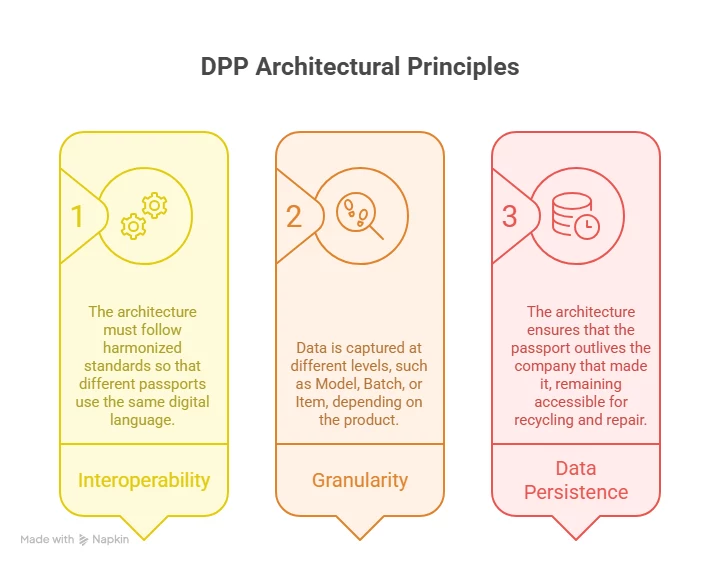
Most companies won’t struggle with ESPR because they lack intent they’ll struggle because their data isn’t ready. ESPR Digital Product Passports move compliance away from static documents and PDFs into living, structured digital systems. DPP Data Architecture defines how product, supply chain, and sustainability data is structured, linked, and shared to meet ESPR Digital Product Passport requirements. It relies on standardized data models, unique product identifiers such as GS1 Digital Link, and interoperable systems connected via APIs.
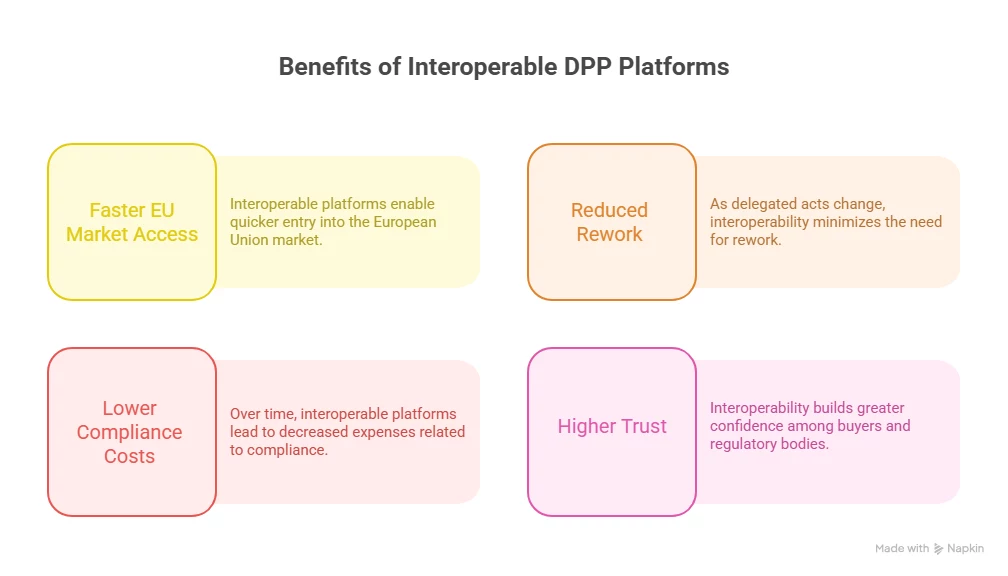
That shift exposes a hard reality: if product, supplier, and sustainability data cannot talk to each other, compliance breaks down fast. Fragmented ERPs, disconnected supplier spreadsheets, and siloed ESG tools create blind spots that are impossible to fix at scale. Without interoperable data architecture, every new delegated act adds cost, delay, and risk turning ESPR from a compliance task into a market access problem. This architecture enables machine-readable, audit-ready data flows across suppliers, brands, regulators, and consumers. A robust DPP Data Architecture avoids data silos, supports product- and batch-level traceability, and ensures scalability as delegated acts introduce new data fields and verification rules.
Key Takeaways
ESPR Digital Product Passports (DPP) require a robust data architecture that structures product, supplier, and sustainability information in a machine-readable, audit-ready format.
Interoperability ensures seamless data exchange across brands, suppliers, regulators, and consumers, supported by standardized models and APIs.
GS1 identifiers like GTIN and Digital Link link physical products to digital records, enabling consistent traceability.
Common challenges include fragmented supplier data, siloed ERP/PLM/ESG systems, and manual updates.
Effective DPP implementation relies on integrated technology stacks and thoughtfully designed architectures, while platforms like TraceX provide scalable, interoperable, and compliance-by-design solutions for multi-supplier ecosystems.
Unlock the Full Potential of DPPs
Download our comprehensive eBook, DPP Explained: From Compliance to Competitive Advantage, and learn how to transform regulatory requirements into a strategic growth driver.
ESPR DPP data architecture refers to the underlying structure that defines how product, supplier, and sustainability data is organized, connected, stored, and accessed to support Digital Product Passport requirements under the Ecodesign for Sustainable Products Regulation. It governs how data flows across systems and stakeholders not just what data is collected. To move away from “greenwashing” and toward “proof,” the EU’s Ecodesign for Sustainable Products Regulation (ESPR) relies on a specific technical framework called the Digital Product Passport (DPP) Data Architecture.
The Three Core Layers of DPP Architecture
The architecture is designed to be interoperable, meaning different software systems can “talk” to each other across global supply chains. It generally consists of three distinct layers:
1. The Physical Layer (The “Key”)
Every product must have a Unique Product Identifier (UPI). This is physically attached to the product via a data carrier, such as a QR code, RFID tag, or NFC chip.
The Role: When scanned, this “key” points the user to the digital twin of that specific item or batch.
2. The Decentralized Data Layer (The “Safe”)
Contrary to popular belief, the EU does not store all your product data. Instead, the data remains with the Economic Operator (the brand or manufacturer).
The Role: Information on material composition, carbon footprint, and repairability is hosted on decentralized servers or blockchain-based platforms. This ensures that companies maintain control over their proprietary data while making it accessible to those with the right “permissions.”
3. The EU Central Registry (The “Directory”)
The European Commission manages a Central Registry that stores only the “metadata.”
The Role: It keeps a record of all active UPIs and links them to the correct decentralized data source. This allows customs and market surveillance authorities to verify that a product has a valid passport before it enters the EU market.
Stay Ahead in Compliance:Explore our latest insights onDPP regulationsand understand how evolving EU mandates impact your products and supply chain.
Build a Future-Ready DPP:Dive into our blog on thetechnology stack for Digital Product Passportsand learn how to implement scalable, interoperable solutions.
It is important to distinguish data content from data architecture. Data content answers what information must be disclosed, such as product identifiers, material composition, carbon footprint, or compliance declarations. Data architecture defines how that information is structured, how different data points are linked across suppliers and components, how updates are managed, and how data is made machine-readable and accessible to regulators, buyers, and consumers.
Architecture ultimately determines whether DPP compliance can scale. A well-designed ESPR DPP data architecture enables consistent product and batch-level traceability, supports verification and audits, and allows new data fields to be added as delegated acts evolve. Poor architecture, by contrast, leads to fragmented
Why It Matters for Your Business
For companies today, the challenge isn’t just “collecting data” it’s building the API-driven infrastructure to serve that data to the DPP ecosystem. Moving from manual spreadsheets to a structured data architecture is the only way to meet the 2027-2030 enforcement deadlines.
How does Interoperability work in ESPR Digital Product Passports?
Interoperability is a core requirement under ESPR because Digital Product Passports must function across multiple stakeholders and systems, not within a single organization. Regulators need reliable access for enforcement, brands and manufacturers must manage product and supplier data, downstream buyers require verified information, and consumers need simplified access to selected data points. ESPR therefore demands cross-border, cross-system data exchange that works consistently across the EU’s single market.
To enable this, ESPR pushes for standardized, machine-readable data rather than unstructured documents. Data must be readable by different IT systems, comparable across products, and accessible through defined access rights. Without interoperability, DPPs would remain isolated databases, undermining enforcement, transparency, and circular economy goals.
How Interoperability Works in Practice
In practice, interoperability is achieved through common data models that define how product, component, supplier, and sustainability attributes are structured across product categories. These shared models ensure that data collected from different suppliers or regions can be understood and reused without manual reformatting.
APIs play a critical role by enabling secure, real-time system-to-system communication between traceability platforms, ERP and PLM systems, sustainability tools, and regulatory interfaces. This allows DPP data to be updated automatically rather than manually re-entered.
Finally, interoperable architectures support continuous updates as delegated acts evolve. When new data fields or verification rules are introduced, interoperable systems can adapt without rebuilding the entire DPP framework, ensuring long-term compliance and scalability.
Interoperability works across three distinct “handshakes”:
1. The Technical Handshake (The “Plug”)
This layer ensures that the physical product can connect to the digital world.
Standardized Data Carriers: Instead of proprietary codes, companies use global standards like GS1 Digital Link. This allows a standard smartphone camera or an industrial scanner to “read” the link.
Open APIs: Manufacturers don’t send their data to a central EU database. Instead, they provide an API (Application Programming Interface). When a regulator scans a code, the API “serves” the required data from the manufacturer’s server to the regulator’s screen in milliseconds.
2. The Semantic Handshake (The “Language”)
Even if two systems can connect, they need to speak the same language. If one company labels a material as “PET” and another calls it “Recycled Polyester,” a recycling robot won’t know they are the same thing.
Common Ontologies: The EU is mandating a Shared Vocabulary. This means every DPP must use the same “dictionary” (like ECLASS or GS1 standards) to describe materials, units of measure (kg vs. g), and environmental metrics.
Machine-Readability: Data is structured in formats like JSON-LD or XML.This allows AI and automated sorting machines to “read” the passport and make decisions without human intervention.
3. The Organizational Handshake (The “Trust”)
This is about governance deciding who is allowed to see what.
Role-Based Access Control (RBAC): Interoperability doesn’t mean everyone sees everything.
A Consumer scans the code and sees the carbon footprint and repair guide.
A Recycler scans the same code and sees the chemical bill of materials (BoM).
A Market Surveillance Authority scans it and sees the private compliance test reports.
Cross-Border Recognition: Interoperability ensures that a battery made in China, sold in Germany, and recycled in France has a “data trail” that is legally and technically recognized in all three jurisdictions.
Interoperability in Action: A Practical Example
Imagine a Tire equipped with a DPP.
Manufacturer (Italy): Produces the tire and assigns it a GS1 identifier. They host the data on their own secure server.
Mechanic (Spain): Scans the tire during a service. The “Technical Handshake” connects his tablet to the Italian server. He sees the “Semantic” data telling him the recommended pressure and tread life.
Recycler (Poland): Five years later, the tire is scrapped. The recycler’s automated system scans the tire. Because of the “Organizational Handshake,” the system is granted access to the specific chemical breakdown needed to safely melt the rubber.
Why This Matters
If you build a “closed” system today, you will likely have to rebuild it. To be DPP-ready, your data architecture must be:
Vendor-Agnostic: Don’t get locked into a single software provider’s proprietary format.
API-First: Ensure your ERP can share data securely with external “resolvers.”
Standard-Aligned: Start mapping your material data to international standards (GS1, ISO) now.
How does GS1 support ESPR Digital Product Passports?
GS1 identifiers play a foundational role in enabling Digital Product Passports under ESPR by providing globally recognized, standardized product identification. Identifiers such as the Global Trade Item Number (GTIN) uniquely identify products, while GS1 Digital Link connects those identifiers to dynamic, web-based product data, forming the bridge between physical products and their digital passports.
By linking a physical product, package, or batch to a digital record through a QR code or URL, GS1 Digital Link ensures that the same product identity is consistently referenced across manufacturers, suppliers, logistics providers, retailers, regulators, and consumers. This eliminates ambiguity caused by internal SKUs or proprietary codes and allows DPP data to be accessed reliably throughout the product lifecycle.
GS1 standards are critical for interoperability at scale because they are already embedded in global trade and supply chains. Using GS1 identifiers enables DPP systems to exchange data seamlessly across organizations and borders without custom integrations. As ESPR requirements expand across product categories and markets, GS1 provides the common identification layer that allows DPP architectures to scale efficiently while remaining compatible with existing enterprise and regulatory systems.
What causes Data silos in DPP implementations?
Data silos in Digital Product Passport implementations typically arise when companies rely on disconnected, manual, or legacy data practices to meet new ESPR requirements.
One of the most common pitfalls is continued dependence on supplier spreadsheets, where critical product, material, or sustainability data is collected in inconsistent formats, updated infrequently, and is difficult to validate. As supplier numbers grow, these spreadsheets quickly become unmanageable and error-prone.
Another major cause is the lack of integration between ERP, PLM, and ESG systems. Product specifications may sit in PLM tools, supplier and transaction data in ERP systems, and sustainability metrics in separate ESG platforms. Without a unifying data architecture, these systems cannot exchange information automatically, resulting in duplicated data, conflicting records, and manual reconciliation efforts.
Manual updates for compliance further compound the problem. When delegated acts change or new data fields are introduced, teams often update documents and databases separately, increasing the risk of inconsistencies and outdated information. This siloed approach significantly raises compliance risk, as regulators require accurate, up-to-date, and verifiable DPP data.
A single source of truth is therefore essential. Centralized, interoperable DPP platforms consolidate product and sustainability data, enable controlled updates, and maintain audit trails, reducing audit fatigue while ensuring consistent, reliable compliance across products, markets, and stakeholders.
What Technology is required for ESPR DPP implementation?
Core Components of the ESPR DPP Technology Stack
A scalable ESPR Digital Product Passport relies on a set of tightly connected technical components that work together to capture, validate, and share product data across the value chain.
Traceability platforms for multi-tier data capture form the backbone of the DPP stack. These platforms collect product, material, and sustainability data across multiple supply chain tiers from raw material suppliers to manufacturers and distributors at the product or batch level. They ensure data continuity across stages and enable end-to-end visibility required for ESPR compliance.
Supplier data onboarding and validation is critical because a large portion of DPP data originates outside the brand’s direct control. Structured onboarding workflows standardize how suppliers submit data, while validation rules, documentation checks, and evidence requirements help ensure data accuracy and completeness before it enters the DPP system.
ERP, PLM, and sustainability system integration ensures that DPP data flows automatically from existing enterprise systems rather than being manually re-entered. Integrations allow product specifications, supplier details, lifecycle data, and ESG metrics to remain synchronized, reducing errors and maintaining a single, consistent dataset.
Secure registries and optional blockchain layers support data integrity, access control, and auditability. While not mandatory, blockchain or secure registries can add an additional layer of trust by creating tamper-resistant records and verifiable data histories, strengthening confidence for regulators, buyers, and certification bodies.
Designing an ESPR-Ready DPP Architecture
Designing a Digital Product Passport (DPP) architecture that is ESPR-ready requires careful planning to ensure data is accurate, scalable, and audit-ready across all product categories.
Product-level vs batch-level data models: Product-level models capture information applicable to all units of a product, such as composition, certifications, or manufacturer details. Batch-level models provide granular traceability, recording variations in specific production lots, such as material origin, processing conditions, or quality test results. Combining both ensures compliance while enabling detailed lifecycle tracking.
Linking materials, components, and suppliers: A robust architecture connects every raw material and component to its supplier, creating a transparent map of the supply chain. This linkage allows brands to trace products back to their source, verify ESG claims, and respond quickly to regulatory queries.
Version control and update management: As delegated acts evolve and new compliance requirements emerge, DPP data must be updated systematically. Version control ensures that historical records remain intact, changes are logged, and all stakeholders have access to the most current, verified information.
Audit-ready data flows by design: From the outset, the architecture should generate traceable, standardized data flows that support regulatory audits and internal verification. Structured workflows, automated validations, and clear documentation minimize manual effort and ensure that compliance is continuous rather than reactive.
How TraceX Enables ESPR DPP Interoperability at Scale
TraceX provides a comprehensive platform designed to simplify ESPR Digital Product Passport (DPP) implementation, ensuring interoperability and compliance at scale.
Standards-aligned data architecture: TraceX organizes product, supplier, and sustainability data according to ESPR requirements and industry best practices, enabling consistent, structured, and machine-readable records across the supply chain.
GS1-compatible product identification: By integrating GS1 identifiers such as GTIN and Digital Link, TraceX connects physical products to their digital passports, ensuring global consistency and traceability from manufacturer to end consumer.
API-first, interoperable platform design: The platform supports seamless system-to-system data exchange across ERP, PLM, sustainability tools, and regulatory interfaces, enabling real-time updates and eliminating data silos.
Built for complex, multi-supplier ecosystems: TraceX can manage thousands of SKUs, multiple suppliers, and multi-tier supply chains, capturing detailed product and batch-level information while maintaining audit-ready data flows.
Compliance-by-design, not compliance-by-retrofit: TraceX embeds ESPR requirements into data capture and management workflows from the start, reducing manual interventions, audit risks, and compliance costs, while future-proofing operations as delegated acts evolve.
This combination ensures that companies can implement DPPs efficiently, maintain regulatory readiness, and achieve end-to-end supply chain transparency.
Implementing ESPR Digital Product Passports is less about ticking boxes and more about how you structure your data from the start. Early architectural choices, such as how product, supplier, and sustainability data are modelled, linked, and updated, determine whether DPP compliance can scale efficiently or become a long-term bottleneck.
Interoperability is at the heart of this decision. A well-designed, interoperable DPP architecture ensures that data flows seamlessly across suppliers, brands, regulators, and consumers, supporting transparency, traceability, and the broader goals of a circular economy.
Finally, DPP platforms should be seen as strategic infrastructure, not merely compliance tools. When data architecture is built thoughtfully, the platform becomes an operational backbone, enabling real-time insights, audit-ready reporting, and value creation across the supply chain transforming regulatory compliance into a competitive advantage.
Discover Circular Economy Insights:Read our blog to see how DPPs enable circularity and sustainable product lifecycles.
Master DPP Interoperability:Learn how systems, APIs, and GS1 standards work together for seamless Digital Product Passport implementation.
Your Complete DPP Guide:Explore our in-depth blog covering everything from data requirements to compliance strategies for ESPR Digital Product Passports.
Frequently Asked Questions (FAQ’s)
What is DPP data architecture and why is it important?
DPP data architecture defines how product, supplier, and sustainability data is structured, linked, and shared to ensure interoperability, traceability, and compliance under ESPR.
How do GS1 identifiers support DPP interoperability?
GS1 identifiers, such as GTIN and Digital Link, uniquely link physical products to their digital passports, enabling standardized, cross-system data exchange across the supply chain.
What are common challenges in DPP data management?
Challenges include fragmented supplier data, disconnected ERP/PLM/ESG systems, manual updates, and siloed information, all of which increase compliance risk and audit complexity.
Start using TraceX
Transparency, Trust, & Success for your Climate Journey.
We use cookies on our website to give you the most relevant experience by remembering your preferences and repeat visits. By clicking “Accept All”, you consent to the use of ALL the cookies. However, you may visit "Cookie Settings" to provide a controlled consent.
This website uses cookies to improve your experience while you navigate through the website. Out of these, the cookies that are categorized as necessary are stored on your browser as they are essential for the working of basic functionalities of the website. We also use third-party cookies that help us analyze and understand how you use this website. These cookies will be stored in your browser only with your consent. You also have the option to opt-out of these cookies. But opting out of some of these cookies may affect your browsing experience.
Necessary cookies are absolutely essential for the website to function properly. These cookies ensure basic functionalities and security features of the website, anonymously.
Cookie
Duration
Description
cookielawinfo-checkbox-analytics
11 months
This cookie is set by GDPR Cookie Consent plugin. The cookie is used to store the user consent for the cookies in the category "Analytics".
cookielawinfo-checkbox-functional
11 months
The cookie is set by GDPR cookie consent to record the user consent for the cookies in the category "Functional".
cookielawinfo-checkbox-necessary
11 months
This cookie is set by GDPR Cookie Consent plugin. The cookies is used to store the user consent for the cookies in the category "Necessary".
cookielawinfo-checkbox-others
11 months
This cookie is set by GDPR Cookie Consent plugin. The cookie is used to store the user consent for the cookies in the category "Other.
cookielawinfo-checkbox-performance
11 months
This cookie is set by GDPR Cookie Consent plugin. The cookie is used to store the user consent for the cookies in the category "Performance".
viewed_cookie_policy
11 months
The cookie is set by the GDPR Cookie Consent plugin and is used to store whether or not user has consented to the use of cookies. It does not store any personal data.
Functional cookies help to perform certain functionalities like sharing the content of the website on social media platforms, collect feedbacks, and other third-party features.
Performance cookies are used to understand and analyze the key performance indexes of the website which helps in delivering a better user experience for the visitors.
Analytical cookies are used to understand how visitors interact with the website. These cookies help provide information on metrics the number of visitors, bounce rate, traffic source, etc.
Advertisement cookies are used to provide visitors with relevant ads and marketing campaigns. These cookies track visitors across websites and collect information to provide customized ads.
Download the 2026 Traceability Scorecard and Benchmark Your Supply Chain Across 10 Critical Capabilities.
Download our eBook
Don’t Wait for an Audit to Find Your EUDR Gaps
The 2026 Simplification Package changes how HS codes, DDS pass-through and geolocation rules apply to you. Get the free guide and 20-point readiness checklist before enforcement catches you unprepared.