Cocoa Farming in Nigeria: Challenges, Compliance & the Traceability Advantage
Published
, 8 minute read
Share this article
Quick summary: Cocoa farming in Nigeria faces yield, climate and EUDR pressures. See the challenges, the 2026 compliance stakes, and how traceability protects EU market access.
Cocoa farming in Nigeria is a smallholder-driven, export-critical sector under pressure from ageing trees, climate stress, pests and financing gaps but the decisive challenge for 2026 is market access. To keep selling into Europe, Nigerian cocoa must be proven deforestation-free and traceable to the plot of land where it was grown, under the EU Deforestation Regulation (EUDR). Digital, plot-level traceability is now the difference between a sale and a rejected shipment.
Cocoa farming in Nigeria sits at a crossroads. The country is one of the world’s leading producers, yet the same farms that anchor rural livelihoods now face a squeeze from every direction falling yields on the ground and rising compliance demands in the market. For exporters, processors and buyers, understanding both sides of that squeeze is no longer optional; it decides who keeps access to Europe and who gets locked out.
In plain terms, cocoa farming in Nigeria is the smallholder-led cultivation of cacao across the country’s cocoa belt Ondo, Cross River, Osun, Ekiti, Edo and Ogun that feeds a supply chain running from village aggregators to EU chocolate makers. This guide covers the operational challenges, why 2026 raises the stakes, and what compliant, traceable sourcing actually requires.
Key takeaways
• Nigeria is one of the world’s largest cocoa producers, with over 90% of output from smallholder farmers
• The biggest threats to cocoa farming in Nigeria are ageing farms, climate-driven disease, weak infrastructure and thin farm finance.
• EUDR applies from 30 December 2026 (large/medium operators) cocoa entering the EU must be deforestation-free and plot-level traceable.
• Certifications help, but do not replace geolocation, due diligence statements and plot-level evidence.
• TraceX EUDR Solutions is built to turn fragmented, paper-based sourcing into audit-ready, deforestation-free records.
December 2026 is approaching. Is your supply chain actually ready?
Move from spreadsheets and fragmented supplier data to a traceable, audit-ready EUDR workflow with TraceX.
Cocoa farming in Nigeria ranks among the world’s largest, contributing an estimated 5–6% of global supply ,with annual output around 330,000 tonnes .Cocoa is a cornerstone non-oil export and a livelihood for hundreds of thousands of households.
Over 90% of production comes from smallholder farmers, many on plots under three hectares .
The bulk of Nigerian cocoa is destined for Europe, making EU rules an existential market question .
Sourcing typically passes through multiple intermediaries buying agents, aggregators, cooperatives and processors before export.
That fragmented, multi-layer structure is exactly what makes farm-level traceability hard and it is the structure that EUDR now requires exporters to untangle.
Why cocoa farming in Nigeria faces mounting pressure
Before any regulation enters the picture, the fundamentals of cocoa farming in Nigeria are already strained. Four pressures stand out.
Ageing trees and declining yields
Many farms are planted with old, unproductive trees and low-yield varieties, compounded by poor soil fertility and outdated practices. The result is falling output per hectare and farmers unable to replant without support.
Climate stress, pests and disease
Rising temperatures and erratic rainfall make trees more vulnerable to black pod disease and pests such as cocoa mirids (capsids), which can wipe out entire harvests and degrade bean quality.
Financing and infrastructure gaps
Thin access to credit, inputs and reliable rural infrastructure limits reinvestment. Weak data management leaves farmers and buyers without the records that increasingly determine price and market access.
Each of these problems shortens supply and squeezes margins. But there is a fifth pressure that turns operational pain into a hard commercial deadline and it comes from the destination market, not the farm.
How EUDR changes the stakes for cocoa farming in Nigeria
The EU Deforestation Regulation (EUDR Regulation (EU) 2023/1115, as amended by (EU) 2025/2650) is the single biggest shift facing cocoa farming in Nigeria this decade. Cocoa is one of seven in-scope commodities, so beans and derived products entering or leaving the EU market must be proven deforestation-free.
Deforestation-free means produced on land not cleared or degraded after 31 December 2020.
Application: 30 December 2026 for large and medium operators; 30 June 2027 for micro and small operators.
Traceability must reach the specific plot of land mass-balance mixing of compliant and non-compliant material is not permitted.
Non-SME downstream operators and traders must register in the EU information system and handle due diligence statement (DDS) reference numbers.
The market is already splitting into compliant and non-compliant tiers, and EU buyers are actively seeking deforestation-free cocoa ahead of the deadline. For Nigerian suppliers, the risk of inaction is concrete: rejected shipments, lost buyers and eroded credibility.
What compliant cocoa farming in Nigeria actually requires
Meeting EUDR is less about a single certificate and more about a chain of verifiable evidence. Compliant cocoa farming in Nigeria has four evidence pillars.
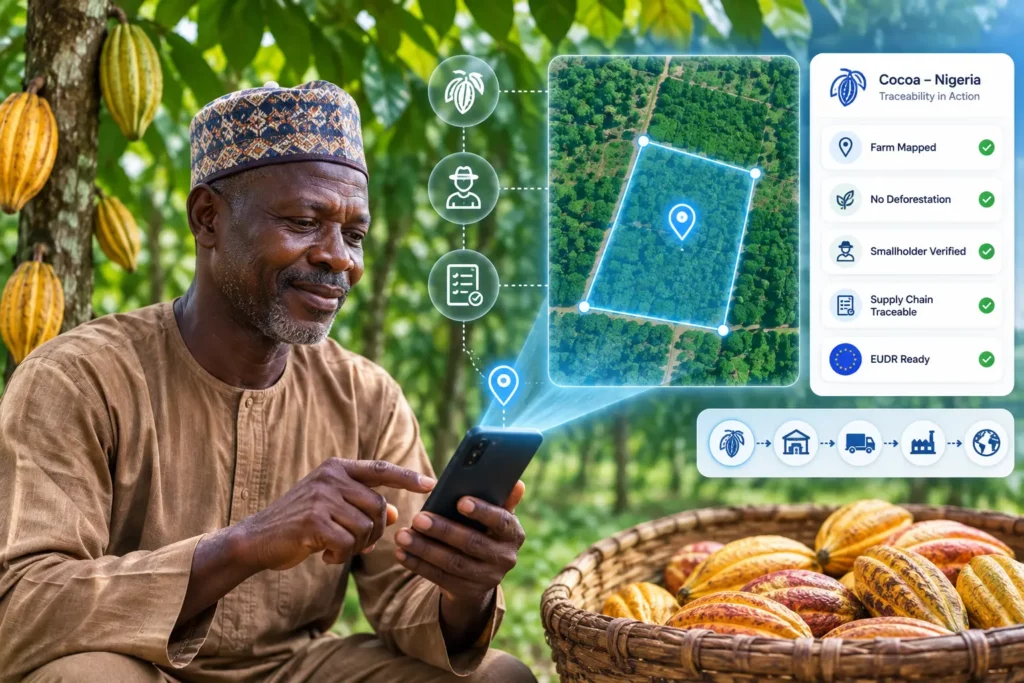
Geolocation: polygon or plot-level coordinates for every farm supplying a batch.
Legality: proof the cocoa was produced in line with the laws of the country of production.
Deforestation-free proof: land-use evidence showing no clearing after 31 December 2020.
Due diligence: a documented risk assessment and mitigation trail, submitted as a DDS.
A common misconception is that FSC, Rainforest Alliance or Fairtrade certification is enough on its own. It is not those schemes support risk mitigation but do not replace geolocation, the DDS or plot-level evidence. Certification and traceability work together; only one of them satisfies EUDR.
The exporters who will win the EU cocoa market aren’t the ones scrambling for paperwork in late 2026 they’re the ones digitising farmer registration and plot mapping now. Traceability isn’t a compliance cost; it’s the asset that converts a fragmented smallholder base into a premium, deforestation-free supply that European buyers will pay for and stay loyal to.
Read our guide on EUDR Requirementsto understand the key obligations, what data you need to collect, and what you should have in place before your next EU shipment.
Know the requirements. Close the gaps. Be ready for EUDR.
Cocoa farming in Nigeria: manual sourcing vs. digital traceability
For cocoa farming in Nigeria, the gap between traditional, paper-based sourcing and a digital traceability platform is where EUDR readiness is won or lost.
Requirement
Manual / paper-based sourcing
Digital traceability (TraceX Cleara AI)
Farm geolocation
Ad-hoc, often missing or unverifiable
Polygon/plot-level GPS capture per farmer
Deforestation check
No historical land-use evidence
Satellite-backed land-use analysis vs. 2020 baseline [capability claim — confirm]
Due diligence (DDS)
Manual, error-prone, hard to audit
Structured, audit-ready DDS records
Chain of custody
Broken across intermediaries
End-to-end, farm-to-export linkage
Buyer confidence
Difficult to prove at scale
Verifiable, deforestation-free claims
How TraceX supports cocoa farming in Nigeria
TraceX EUDR solution, is built to close exactly the gaps that make cocoa farming in Nigeria hard to verify. It targets the fragmentation problem at its root the farm.
Digital farmer onboarding and plot mapping to build a clean, geolocated supplier base.
Automated deforestation risk screening against the 31 December 2020 baseline.
Guided due diligence and DDS generation, so evidence is audit-ready, not assembled in a panic.
End-to-end chain of custody that links farm data to the exported batch.
The proof point is market access: exporters that can show verifiable, plot-level, deforestation-free records keep their EU buyers and command a premium, while those relying on paper trails risk rejection.
Buyer’s checklist: evaluating a traceability solution for cocoa farming in Nigeria
If you’re sourcing or exporting from cocoa farming in Nigeria, use this checklist to judge any traceability platform before you commit.
Does it capture polygon/plot-level geolocation for smallholder farms?
Can it screen land use against the 31 December 2020 deforestation cut-off?
Does it generate audit-ready due diligence statements (DDS)?
Can it maintain chain of custody across aggregators and intermediaries?
Does it map to Regulation (EU) 2023/1115 as amended by (EU) 2025/2650, with the correct application dates?
Will it onboard low-connectivity, smallholder-heavy supply bases in the field?
Frequently Asked Questions
Is cocoa farming in Nigeria affected by EUDR?
Yes. Cocoa is one of the seven commodities covered by the EU Deforestation Regulation. Any Nigerian cocoa entering or leaving the EU market must be proven deforestation-free and traceable to the plot of land where it was grown.
When does EUDR apply to Nigerian cocoa?
It applies from 30 December 2026 for large and medium operators, and from 30 June 2027 for micro and small operators, under Regulation (EU) 2025/2650. The deforestation cut-off date is 31 December 2020.
What are the biggest challenges in cocoa farming in Nigeria?
Cocoa farming in Nigeria contends with ageing, low-yield trees; climate stress and disease such as black pod; pests like cocoa mirids; limited farm finance and infrastructure; and, increasingly, the traceability and compliance demands of export markets.
How many farmers are involved in cocoa farming in Nigeria?
The sector is overwhelmingly smallholder-driven over 90% of production comes from smallholder farmers, many working plots of under three hectares.
Does certification alone meet EUDR for Nigerian cocoa?
No. Schemes like FSC, Rainforest Alliance and Fairtrade support risk mitigation but do not replace the geolocation, due diligence statement and plot-level evidence that EUDR requires.
What does deforestation-free cocoa mean?
It means the cocoa was produced on land that was not deforested or degraded after 31 December 2020, with evidence to prove it. Both legal and illegal deforestation count EUDR does not distinguish.
How can exporters make cocoa farming in Nigeria EUDR-compliant?
By digitising farmer registration, capturing plot-level geolocation, screening land use against the 2020 baseline, and generating audit-ready due diligence the workflow TraceX Solution is built to run.
Start using TraceX
Transparency, Trust, & Success for your Climate Journey.
We use cookies on our website to give you the most relevant experience by remembering your preferences and repeat visits. By clicking “Accept All”, you consent to the use of ALL the cookies. However, you may visit "Cookie Settings" to provide a controlled consent.
This website uses cookies to improve your experience while you navigate through the website. Out of these, the cookies that are categorized as necessary are stored on your browser as they are essential for the working of basic functionalities of the website. We also use third-party cookies that help us analyze and understand how you use this website. These cookies will be stored in your browser only with your consent. You also have the option to opt-out of these cookies. But opting out of some of these cookies may affect your browsing experience.
Necessary cookies are absolutely essential for the website to function properly. These cookies ensure basic functionalities and security features of the website, anonymously.
Cookie
Duration
Description
cookielawinfo-checkbox-analytics
11 months
This cookie is set by GDPR Cookie Consent plugin. The cookie is used to store the user consent for the cookies in the category "Analytics".
cookielawinfo-checkbox-functional
11 months
The cookie is set by GDPR cookie consent to record the user consent for the cookies in the category "Functional".
cookielawinfo-checkbox-necessary
11 months
This cookie is set by GDPR Cookie Consent plugin. The cookies is used to store the user consent for the cookies in the category "Necessary".
cookielawinfo-checkbox-others
11 months
This cookie is set by GDPR Cookie Consent plugin. The cookie is used to store the user consent for the cookies in the category "Other.
cookielawinfo-checkbox-performance
11 months
This cookie is set by GDPR Cookie Consent plugin. The cookie is used to store the user consent for the cookies in the category "Performance".
viewed_cookie_policy
11 months
The cookie is set by the GDPR Cookie Consent plugin and is used to store whether or not user has consented to the use of cookies. It does not store any personal data.
Functional cookies help to perform certain functionalities like sharing the content of the website on social media platforms, collect feedbacks, and other third-party features.
Performance cookies are used to understand and analyze the key performance indexes of the website which helps in delivering a better user experience for the visitors.
Analytical cookies are used to understand how visitors interact with the website. These cookies help provide information on metrics the number of visitors, bounce rate, traffic source, etc.
Advertisement cookies are used to provide visitors with relevant ads and marketing campaigns. These cookies track visitors across websites and collect information to provide customized ads.
Download the 2026 Traceability Scorecard and Benchmark Your Supply Chain Across 10 Critical Capabilities.
Download our eBook
Don’t Wait for an Audit to Find Your EUDR Gaps
The 2026 Simplification Package changes how HS codes, DDS pass-through and geolocation rules apply to you. Get the free guide and 20-point readiness checklist before enforcement catches you unprepared.