PPWR Responsibilities: Who Does What Across Supply Chain Scenarios
Published
, 11 minute read
Share this article
Quick summary: PPWR responsibilities explained across 20 supply chain scenarios: who is the manufacturer, importer, holds the Declaration of Conformity and places packaging on the EU market.
PPWR responsibilities fall on four economic operators the manufacturer, importer, distributor and producer. The manufacturer (usually the filler or brand owner that applies the final packaging steps) prepares the technical documentation and draws up the EU Declaration of Conformity. The importer places third-country packaging on the EU market and must verify that documentation and keep a copy. Whoever first makes the packaging available in the EU “places it on the market.” There is only one manufacturer per supply chain, and any operator that puts its own name or trademark on the packaging or modifies it in a way that affects compliance becomes the manufacturer under Article 21.
Key takeaways
PPWR responsibilities are assigned by role, not by company size there is no general SME exemption.
The manufacturer prepares the technical documentation and the EU Declaration of Conformity (DoC); the importer verifies and keeps a copy.
Only one manufacturer exists per supply chain usually the filler or brand owner applying the final steps.
Put your own brand on the packaging, or modify it so compliance is affected, and you become the manufacturer under Article 21.
“Placing on the market” is the first time packaging is made available in the EU for imports, that is the importer.
Producer (EPR) duties are separate: register in every Member State where you first make packaging available; non-EU producers may need an Authorised Representative.
PPWR responsibilities start with one question: which operator are you?
PPWR responsibilities are the single biggest source of confusion for teams preparing for the EU Packaging and Packaging Waste Regulation. The regulation is a product law applied to packaging, and it assigns duties to defined economic operators rather than to “whoever handles the box.” Get the role wrong and you either duplicate work or, worse, leave a gap that surfaces as a blocked shipment when general application begins on 12 August 2026.
The hard part is that the same company can be a manufacturer in one flow and merely a distributor in another. A German business importing coffee pouches from India is an importer for that line but the moment it prints its own logo on those pouches, it inherits full manufacturer PPWR responsibilities. Below, we answer five questions for real supply chain scenarios so you can place your business correctly.
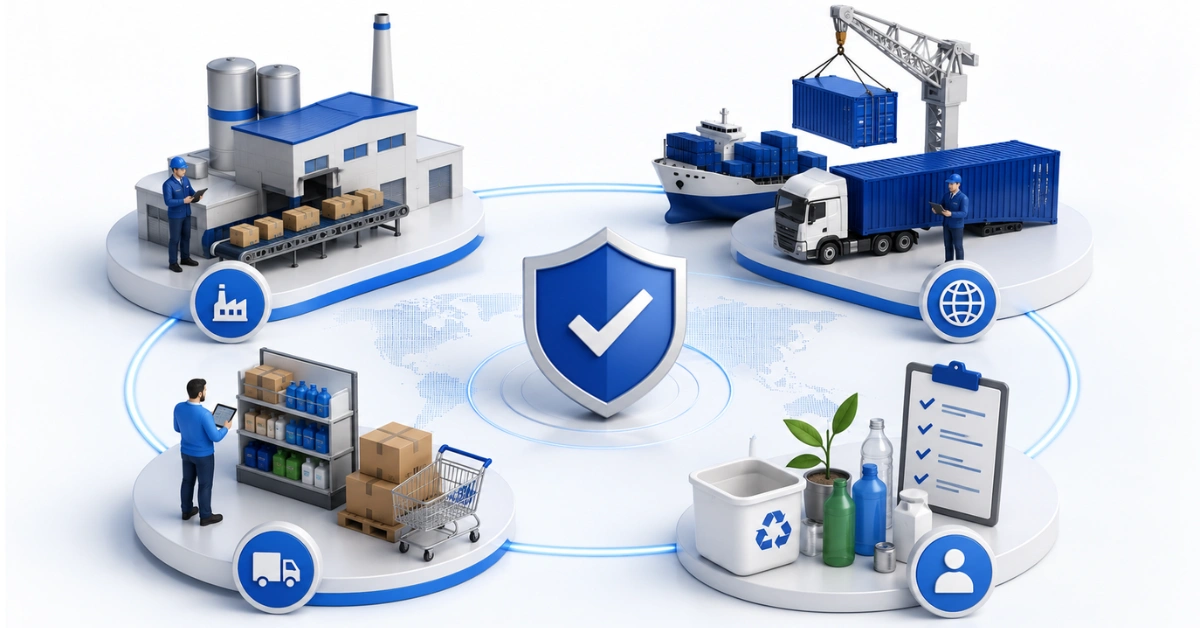
Your compliance obligations depend on whether you’re a manufacturer, importer, distributor, brand owner, or another economic operator. Understanding your role is the first step toward building a compliant packaging strategy.
The five questions that decide your PPWR responsibilities
Who is the manufacturer? The operator that makes the packaging, or has it designed and made, and markets it under its own name normally the filler or brand owner. Only one per chain.
Who is the importer? The EU-established operator that places packaging from a third country on the Union market.
Who prepares the technical documentation? The manufacturer, following Annex VII, before the packaging is placed on the market.
Who maintains the Declaration of Conformity? The manufacturer draws it up (Annex VIII) and keeps it; the importer keeps a copy for [5] years and verifies it exists.
Who places the packaging on the EU market? The operator that first makes it available in the EU the filler domestically, or the importer for third-country goods.
From packaging conformity assessments and technical documentation to supplier collaboration and Declarations of Conformity, manufacturers have a critical role to play under PPWR.
PPWR responsibilities across supply chain scenarios
Use this scenario matrix to place your business. Each row answers the five questions above. Read it as “for this flow, this SKU” because your role can change line by line.
Supply-chain scenario
Who is the manufacturer?
Who is the importer?
Tech docs + Declaration of Conformity
Who places packaging on the EU market?
1. Indian manufacturer → German importer
Indian producer (fills & finishes)
German company
Indian mfr prepares; German importer verifies & keeps copy 5 yrs
PPWR responsibilities explained: six scenarios in detail
1. Indian manufacturer → German importer
The Indian producer fills and finishes the packaging, so it is the manufacturer and must prepare the technical documentation and draw up the Declaration of Conformity. The German company is the importer: it places the goods on the EU market, must verify the DoC and technical file exist, keep a copy, and ensure its own name and address appear on the packaging. If the German importer sold the pouches unbranded, these duties stay split producer duties for EPR still attach to the German entity.
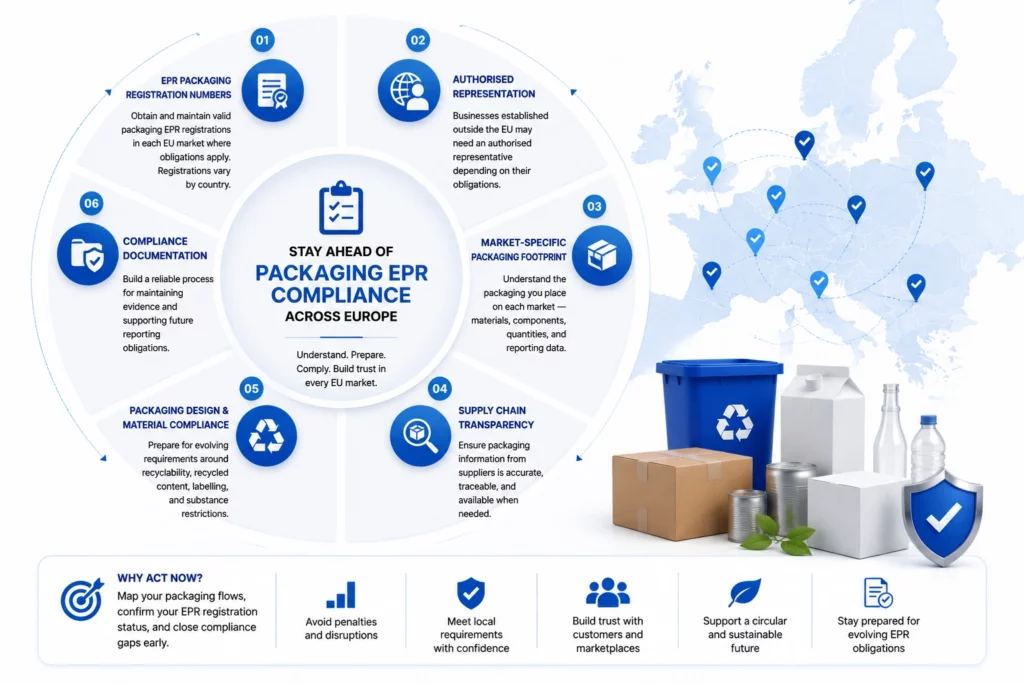
Understanding your Extended Producer Responsibility (EPR) obligations is essential for PPWR compliance. Learn who needs to register, when registration is required, and how to prepare for country-specific requirements.
For sales packaging, the converter that supplies empty pouches is a supplier, not the PPWR manufacturer. The FMCG company that fills and brands the pack applies the final steps, so it holds the manufacturer duties: it prepares the technical documentation and the DoC using the converter’s material data, and it is the operator that places the packaged product on the market.
From packaging conformity assessments and technical documentation to Declarations of Conformity and design requirements, PPWR introduces new technical obligations that every business should understand.
A contract packer (co-packer) fills on the brand owner’s behalf. Because the packaging is marketed under the brand owner’s name, the brand owner carries the manufacturer duties it prepares and maintains the DoC and technical file, with the co-packer supplying process and material evidence. The brand owner places the product on the market.
4. Retailer with private label
A private-label retailer puts its own brand on the packaging, which makes it the manufacturer under Article 21 even though a third party physically produced the goods. The retailer prepares and holds the technical documentation and DoC and places the packaging on the market. If the private-label goods come from outside the EU, the retailer is also the importer, absorbing both sets of duties.
5. Distributor importing products
A distributor that sources finished products from a third country is legally an importer for that flow, not a mere distributor. The third-country producer is the manufacturer and prepares the technical file and DoC; the importing distributor verifies them, keeps a copy, checks labelling, and is the operator that places the packaging on the EU market.
6. Amazon seller importing products
An Amazon seller that imports products into the EU is the importer of record and shoulders those duties: verify the manufacturer’s DoC and technical documentation, keep a copy, and ensure operator identification on the pack. Because the seller first makes the packaging available in the EU, it also counts as a producer for EPR and must register in each Member State where it sells or appoint an Authorised Representative where it is not established.
PPWR responsibilities: manual workflow vs automated
Mapping these operator roles by hand works until you have hundreds of SKUs across several countries and roles. The table below shows where TraceX PPWR Solutions closes the gaps that spreadsheets leave open.
PPWR responsibility
Manual / spreadsheet workflow
Automated with TraceX
Classifying each operator’s role
Legal team reads Articles 3, 15–21 per SKU line; error-prone across chains
Chasing suppliers by email; DoCs scattered in inboxes
Central DoC vault with request, reminder and version tracking
Verifying technical documentation
Manual PDF checks; missing Annex VII files found late
Automated completeness checks flag gaps before market entry
Art. 21 re-classification (rebrand/modify)
Easy to miss when you become the manufacturer
Rule engine re-classifies you the moment own-brand or modification is logged
EPR registration across Member States
Tracked in spreadsheets; registrations missed per country
Per-MS producer register with renewal alerts
Audit readiness
Reconstructing evidence under deadline pressure
One-click, time-stamped compliance file per packaging unit
The benefit is defensible market access: when a market-surveillance authority asks who the manufacturer is and to see the Declaration of Conformity, you answer in minutes with a complete, time-stamped file instead of scrambling while shipments wait at the border.
See your PPWR responsibilities mapped for every SKU
Book a exploratory call and we’ll classify your roles, surface missing Declarations of Conformity, and build your audit-ready file before 12 August 2026.
PPWR responsibilities: a buyer’s evaluation checklist
When evaluating any compliance platform against these obligations, confirm it can:
Classify each SKU’s operator role (manufacturer / importer / distributor / producer) automatically, and re-classify on Article 21 triggers.
Store, request and version-control every Declaration of Conformity in one vault with supplier reminders.
Validate technical documentation against Annex VII completeness before market entry.
Track EPR producer registration and eco-modulated fees per Member State, with renewal alerts.
Enforce operator identification (name, trademark, address) on the pack for manufacturer and importer.
Produce a one-click, audit-ready evidence file per packaging unit.
Integrate with your ERP and supplier systems confirm connector list with product team
Frequently Asked Questions (FAQ’s)
Can there be more than one manufacturer under PPWR?
No. Commission guidance treats PPWR responsibilities as having only one manufacturer per supply chain normally the operator that applies the final packaging steps and markets under its own name. Suppliers and converters are not the manufacturer for sales packaging.
When does an importer become a manufacturer?
When it places packaging on the market under its own name or trademark, or modifies packaging already on the market so that compliance may be affected. At that point Article 21 transfers the full manufacturer duties including the technical documentation and Declaration of Conformity to that operator.
Who prepares the technical documentation?
The manufacturer, following Annex VII, before the packaging is placed on the market, and keeps it for [5] years. The importer verifies it exists and can be provided on request but does not create it (unless it is the manufacturer under Article 21).
Who maintains the Declaration of Conformity?
The manufacturer draws up and maintains the EU Declaration of Conformity (Annex VIII model). The importer keeps a copy and confirms the packaging carries the required conformity and operator information.
Who places packaging on the EU market?
The operator that first makes the packaging available in the EU. For domestic production that is the filler or brand owner; for third-country goods it is the importer. This is central to assigning the right operator role.
Are small businesses exempt from PPWR responsibilities?
There is no general SME exemption. Some obligations phase in on later dates and certain simplifications exist, but the core role-based duties apply regardless of company size verify the current position on EUR-Lex.
Do PPWR responsibilities change country by country?
The product-conformity duties (technical documentation, DoC, placing on the market) are harmonised EU-wide one manufacturer, one DoC. EPR producer registration, however, is per Member State, so a single product can trigger registration duties in several countries.
Start using TraceX
Transparency, Trust, & Success for your Climate Journey.
We use cookies on our website to give you the most relevant experience by remembering your preferences and repeat visits. By clicking “Accept All”, you consent to the use of ALL the cookies. However, you may visit "Cookie Settings" to provide a controlled consent.
This website uses cookies to improve your experience while you navigate through the website. Out of these, the cookies that are categorized as necessary are stored on your browser as they are essential for the working of basic functionalities of the website. We also use third-party cookies that help us analyze and understand how you use this website. These cookies will be stored in your browser only with your consent. You also have the option to opt-out of these cookies. But opting out of some of these cookies may affect your browsing experience.
Necessary cookies are absolutely essential for the website to function properly. These cookies ensure basic functionalities and security features of the website, anonymously.
Cookie
Duration
Description
cookielawinfo-checkbox-analytics
11 months
This cookie is set by GDPR Cookie Consent plugin. The cookie is used to store the user consent for the cookies in the category "Analytics".
cookielawinfo-checkbox-functional
11 months
The cookie is set by GDPR cookie consent to record the user consent for the cookies in the category "Functional".
cookielawinfo-checkbox-necessary
11 months
This cookie is set by GDPR Cookie Consent plugin. The cookies is used to store the user consent for the cookies in the category "Necessary".
cookielawinfo-checkbox-others
11 months
This cookie is set by GDPR Cookie Consent plugin. The cookie is used to store the user consent for the cookies in the category "Other.
cookielawinfo-checkbox-performance
11 months
This cookie is set by GDPR Cookie Consent plugin. The cookie is used to store the user consent for the cookies in the category "Performance".
viewed_cookie_policy
11 months
The cookie is set by the GDPR Cookie Consent plugin and is used to store whether or not user has consented to the use of cookies. It does not store any personal data.
Functional cookies help to perform certain functionalities like sharing the content of the website on social media platforms, collect feedbacks, and other third-party features.
Performance cookies are used to understand and analyze the key performance indexes of the website which helps in delivering a better user experience for the visitors.
Analytical cookies are used to understand how visitors interact with the website. These cookies help provide information on metrics the number of visitors, bounce rate, traffic source, etc.
Advertisement cookies are used to provide visitors with relevant ads and marketing campaigns. These cookies track visitors across websites and collect information to provide customized ads.
Download the 2026 Traceability Scorecard and Benchmark Your Supply Chain Across 10 Critical Capabilities.
Download our eBook
Don’t Wait for an Audit to Find Your EUDR Gaps
The 2026 Simplification Package changes how HS codes, DDS pass-through and geolocation rules apply to you. Get the free guide and 20-point readiness checklist before enforcement catches you unprepared.