PPWR Compliance for Manufacturers: A 2026 Brand Owner’s Guide
Published
, 11 minute read
Share this article
Quick summary: PPWR compliance deadline: August 2026. Brand owners need supplier documentation, technical files & Declarations of Conformity. Complete guide for food, cosmetics & FMCG manufacturers.
August 12, 2026 is a hard deadline. On that date, the EU Packaging and Packaging Waste Regulation (PPWR) becomes enforceable across all 27 EU member states, making PPWR compliance for manufacturers a critical requirement for maintaining access to European markets. If your products lack a signed Declaration of Conformity (DoC) backed by technical documentation, they cannot legally enter EU ports. Shipments may be delayed or rejected, products could be withdrawn from the market, and compliance costs will rise significantly.
For food manufacturers, tire companies, cosmetics brands, and FMCG enterprises that export to or source from the EU, this isn’t a future problem it’s a now problem. Yet most companies lack centralized packaging data, haven’t identified what documentation to request from suppliers, and don’t understand who legally bears the burden of compliance.
This guide clarifies exactly what you need: which documents to collect from suppliers, how to prepare technical files, who is legally responsible, and how to avoid costly mistakes that delay market entry.
Key Takeaways
PPWR enforcement begins August 12, 2026. Every unique packaging type needs a signed Declaration of Conformity and technical file, or products cannot legally enter EU markets.
Brand owners, manufacturers, and importers all have compliance duties. Identify your role first many companies hold multiple roles simultaneously.
Collect verified supplier data: material composition, recyclability certificates, PFAS test reports, and hazardous substance assessments. Start now if you manage 100+ packaging SKUs.
Your Team Shouldn’t Decode PPWR Alone
Save weeks of internal research. Bring your questions to a PPWR specialist and leave with concrete next steps for your compliance program.
PPWR Compliance for Manufacturers: A 2026 Brand Owner’s Guide
The PPWR (Regulation EU 2025/40) entered into force on February 11, 2025, and replaces the old Packaging and Packaging Waste Directive. Unlike its predecessor, PPWR is a single, unified regulation with no national variation one rule book for all 27 EU member states.
It applies to any packaging placed on the EU market, regardless of where the company is based. That means food manufacturers in India, tire companies in Thailand, and cosmetics brands in the United States all fall under PPWR if they ship products to EU buyers or source components from EU suppliers.
Hazardous substance restrictions — no intentionally added PFAS, limits on chromium/lead/cadmium, traceability of problematic chemicals
Proof of compliance — every packaging type must have a signed Declaration of Conformity and supporting technical file
The enforcement mechanism is blunt: market access. Authorities will not issue fines first they will stop shipments. This means non-compliance isn’t a regulatory fine to negotiate; it’s a supply chain crisis.
Explore the key PPWR requirements, understand who is affected, and learn how manufacturers can prepare for compliant and audit-ready packaging operations.
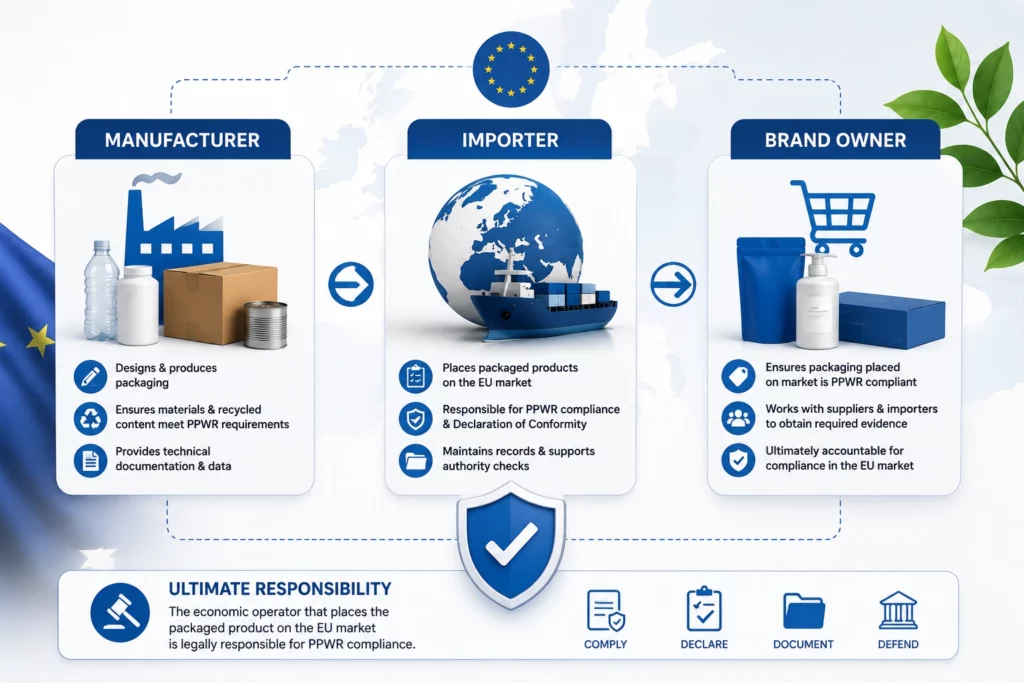
Who Is Responsible for PPWR Compliance- Manufacturer, Importer, or Brand Owner?
Confusion about roles is the #1 reason companies miss PPWR deadlines. A single company can simultaneously be a manufacturer, importer, and producer and each role carries distinct obligations.
What Is a “Manufacturer”?
Under PPWR, the “manufacturer” is the entity that produces the packaging material itself. This is the plastic film maker, the paper board supplier, the glass bottle producer. The manufacturer must ensure their packaging complies with PPWR standards and has evidence in the form of harmonized EN standards compliance or testing.
Manufacturer obligations:
Design packaging to meet PPWR requirements (Articles 5–12)
Maintain technical documentation
Provide declarations to downstream buyers (importers, producers, retailers)
What Is a “Producer”?
The “producer” is the entity placing the finished packaged product on the EU market. This is typically the brand owner, the food company filling jars, the cosmetics firm bottling lotion. The producer is often not the packaging manufacturer but bears primary responsibility for compliance.
Producer (brand owner) obligations:
Ensure all packaging complies with PPWR
Collect technical documentation from suppliers
Issue signed Declaration of Conformity for each packaging type
Register with Extended Producer Responsibility (EPR) schemes in relevant member states
What Is an “Importer”?
An importer is any entity bringing packaging or packaged products into the EU from outside. If you source packaging from China, Vietnam, or India, you are an importer. Importers must ensure that packaging entering the EU already complies with PPWR and must maintain documentation.
Importer obligations:
Verify packaging meets PPWR before import
Obtain supplier declarations and test reports
Maintain records for audits
The critical insight: Many companies hold multiple roles. A food brand that manufactures some packaging in-house, imports pre-filled containers, and places finished products on the EU market is simultaneously a manufacturer, importer, and producer. Responsibilities compound.
What Documentation Must You Collect from Suppliers?
Operational compliance is a data problem. Most companies already produce packaging that meets PPWR’s physical requirements, but they lack proof. Here are the 5 core documents you must request from every packaging supplier:
1. Material Composition Declaration
Your supplier must declare the exact percentage by weight of every material in the packaging. For example, a composite container might be: 40% cardboard, 35% polyethylene, 15% aluminum foil, 10% adhesive. No ranges, no “approximately.” Exact percentages.
2. Recyclability Certificate
Proof that the packaging can be mechanically recycled and meets the recycling performance grade mandated by PPWR Article 8. This typically comes from accredited testing labs or the supplier’s in-house testing. Costs: €300–€2,000 per packaging type.
3. PFAS (“Forever Chemicals”) Test Report
PPWR prohibits intentionally added PFAS. Suppliers must test to confirm zero or negligible PFAS. Testing cost: €500–€5,000 per test, depending on lab complexity. Many suppliers have not yet conducted these tests.
Explore the risks, regulations, and what food manufacturers and packaging suppliers need to know about PFAS in food packaging.
PPWR sets maximum thresholds for heavy metals: chromium (max 100 mg/kg), lead (max 100 mg/kg), cadmium (max 100 mg/kg). Suppliers must declare that packaging is below these limits. For complex items (printed packaging, laminates), a full elemental analysis is needed.
5. Manufacturing Process & Standards Compliance Document
Proof that packaging was manufactured according to harmonized standards (e.g., EN 13428 for packaging composition, EN 13432 for compostable packaging). Suppliers should provide certificates of compliance or testing reports from accredited bodies.
Creating a Supplier Data Request Template
Don’t reinvent the wheel. Create a standardized supplier questionnaire that requests all 5 document types for each packaging SKU. Include:
Packaging material composition (by %)
Recycling performance grade
PFAS test results (date, lab, findings)
Heavy metal elemental analysis
Manufacturing standards certification
Supplier contact for follow-up questions
Issue this template now, with a deadline of Q3 2026. Most suppliers will need 3–6 months to compile and test.
Find Out Which PPWR Rules Apply to Your Packaging
Recyclability, recycled content, labelling, DoCs — the handbook helps you identify what’s relevant to your products so you focus on what matters.
How to Prepare Technical Files for Declaration of Conformity
Once you’ve collected supplier data, you must compile it into a technical file. This is the legal evidence that a specific packaging type complies with PPWR Articles 5–12. Think of it as your insurance policy.
Manufacturing documentation — process flow, suppliers, standards used
Test reports — recyclability, PFAS, elemental analysis (originals from accredited labs)
Hazardous substance assessment — how packaging meets Article 6 requirements
Design documentation — proving the packaging meets reusability, lightness, and recyclability standards
Supplier certificates and declarations
PFAS Compliance: The Hidden Cost
PFAS testing is mandatory under Article 6 of PPWR. “PFAS” (per- and polyfluoroalkyl substances) are synthetic chemicals used in non-stick coatings, water resistance, and grease-proofing. They don’t degrade in the environment (hence “forever chemicals”) and accumulate in living organisms.
A single PFAS analysis costs €500–€5,000. If you manage 100 unique packaging SKUs, you’re looking at €50,000–€500,000 in testing alone. Moreover, suppliers often discover they do have PFAS (from printing inks, adhesives, coatings), which requires re-formulation and re-testing.
Hazardous Substance Assessments
Article 6 also sets limits on heavy metals:
Chromium: max 100 mg/kg
Lead: max 100 mg/kg
Cadmium: max 100 mg/kg
Many suppliers haven’t tested for these. Particularly at-risk: printed packaging (inks can contain chromium), recycled plastic (contaminated feedstock), and adhesives. Budget €300–€2,000 per elemental analysis.
Real-World Examples: PPWR Compliance Across Industries
PPWR applies uniformly, but each industry faces distinct data challenges:
Food & Coffee Exporters
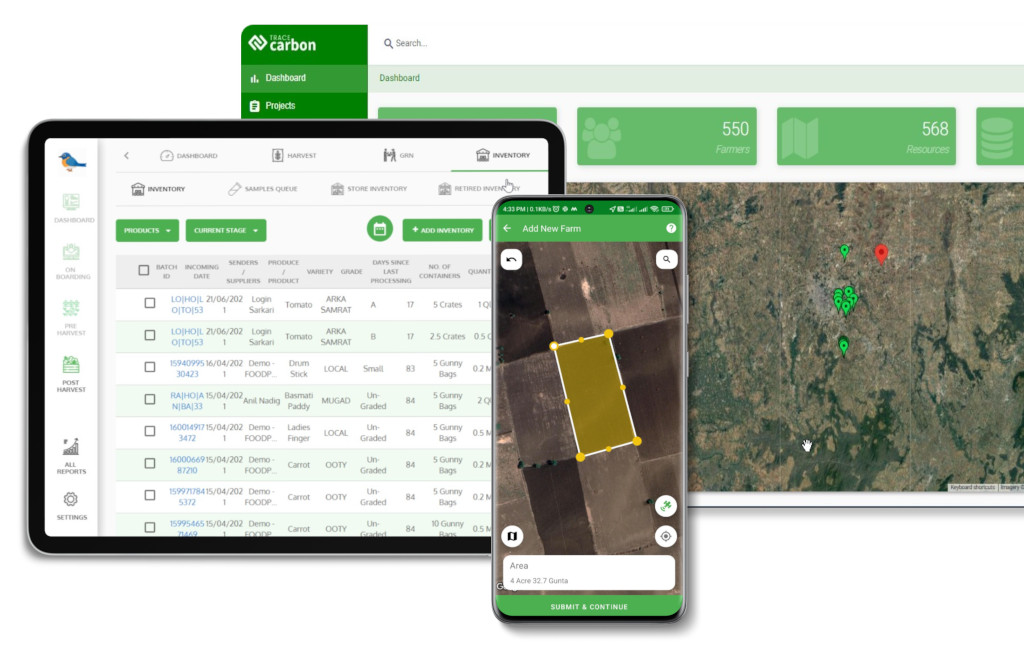
Challenge: Sourcing from 100s–1000s of smallholder farmers in India, Africa, and SE Asia. These farmers don’t have digital infrastructure or English-language documentation. Collecting packaging data from them is like herding cats. Solution: Implement farmer-friendly data collection via mobile apps with offline capability and multilingual interfaces. Provide standardized templates that can be filled out on paper and then digitized.
Tire Manufacturers
Challenge: Managing technical files for 20+ distinct tire models, each with complex packaging (plastic film, cardboard, labels, tags). Every variant has different material specs. Solution: Create a centralized packaging database with version control. Each packaging SKU gets a unique technical file updated whenever suppliers change. Use automation to flag missing certifications.
Cosmetics Brands
Challenge: Imported glass bottles and plastic pumps from multiple suppliers. Determining whether the cosmetics brand or the packaging importer bears compliance responsibility. Solution: Clarify roles early. If the cosmetics brand imports finished packaging (not raw materials), the brand is the importer and producer full responsibility. Request PPWR compliance certificates before importing.
5 Critical Mistakes to Avoid in PPWR Compliance
Mistake #1: Misidentifying Your Legal Role
Many companies believe they’re just “brand owners” with no compliance duty. Wrong. If you place packaging on the EU market, you are a “producer,” and you bear primary responsibility. Clarify your role in writing before August 2026.
Mistake #2: Starting Supplier Data Collection Too Late
If you manage 100+ SKUs and haven’t yet contacted suppliers, you’re behind. Suppliers need 3–6 months to source, test, and compile documentation. Request data immediately.
Mistake #3: Using Generic Templates
A one-size-fits-all questionnaire won’t capture the specific data you need. Create packaging-specific templates that ask for exact composition %, test lab names and dates, and certificate reference numbers.
Mistake #4: Relying on Supplier Self-Certification Without Independent Testing
Suppliers will claim compliance, but regulators require independent test reports from accredited labs. Don’t accept “trust me” as evidence. Budget for third-party testing.
Mistake #5: Assuming Compliance Is “Done” After August 2026
PPWR is not a one-time checkbox. It’s ongoing: when you change suppliers, when packaging designs evolve, when regulations add new requirements (e.g., recyclability standards 18 months post-enforcement). Plan for continuous compliance.
Next Steps: Your PPWR Compliance Roadmap
Compliance is achievable but requires systematic action. Here’s what to do:
Month 1 (Now): Identify your role(s). Are you a manufacturer, importer, producer, or all three?
Month 1–2: Create and distribute a supplier data request template. Give suppliers a deadline of Q3 2026.
Month 3–6: Receive and compile supplier responses. Identify gaps (missing test reports, unclear specs).
Month 8: Assemble technical files for each packaging SKU.
Month 8–9: Issue signed Declarations of Conformity and register with EPR schemes.
Automate PPWR Compliance with TraceX
Managing packaging compliance across 100s of suppliers and 1000s of SKUs is operationally intensive. Most companies lack a centralized system to collect data, track missing documentation, and generate audit-ready technical files. TraceX PPWR Solutions automates PPWR compliance by:
Collecting verified packaging data from suppliers via a multilingual portal
Auto-flagging missing certifications and test reports
Generating technical files and Declarations of Conformity for each packaging type
Maintaining audit-ready records for regulatory inspections
Learn how TraceX helps food exporters, tire manufacturers, and cosmetics brands achieve PPWR compliance by August 2026.
For manufacturers and brand owners, PPWR compliance is no longer just about packaging sustainability it’s about protecting market access, strengthening supplier collaboration, and building resilient supply chains. Waiting until 2026 to collect packaging data, technical documentation, and supplier declarations may leave organizations scrambling to address gaps under increasing customer and regulatory scrutiny. The companies that start preparing now will be better positioned to streamline compliance, reduce operational risk, and maintain uninterrupted access to the European market. In the era of circular packaging, transparency and documentation are quickly becoming as important as the products themselves.
Frequently Asked Questions (FAQ’s)
What happens if I don’t comply with PPWR by August 12, 2026?
Market access is blocked. Your products cannot legally enter EU ports. Shipments will be held, and inventory may be destroyed. There are no grace periods. Additionally, member states will implement fines (amounts currently being determined), which can range from thousands to hundreds of thousands of euros depending on the member state and severity.
Do I need separate Declaration of Conformity for each packaging variant?
Yes. Every unique packaging type requires its own DoC and technical file. If you have a 500ml plastic bottle and a 1L plastic bottle, those are two separate packaging types and require two separate declarations.
Who pays for PFAS and heavy metal testing?
Legally, the manufacturer (packaging supplier) is responsible. In practice, if suppliers don’t have test reports, brand owners must commission testing themselves to comply. This is a major cost driver
Does PPWR apply to packaging from outside the EU?
Yes. If you import packaging (or packaged products) from China, Vietnam, India, or anywhere else, it must comply with PPWR before entering the EU. You, as the importer, must verify and document compliance.
Can I use old test reports, or do I need new PPWR-specific tests?
If you have existing recyclability or composition test reports that are current (within the last 3 years) and were conducted by accredited labs using PPWR-aligned standards, you may use them. However, PFAS testing is new most suppliers won’t have existing PFAS data and must conduct new tests.
Start using TraceX
Transparency, Trust, & Success for your Climate Journey.
We use cookies on our website to give you the most relevant experience by remembering your preferences and repeat visits. By clicking “Accept All”, you consent to the use of ALL the cookies. However, you may visit "Cookie Settings" to provide a controlled consent.
This website uses cookies to improve your experience while you navigate through the website. Out of these, the cookies that are categorized as necessary are stored on your browser as they are essential for the working of basic functionalities of the website. We also use third-party cookies that help us analyze and understand how you use this website. These cookies will be stored in your browser only with your consent. You also have the option to opt-out of these cookies. But opting out of some of these cookies may affect your browsing experience.
Necessary cookies are absolutely essential for the website to function properly. These cookies ensure basic functionalities and security features of the website, anonymously.
Cookie
Duration
Description
cookielawinfo-checkbox-analytics
11 months
This cookie is set by GDPR Cookie Consent plugin. The cookie is used to store the user consent for the cookies in the category "Analytics".
cookielawinfo-checkbox-functional
11 months
The cookie is set by GDPR cookie consent to record the user consent for the cookies in the category "Functional".
cookielawinfo-checkbox-necessary
11 months
This cookie is set by GDPR Cookie Consent plugin. The cookies is used to store the user consent for the cookies in the category "Necessary".
cookielawinfo-checkbox-others
11 months
This cookie is set by GDPR Cookie Consent plugin. The cookie is used to store the user consent for the cookies in the category "Other.
cookielawinfo-checkbox-performance
11 months
This cookie is set by GDPR Cookie Consent plugin. The cookie is used to store the user consent for the cookies in the category "Performance".
viewed_cookie_policy
11 months
The cookie is set by the GDPR Cookie Consent plugin and is used to store whether or not user has consented to the use of cookies. It does not store any personal data.
Functional cookies help to perform certain functionalities like sharing the content of the website on social media platforms, collect feedbacks, and other third-party features.
Performance cookies are used to understand and analyze the key performance indexes of the website which helps in delivering a better user experience for the visitors.
Analytical cookies are used to understand how visitors interact with the website. These cookies help provide information on metrics the number of visitors, bounce rate, traffic source, etc.
Advertisement cookies are used to provide visitors with relevant ads and marketing campaigns. These cookies track visitors across websites and collect information to provide customized ads.
Download the 2026 Traceability Scorecard and Benchmark Your Supply Chain Across 10 Critical Capabilities.
Download our eBook
Don’t Wait for an Audit to Find Your EUDR Gaps
The 2026 Simplification Package changes how HS codes, DDS pass-through and geolocation rules apply to you. Get the free guide and 20-point readiness checklist before enforcement catches you unprepared.